
Jiji
Well-Known Member
- First Name
- Rick
- Joined
- Jun 21, 2023
- Threads
- 17
- Messages
- 296
- Reaction score
- 430
- Location
- Finger Lakes, NY
- Website
- github.com
- Vehicles
- Rivian Blue R1S
- Thread starter
- #1
TL;DR - idle power and some things in the trip odometer are not as they appear.
So this trip actually started on Thursday evening when I charged to 70%. The R1S sat on Friday and today I was tasked with running some pre-holiday errands. So how much range did I lose before getting started?

Well that's not a great start, a 39 hour idle lost nearly 4% of battery, in miles this would 219 -206, 13 miles range lost parked in the driveway. Surely the trip odometer that I reset following the charge would help explain this:

The trip odometer captures something but otherwise isn't very useful yet. Let's see what it says at the end of the day's trips and compare to the results in my personal iPhone app I use to keep track of my R1S:

I made five separate trips and the app and trip odometer agree on the basics but what about the reported efficiency? Not sure just how Rivian arrives at the 2.0 mi/kWh efficiency value, even backing out the 0.7 kWh initial value I get 1.76 mi/kWh (48.3 / (28.1 - 0.7)) so just what efficiency is being calculated here? Is it just the energy used by the motors and ignores the cabin climate and other electrical loads? I don't have the answer to this question but it does make me take the Rivian reported efficiency number with a grain of salt.
2.0 mi/kWh would be great on a cold winter day but we can also look at how the displayed range changed which I refer to as the rated range. So to drive 48.3 miles I consumed 81.4 miles of range. Good thing I didn't start with 75 miles in the tank thinking I had plenty for a 50 mile trip. Even the big downhill leg used quite a bit more range despite a drop of 600' in elevation.

Maybe it had something to do with a headwind. Now the headwind changes all the time unless you are consistently moving in one direction. Luckily the trip dashboard displays the wind direction and magnitude and in this case there was a small tailwind when the screenshot was taken.
In the evening I plugged back in at 40% SoC and charged to 70%, the same level as two evenings prior so we get the only energy value currently available from the Rivian API:
It took 33.3 kWh to restore the previous state of charge and range and finally having an energy value allows for the true efficiency to be calculated. On this busy day, 48.3 mi / 33.3 kWh yields an overall efficiency of 1.45 mi/kWh. If I measure the energy at my electrical panel using Home Assistant and a current transformer (I have a older Tesla wall connector) I see I used 35.2 kWh so the true efficiency for the day was just 1.37 mi/kWh. Not far off from the 1.30 mi/kWh the app reported but also not close to the 2.0 mi/kWh for the Rivian trip odometer.
My personal take is the Rivian trip odometer isn't very trustworthy, at least not in the winter. It seems it doesn't include the entire vehicle load and will be off when operating in colder weather. It should be better in more benign conditions when there are lower cabin and/or battery conditioning loads but I will have to wait until spring to see the results.
And watch your idle period losses, the Rivian is an outlier compared to other EVs I own or have owned (Nissan Leaf, Tesla Model 3, Ford Mustang Mach-e) and is something that hopefully be improved with a future software update.
So this trip actually started on Thursday evening when I charged to 70%. The R1S sat on Friday and today I was tasked with running some pre-holiday errands. So how much range did I lose before getting started?
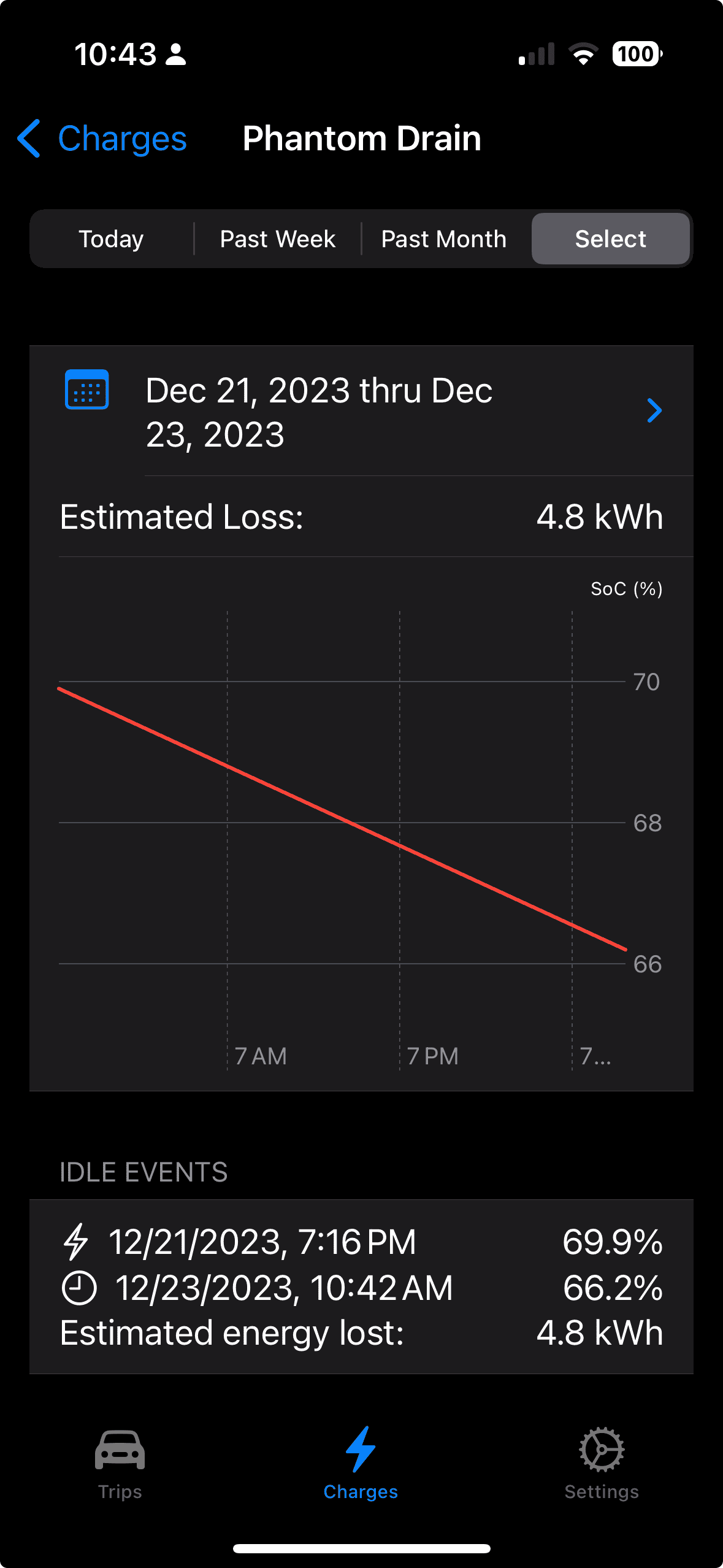
Well that's not a great start, a 39 hour idle lost nearly 4% of battery, in miles this would 219 -206, 13 miles range lost parked in the driveway. Surely the trip odometer that I reset following the charge would help explain this:
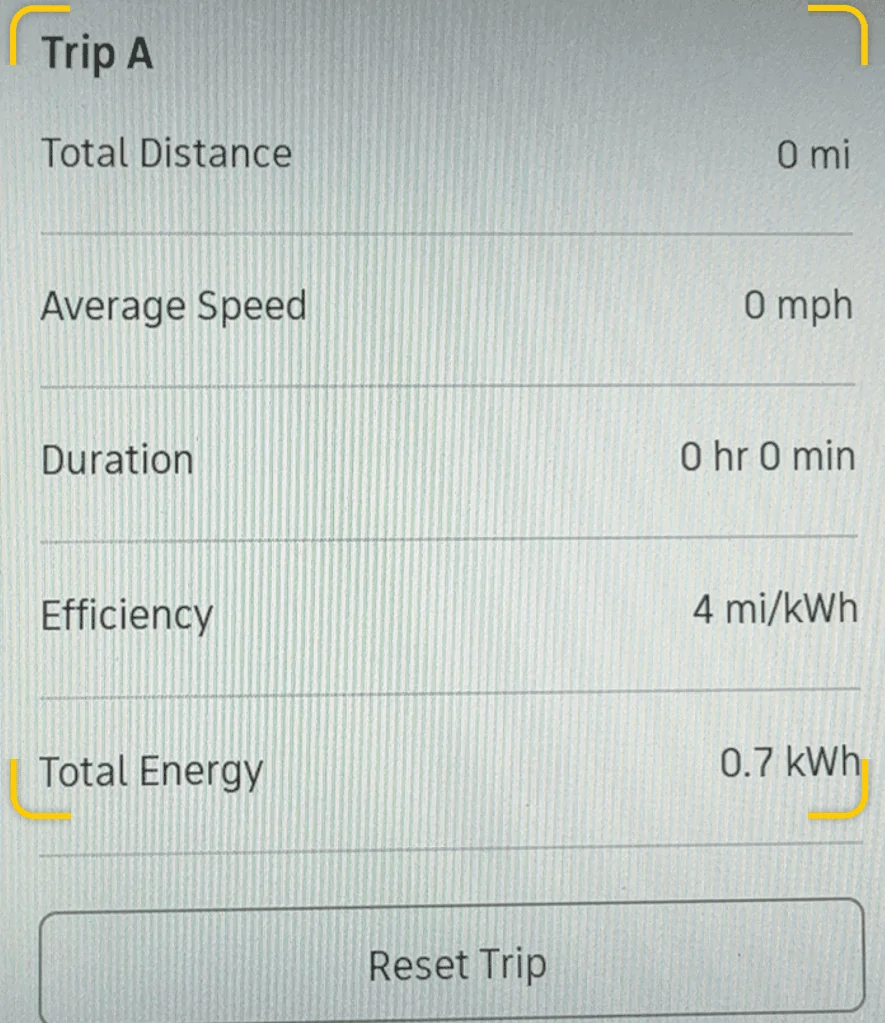
The trip odometer captures something but otherwise isn't very useful yet. Let's see what it says at the end of the day's trips and compare to the results in my personal iPhone app I use to keep track of my R1S:
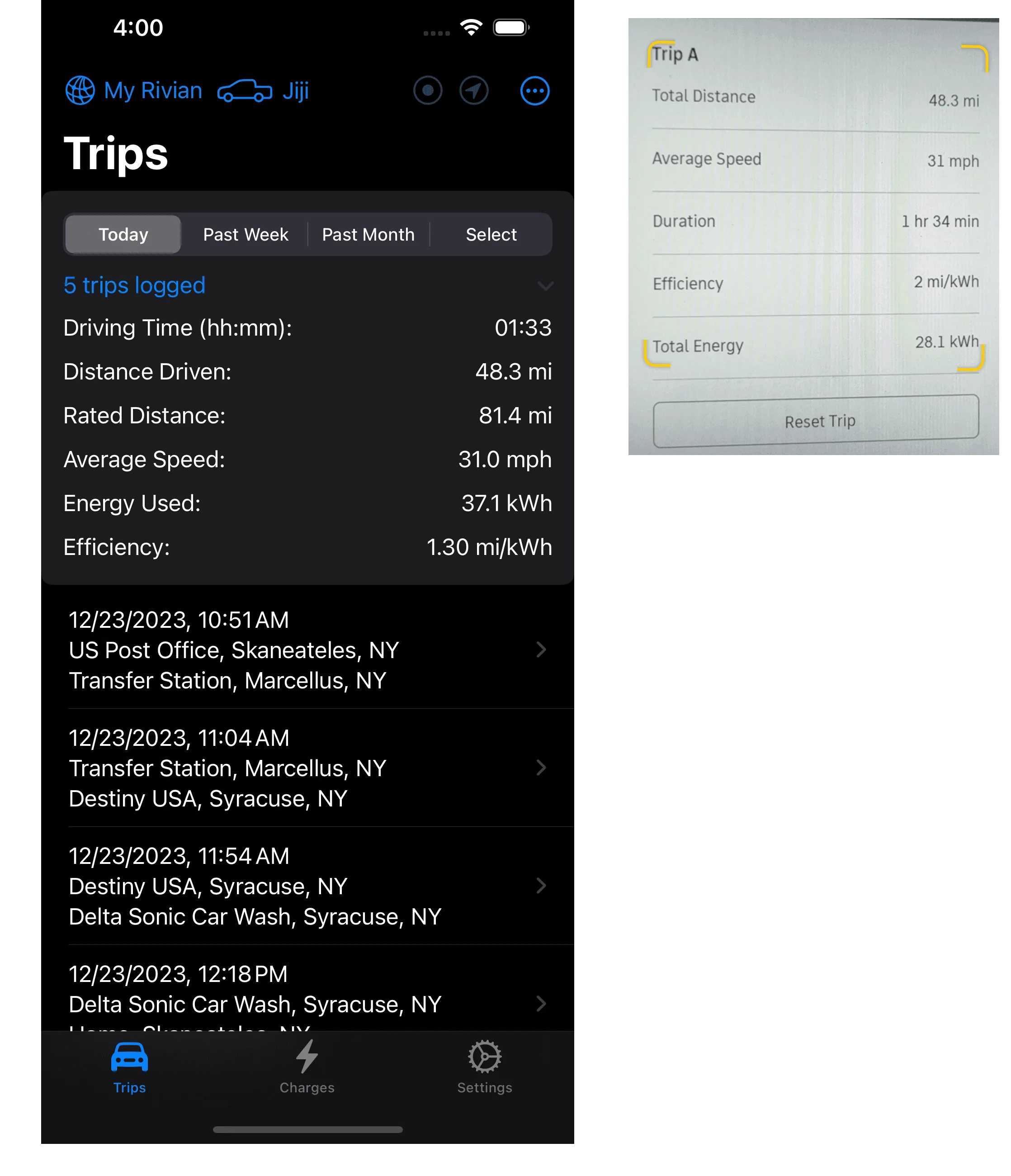
I made five separate trips and the app and trip odometer agree on the basics but what about the reported efficiency? Not sure just how Rivian arrives at the 2.0 mi/kWh efficiency value, even backing out the 0.7 kWh initial value I get 1.76 mi/kWh (48.3 / (28.1 - 0.7)) so just what efficiency is being calculated here? Is it just the energy used by the motors and ignores the cabin climate and other electrical loads? I don't have the answer to this question but it does make me take the Rivian reported efficiency number with a grain of salt.
2.0 mi/kWh would be great on a cold winter day but we can also look at how the displayed range changed which I refer to as the rated range. So to drive 48.3 miles I consumed 81.4 miles of range. Good thing I didn't start with 75 miles in the tank thinking I had plenty for a 50 mile trip. Even the big downhill leg used quite a bit more range despite a drop of 600' in elevation.
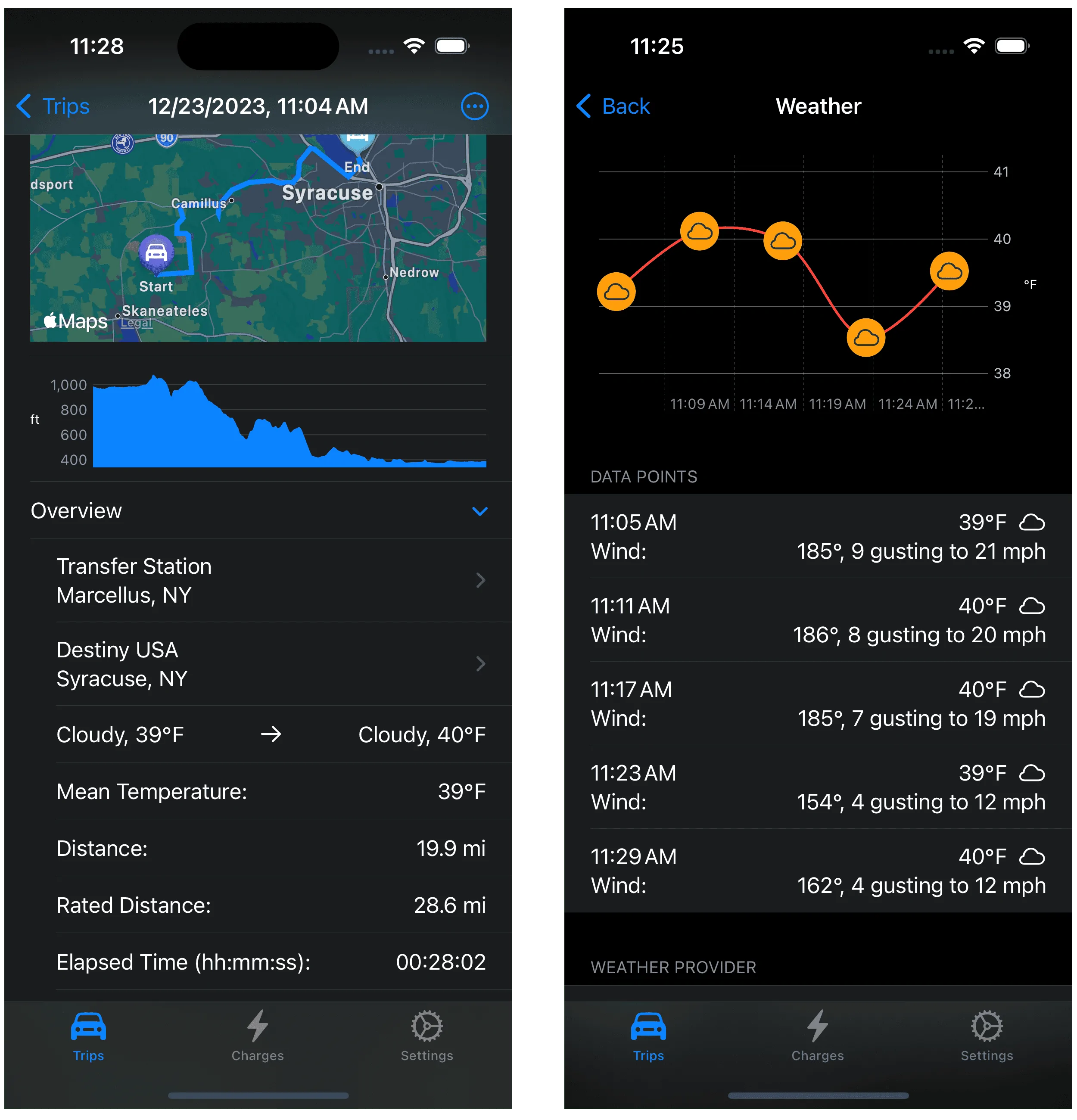
Maybe it had something to do with a headwind. Now the headwind changes all the time unless you are consistently moving in one direction. Luckily the trip dashboard displays the wind direction and magnitude and in this case there was a small tailwind when the screenshot was taken.
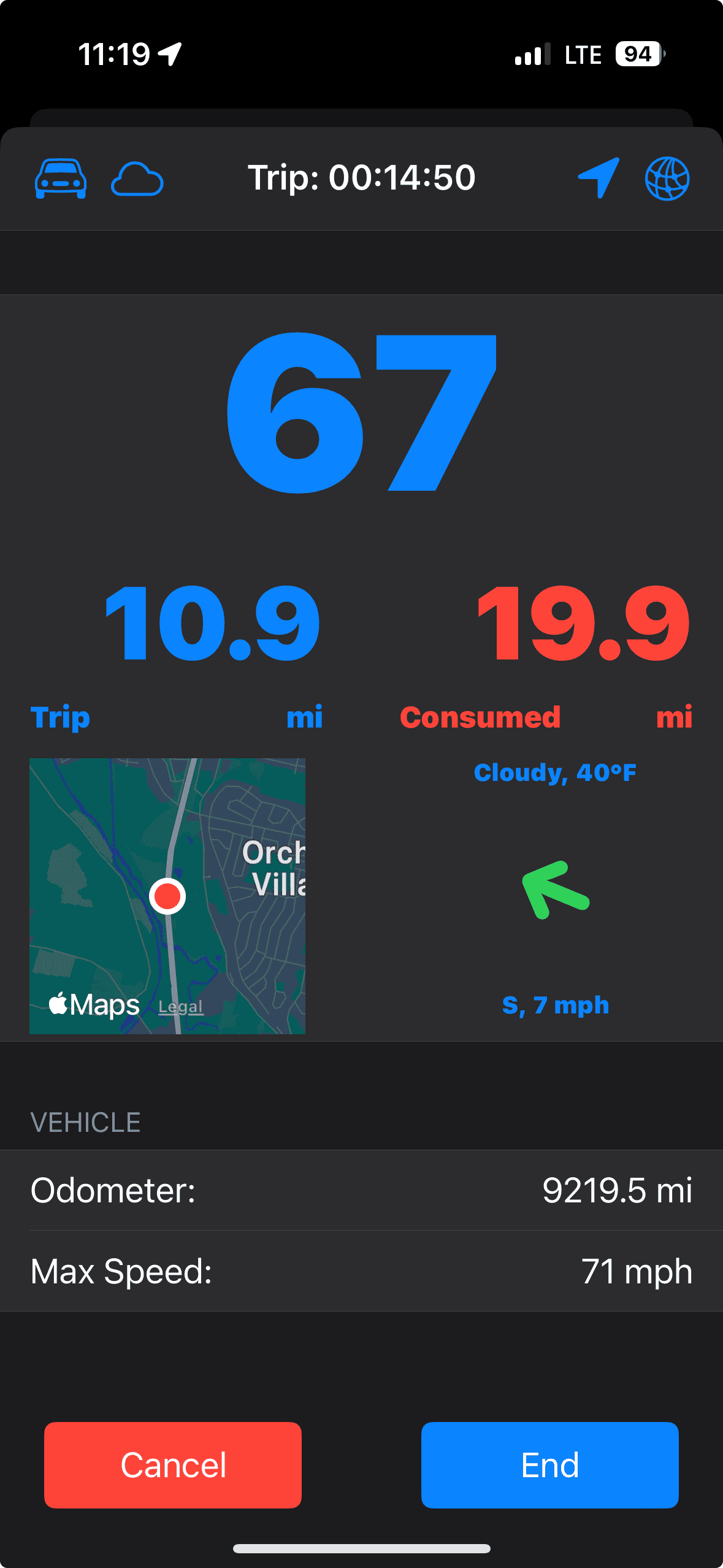
In the evening I plugged back in at 40% SoC and charged to 70%, the same level as two evenings prior so we get the only energy value currently available from the Rivian API:
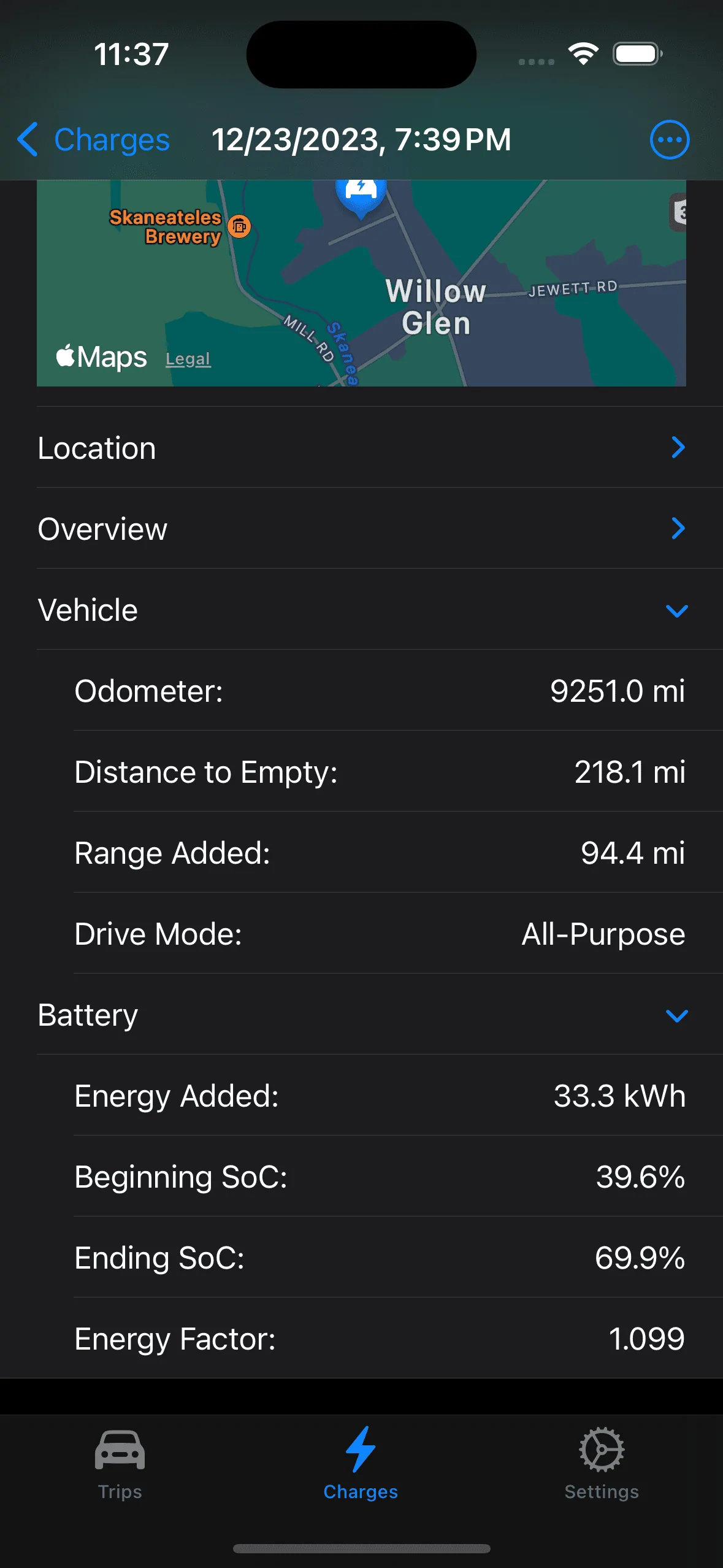
It took 33.3 kWh to restore the previous state of charge and range and finally having an energy value allows for the true efficiency to be calculated. On this busy day, 48.3 mi / 33.3 kWh yields an overall efficiency of 1.45 mi/kWh. If I measure the energy at my electrical panel using Home Assistant and a current transformer (I have a older Tesla wall connector) I see I used 35.2 kWh so the true efficiency for the day was just 1.37 mi/kWh. Not far off from the 1.30 mi/kWh the app reported but also not close to the 2.0 mi/kWh for the Rivian trip odometer.
My personal take is the Rivian trip odometer isn't very trustworthy, at least not in the winter. It seems it doesn't include the entire vehicle load and will be off when operating in colder weather. It should be better in more benign conditions when there are lower cabin and/or battery conditioning loads but I will have to wait until spring to see the results.
And watch your idle period losses, the Rivian is an outlier compared to other EVs I own or have owned (Nissan Leaf, Tesla Model 3, Ford Mustang Mach-e) and is something that hopefully be improved with a future software update.
Sponsored