Sponsored

EV Efficiency Variable: Tire Mass Matters

mkhuffman

Well-Known Member
First Name
Mike
Joined
Nov 9, 2020
Threads
14
Messages
2,997
Reaction score
3,410
Location
Virginia
Vehicles
2025 R1T Tri-Max, Jeep GC-L, VW Jetta
This exactly.


While it can be patronizing to get a LLM response, you disbelieve the robot that has a far broader "knowledge" than any human in the world? What is your rationale or evidence dismiss it? Clue us in.

As a tire nerd (both cars and bikes), the explanation is *perfectly* accurate.
It is shocking you think LLMs can't make mistakes. I can't count how many times I have gotten responses with errors, and when I point it out to the LLM, it apologizes and fixes the response.

These fake people are good at sounding convincing, when making up crap that isn't true. And they do it all the time.

All AI responses need to be verified if you plan to make any important decisions based on the responses.
Sponsored
 

Dark-Fx

Well-Known Member
First Name
Brian
Joined
Jul 15, 2020
Threads
150
Messages
13,721
Reaction score
27,841
Location
Michigan
Vehicles
R1T, R1S, Livewire One, Sierra EV, R1S, R2
Occupation
Engineering, Dog Petting
Clubs
 

mkhuffman

Well-Known Member
First Name
Mike
Joined
Nov 9, 2020
Threads
14
Messages
2,997
Reaction score
3,410
Location
Virginia
Vehicles
2025 R1T Tri-Max, Jeep GC-L, VW Jetta
Here is some factual information that may help this discussion.

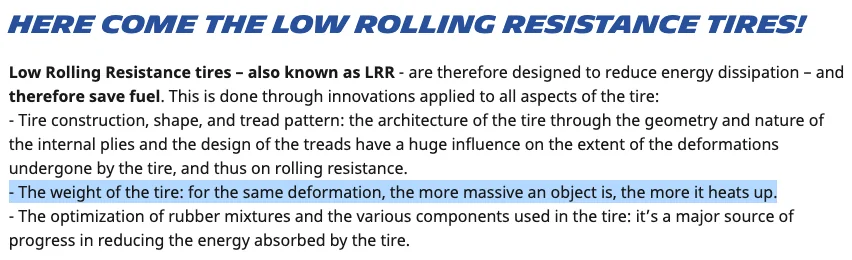
Typically, low rolling resistance tires have either poor life expectancy, or poor wet traction (or both). The challenge has been designing a tire that has low rolling resistance but doesn't wear out quickly or is unsafe on wet roads.

If all they had to do is decrease weight of the tire to increase efficiency, this would not the technical challenge it is. Obviously.

" High-performance tires (also known as green tires) are of great significance for energy-saving, driving safety and air pollution control. Compared with traditional tires, the green tires may reduce rolling resistance by 22–35%, resulting in fuel consumption reduced by 3–8% [[1], [2], [3]]. The abrasion resistance of tire tread rubber directly determines the service life of tire. Importantly, it has been demonstrated that the rubber particles produced by tire abrasion are also closely related to the formation of PM2.5 (particulate matter with diameter lower than 2.5 μm) [4,5]. Therefore, improving the abrasion resistance of tread rubber is an important way to prolong the service life of tire and reduce the pollution from the worn particles. The wet traction of tire is one of the determinants related to the driving safety of vehicles [6]. The most stubborn problem in the research and development of high-performance tires is that there are contradictions among the abrasion resistance, rolling resistance and wet traction of rubber materials, which is called “magic triangle” in industry [7]. Using the existing technology to improve any one or both of them will generally reduce the third performance, especially the contradiction between wet traction and rolling resistance is the most prominent. "

Solving “magic triangle” of tread rubber composites with phosphonium-modified petroleum resin - ScienceDirect

Basically, tires that perform extremely well on wet roads are also the least efficient. It has NOTHING to do with weight. Nothing.

Rivian R1T R1S EV Efficiency Variable: Tire Mass Matters 1783601990902-h1


Edit: I guess I should not say "nothing", because as I have posted previously, weight does matter. But it is practically insignificant when tire designers are trying to design an efficient tire. Yes, it matters. But tread design (and rubber compound) matter more. A lot more.

A good way to improve city driving efficiency is by replacing the rim with one that is lighter but just as aerodynamic as the original. The problem is, how do you know the rim is just as aerodynamic as the original? Even one that looks great might not be once you put it on.

I admit that if all you care about is efficiency in stop and go traffic, maybe weight matters more than I am making it out to be.

But I care mostly about highway efficiency, where weight has almost no impact. I care because that is when I need to public charge, which I generally hate. Because it sucks.
 
Last edited:

mkhuffman

Well-Known Member
First Name
Mike
Joined
Nov 9, 2020
Threads
14
Messages
2,997
Reaction score
3,410
Location
Virginia
Vehicles
2025 R1T Tri-Max, Jeep GC-L, VW Jetta
I think I may be beating a dead horse, but here is another source of good information.

I will start with the AI summary, since the text is long, and then the text of the study and the link.

AI summary:

Key Points on Rolling Resistance:
  • Definition & Cause: Rolling resistance force arises primarily from continuous deformation (hysteresis losses) in the tire structure, contact patch, and road surface during rolling; energy is not fully recovered due to material damping.
  • Road vs. Lab: Real-road rolling resistance is higher than on smooth drums/belts due to vehicle vibrations, suspension losses, micro-slip in the contact patch, changing effective radius (causing angular acceleration), and asymmetrical contact pressure distribution.
  • Additional Contributors: Friction in wheel hubs; tire/rim aerodynamics; heat buildup (which raises temperature and alters hysteresis).
  • Main Influencing Factors:
    • Speed: Small positive effect (increases RR slightly), mainly via inertial forces causing vibrations that raise tire temperature and modify hysteresis (more noticeable in passenger car tires).
    • Vertical Load: Small positive effect due to increased tire deformation.
    • Inflation Pressure: Higher pressure reduces RR by decreasing deformation (note: pressure rises with temperature).
    • Temperature & Road Surface: Ambient/road temperature affects heat transfer; small-scale road irregularities and soft surfaces (snow, mud) increase RR via extra hysteresis and material displacement.
    • Alignment: Toe-in/camber and misalignment significantly increase losses through side forces and uneven load distribution.
    • Tire Design & Construction: Carcass/belt plies, cord materials, tread (including sipes), geometry (width/rim ratio, height/width ratio, overall size), and single wide-base tires vs. duals all strongly influence RR via stiffness, deformation, and hysteresis.
    • Materials: Rubbers have major impact due to hysteresis; cords affect it in carcass/belt.
  • Tire Position & Maintenance: Trailer tires often have greater impact on fuel economy when upgraded to low-RR types; proper inflation, alignment, and balancing are critical. Trade-off exists between low RR (economy) and traction/safety.
  • Overall: Heat production/dissipation indicates total resistance; optimization involves balancing multiple correlated parameters.
Highlights Potentially Related to Tire Weight (inferred from context):
  • Vertical Load has a small positive effect on rolling resistance due to higher deformations — tire weight contributes directly to this load.
  • Speed has a small positive effect mainly due to inertial forces (mass-related) causing vibrational energy that increases temperature and hysteresis losses.
Article Text:

14.3 Rolling resistance in vehicles
The most usual way to represent energy losses relating to the tires is through the rolling resistance force which acts on the wheel axis. For a tire rolling on a flat surface without deformation there would be no resistance. Automotive tires are continuously deforming whilst rotating and the road surface also flexes during contact. To produce this deformation energy is needed and this energy cannot be completely recovered at the end of contact due to the damping of the materials. The rolling resistance is the product of the deformation processes which occur in the tire structure, contact patch and the road surface.

The rolling resistance of a vehicle on the road is larger than that measured on a smooth drum or belt. Vehicle vibration due to an uneven road surface leads to energy dissipation in the suspension. Dynamic vertical deflection causes frictional losses during contact due to micro slip. The effective radius of the tire changes, and whilst driving at constant speed, an angular acceleration occurs at the wheel. The distribution of the contact pressure with respect of centre of the contact zone is unsymmetrical under rolling conditions, and results in a torque at the rotation axis which constitutes the main component of rolling resistance. Further contributions derive from friction in the wheel hub, and tire and rim aerodynamics can also contribute.

Resistance depends on tire construction and on the operating conditions. In practice, it is difficult to analyse the significant parameters in detail as they are strongly correlated, however the amount of heat produced is indicative of total resistance. As heat dissipation is normally lower than heat production in a tire, temperature increases which will affect the hysteresis properties of the tire materials, and also therefore the rolling resistance.

The main factors influencing rolling resistance are as follows:
•
Rolling speed has a small positive effect on rolling resistance. This is mainly due to inertial forces which at higher speeds cause vibrational energy to modify the hysteresis of the material and thus increase temperature. This tendency is more evident with passenger car tires than with the stiffer tires of trucks.
•
Vertical load can have a small positive effect on rolling resistance due to higher deformations.
Experiments have shown that rolling resistance decreases with increasing inflation pressure which is due to a reduction in tire deformation. Inflation pressure itself increases with increasing temperature so that a comparison of results should always be made at a fixed temperature.

The temperature of the environment, including that of the road surface, affects heat transfer and thus also the rolling resistance. Also, road surface irregularities on a scale smaller than that of the contact area have an effect on the rolling resistance, although the mechanisms for this are not yet fully understood. It is likely due in part to the hysteresis of the material in the contact region adjusting to the irregularities. Whilst the effect of road deformation is likely to be small in built up areas, it can be significant in soft soil or deep snow. On wet or snowy roads rolling resistance increases due to the cooling effect of the water, a corresponding change in deformation behaviour, and also due to the increased energy required for the displacement of the water or snow.

Alignment of the axles in the form of toe-in and camber angles on the road can contribute significantly to rolling losses. If the longitudinal axis differs from the direction of driving, an effective side force develops. The vertical axis has an effect on the load distribution in the contact region and thus affects the hysteresis behaviour at the contact region and side walls.

Carcass and belt design affect the flexibility thus also the stresses between plies. The number of plies of the carcass also has a significant effect on losses. Cord wires display a dual influence; firstly, they absorb some deformation energy via hysteresis and secondly, they control the deformation amplitude. The effect of the cord wire dimensions is in fact negligible as instead they affect the behavior of the rubber lies between cords.

Tread design affects the hysteresis behavior of the tire. Micro level tread design components, called sipes, have an important impact on the behaviour of the tread, and it is claimed that the use of double compound layers can improve the resistance behavior without overly compromising other important factors. Tire geometry is another factor which significantly impacts the resistance value. An optimum value for rolling resistance can be obtained by optimizing the ratio between the width of the tire and that of the rim. This affects the behavior of the sidewall during deformation. It is also the case that a larger tire has a lower rolling resistance which is explained by the fact that the radius of the tire is correlated to the length of the contact region and thus to the nominal load of the tire. Thus a larger tire has a higher stiffness and lower deformation with the same vertical load. Another factor influencing stiffness, and thus rolling resistance, is the ratio between the height of the tire and its width. Further, a single wide base tire has a lower resistance than a pair of conventional tires with the same total load rating. This is due to the fact that there are only two walls in the former case and thus a lower amount of material participating in deformation, leading to reduced hysteresis.

The main materials employed for tire construction are cord materials, rubbers, and composites. When used for the carcass, cord material has some influence on rolling resistance although the effect is somewhat higher when used for the belt. Rubbers have a major effect on rolling losses due to their different hysteresis properties.

Tires on different axles make different contributions to the overall fuel economy. Changing trailer tires to low resistance types produces a larger effect than changing tractor tires.

How well tires are maintained also has a critical effect on their rolling resistance. Proper tire pressure is especially important in controlling rolling resistance. Tire misalignment and misbalancing are other factors that are claimed to increase vehicle energy consumption due to rolling resistance. Tire traction must also be considered as it too is controlled by the tread region and side walls. This results in a conflict between economy and safety such that a compromise must be sought.

Link: Rolling Resistance - an overview | ScienceDirect Topics
 

Sponsored

SwampNut

Well-Known Member
First Name
Carlos
Joined
Apr 22, 2024
Threads
53
Messages
3,662
Reaction score
3,894
Location
Peoria AZ
Vehicles
2022 R1T Launch Edition
Occupation
Geek
Clubs
 
Your LLM is smarter than the OP's.
Fable 5 is rather amazing. Unfortunately it’s going to get locked up behind a very e-pensive paywall and enterprise access this week.

Can anyone tell me why they would care about the tiny improvements they would see here at the expense of changing their tires?
 
OP
OP
ksurfier

ksurfier

Well-Known Member
First Name
Ken
Joined
Aug 23, 2022
Threads
49
Messages
1,124
Reaction score
1,030
Location
CA
Vehicles
R1S, Tesla
Occupation
Fake Science Lead
Clubs
 
I think I may be beating a dead horse, but here is another source of good information.

I will start with the AI summary, since the text is long, and then the text of the study and the link.

AI summary:

Key Points on Rolling Resistance:
  • Definition & Cause: Rolling resistance force arises primarily from continuous deformation (hysteresis losses) in the tire structure, contact patch, and road surface during rolling; energy is not fully recovered due to material damping.
  • Road vs. Lab: Real-road rolling resistance is higher than on smooth drums/belts due to vehicle vibrations, suspension losses, micro-slip in the contact patch, changing effective radius (causing angular acceleration), and asymmetrical contact pressure distribution.
  • Additional Contributors: Friction in wheel hubs; tire/rim aerodynamics; heat buildup (which raises temperature and alters hysteresis).
  • Main Influencing Factors:
    • Speed: Small positive effect (increases RR slightly), mainly via inertial forces causing vibrations that raise tire temperature and modify hysteresis (more noticeable in passenger car tires).
    • Vertical Load: Small positive effect due to increased tire deformation.
    • Inflation Pressure: Higher pressure reduces RR by decreasing deformation (note: pressure rises with temperature).
    • Temperature & Road Surface: Ambient/road temperature affects heat transfer; small-scale road irregularities and soft surfaces (snow, mud) increase RR via extra hysteresis and material displacement.
    • Alignment: Toe-in/camber and misalignment significantly increase losses through side forces and uneven load distribution.
    • Tire Design & Construction: Carcass/belt plies, cord materials, tread (including sipes), geometry (width/rim ratio, height/width ratio, overall size), and single wide-base tires vs. duals all strongly influence RR via stiffness, deformation, and hysteresis.
    • Materials: Rubbers have major impact due to hysteresis; cords affect it in carcass/belt.
  • Tire Position & Maintenance: Trailer tires often have greater impact on fuel economy when upgraded to low-RR types; proper inflation, alignment, and balancing are critical. Trade-off exists between low RR (economy) and traction/safety.
  • Overall: Heat production/dissipation indicates total resistance; optimization involves balancing multiple correlated parameters.
Highlights Potentially Related to Tire Weight (inferred from context):
  • Vertical Load has a small positive effect on rolling resistance due to higher deformations — tire weight contributes directly to this load.
  • Speed has a small positive effect mainly due to inertial forces (mass-related) causing vibrational energy that increases temperature and hysteresis losses.
Article Text:

14.3 Rolling resistance in vehicles
The most usual way to represent energy losses relating to the tires is through the rolling resistance force which acts on the wheel axis. For a tire rolling on a flat surface without deformation there would be no resistance. Automotive tires are continuously deforming whilst rotating and the road surface also flexes during contact. To produce this deformation energy is needed and this energy cannot be completely recovered at the end of contact due to the damping of the materials. The rolling resistance is the product of the deformation processes which occur in the tire structure, contact patch and the road surface.

The rolling resistance of a vehicle on the road is larger than that measured on a smooth drum or belt. Vehicle vibration due to an uneven road surface leads to energy dissipation in the suspension. Dynamic vertical deflection causes frictional losses during contact due to micro slip. The effective radius of the tire changes, and whilst driving at constant speed, an angular acceleration occurs at the wheel. The distribution of the contact pressure with respect of centre of the contact zone is unsymmetrical under rolling conditions, and results in a torque at the rotation axis which constitutes the main component of rolling resistance. Further contributions derive from friction in the wheel hub, and tire and rim aerodynamics can also contribute.

Resistance depends on tire construction and on the operating conditions. In practice, it is difficult to analyse the significant parameters in detail as they are strongly correlated, however the amount of heat produced is indicative of total resistance. As heat dissipation is normally lower than heat production in a tire, temperature increases which will affect the hysteresis properties of the tire materials, and also therefore the rolling resistance.

The main factors influencing rolling resistance are as follows:
•
Rolling speed has a small positive effect on rolling resistance. This is mainly due to inertial forces which at higher speeds cause vibrational energy to modify the hysteresis of the material and thus increase temperature. This tendency is more evident with passenger car tires than with the stiffer tires of trucks.
•
Vertical load can have a small positive effect on rolling resistance due to higher deformations.
Experiments have shown that rolling resistance decreases with increasing inflation pressure which is due to a reduction in tire deformation. Inflation pressure itself increases with increasing temperature so that a comparison of results should always be made at a fixed temperature.

The temperature of the environment, including that of the road surface, affects heat transfer and thus also the rolling resistance. Also, road surface irregularities on a scale smaller than that of the contact area have an effect on the rolling resistance, although the mechanisms for this are not yet fully understood. It is likely due in part to the hysteresis of the material in the contact region adjusting to the irregularities. Whilst the effect of road deformation is likely to be small in built up areas, it can be significant in soft soil or deep snow. On wet or snowy roads rolling resistance increases due to the cooling effect of the water, a corresponding change in deformation behaviour, and also due to the increased energy required for the displacement of the water or snow.

Alignment of the axles in the form of toe-in and camber angles on the road can contribute significantly to rolling losses. If the longitudinal axis differs from the direction of driving, an effective side force develops. The vertical axis has an effect on the load distribution in the contact region and thus affects the hysteresis behaviour at the contact region and side walls.

Carcass and belt design affect the flexibility thus also the stresses between plies. The number of plies of the carcass also has a significant effect on losses. Cord wires display a dual influence; firstly, they absorb some deformation energy via hysteresis and secondly, they control the deformation amplitude. The effect of the cord wire dimensions is in fact negligible as instead they affect the behavior of the rubber lies between cords.

Tread design affects the hysteresis behavior of the tire. Micro level tread design components, called sipes, have an important impact on the behaviour of the tread, and it is claimed that the use of double compound layers can improve the resistance behavior without overly compromising other important factors. Tire geometry is another factor which significantly impacts the resistance value. An optimum value for rolling resistance can be obtained by optimizing the ratio between the width of the tire and that of the rim. This affects the behavior of the sidewall during deformation. It is also the case that a larger tire has a lower rolling resistance which is explained by the fact that the radius of the tire is correlated to the length of the contact region and thus to the nominal load of the tire. Thus a larger tire has a higher stiffness and lower deformation with the same vertical load. Another factor influencing stiffness, and thus rolling resistance, is the ratio between the height of the tire and its width. Further, a single wide base tire has a lower resistance than a pair of conventional tires with the same total load rating. This is due to the fact that there are only two walls in the former case and thus a lower amount of material participating in deformation, leading to reduced hysteresis.

The main materials employed for tire construction are cord materials, rubbers, and composites. When used for the carcass, cord material has some influence on rolling resistance although the effect is somewhat higher when used for the belt. Rubbers have a major effect on rolling losses due to their different hysteresis properties.

Tires on different axles make different contributions to the overall fuel economy. Changing trailer tires to low resistance types produces a larger effect than changing tractor tires.

How well tires are maintained also has a critical effect on their rolling resistance. Proper tire pressure is especially important in controlling rolling resistance. Tire misalignment and misbalancing are other factors that are claimed to increase vehicle energy consumption due to rolling resistance. Tire traction must also be considered as it too is controlled by the tread region and side walls. This results in a conflict between economy and safety such that a compromise must be sought.

Link: Rolling Resistance - an overview | ScienceDirect Topics
I’ve backed my position with empirical data. If you want me to reconsider, show empirical evidence that the tire-weight-to-MPK relationship breaks down between 30-, 40-, and 50-pound tires. Otherwise, you’re arguing theory against data.
Sponsored


Top