Sponsored

load sharing, hardwiring, and charging speed

abirozy

Well-Known Member
First Name
Adam
Joined
Oct 11, 2020
Threads
114
Messages
558
Reaction score
407
Location
southern california
Vehicles
tesla model s, lexus gs 350 f sport, toyota corolla
Occupation
lawyer
Clubs
 
good evening

I have a tesla Model S, and an R1T. I am getting solar soon and putting two chargers in my garage. The solar installers are supposed to install two EV outlets in my garage. I have been reading that load sharing is a great thing and would allow me to have both my EV's plugged in charging overnight off of one 60 amp circuit. But i have a few questions:

1). I was under the impression that to get the full charging speed from a 48 amp charger, you need to have both a dedicated 60 amp circuit and have it hardwired. If you are load sharing two chargers off of a single 60amp circuit will you be able to use the full charging speed?

2). Do you run a wire from the panel to the garage for each 60amp circuit? I.E. If I get the home flex that does not have load sharing, will i need to run two lines from the box to the garage, or do they both get run on the same wire? I am just trying to think expense.

3). I drive 80 miles a day in the Rivian and my wife drives 50 miles a day in the Tesla. If I load share, do you think i will be able to charge both vehicles sufficiently?

4). For those of you who also have a tesla, would you recommend getting a tesla charger for the tesla and then whatever charger I end up getting for the Rivian or getting two of the same chargers and using the tesla adapter?

Sorry if the questions sound dumb. I am an idiot when it comes to electrical stuff.

Best

Adam
Sponsored

 

VSG

Well-Known Member
Joined
Oct 3, 2022
Threads
4
Messages
3,233
Reaction score
6,040
Location
WA
Vehicles
R1T LE/RB/OC/20
  1. With load sharing, when both vehicles are charging they will each get half the speed.
  2. You can run two cables from the panel to the garage, or you can install a sub-panel in the garage and run one cable from the panel to the sub-panel. But you will still have to run two cables from the sub-panel - one to each charger. Whether a sub-panel is cheaper or not depends on how long a run you have and whether you really want two circuits or just one with load sharing, and whether you might have future uses for the sub-panel.
  3. "Full speed" will recharge your Rivian in about three hours. Less time for the Tesla. So when sharing the load it shouldn't take more than 6 hours to charge them both.
  4. I would get two of the same chargers so they can share power on one circuit. Two Tesla chargers will work with one adapter. Two J1772 chargers will work with one adapter (I have a Wallbox charger for the power sharing). Choose based on total cost (including adapter cost), features, and whether your power company provides incentives for a specific charger brand.
 

Christopher

Well-Known Member
First Name
Christopher
Joined
May 31, 2022
Threads
34
Messages
583
Reaction score
573
Location
South Florida
Vehicles
R1T
Occupation
Tech
Clubs
 
1. Yes you would need a single 60a breaker to get full 48a charging. If you have two Rivian chargers sharing the same 60a breaker you'd have to set the dip switches to 24v each. Anything higher, and if both are charging it will trip the breaker. You could have them both set to 48a and use one at a time or when using both you can manually lower the amps in the infotainment but this isn't foolproof and you could trip the breaker. I don't think the vehicle remembers that you lowered the amps and would default back to 48, and if power to the home goes off and back on I think Rivian may go back to 48a. Too risky so I wouldn't recommend.

2. Ideally yes, you'd want two individual 60a breakers wired to each charger. If costs or panel size is an issue and you can only do one 60a breaker you'll need to load share and the Home Flex and Rivian charger don't support that so you'd have to go back to #1 and reduce the amps for each charger.

3. You'd be fine charging each at 24a with the miles you drive.

Ideally run two dedicated circuits. Costs should be minimal (if run isn't very long) to add another circuit if they're already doing the install and other electrical work.

Another option would be to use a 125a breaker and run that to a sub panel with 2 60a breakers near your chargers and wire your chargers to the sub panel.

Another option is to find an EVSE that supports sharing so you can run off a single circuit. Juicebox and Clipper Creek makes ones that can communicate with each other and share the load. Only one car charging you get full 48a. Both charging they both share the 48a. I think these chargers carry a premium and it may just be cheaper to run separate circuits and buy a cheaper charger.
 

wizard467

Well-Known Member
First Name
Brian
Joined
Oct 5, 2021
Threads
0
Messages
87
Reaction score
174
Location
MO
Vehicles
R1T (10/2022), Honda Ridgeline
good evening

I have a tesla Model S, and an R1T. I am getting solar soon and putting two chargers in my garage. The solar installers are supposed to install two EV outlets in my garage. I have been reading that load sharing is a great thing and would allow me to have both my EV's plugged in charging overnight off of one 60 amp circuit. But i have a few questions:

1) If you are load sharing two chargers off of a single 60amp circuit will you be able to use the full charging speed?

2). Do you run a wire from the panel to the garage for each 60amp circuit?

3). I drive 80 miles a day in the Rivian and my wife drives 50 miles a day in the Tesla. If I load share, do you think i will be able to charge both vehicles sufficiently?

4). For those of you who also have a tesla, would you recommend getting a tesla charger for the tesla and then whatever charger I end up getting for the Rivian or getting two of the same chargers and using the tesla adapter?
1) yes, 60 amps to get 48 to the truck. So if you actually want both charging at the same time you need 120 amps.
2) based on your answer to 3 if you really want 120 amps it will be FAR cheaper to run a sub panel to the garage with aluminum service wire and then put two 60 amp breakers in the sub panel. Aluminum wire is cheaper for larger amperage and is what is coming into your house. Copper is used in the house because is is easier and slightly safer to connect to receptacles, but it is more expensive. I ran a subpanel to my garage, 60 for charging and 40 for a second charger or welder, etc.
3) you will be able to easily drive the Rivian for 2 days before charging at 80 miles a day. The Tesla is probably easily a few days also at only 50 a day. So you could charge overnight each vehicle every other day on a single 60 amp charger. If you think you might drive more in the future or just want to be sure you could go with the subpanel solution I mentioned in #2. You probably wouldn’t need a full 120 amp service to the garage. You could do the second charger at a lower rate since it might not need to fully charge the 2nd vehicle.
4) I don’t have a Tesla, but in the forums some have said adapters that work. Need to search for those if you go this route.
 
Last edited:

MoreTrout

Well-Known Member
First Name
Jay
Joined
Sep 12, 2021
Threads
19
Messages
554
Reaction score
841
Location
PA
Vehicles
Ford Fusion Hybrid, Rivian R1T
Occupation
Retired USN
The biggest cost is in the wire and how far it is from your panel to the outlet. Given your geographic location, having a solar installer with experience in installing EV outlets should mean they can answer your questions and come up with your best plan. And you don't necessarily have to go all in now. It sounds like having them put a subpanel in your garage might be your most cost effective option.

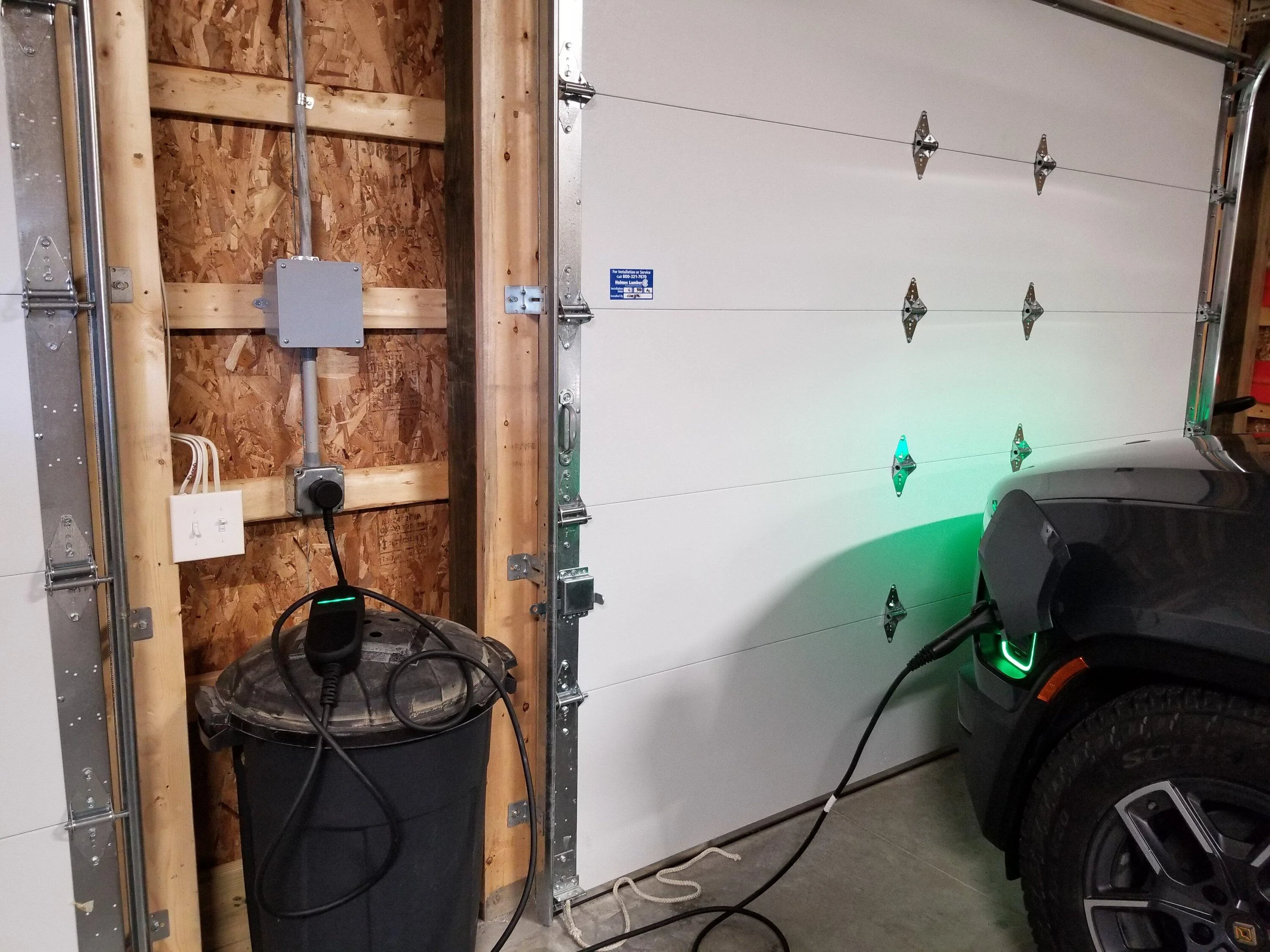
I already had a subpanel in my garage, so I told my electrician installing my NEMA 14-50 outlet that I wanted to future proof it. So they ran aluminum wire capable of handling 80A loads if and when I ever upgrade to a 2 EV garage and want a load sharing EVSE capable of charging two at 40A. But for now, I just needed an outlet to handle the 32A portable EVSE that comes with the truck. Here is what it looks like:

Rivian R1T R1S load sharing, hardwiring, and charging speed 20220907_152525


The aluminum wire goes to that grey box about a foot above the outlet, then is joined to copper that is all the outlet needs to run up to 40A on a 50A breaker. If I ever want to upgrade, that last foot is the only section I need to upgrade/hardwire. I originally thought I was going to immediately upgrade to a portable 40A EVSE, but the 32A Rivian EVSE has been plenty for me.

Since you are going to have to get an adapter for at least one of the vehicles, I would opt for getting the adapter to allow you to charge the Rivian from a Tesla charger. I suspect it would be much more valuable when on the road having access to the vastly more reliable and abundant Tesla chargers for your Rivian than it would be to have an adapter that allows you to charge a Tesla on the other networks.
Sponsored


Top