
Sponsored
OP
OP
ksurfier

ksurfier

Well-Known Member
First Name
Ken
Joined
Aug 23, 2022
Threads
51
Messages
1,180
Reaction score
1,134
Location
CA
Vehicles
R1S, Tesla
Occupation
Fake Science Lead
Clubs
 
Holy smokes…just crank up your brain cell for a single GD moment and realize the variables at play!

Best estimate

346 miles in warm, high-altitude Colorado translates to approximately 300–310 miles at 70 mph, sea level, and 70°F.

Using 305 miles as the midpoint:

* Reported Colorado efficiency: approximately 2.45 mi/kWh
* Sea-level normalized efficiency: approximately 2.15–2.20 mi/kWh
* Range reduction: approximately 11–14%
* Central normalized range: ~305 miles

The temperature adjustment itself is probably small. Moving from very warm weather to 70°F may slightly reduce battery/drivetrain efficiency, but it also reduces air-conditioning demand. The higher sea-level air density is the dominant correction.

Using the reported ~346-mile result from Out of Spec’s standardized 70-mph test as the starting point, a reasonable sea-level normalization is possible. The original test was performed in northern Colorado, and Out of Spec identifies it as a standardized 70-mph highway test.

Approximate normalization

Assumptions:

* Test elevation: approximately 5,000 ft
* Test temperature: roughly 80–90°F
* Normalized condition: sea level, 70°F
* Approximately 60–70% of the R1S’s 70-mph road load is aerodynamic
* Calm wind and no meaningful net elevation change
* Same tires, vehicle settings, and usable battery capacity

At 5,000 ft and warm temperatures, air density would be roughly 20–25% lower than at sea level and 70°F. Only the aerodynamic portion of consumption changes by that full amount; rolling resistance and drivetrain loads remain broadly similar.
Sponsored
 

Thebandit

Well-Known Member
Joined
Jul 14, 2025
Threads
1
Messages
214
Reaction score
330
Location
NY
Vehicles
Subaru Crosstrek, Ascent
Not necessarily. Lots of folks on here buying their first ever EVs may not. ICE cars are so inefficient that you don't really notice the efficiency hit for going a bit faster.
That's nonsense. It matters less because has stations are so much more common and no ones car is calculating the next gas stop for them.

But MPG and range is affected just as much in an ICE car as an EV.
 

Jeremy3292

Well-Known Member
First Name
Jeremy
Joined
Apr 27, 2026
Threads
6
Messages
844
Reaction score
1,384
Location
South Carolina
Vehicles
R2
Holy smokes…just crank up your brain cell for a single GD moment and realize the variables at play!

Best estimate

346 miles in warm, high-altitude Colorado translates to approximately 300–310 miles at 70 mph, sea level, and 70°F.

Using 305 miles as the midpoint:

* Reported Colorado efficiency: approximately 2.45 mi/kWh
* Sea-level normalized efficiency: approximately 2.15–2.20 mi/kWh
* Range reduction: approximately 11–14%
* Central normalized range: ~305 miles

The temperature adjustment itself is probably small. Moving from very warm weather to 70°F may slightly reduce battery/drivetrain efficiency, but it also reduces air-conditioning demand. The higher sea-level air density is the dominant correction.

Using the reported ~346-mile result from Out of Spec’s standardized 70-mph test as the starting point, a reasonable sea-level normalization is possible. The original test was performed in northern Colorado, and Out of Spec identifies it as a standardized 70-mph highway test.

Approximate normalization

Assumptions:

* Test elevation: approximately 5,000 ft
* Test temperature: roughly 80–90°F
* Normalized condition: sea level, 70°F
* Approximately 60–70% of the R1S’s 70-mph road load is aerodynamic
* Calm wind and no meaningful net elevation change
* Same tires, vehicle settings, and usable battery capacity

At 5,000 ft and warm temperatures, air density would be roughly 20–25% lower than at sea level and 70°F. Only the aerodynamic portion of consumption changes by that full amount; rolling resistance and drivetrain loads remain broadly similar.
You really should fact check yourself before posting. Maybe "just crank up your brain cell for a single GD moment?" Might help you, just a thought. :CWL:

R1S got 376 miles not 346 miles on the OOO 70 mph range test, which again I linked the video. So your diatribe started with an incorrect baseline. Additionally, 5,000 feet elevation is not 20-25% less air density; it's 15% at best, which again is easily fact checked.
 

Jeremy3292

Well-Known Member
First Name
Jeremy
Joined
Apr 27, 2026
Threads
6
Messages
844
Reaction score
1,384
Location
South Carolina
Vehicles
R2
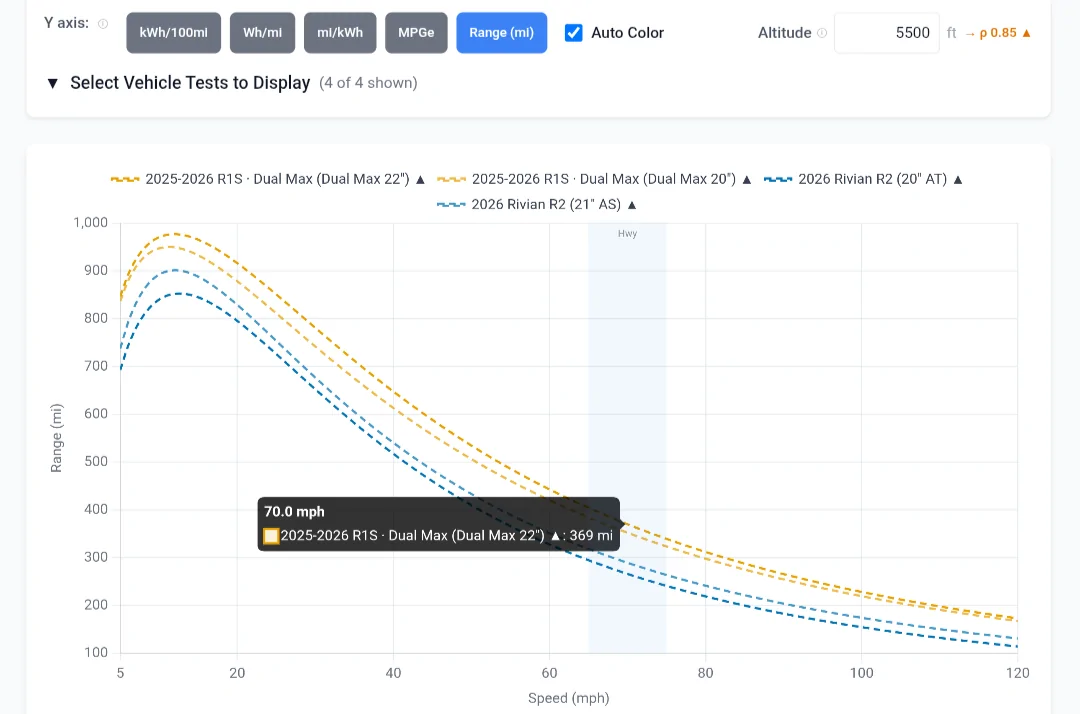
That's why I said never have to enter regen.


Vs the 369mi the dyno numbers suggest - also within margin of error.
Screenshot_20260721-182001.webp


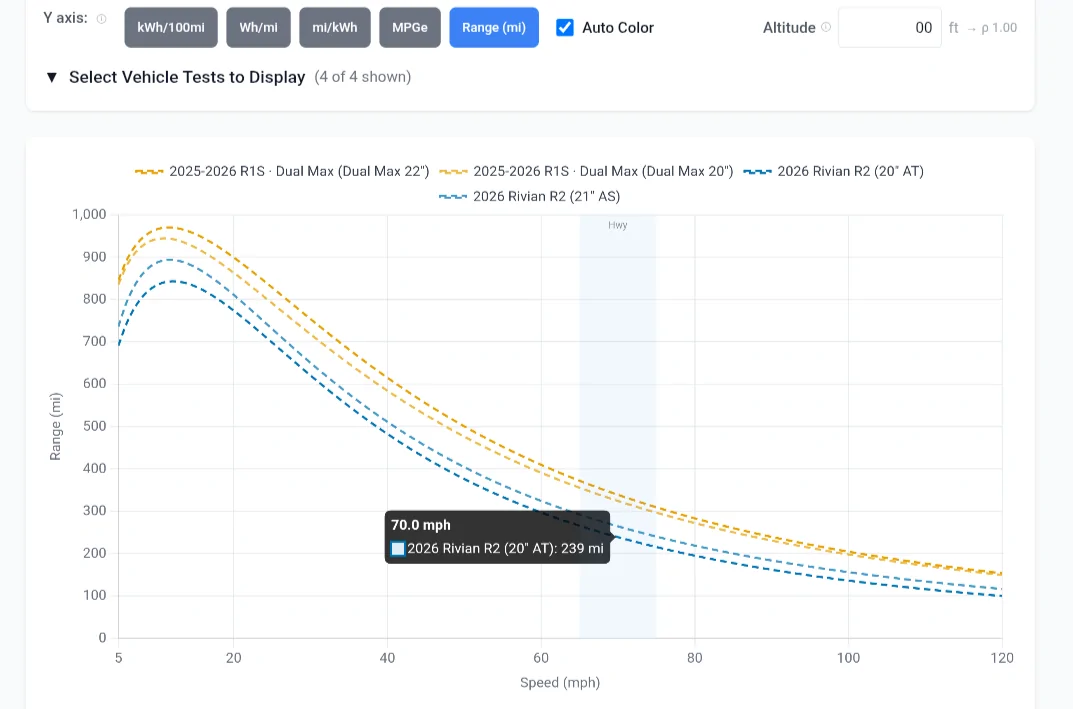
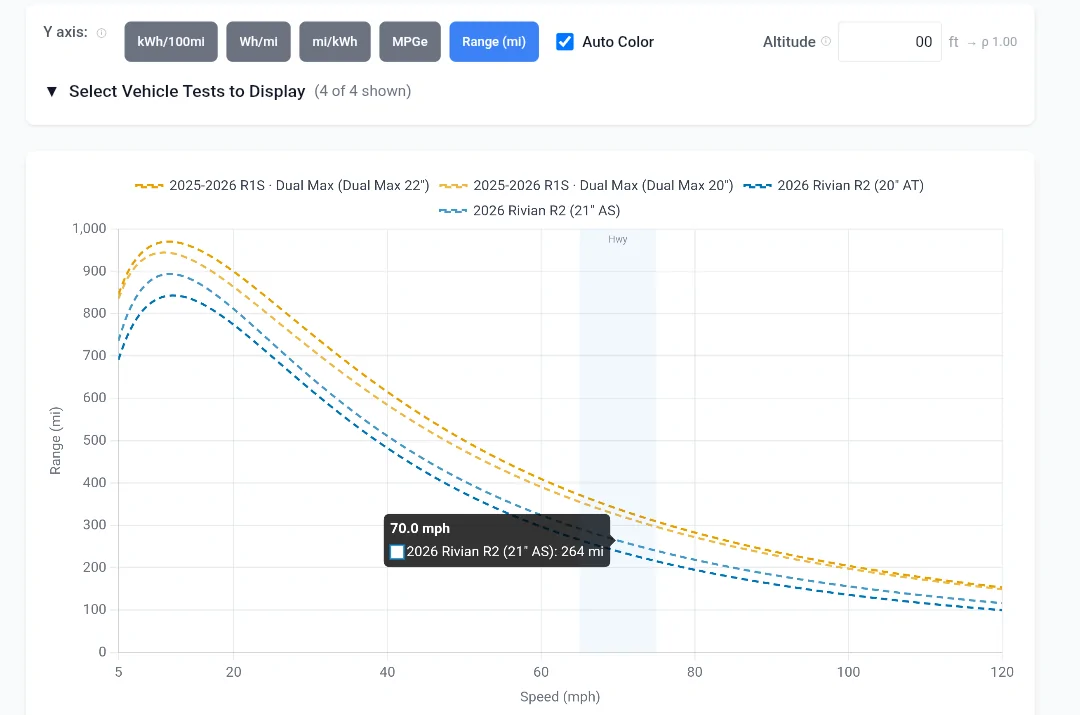
I've been using these to anchor my calculator, so I'm quite confident in it.

At sea level, R2 is 265mi on 21" AS and 240mi on 20" AT.

Screenshot_20260721-182326.webp

Screenshot_20260721-182314.webp


I'd bet my R1T on it.
Ok so a lot of words and graphs just to show you also have 3 MPK for R2 at 70 mph...which is what I said from the beginning? Which is also what Tom got in his test?
 

Indy avocado

Well-Known Member
First Name
Greg
Joined
Dec 17, 2022
Threads
3
Messages
237
Reaction score
326
Location
Indiana
Vehicles
'22 R1T, '17 Macan S, '11 Mustang GT
Ok so a lot of words and graphs just to show you also have 3 MPK for R2 at 70 mph...which is what I said from the beginning? Which is also what Tom got in his test?
Yes (2.95), on the 21" wheels and tires on a good day. And that equates to 265 mi.

Guilty of incorrectly reading that you were estimating the R2 at nearly 300mi range.

265mi. Nobody in the real world is going to achieve more than that without hypermiling.
 
Last edited:

Sponsored

OP
OP
ksurfier

ksurfier

Well-Known Member
First Name
Ken
Joined
Aug 23, 2022
Threads
51
Messages
1,180
Reaction score
1,134
Location
CA
Vehicles
R1S, Tesla
Occupation
Fake Science Lead
Clubs
 
Ok so a lot of words and graphs just to show you also have 3 MPK for R2 at 70 mph...which is what I said from the beginning? Which is also what Tom got in his test?
Dunno, ask TexasBob…he knows:

“So I did the 70 mph range test on conserve this morning. I ran from 100% down to 2% and got 324 miles => 330 miles. Adding in the buffer the total range is ~335.

Michelin Defender tires on the Dune 275/60/R20s
Max Pack
On Conserve mode
Efficiency 2.43 mi / kwh
Temps ranged 55 - 73 degrees during the drive
Elevation 50ft - 150ft
Ran 2x separate speedometer apps to validate speed 71 mph on Rivian = 70 on both apps”
 

Jeremy3292

Well-Known Member
First Name
Jeremy
Joined
Apr 27, 2026
Threads
6
Messages
844
Reaction score
1,384
Location
South Carolina
Vehicles
R2
Yes (2.95), on the 21" wheels and tires on a good day. And that equates to 265 mi.

Guilty of incorrectly reading you estimating the R2 at nearly 300mi range.

265mi. Nobody in the real world is going to achieve more than that without hypermiling.
Wonderful 🤝

And yes, 300 miles is very unrealistic at 70 mph. There's probably some lovely spring day outside where someone could eek it out, but it's not a normal thing for sure.
 

Indy avocado

Well-Known Member
First Name
Greg
Joined
Dec 17, 2022
Threads
3
Messages
237
Reaction score
326
Location
Indiana
Vehicles
'22 R1T, '17 Macan S, '11 Mustang GT
Dunno, ask TexasBob…he knows:

“So I did the 70 mph range test on conserve this morning. I ran from 100% down to 2% and got 324 miles => 330 miles. Adding in the buffer the total range is ~335.

Michelin Defender tires on the Dune 275/60/R20s
Max Pack
On Conserve mode
Efficiency 2.43 mi / kwh
Temps ranged 55 - 73 degrees during the drive
Elevation 50ft - 150ft
Ran 2x separate speedometer apps to validate speed 71 mph on Rivian = 70 on both apps”

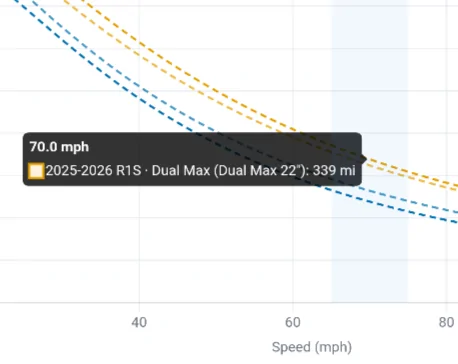
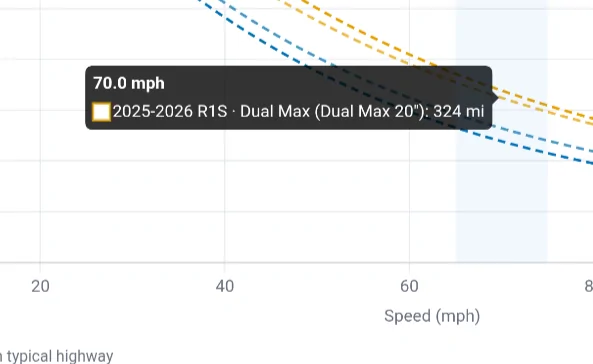
Rivian R1T R1S R2 Highway Efficiency Test: 80 MPH vs 70 MPH Changed Everything Screenshot_20260721-185622

Take off 3% efficiency due to 20" Defenders* vs 22" range wheels/tires and you get 328mi.

Or use 20" AT to get 324mi
Rivian R1T R1S R2 Highway Efficiency Test: 80 MPH vs 70 MPH Changed Everything Screenshot_20260721-190013


So... Yeah, that ALSO matches.

All thse variables can be modeled 😅

*(I saw 1-2% loss going from 21" range to 20" defenders)
 

Jeremy3292

Well-Known Member
First Name
Jeremy
Joined
Apr 27, 2026
Threads
6
Messages
844
Reaction score
1,384
Location
South Carolina
Vehicles
R2
Screenshot_20260721-185622.webp

Take off 3% efficiency due to 20" Defenders* vs 22" range wheels/tires and you get 328mi.

Or use 20" AT to get 324mi
Screenshot_20260721-190013.webp


So... Yeah, that ALSO matches.

All thse variables can be modeled 😅

*(I saw 1-2% loss going from 21" range to 20" defenders)
I am in full agreement with you for the record. Others on here seemingly aren't, but 3 MPK on R2 is the baseline 70 mph test. You also are in agreement with the OOO 70 mph range test for R1S, which yielded 376 miles or 2.69 MPK, which I believe you showed your graphs on that on the prior page which were the same (or within 1-2%).
 

mkhuffman

Well-Known Member
First Name
Mike
Joined
Nov 9, 2020
Threads
14
Messages
3,058
Reaction score
3,491
Location
Virginia
Vehicles
2025 R1T Tri-Max, Jeep GC-L, VW Jetta
Dunno, ask TexasBob…he knows:

“So I did the 70 mph range test on conserve this morning. I ran from 100% down to 2% and got 324 miles => 330 miles. Adding in the buffer the total range is ~335.

Michelin Defender tires on the Dune 275/60/R20s
Max Pack
On Conserve mode
Efficiency 2.43 mi / kwh
Temps ranged 55 - 73 degrees during the drive
Elevation 50ft - 150ft
Ran 2x separate speedometer apps to validate speed 71 mph on Rivian = 70 on both apps”
This morning I drove 150 miles with an average speed of 75 mph. Efficiency was just under 2.5, which IMO is freaking incredible for a 7,000 pound brick with smooth edges.

If my R1T can hit 2.5 mi/kWh at 75, definitely the R2 can hit 3.0, which is a 20% improvement, not 50%.

Test conditions:
- Cruise set to 81 mph (GPS 79)
- some light rain for a few minutes, but mostly dry with temps around 85 F
- Lots of regen due to slow traffic, which is why the average speed was not 79 mph.
- 22" OEM tires with 20k miles on them. Tread is getting pretty thin. I expect new tires will knock 5% off my efficiency until they are broken in. (Because of rolling resistance, not weight. LOL.)
 

Sponsored

jrmbadger

Well-Known Member
Joined
Jul 16, 2025
Threads
9
Messages
213
Reaction score
351
Location
USA
Vehicles
R1S (Gen 1)
That's nonsense. It matters less because has stations are so much more common and no ones car is calculating the next gas stop for them.

But MPG and range is affected just as much in an ICE car as an EV.
I agree that one reason it's not noticed is that fueling stations are common and fast. However, MPG does decrease less going from 70-80mph in a gas car vs. range in an EV.

As one example:
In one test, the model Y efficiency decreased about 21% going from 70-80 (302.2 Wh/mi->366 Wh/mi) carscoops.com (if I did the math right)
Meanwhile, an ICE car loses about 11%: MPG for Speed (28%-17% - that site is based upon DOE studies).

The transmission helps a gasoline engine stay near its most efficient operating range as speed increases, partially offsetting the higher power needed to overcome aerodynamic drag. An EV's motor is already highly efficient at highway speeds, so as speed rises from 70 to 80 mph, the increased energy consumption is driven primarily by air resistance.
 

Indy avocado

Well-Known Member
First Name
Greg
Joined
Dec 17, 2022
Threads
3
Messages
237
Reaction score
326
Location
Indiana
Vehicles
'22 R1T, '17 Macan S, '11 Mustang GT
I am in full agreement with you for the record. Others on here seemingly aren't, but 3 MPK on R2 is the baseline 70 mph test. You also are in agreement with the OOO 70 mph range test for R1S, which yielded 376 miles or 2.69 MPK, which I believe you showed your graphs on that on the prior page which were the same (or within 1-2%).
Yup.

Just reiterating that a lot of the vehement disagreement is based on data that ALL AGREES when variables are properly accounted for.

And if anyone wants to use my calculator that matches these data points, please do. (I need to add temperature adjustment. Give me a bit)

https://evbench.pluginpath.com/?tab=chart&v=21,26&x=time&y=chargeRate&m=epacurves&epa_ya=range_mi
 

Jeremy3292

Well-Known Member
First Name
Jeremy
Joined
Apr 27, 2026
Threads
6
Messages
844
Reaction score
1,384
Location
South Carolina
Vehicles
R2
Yup.

Just reiterating that a lot of the vehement disagreement is based on data that ALL AGREES when variables are properly accounted for.

And if anyone wants to use my calculator that matches these data points, please do. (I need to add temperature adjustment. Give me a bit)

https://evbench.pluginpath.com/?tab=chart&v=21,26&x=time&y=chargeRate&m=epacurves&epa_ya=range_mi
What would move the R2 data to a more favorable range? R2 "highway" EPA was 276 miles I believe and Tom seemed to think R2 could beat that at sea level back in New Jersey. So he's saying 280 miles would be "normal" in his eyes. I assume you took all the variables from Tom's test also - crosswinds, 20" AT tires, temperature, elevation, etc. Do you add new data when it comes about, say when Kyle does his 70 mph test with R2? Not advocating for anything, just curious.
 

Indy avocado

Well-Known Member
First Name
Greg
Joined
Dec 17, 2022
Threads
3
Messages
237
Reaction score
326
Location
Indiana
Vehicles
'22 R1T, '17 Macan S, '11 Mustang GT
What would move the R2 data to a more favorable range? R2 "highway" EPA was 276 miles I believe and Tom seemed to think R2 could beat that at sea level back in New Jersey. So he's saying 280 miles would be "normal" in his eyes. I assume you took all the variables from Tom's test also - crosswinds, 20" AT tires, temperature, elevation, etc. Do you add new data when it comes about, say when Kyle does his 70 mph test with R2? Not advocating for anything, just curious.
EPA highway is based on a cycle that isn't steady state. It averages well under 65mph.

I like Tom, but he's just guessing in this case. His stated wind impact was limited to less than 2hrs of almost 4hrs of driving. I think he's under-estimating the impact of altitude since he never does them at altitude.

I already "calibrated" using 20" AT EPA dyno data.

Site is a perpetual work in progress. Data gets added when I need to support an argument...
And then my argument adapts because there's always nuance 😅

I usually try to note conditions, but we also have to recognize no test is perfect, so I have multiple tests for some vehicles.

I treat Toms and OoS tests basically the standard.

I split tests by trim that matter for range (tire, battery), but I've been applying EPA data to multiple because it's separately labeled.

I'm still feeling out what this site can/should be.
 

Alan in Tempe

Well-Known Member
First Name
Alan
Joined
Feb 18, 2026
Threads
1
Messages
90
Reaction score
131
Location
Tempe, AZ
Vehicles
Mustang Mach-e First Edition
But MPG and range is affected just as much in an ICE car as an EV.
There are some real differences:

Very cold impacts EVs far more because cabin heating robs from the battery in an EV, while it is reuse of waste engine heat in an ICE.

Lots of acceleration and deceleration impacts ICEs far more than EVs because ICEs have much lower efficiencies while accelerating due to engine efficiencies varying greatly with varying load and speeds and losses in transmissions, while EVs have much greater efficiencies while decelerating due to the ability to regen.

Note that jackrabbit starts greatly reduce ICE efficiency while having minimal impact on EV efficiency. This is a long post explanation in itself, but is very true.

High altitudes impact ICEs slightly more than EVs because lower O2 requires harder "breathing" for an ICE.

Finally, audio impacts ICEs so much worse than EVs because of the louder playing volumes required to hear it over the engine noise!
Sponsored


Top