Sponsored

White Shadow

Well-Known Member
First Name
Thomas
Joined
Nov 11, 2021
Threads
13
Messages
1,407
Reaction score
1,159
Location
NJ
Vehicles
Jeep & Audi
Occupation
SP
I think they should do whatever is most efficient for heating the cabin during winter driving. I'm someone who likes to drive in winter without wearing a coat in the car.....no hat, gloves, nothing. I crank up the heat and like it nice and toasty inside. In an ICE vehicle, that's easy to do and it doesn't impact economy since the heat is "free"

I was watching a video by Rivian Dad the other day where he was doing winter range tests in extreme cold and noticed that he was all bundled up inside his vehicle. I also noticed that he had to stop on the side of the road to scrape ice build-up off the outside of his windshield, which made it pretty obvious that he either wasn't using his defroster or if he was, that the defroster simply couldn't keep up to keep ice off the windshield.

Anyway, the last thing I want to do is bundle up inside an EV during a winter road trip because I'm worried about impacting range. So if a heat pump is the answer to that problem, then I'm on Team Heat Pump.
Sponsored
 

Gen(R3)Xer

Well-Known Member
Joined
Mar 10, 2024
Threads
49
Messages
1,453
Reaction score
1,433
Location
Ohio
Vehicles
Leasing Model 3 until R3X comes out, but now I have an R2 reservation as well.
This is good news as resistive heaters really reduce the range quickly. Interestingly though, if you have heated seats just use those and you can really save on range. There’s no need to heat the entire cabin of the vehicle.
 

jbssfelix

Well-Known Member
First Name
J
Joined
Apr 3, 2022
Threads
3
Messages
192
Reaction score
384
Location
Denver, CO
Vehicles
Tesla Model 3; Rivian R1S
Clubs
 
I think they should do whatever is most efficient for heating the cabin during winter driving. I'm someone who likes to drive in winter without wearing a coat in the car.....no hat, gloves, nothing. I crank up the heat and like it nice and toasty inside. In an ICE vehicle, that's easy to do and it doesn't impact economy since the heat is "free"

I was watching a video by Rivian Dad the other day where he was doing winter range tests in extreme cold and noticed that he was all bundled up inside his vehicle. I also noticed that he had to stop on the side of the road to scrape ice build-up off the outside of his windshield, which made it pretty obvious that he either wasn't using his defroster or if he was, that the defroster simply couldn't keep up to keep ice off the windshield.

Anyway, the last thing I want to do is bundle up inside an EV during a winter road trip because I'm worried about impacting range. So if a heat pump is the answer to that problem, then I'm on Team Heat Pump.
I live in the same area (Denver/Front Range Metro) and regularly drive to/from the mountains as well (thanks a lot, Breck Bombers ski school). The R1 has no problem blasting heat even in single-digit weather, and I still have zero issues getting from Denver to Breck to Denver on a single charge (20" A/Ts, quad motor, underbody, all-purpose mode).

Conversely, when our heat-pumped Tesla encounters single digits, it gets noticeably cooler in the car, as I don't think it can scavenge enough heat from the outside air to keep the cabin at 70F. I wouldn't say it gets "cold", but definitely keep your pants shoes and a light jacket on if you know you'll be dealing with that outside temp.

My other theory is that the Tesla is also just leaky as shit...which is equally plausible thanks to it's questionable build quality and design choices (frameless windows)
 

Zoidz

Well-Known Member
First Name
Gil
Joined
Feb 28, 2021
Threads
227
Messages
5,251
Reaction score
11,807
Location
PA
Vehicles
23 R1S Adv, Avalanche, BMWs-X3,330cic,K1200RS bike
Occupation
Engineer
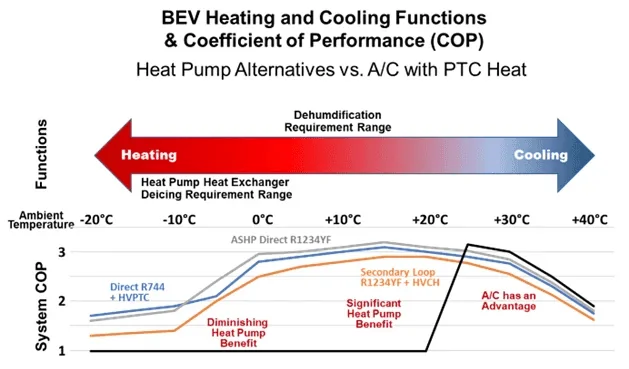
The BEV Heat Pump hype is real, but science and engineering paints a bleaker picture. Those who have heat pumps at home know that they get less efficient as the OAT (Outside Air Temperature) drops, and that an auxillary heating source may be needed below about 25F/-3c. If your OAT is 40-70F you will save energy in your EV with a heat pump. But if you are routinely 32/0c or below, the benefit of a heat pump vs. PTC is minimal, and gets worse as the temperature drops and becomes break even. You won't see any benefits in cold weather, and it WILL take longer for the cabin to warm up - if it warms toasty up at all, as @jbssfelix mentioned above.

"For highway driving in cold conditions, the share of losses is dominated by battery and aerodynamic effects, and cabin losses account for 5-10%. With a system COP of 1.5 and losses of 5-10%, the benefit of a heat pump for cabin conditioning would be on the order of 1.7 -3.3%. Then the mass of the heat pump system slightly reduces the overall impact of a heat pump.

Although heat pump systems on average save energy and increase range, it is not surprising that customers don’t notice the small heat pump benefit in cold highway driving. Coolant waste heat recovery and multiple-source heat pumps may provide greater range improvement than air-source heat pumps in cold conditions."


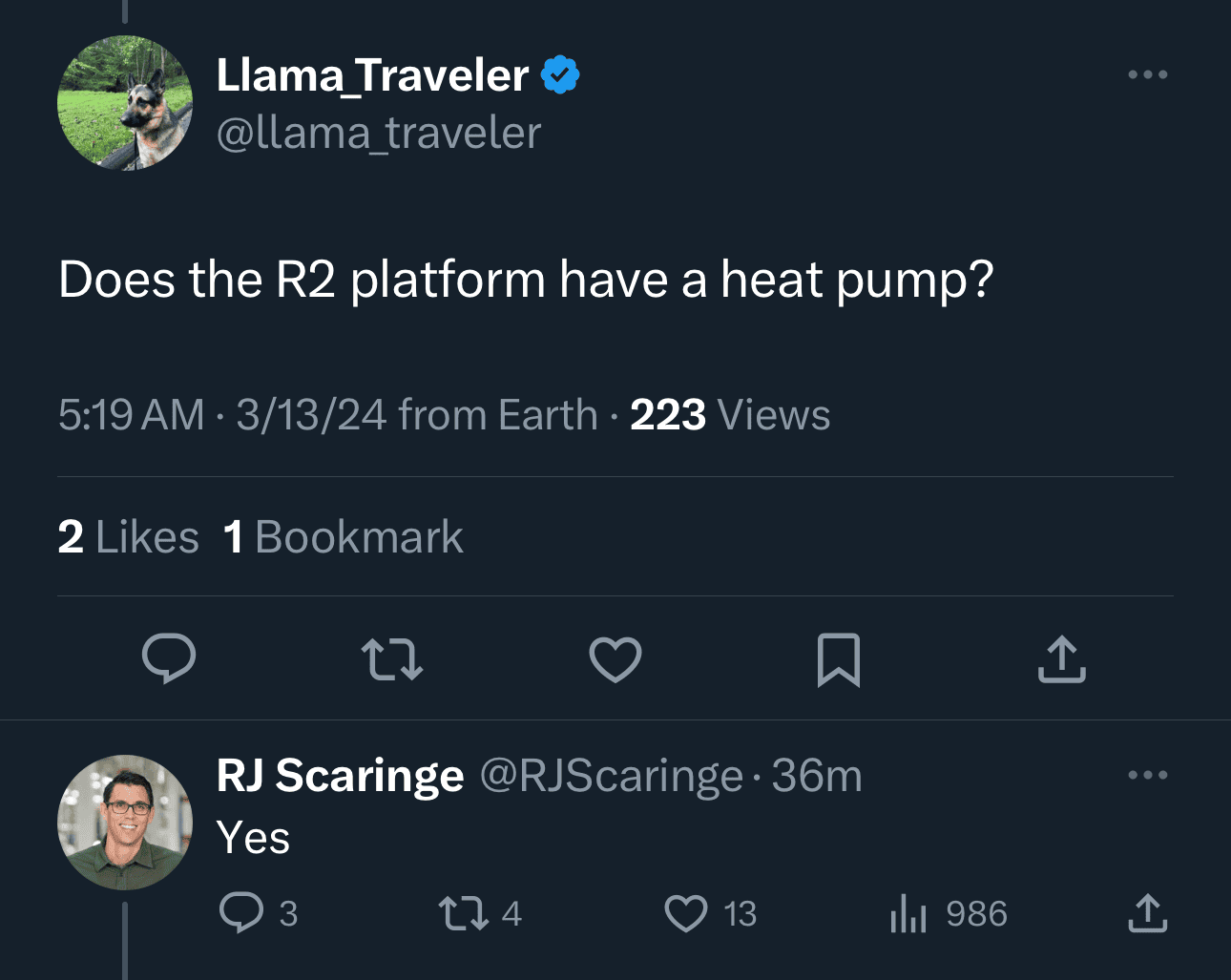
Rivian R1T R1S R2 / R3 has heat pump (confirmed by RJ) 1710431245807-di
 

pricedm

Well-Known Member
First Name
Adam
Joined
Oct 22, 2022
Threads
1
Messages
249
Reaction score
333
Location
Denver, CO near Rivian and Tesla service centers
Vehicles
Tesla
I hope all you granola eaters enjoy your heat pump hard-on you are sporting now.
The difference in energy use between my 2018 Tesla Model 3 with resistance heater versus 2023 Tesla Model Y with heat pump is significant. In the winter, camping outdoors overnight with heat pump equiped EV while plugged into a 16a charger and temps in the 5-20*F range, once the car reaches comfortable sleeping temperature (mid/low 60s) the charge rate to the battery is minimally impacted. In comparison, the resistance heater used most of the incoming electricity.

TL, DR: a well-designed heat pump can significantly reduce energy consumption.
 

Sponsored

mkhuffman

Well-Known Member
First Name
Mike
Joined
Nov 9, 2020
Threads
14
Messages
3,051
Reaction score
3,476
Location
Virginia
Vehicles
2025 R1T Tri-Max, Jeep GC-L, VW Jetta
I don't have any hard data to prove it, but replacing a glass roof with an insulated roof should make a huge difference, and make it much easier to keep the cabin warm.

Also, radiant heating devices in the cabin would be a big improvement over blowing heated air through ducts. I know the cheap little 300 Watt heater I have next to my desk puts out a ton of heat and could easily warm the space the size of a vehicle cabin, especially if the roof was insulated.

Anyway, since this is a BEV specific problem, they should be looking at new ways to heat rather than trying what works in ICEVs. I think it will happen.
 
Last edited:

spicyR1T78

New Member
First Name
Lamar
Joined
Feb 23, 2024
Threads
0
Messages
4
Reaction score
1
Location
Maryland
Vehicles
R1T
Occupation
Mechanic
The difference likely won't be as big as people want to see. My MINI Cooper SE had a heat pump and below probably 32F I'd notice a pretty big hit to efficiency. That said, that vehicle didn't have a battery warmer so some of its cold weather inefficiency was likely due to that issue. In warm weather I'd see around 4-4.2 mi/kWh, but below 32F it dropped to more like 3.5 mi/kWh and closer to 10F it was more like 3 mi/kWh. Can't say all of that is due to heating the cabin, but I saw a 25-30% impact from temperature alone with no change in driving style/location.
Your correct heat pumps are useless below a certain temperature
 

White Shadow

Well-Known Member
First Name
Thomas
Joined
Nov 11, 2021
Threads
13
Messages
1,407
Reaction score
1,159
Location
NJ
Vehicles
Jeep & Audi
Occupation
SP
I live in the same area (Denver/Front Range Metro) and regularly drive to/from the mountains as well (thanks a lot, Breck Bombers ski school). The R1 has no problem blasting heat even in single-digit weather, and I still have zero issues getting from Denver to Breck to Denver on a single charge (20" A/Ts, quad motor, underbody, all-purpose mode).

Conversely, when our heat-pumped Tesla encounters single digits, it gets noticeably cooler in the car, as I don't think it can scavenge enough heat from the outside air to keep the cabin at 70F. I wouldn't say it gets "cold", but definitely keep your pants shoes and a light jacket on if you know you'll be dealing with that outside temp.

My other theory is that the Tesla is also just leaky as shit...which is equally plausible thanks to it's questionable build quality and design choices (frameless windows)
How much do you lose when you're blasting heat in single-digit temps? Have you ever tracked it to see the efficiency loss?

BTW, I had a heat pump in my old house before I moved a few years ago, but it also had the ability to switch off and use the gas furnace instead. The heat pump could definitely keep the house warm, but it somehow felt like a "cooler" type of warmth than when the gas furnace was running. I don't know how to explain that, but it's just the feeling I got. Both heat pump and gas furnace could keep the house at 70 degrees, but you could feel the difference between them with the gas furnace being more of a warm 70 and the heat pump being more of a cool 70. I know that probably doesn't make any sense, but it's something that everyone noticed.

I've also heard that heat pump technology has improved a lot and that they're supposedly far more efficient than they were a decade ago.
 

Mooeymoose

Well-Known Member
First Name
Jeffrey
Joined
Sep 7, 2023
Threads
22
Messages
118
Reaction score
110
Location
Park Ridge IL
Vehicles
R1S
Occupation
MD
Everything has trade offs. Heats pumps will be more efficient is colder / hot weather but they can have a hard time warming the car is very cold weather. Obviously the overall efficiency impact will vary depending on the climate but I do not think the KWH/mile impact will be huge but certainly measurable.
 

White Shadow

Well-Known Member
First Name
Thomas
Joined
Nov 11, 2021
Threads
13
Messages
1,407
Reaction score
1,159
Location
NJ
Vehicles
Jeep & Audi
Occupation
SP
...Those who have heat pumps at home know that they get less efficient as the OAT (Outside Air Temperature) drops, and that an auxillary heating source may be needed below about 25F/-3c....
I think that used to be true, but not with modern heat pumps. My old heat pump wasn't all that great once temps got down below freezing, but the newer units are supposed to work well even when temps get below zero. For that reason, I see more and more new construction houses here in the northeast being built with heat pumps. That's a lot different than it was 20 years ago, when heat pumps around here were almost completely absent because the temps during winter just got too cold to use them.
 

Sponsored

Supratachophobia

Well-Known Member
Joined
Apr 8, 2023
Threads
9
Messages
1,790
Reaction score
2,140
Location
Ohio
Vehicles
S
Clubs
 
Hol' up, are we saying heat pump is a replacement for resistive heat? Because they should keep both systems to compliment each other. I highly doubt a heat pump can keep up with cabin AND battery heating when it's cold out. And even more importantly, not decrease the battery size because of perceived efficiencies of the heat pump.
 

JeremyP

Well-Known Member
Joined
Feb 27, 2021
Threads
12
Messages
384
Reaction score
701
Location
Grand Junction, CO
Vehicles
Toyota 4runner, BMW I3, preordered R1S
Occupation
Engineer
I remember seeing this video last year during the cold snap. They compare a resistive heater model 3 to a newer one with a heat pump

Edit: also I see in the comments the ptc heater used about 8kwh while the heat pump car used 5-6. Another takeaway is Kyle thinks the heater and insulation in his Rivian is better than his Teslas:)

 
Last edited:

Zoidz

Well-Known Member
First Name
Gil
Joined
Feb 28, 2021
Threads
227
Messages
5,251
Reaction score
11,807
Location
PA
Vehicles
23 R1S Adv, Avalanche, BMWs-X3,330cic,K1200RS bike
Occupation
Engineer
I think that used to be true, but not with modern heat pumps. My old heat pump wasn't all that great once temps got down below freezing, but the newer units are supposed to work well even when temps get below zero. For that reason, I see more and more new construction houses here in the northeast being built with heat pumps. That's a lot different than it was 20 years ago, when heat pumps around here were almost completely absent because the temps during winter just got too cold to use them.
Modern heat pumps are indeed more efficient, but they still decline as the OAT gets colder. It's just a fact of physics. That's why I went with a geothermal groundwater heat pump in my house. 200 feet down, it's 53 degrees year round.
 

Dark-Fx

Well-Known Member
First Name
Brian
Joined
Jul 15, 2020
Threads
152
Messages
13,766
Reaction score
28,000
Location
Michigan
Vehicles
R1S, Livewire One, Sierra EV, R1S, R2
Occupation
Engineering, Dog Petting
Clubs
 
Although heat pump systems on average save energy and increase range, it is not surprising that customers don’t notice the small heat pump benefit in cold highway driving. Coolant waste heat recovery and multiple-source heat pumps may provide greater range improvement than air-source heat pumps in cold conditions."
I'd definitely agree that the real trick for heat pumps in an EV is being able to scavenge waste heat from the motor inverters and the motors themselves. Doing a straight heat exchange is helpful, but you can get higher efficiency there with a heat pump.
 

jbssfelix

Well-Known Member
First Name
J
Joined
Apr 3, 2022
Threads
3
Messages
192
Reaction score
384
Location
Denver, CO
Vehicles
Tesla Model 3; Rivian R1S
Clubs
 
How much do you lose when you're blasting heat in single-digit temps? Have you ever tracked it to see the efficiency loss?

BTW, I had a heat pump in my old house before I moved a few years ago, but it also had the ability to switch off and use the gas furnace instead. The heat pump could definitely keep the house warm, but it somehow felt like a "cooler" type of warmth than when the gas furnace was running. I don't know how to explain that, but it's just the feeling I got. Both heat pump and gas furnace could keep the house at 70 degrees, but you could feel the difference between them with the gas furnace being more of a warm 70 and the heat pump being more of a cool 70. I know that probably doesn't make any sense, but it's something that everyone noticed.

I've also heard that heat pump technology has improved a lot and that they're supposedly far more efficient than they were a decade ago.
Just anecdotal. Driving into the mountains in the winter means a good chunk of energy loss is simply from driving up 5000' of elevation, so I never bothered to see "what if I do the same drive at 60F vs 70F interior temp?" (not to mention, my wife and kids would likely murder me and throw my body out somewhere near Georgetown, CO).
Sponsored


Top