Sponsored

Range and Battery Comparison Thought - What am I missing?

Sundin67

Member
First Name
Craig
Joined
Sep 15, 2024
Threads
2
Messages
18
Reaction score
10
Location
11791
Vehicles
GLE and Q7
Clubs
 
We test-drove the R1S yesterday. Unfortunately, the salesperson knew little about the batteries or the financing.

I understand EPA mileage varies but to use that as a benchmark

Online:

Dual Standard 22” Sport Bright has EPA 270MI

Dual Standard 20” All Season has EPA 258MI.

Do the above have the LFP batteries? This means we can charge to 100 percent, meaning EPA is 270MI.

If the Dual Large has an older battery which limits charging to 80%, why spend the extra money on it? EPA Range is 330MI. When you take 80% it is 264MI range. Even the Dual Max, Est. at 410MI at 80%, is 328MI. Would you be better off sticking with the Dual Standard?


Thanks for any help!
Sponsored

 
Last edited:
Mathme

Well-Known Member
First Name
Matt
Joined
Jul 25, 2022
Threads
3
Messages
1,378
Reaction score
1,809
Location
Los Altos, CA
Vehicles
R1T: El Cap, OC, 20AT, Off road package
Occupation
High Tech
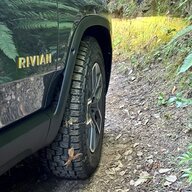
Your mileage will vary...are key words. in your comparison above, you're comparing basically 22" all season tires against 20" more rugged all terrain type tires (they look to be the new Goodyear ones). If you drill into the pics on the configurator of the differences, you'll see (I noticed that this morning).

These EPA figures are likely also at 100% charge however getting anywhere near those miles in a BEV is about like getting them in an ICE.

I have a 2023 R1T with the AT 20s and my truck says about 285 miles on a 100% charge and I've never come close to that kind of mileage. I could cite lots of examples, but one that readily comes to mind is when on a roadtrip from San Francisco to Seattle . The typical charge profile was about 80-85% down to 25ish % on that trip. Charging anything higher than 85% on a road trip is generally not worth the time vs. the miles gained in that last 15% SoC. In those stretches driving about 70, I would get anywhere from 150-180ish miles per charge on I-5 (depending on winds, elevation gain/loss, etc). This equaled about 2.5-3 hours of driving, and then about 30-35 minutes of charging...which is enough so that I wanted a break anyway.
 

electrictaco

Well-Known Member
Joined
Apr 2, 2021
Threads
0
Messages
267
Reaction score
468
Location
California
Vehicles
R1S
We test-drove the R1S yesterday. Unfortunately, the salesperson knew little about the batteries or the financing.

I understand EPA mileage varies but to use that as a benchmark

Online:

Dual Standard 22” Sport Bright has EPA 270MI

Dual Standard 20” All Season has EPA 258MI.

Do the above have the LFP batteries? This means we can charge to 100 percent, meaning EPA is 270MI.

If the Dual Large has an older battery which limits charging to 80%, why spend the extra money on it? EPA Range is 330MI. When you take 80% it is 264MI range. Even the Dual Max, Est. at 410MI at 80%, is 328MI. Would you be better off sticking with the Dual Standard?


Thanks for any help!
Daily mileage will be roughly the same between the two assuming you charge to 100% on LFP Standard Pack and 70-80% on the NMC Large Pack. However, where you get the benefit is your first leg of roadtrips where you'll get an extra ~50 miles at highway speed. For my Large Pack, I can do about 250 miles in conserve before hitting 10% if I don't try to limit my speed at all (80ish mph going with California traffic). If I had the standard pack, that first leg would be around 200ish I assume.

After the first leg the relative speed of charging the batteries is almost identical. The LFP pack will charge up to 80% in 30 mins, which is close to what the NMC pack does to 70%. Getting you close to the same range for the next leg(s) of your trip.

So to answer your question, if you want or need that extra 50 mile buffer, the Large pack gives it to you on trips where you charge to 100%. Otherwise they have the same daily range, effectively.
 

Electrified Outdoors

Well-Known Member
First Name
Ken
Joined
Jan 30, 2023
Threads
63
Messages
3,683
Reaction score
3,980
Location
Mount Airy, Maryland
Website
EVoutdoors.org
Vehicles
2024 Rivian R1S Quad, 2024 Silverado EV RST First Edition
Occupation
Real Estate
Clubs
 
We test-drove the R1S yesterday. Unfortunately, the salesperson knew little about the batteries or the financing.

I understand EPA mileage varies but to use that as a benchmark

Online:

Dual Standard 22” Sport Bright has EPA 270MI

Dual Standard 20” All Season has EPA 258MI.

Do the above have the LFP batteries? This means we can charge to 100 percent, meaning EPA is 270MI.

If the Dual Large has an older battery which limits charging to 80%, why spend the extra money on it? EPA Range is 330MI. When you take 80% it is 264MI range. Even the Dual Max, Est. at 410MI at 80%, is 328MI. Would you be better off sticking with the Dual Standard?


Thanks for any help!
EPA is a good estimate but only expect to get close to that under ideal conditions.

They are indeed LFP batteries. The standard packs are all LFP. Large and Max are still NMC.

Charging LFP to 100% daily isn't what I recommend. While LFP does have more cycling capability than NMC it still doesn't like to sit at 100% charge.

The way the car can tell how much battery is left is by reading voltage. The lower the voltage the lower the state of charge. Higher SOC higher voltage. LFP has a much flatter voltage curve and this makes it harder for the car to determine the state of charge in the battery. Charging to 100% helps calibrate this and provides the most accurate SOC.

For me, I would charge to 100% once or twice a month to maintain accurate SOC but otherwise charge to 70 or 80% daily for optimum battery longevity.
 

mudito

Well-Known Member
First Name
Aldo
Joined
Jul 30, 2024
Threads
18
Messages
1,011
Reaction score
1,414
Location
Texas
Vehicles
Rivian R1T
EPA is a good estimate but only expect to get close to that under ideal conditions.

They are indeed LFP batteries. The standard packs are all LFP. Large and Max are still NMC.

Charging LFP to 100% daily isn't what I recommend. While LFP does have more cycling capability than NMC it still doesn't like to sit at 100% charge.

The way the car can tell how much battery is left is by reading voltage. The lower the voltage the lower the state of charge. Higher SOC higher voltage. LFP has a much flatter voltage curve and this makes it harder for the car to determine the state of charge in the battery. Charging to 100% helps calibrate this and provides the most accurate SOC.

For me, I would charge to 100% once or twice a month to maintain accurate SOC but otherwise charge to 70 or 80% daily for optimum battery longevity.
+1

And actually for the NMC batteries is recommended that you maintain it at the higher range of the SoC capacity (i.e.: it's OK to charge it 'daily' from 50 to 70%) rather than the lower portion of it (i.e.: from 20-50%).

So for an NMC chemistry battery you can keep the limit at 70% and always plug the truck in when you're at home for the night and, of course, charge it to 100% for long trips and for BMS re-calibration every other month or so.

I'm myself a bit lazy so I forget to plug it in every night but as a rule of thumb I don't let it go lower than 30% and depending on my plans, I charge it to 70 or 80% (this is Texas... sometimes I need to higher range) :)
 

Sponsored

OP
OP

Sundin67

Member
First Name
Craig
Joined
Sep 15, 2024
Threads
2
Messages
18
Reaction score
10
Location
11791
Vehicles
GLE and Q7
Clubs
 
Thank you all for jumping in and helping guide me. We are considering this a more local car so sounds like no need for the upgrade.

FYI - We drove the Model X today and felt the Rivian, was nicer overall, even the ride. We are waiting for the salespeople to call and explain the financing.

Thank you
 

Hereforthesnacks

Well-Known Member
Joined
Jun 6, 2024
Threads
3
Messages
1,247
Reaction score
1,469
Location
West Coast
Vehicles
Ford Bronco
EPA is a good estimate but only expect to get close to that under ideal conditions.

They are indeed LFP batteries. The standard packs are all LFP. Large and Max are still NMC.

Charging LFP to 100% daily isn't what I recommend. While LFP does have more cycling capability than NMC it still doesn't like to sit at 100% charge.

The way the car can tell how much battery is left is by reading voltage. The lower the voltage the lower the state of charge. Higher SOC higher voltage. LFP has a much flatter voltage curve and this makes it harder for the car to determine the state of charge in the battery. Charging to 100% helps calibrate this and provides the most accurate SOC.

For me, I would charge to 100% once or twice a month to maintain accurate SOC but otherwise charge to 70 or 80% daily for optimum battery longevity.
Agree. Here is a recent example with an R1S max pack. EPA = 410 miles. Trip from Bay Area to Yosemite - which includes elevation change. Range = 250 miles. Definitely not ideal conditions though.
 

BrianB

Well-Known Member
First Name
Brian
Joined
Jun 9, 2024
Threads
14
Messages
189
Reaction score
294
Location
Conroe, TX
Vehicles
2025 R1S
Clubs
 
Range only really matters on a road trip or towing, not routine driving. Whichever battery you have, the night before a road trip, you’ll charge to 100%. I have the dual standard and have only charged away from home twice, during road trips.
 

Mark_AZR1T

Well-Known Member
Site Sponsor
First Name
Mark
Joined
May 28, 2021
Threads
42
Messages
2,222
Reaction score
3,867
Location
Gilbert, AZ
Website
jackpucks.com
Vehicles
R1T Launch, R1S Canyon Red
Clubs
 
Range only really matters on a road trip or towing, not routine driving. Whichever battery you have, the night before a road trip, you’ll charge to 100%. I have the dual standard and have only charged away from home twice, during road trips.
Short and simple. This is what we do on both ours.
 

Dave Cundiff

Well-Known Member
First Name
Dave
Joined
Feb 28, 2024
Threads
4
Messages
1,172
Reaction score
1,584
Location
Pacific County, Washington
Vehicles
'23 R1S (DM,Max); '23 R1T (QM,Lg); '23 Chevy Bolt
As I recall, the guy who does the Engineering Explained videos says to drain LFP batteries as far as you like over time, then charge in one session to 100% at least once a month.

I hope this is helpful advice. We have NMC batteries in both of ours, so I haven't mastered LFP advice nearly as well as NMC....
 
Last edited:

Sponsored

McLovin

Well-Known Member
Joined
Jul 30, 2024
Threads
7
Messages
509
Reaction score
1,156
Location
Virginia
Vehicles
R1T
Clubs
 
We are waiting for the salespeople to call and explain the financing.
What type of financing are you looking at? If a lease, many people here (including me) have leased and could probably answer the majority of your questions. On purchasing, probably the same, although I haven't seen many questions/conversations on it (there are a bunch of leasing threads here already).

On the battery, yeah, I think @BrianB said it best.
 

Electrified Outdoors

Well-Known Member
First Name
Ken
Joined
Jan 30, 2023
Threads
63
Messages
3,683
Reaction score
3,980
Location
Mount Airy, Maryland
Website
EVoutdoors.org
Vehicles
2024 Rivian R1S Quad, 2024 Silverado EV RST First Edition
Occupation
Real Estate
Clubs
 
Just add that for road trips I calculate range at 70%. This. Is because you don't want to run it below 10% and charging above 80% on road trips is slow.

The lowest range model should go an EPA 180 miles between charging stops on road trips. Even if real world is say 150 miles that's still 2 or two and a half hours driving between stops.

When calculating your daily charge limit. I would set the lower limit to 20% and the upper limit to 70%, so 50% of the battery. That would give you about 130 mi EPA range for daily driving.

Standard still has a decent amount of range for what many owners will need out of it.

The only situations where I would recommend against it would be if you lived in a very harsh cold climate area, if you need the performance, or if you tow with it.

In those cases I would recommend going with large or Max. LFP is more sensitive to extreme cold conditions. Probably still ok as long as you can leave it plugged in.
 
Last edited:

Bob R1T

Well-Known Member
First Name
Bob
Joined
Feb 16, 2023
Threads
2
Messages
64
Reaction score
48
Location
Virginia
Vehicles
R1T, Model S
Occupation
architect
Clubs
 
Your mileage will vary...are key words. in your comparison above, you're comparing basically 22" all season tires against 20" more rugged all terrain type tires (they look to be the new Goodyear ones). If you drill into the pics on the configurator of the differences, you'll see (I noticed that this morning).

These EPA figures are likely also at 100% charge however getting anywhere near those miles in a BEV is about like getting them in an ICE.

I have a 2023 R1T with the AT 20s and my truck says about 285 miles on a 100% charge and I've never come close to that kind of mileage. I could cite lots of examples, but one that readily comes to mind is when on a roadtrip from San Francisco to Seattle . The typical charge profile was about 80-85% down to 25ish % on that trip. Charging anything higher than 85% on a road trip is generally not worth the time vs. the miles gained in that last 15% SoC. In those stretches driving about 70, I would get anywhere from 150-180ish miles per charge on I-5 (depending on winds, elevation gain/loss, etc). This equaled about 2.5-3 hours of driving, and then about 30-35 minutes of charging...which is enough so that I wanted a break anyway.
With my R1T 2022 vin#18483 large pac, 21"s, 210 interstate miles, 70mph cruise, 600' elevation change, light wind, 70f, I typically use 205 to 215 battery miles. Cruise at 77mph uses roughly 275 battery miles. I'd venture to say if you watched your ICE in miles mode instead of fraction mode, you'd see the same relative useage.
 

Mathme

Well-Known Member
First Name
Matt
Joined
Jul 25, 2022
Threads
3
Messages
1,378
Reaction score
1,809
Location
Los Altos, CA
Vehicles
R1T: El Cap, OC, 20AT, Off road package
Occupation
High Tech
Agreed. The drive from Sacramento to South Lake Tahoe is about 100 miles and gains about 8,000 feet in elevation - with some hills being 6% for over 4 miles. Going up will cost about 60-70% of your battery. Coming back down will only cost about 10-15%. Just like in an ICE car, it takes more to go up than down.
 

Hereforthesnacks

Well-Known Member
Joined
Jun 6, 2024
Threads
3
Messages
1,247
Reaction score
1,469
Location
West Coast
Vehicles
Ford Bronco
With my R1T 2022 vin#18483 large pac, 21"s, 210 interstate miles, 70mph cruise, 600' elevation change, light wind, 70f, I typically use 205 to 215 battery miles. Cruise at 77mph uses roughly 275 battery miles. I'd venture to say if you watched your ICE in miles mode instead of fraction mode, you'd see the same relative useage.
I have compared my ICE ranges to my EVs. Yes, the ICE ranges do change. But on the a Yosemite drive, one can get 250/410 in an R1S. Using an ICE conventional gas I can get 370/410. Diesel gets you even more. This is at 75-80 mph.

This is not specific to Rivan. It's for EVs generally.
Sponsored


Top