just_jim
New Member
- Thread starter
- #1
I just started paying attention to Rivian again since it looks like customer deliveries are imminent. I have a few questions/concerns regarding what's been disseminated in the last week or so regarding range, charging and a "magical" 2wd drive mode that will somehow increase range:
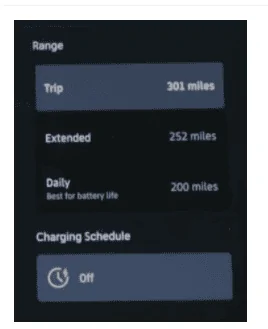
1. A screenshot I saw two days ago from the R1T display showed Trip 301 mile, Extended 252 miles and Daily 200 miles. Assuming that the Trip is 135kWh, why is the Daily SoC only 66% of that? Compare this to my Model Y which has an advertised range of 326 miles, but recommended for 85-90% SoC for daily usage. Nearly 18 months in this gives me a range of 250-270 miles (@85-90% SoC). What is going on with the batteries/BMS that the Daily range is 66% of the max and how much battery degradation is expected at higher SoC?

2. Another screenshot I saw showed charging at 48A (level 2 I assume, so 240V) and 15 miles/hr charge rate. At the 11.5kW charge rate this gives 768 Wh/mile. When I read that, it talked about AC and other accessories running contributing to that number. Comparing this to my Teslas when charging at home (240V @ 48A) with AC on max (playing games, etc) as a test, I charge at 38 miles/hour for 303 wH/mile. Considering the size/weight of the R1T I have problems believing that AC and all accessories going while the truck is parked and charging is drawing more than 1.5x the power it takes to drive 1 mile (~490Wh). Am I missing something here ?

3. This 2WD "economy" mode. I haven't seen this on the Rivian site, but it is mentioned elsewhere. I have a problem seeing how shutting off any number of motors while maintaining any speed will make a significant (>5%) difference in range. Basic physics says that for two identical objects (mass, Cd, atmospheric conditions, etc) x number of watts is required to move that object at y speed. The reason 4WD/AWD is less fuel efficient on ICE vehicles is due to added weight (driveshaft, differential, etc) of the components as well as frictional/rotational losses when the 4WD/AWD system is engaged (the ICE has to move more mass). For the R1T/R1S this isn't the case, so I fail to see how shutting down any motors will increase range. If it takes 490Wh/mile, how does that matter if those 490Wh are split between 2 or 4 motors? Additionally if this is really a "feature" it means that there is a clutch (or other mechanism) that disengages the motors from the wheels (added complexity) or some sort of circuit to handle stray voltage generated by a free-spinning PM motor (which by nature would also induce a small amount of opposite torque). I'm not sure what I'm missing that demonstrates how shutting off motors would increase range, but I would love to hear what I'm missing from an EE/ME who works in motors/electro-mechanicals.
FYI I'm an LE reservation holder from Feb '19.
1. A screenshot I saw two days ago from the R1T display showed Trip 301 mile, Extended 252 miles and Daily 200 miles. Assuming that the Trip is 135kWh, why is the Daily SoC only 66% of that? Compare this to my Model Y which has an advertised range of 326 miles, but recommended for 85-90% SoC for daily usage. Nearly 18 months in this gives me a range of 250-270 miles (@85-90% SoC). What is going on with the batteries/BMS that the Daily range is 66% of the max and how much battery degradation is expected at higher SoC?
2. Another screenshot I saw showed charging at 48A (level 2 I assume, so 240V) and 15 miles/hr charge rate. At the 11.5kW charge rate this gives 768 Wh/mile. When I read that, it talked about AC and other accessories running contributing to that number. Comparing this to my Teslas when charging at home (240V @ 48A) with AC on max (playing games, etc) as a test, I charge at 38 miles/hour for 303 wH/mile. Considering the size/weight of the R1T I have problems believing that AC and all accessories going while the truck is parked and charging is drawing more than 1.5x the power it takes to drive 1 mile (~490Wh). Am I missing something here ?

3. This 2WD "economy" mode. I haven't seen this on the Rivian site, but it is mentioned elsewhere. I have a problem seeing how shutting off any number of motors while maintaining any speed will make a significant (>5%) difference in range. Basic physics says that for two identical objects (mass, Cd, atmospheric conditions, etc) x number of watts is required to move that object at y speed. The reason 4WD/AWD is less fuel efficient on ICE vehicles is due to added weight (driveshaft, differential, etc) of the components as well as frictional/rotational losses when the 4WD/AWD system is engaged (the ICE has to move more mass). For the R1T/R1S this isn't the case, so I fail to see how shutting down any motors will increase range. If it takes 490Wh/mile, how does that matter if those 490Wh are split between 2 or 4 motors? Additionally if this is really a "feature" it means that there is a clutch (or other mechanism) that disengages the motors from the wheels (added complexity) or some sort of circuit to handle stray voltage generated by a free-spinning PM motor (which by nature would also induce a small amount of opposite torque). I'm not sure what I'm missing that demonstrates how shutting off motors would increase range, but I would love to hear what I'm missing from an EE/ME who works in motors/electro-mechanicals.
FYI I'm an LE reservation holder from Feb '19.
Sponsored
Last edited: