Sponsored

stewart

Well-Known Member
First Name
stewart
Joined
Apr 14, 2023
Threads
1
Messages
47
Reaction score
22
Location
Nokomis Florida
Vehicles
R1T and Chevy Blazer
Occupation
Consultant
Good Day Ladies and Gents, and especially the fellow nerd who will actually read this!

This is the moment you've all been waiting for (well, the 3 of you who were heavily invested in debating the efficacy of aftermarket cabin air filters in a vendor post on this very forum).

Report on Rivian OEM & Aftermarket Cabin Air Filtration Performance with respect to Penetration and Pressure Drop

Introduction
This report aims to evaluate the performance of the Rivian OEM (Mann) air filter in comparison to available aftermarket HVAC / Cabin Air Filters. Given the industries we serve and the industry regulations around personal protective equipment (PPE) regulated personal air filtration, we do not have the ability to test exactly for automotive spec HEPA filtration.

The automotive standards for automotive filtration can be found here: https://www.aivc.org/sites/default/files/members_area/medias/pdf/Conf/1999/paper095.pdf
Notably, the ability to performatively test to 105 L/s (liters per second), 70 L/s, and 35 L/s are the defined flow rates for this industry and compliance governance. Our equipment can test up to 120 SLPM but is typically calibrated to test at 85 SLPM (standard liters per minute) and below. Therefore, our testing was performed initially at 85 SLPM and re-performed at 32 SLPM for comparative reasons, as is standard practice in all filter leak testing standards and regulations.

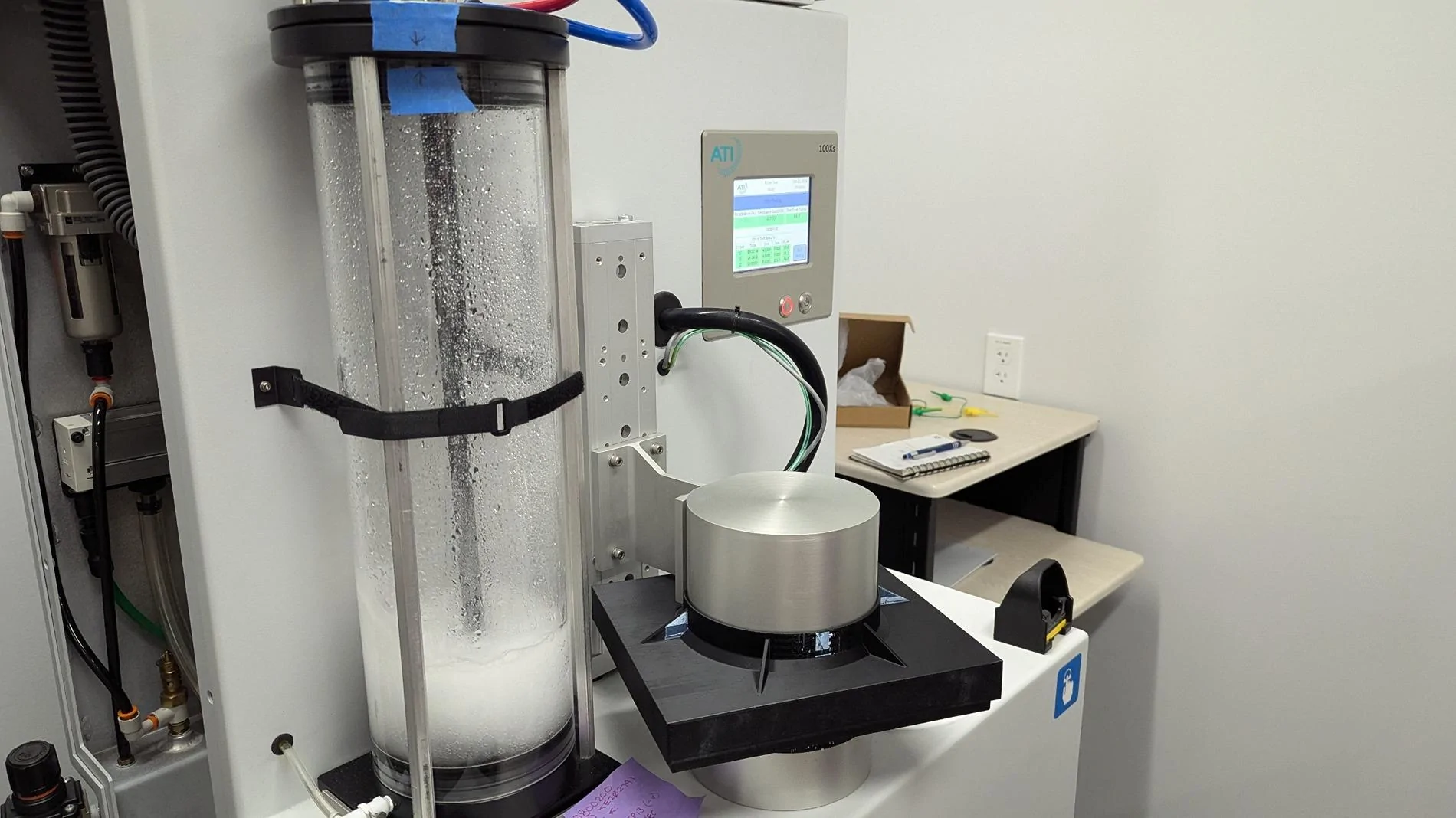
The equipment: I have access to ATI’s 100X Automated Filter Tester which is certified and compliant with NIOSH 42 CFR Part 84, ISO 23328, GB 2626, JICOSH/JMOL, GB 19083, GB/T 32610, YY0469, YY 0469, EN 12941/12942, EN 143/EN 149, ASTM F3502-21, ASTM F2100-23, and our company is in the process of certifying for ISO 17025 compliance.
The 100XS we used tests at the Count Median Diameter (CMD) of 0.075 μm ± 0.02, with a Geometric Standard Deviation (GSD) of ≤ 1.86, with typical concentrations between 15 and 25 mg/m3. Our challenge aerosol of choice was Salt (NaCl) solution with a flow accuracy to ± 0.4% of reading, plus ± 0.2% full scale. Aerosol detection specifications are as follows: Dynamic Range 0.1 μg/m³ to >200 mg/m³, accurate to ± 1% of reading; Penetration 0.0005%; Efficiency 99.9995%. Our unit and all the reagents, components, and supporting equipment comply to the most recent published and ratified standards and certifications as validated by third party lab testing for: CE, RoHS, FCC, and CSA.

Generally, this test equipment is provisioned for use with Flat sheet Filter media, Filtering Face pieces, Medical Device filters, and PAPR filters of all types and geometries including HEPA and ULPA grade and electret media. Typical industry use case of this equipment is to test and quality control validate filter media, cartridges, and industrial hygiene applications.

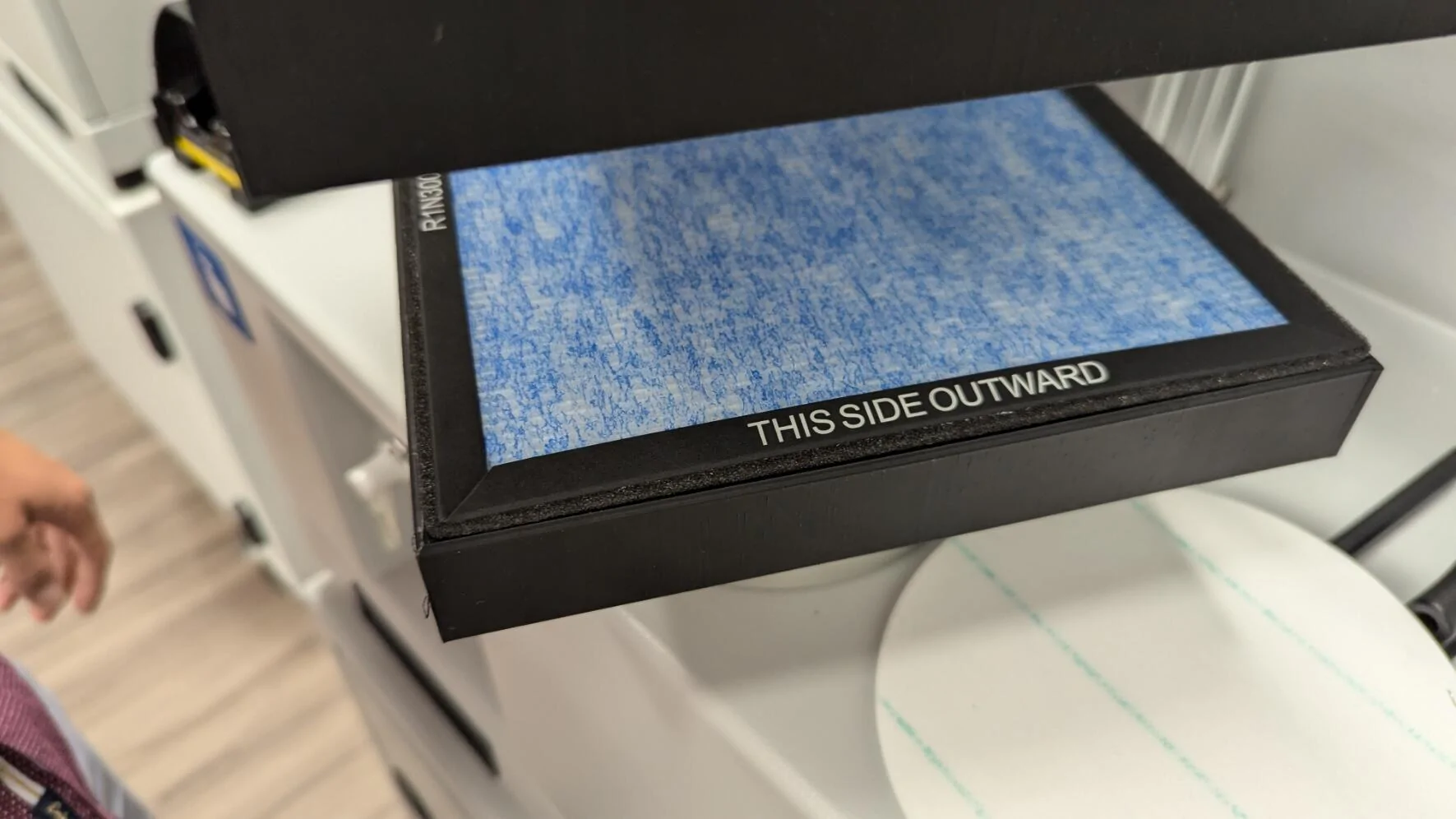
We used our standard automatic [filter media holder] chuck outfitted with a custom adapter that was designed to fit the geometric size of Rivian’s designated cabin filter cartridge location. To note: the orientation of measurement is relatively oriented orthogonal to the mounting of Rivian’s air collection, but would maintain the same fluid path, nonetheless. Also to note: the test fixture was developed to seal along the topmost boundary edges of the filters, which should mimic the intended sealing surfaces of Rivian’s air intake design.

Assumptions
The following assumptions were made:
  • All filter media is nominally installed according to the vendor’s intended fluid path. (In other words, we did not ā€˜flip’ the filters to test reverse flow path or alter the path in any meaningful way.)
  • All filter media should be fully sealed along the perimeter of the filter, as installed. Any opportunity for fluid flow around the filter, would essentially negate the intent of the filter by allowing for unfiltered air to enter the HVAC system.
  • The OEM Rivian filter is considered the ā€˜standard’ and the remaining filters are compared to the OEM.
  • As noted above, given the limitation of our equipment to challenge the performance of automotive cabin air filters, we are only utilizing this is as a comparative analysis of characteristics for penetration performance and pressure drop between the OEM and aftermarkets.
Disclaimers
I CANNOT and do not certify performance of these as HVAC air filters. I am credentialed and trained as a Mechanical Engineer to develop and integrate the test equipment (as noted above, for the intents and industries noted above) but am not a certified air filtration engineer or media certification technician by any stretch of the definition. I did work directly with a PhD Filtration Applications Engineer on this testing, and he is remaining anonymous as we’re not doing this as a professional endeavor.

All content is for educational purposes only. We do not intend for the content to be a substitute for professional advice or evaluation, counseling, certification, or formal representation outside of the scope of this comparative effort. Our content doesn’t engage visitors into a professional relationship.

Testimonials from myself and our engineers reflect our personal experiences and outcomes. Testimonials do not guarantee, warrant, or predict these or any other results. Every test setup is unique, and we did not procure a statistical sample of filters at regular QAE inspection point intervals.

Before posting any content, we do our best to ensure the accuracy and completeness of the information.

Raw Data
The following is based on the testing and test setup using an ATI 100XS configured Automated Filter Leak Tester and input and expertise of our Applications and Field Engineering team.


OEM Rivian Test Filter
Test 1:85. SLPM
Penetration (%)​
Resistance (Pressure Drop, mm H2O)​
4.5​
0.2​
Test 2:85. SLPM
Penetration (%)​
Resistance (Pressure Drop, mm H2O)​
8.7​
0.2​
NOTE: There are concerns will the sealing of this filter about its perimeter
Test A:32 SPLM
Penetration (%)​
Resistance (Pressure Drop, mm H2O)​
2.2​
0.2​
NOTE: There are concerns will the sealing of this filter about its perimeter
Test A:85. SLPMDIRTY/used OEM Rivian Test Filter (16,117 miles)
Penetration (%)​
Resistance (Pressure Drop, mm H2O)​
49​
0.2​
NOTE: There are concerns will the sealing of this filter about its perimeter
Test B:32 SLPMDIRTY/used OEM Rivian Test Filter (16,117 miles)
Penetration (%)​
Resistance (Pressure Drop, mm H2O)​
21.25​
0.2​
NOTE: There are concerns will the sealing of this filter about its perimeter


Aftermarket Filter #1
Test 1:85. SLPM
Penetration (%)​
Resistance (Pressure Drop, mm H2O)​
7.9​
0.7​
Compared to Target:​
176%​
350%​
NOTE: There are concerns will the sealing of this filter about its perimeter
Test 2:85. SLPM
Penetration (%)​
Resistance (Pressure Drop, mm H2O)​
10.8​
0.8​
Compared to Target:​
240%​
400%​
Test A:32 SPLM
Penetration (%)​
Resistance (Pressure Drop, mm H2O)​
13.35​
0.8​
Compared to Target:​
297%​
400%​

Aftermarket Filter #2
Test 1:85. SLPM
Penetration (%)​
Resistance (Pressure Drop, mm H2O)​
1.96​
0.5​
Compared to Target:​
44%​
250%​
Test 2:85. SLPM
Penetration (%)​
Resistance (Pressure Drop, mm H2O)​
1.7​
0.8​
Compared to Target:​
38%​
400%​
Test A:32 SPLM
Penetration (%)​
Resistance (Pressure Drop, mm H2O)​
0.7​
0.8​
Compared to Target:​
16%​
400%​

Aftermarket Filter #3: Every Amp
Test 1:85. SLPM
Penetration (%)​
Resistance (Pressure Drop, mm H2O)​
0.15​
0.6​
Compared to Target:​
3%​
300%​
Test 2:85. SLPM
Penetration (%)​
Resistance (Pressure Drop, mm H2O)​
0.18​
0.6​
Compared to Target:​
4%​
300%​
Test A:32 SPLM
Penetration (%)​
Resistance (Pressure Drop, mm H2O)​
0.06​
0.6​
Compared to Target:​
1%​
300%​

Analysis (Informal)
A few very important notables:

  • Rivian OEM (Mann) air filter does not appear to have been engineered to seal on all 4 sides of its perimeter (you can see this based on the ā€˜fuzzy’ gasket manufactured into the edge of the filter housing). It’s also very concerning, and notable to our AE that the outer edge is not rigid. Best practice when developing filters is to have a hard boundary edge that can seal against a mating surface.
    This could be overcome with appropriate gasketing on the cartridge (or installation provision) of the air handling equipment. As far as we could tell, no such provision is made. We could be wrong, but in our opinion, Rivian’s OE filter, when installed properly, is likely to leak. And as can be ascertained from the data, likely leaks more over time.

  • Note that, when compared to Rivian, all Aftermarket filters have a higher pressure drop. This means that the path of air flow has a higher resistance versus OEM nominal. THAT SAID, even though the numbers appear extreme (300% greater than OE), it’s likely that:
    A) this is incurred due to a better seal than OEM (air cannot leak by, therefore it all has to filter through the media, which is the desired convention) and
    B) Even at the uppermost value of 0.8 mm H2O, we do not feel as though that’s a significant enough pressure delta to incur any measurable mechanical impact on the air handling systems. Especially when accounting for the cross sectional area of the filter that the fluid may flow through. However, this should be monitored over time (in other words, how much does this increase over time.)
    - It should also be noted that the OE ā€˜used’ filter did not incur an increase in pressure drop, which further informs the leakage. There were no obvious surface defects in the pleated fibers, and based on what we were seeing, still believe that the filter was leaking around its perimeter, which seems to have weakened over time (with use).

  • Based on the data, 2 of the 3 aftermarket filters are suitable for use, both performing significantly better over the OE filter from a penetration standpoint. As noted, our equipment is designed to challenge filtration media in the HEPA particulate range and has a nominal particle size distribution (PSD) that covers the range of challenge as an industry standard as such. Technically, to qualify as a ā€œHEPAā€ filter, the design must reduce the HEPA particulate size penetration by 99.7%. So, a penetration value less than 0.3% would certify that metric.

  • Based on #3, Rivian’s own OE filter is NOT likely HEPA compliant.
    The only filter that was hypothetically able to reach HEPA compliance (by our metrics, which again comes with the gigantic caveat that we’re not challenging this filter media to spec due to the difference in industry standards) was the final filter (Aftermarket #3) which achieved 0.15, 0.18, and 0.06% penetration (<0.3%) as tested.
Recommendations
  • More cost is not better. The most expensive filter on this list, Aftermarket Filter #2, with shipping and taxes made it over $40. While it did outperform Rivian’s OE, it likely did so for the simple fact that it seals about the perimeter.

  • All 3 of the aftermarket filters appeared very similar to one another from an aesthetic standpoint. In fact, in a blind test, I don’t know that I would be able to identify which is which. There is only subtlety when it comes to markings, and none of the filters had the vendors’ information listed (no branding, logos, trademarks, etc). The only notable text was with respect to install orientation. That said, don't judge a book by its cover: clearly the functional and internal mechanistic properties of these filters varied significantly, and there is a clear performance delta between all of them. [What matters is on the inside]

  • The better performing filters fit compliantly (read: more snugly/ tightly installed) into the test fixture (and the Rivian Filter Cartridge/Tray).

  • It’s possible that a ā€˜looser’ test fixture may result in a better OE performance filter, as it may have prevented some distortion on the outward edge of the Mann filter. It’s very difficult to tell, as I don’t have the exact geometry Rivian was using and didn’t tear the Cabin Filter Cartridge/Tray out of the truck to get more accurate geometry. The test fixture was developed by measuring all the filters themselves and determining a best-practice path forward to incorporating it into our test setup.
Conclusion
Given the costs, performance data, and observations, I personally will use Aftermarket Filter #3 heretofore. There may be OTHER manufacturers out there that I have not tested that could perform better (or worse, of course). But I single-handly financed this testing, so I stopped at 4x new Rivian Filters and the cost of the adapter and my time.

Appendix
All citations and references are included within the document.

Relevant images of test setup here:


1729707438058-h0.jpg


1729707450658-iu.jpg
This is very helpful. I am.planning on replacing my filter and wasn't sure which way to go. Thank you.
Sponsored


the_mace

Well-Known Member
First Name
Rob
Joined
Apr 8, 2022
Threads
11
Messages
414
Reaction score
343
Location
Boston, MA
Vehicles
Tesla Model S75D, Ford F350 Diesel, Mercedes GLC30
Occupation
CTO
This is great. Dumb question perhaps, but on a R1T how do you replace the filter? On my 2018 Tesla Model S its a painful process so I dont do it myself. Is the Rivian one more accessible?
 

DaveA

Well-Known Member
First Name
David
Joined
Nov 17, 2020
Threads
15
Messages
2,542
Reaction score
4,677
Location
Texas
Vehicles
Rivian R1T
This is great. Dumb question perhaps, but on a R1T how do you replace the filter? On my 2018 Tesla Model S its a painful process so I dont do it myself. Is the Rivian one more accessible?
Its a 2 minute process in the Rivian. Lift up frunk, pop up cowl piece and its right there to wiggle out and replace. I replaced with the Rivian branded one, but next time I'll look into this one.
 

the_mace

Well-Known Member
First Name
Rob
Joined
Apr 8, 2022
Threads
11
Messages
414
Reaction score
343
Location
Boston, MA
Vehicles
Tesla Model S75D, Ford F350 Diesel, Mercedes GLC30
Occupation
CTO
Its a 2 minute process in the Rivian. Lift up frunk, pop up cowl piece and its right there to wiggle out and replace. I replaced with the Rivian branded one, but next time I'll look into this one.
Great sounds easy. The Tesla you have to take apart the dash.

How often are people replacing these? I definitely dont want to drive for 3 hours to have Rivian do this or use the (seemingly inferior) filter from Rivian.
 

DaveA

Well-Known Member
First Name
David
Joined
Nov 17, 2020
Threads
15
Messages
2,542
Reaction score
4,677
Location
Texas
Vehicles
Rivian R1T
Great sounds easy. The Tesla you have to take apart the dash.

How often are people replacing these? I definitely dont want to drive for 3 hours to have Rivian do this or use the (seemingly inferior) filter from Rivian.
I'd change it every 15k miles if you aren't driving in dusty conditions. Mine wasn't too bad at 18k and occasional dusty roads.
 

Sponsored

Yossarian

Well-Known Member
Joined
Oct 20, 2020
Threads
46
Messages
939
Reaction score
929
Location
SE Pennsylvania
Vehicles
R1T,Telluride, Wee-Strom, Lynskey Cooper
Thank you @R1Thor for all of this work...The service center didn't replace my filter when we had our R1S in for HVAC replacement and I need to buy one so your timing is perfect. Should we ever cross paths locally, I'd like to buy you a beverage of your choice (or perhaps a six-pack of said beverage).

Maybe we need a Lancaster-area get together sometime. There are enough of us in the area - Perhaps even @Zoidz would come down from the Reading area. There's also someone in Manheim Township with a beautiful custom cherry-red R1S that I've seen twice. I'll try to set something up...
If you guys set something up, let me know. I'm in Delco, so Lancaster is only about 70 miles away.
 

Zoidz

Well-Known Member
First Name
Gil
Joined
Feb 28, 2021
Threads
227
Messages
5,233
Reaction score
11,754
Location
PA
Vehicles
23 R1S Adv, Avalanche, BMWs-X3,330cic,K1200RS bike
Occupation
Engineer
My neighbor and I have been talking about this very thing. Our friendly neighborhood detailer, Urban Werks says they've serviced more than 80 (yes, eighty) local/local-ish Rivians. And the owner himself is currently shopping for an R1S last I'd heard.

Not to derail this thread too much, but we'll be at Trunk or Treat down there tonight ;)
LMK, I’m in for a beer meet up. Coincidentally, my wrap was one of those done by Urban Werks. Great experience.
 

SwampNut

Well-Known Member
First Name
Carlos
Joined
Apr 22, 2024
Threads
53
Messages
3,689
Reaction score
3,917
Location
Peoria AZ
Vehicles
2022 R1T Launch Edition
Occupation
Geek
Clubs
 
Where's the screwball who was previously claiming that all aftermarket filters cause you to "huff car fumes in traffic?" I'm currently using the BestEVmod filter, simply because it was one of two that looked great, with a foam seal. The other was the EveryAmp. In photos they look close to identical. I realize that this can be misleading. Anyway, I've had good results.

I always replace cabin air filters yearly. It's just so cheap. But I do use my vehicles off road a little bit. The Rivian is so damn easy to change.
 

EveryAmp

Well-Known Member
Site Sponsor
First Name
EveryAmp
Joined
Sep 15, 2021
Threads
25
Messages
161
Reaction score
246
Location
Atascadero, CA
Website
everyamp.com
Vehicles
Rivian R1T, Tesla Model 3, & Model Y
Occupation
3D-Printing
This is great. Dumb question perhaps, but on a R1T how do you replace the filter? On my 2018 Tesla Model S its a painful process so I dont do it myself. Is the Rivian one more accessible?
Here's a short video showing how easy it is. Much easier than crawling around in the Tesla center console! ;)


Rivian recommends an annual replacement or 12,000 miles. Whichever comes sooner. That would also vary by what type of roads your vehicle sees but its pretty standard.
 

madhat

Well-Known Member
Joined
Feb 27, 2024
Threads
10
Messages
335
Reaction score
387
Location
Arizona
Vehicles
22 R1T
This is great! I was hesitant without third party testing (and I posted wondering if the testing existed in their thread), but here we go.
Thanks, and I agree with your mechanisms of filtration. I just have a presentation about HVAC air purification earlier this week. I saw mention in the thread about HEPA+. Is that a thing? With MERV ratings, there’s MERV-A that negates the effects of electrostatic filtration…is that similar? Or just marketing hogwash?
 

Sponsored

the_mace

Well-Known Member
First Name
Rob
Joined
Apr 8, 2022
Threads
11
Messages
414
Reaction score
343
Location
Boston, MA
Vehicles
Tesla Model S75D, Ford F350 Diesel, Mercedes GLC30
Occupation
CTO
Here's a short video showing how easy it is. Much easier than crawling around in the Tesla center console! ;)


Rivian recommends an annual replacement or 12,000 miles. Whichever comes sooner. That would also vary by what type of roads your vehicle sees but its pretty standard.
Ah great. Im at 20K miles and 1.5 years. Just ordered the @EveryAmp one via Amazon.
 

EveryAmp

Well-Known Member
Site Sponsor
First Name
EveryAmp
Joined
Sep 15, 2021
Threads
25
Messages
161
Reaction score
246
Location
Atascadero, CA
Website
everyamp.com
Vehicles
Rivian R1T, Tesla Model 3, & Model Y
Occupation
3D-Printing
This is great! I was hesitant without third party testing (and I posted wondering if the testing existed in their thread), but here we go.
Thanks, and I agree with your mechanisms of filtration. I just have a presentation about HVAC air purification earlier this week. I saw mention in the thread about HEPA+. Is that a thing? With MERV ratings, there’s MERV-A that negates the effects of electrostatic filtration…is that similar? Or just marketing hogwash?
We use H11, not sure where HEPA+ is showing but it should be H11. Maybe its the title of "HEPA + Activated Carbon" that was translated to assume "HEPA+" ?ā€ā™‚
 

the_mace

Well-Known Member
First Name
Rob
Joined
Apr 8, 2022
Threads
11
Messages
414
Reaction score
343
Location
Boston, MA
Vehicles
Tesla Model S75D, Ford F350 Diesel, Mercedes GLC30
Occupation
CTO
Ah great. Im at 20K miles and 1.5 years. Just ordered the @EveryAmp one via Amazon.
Somewhat off topic but the Rivian doesnt have the same smell issues the Model S does. I've found I need to have them clean the HVAC system every year or two as it starts to smell pretty bad and its not just an old filter. Tesla recently seems to be trying to adjust for that by running high fan speeds all the time (when on Auto) which is noisy and annoying.
 

dleepnw

Well-Known Member
Joined
May 13, 2021
Threads
150
Messages
3,057
Reaction score
3,473
Location
WA
Vehicles
Rivian, Toyota, Lexus
Clubs
 
There's some nuance here, for sure, but let me try to break down what we saw to answer your questions.

We do not feel the test is flawed in any way given Rivian's filter needs to seal, period. So, we are comparing 1:1. We also tried 'forcing' a seal (it's not standard or best practice, but we wanted to try), by pushing some gasketing material into the outer edges. It didn't improve the performance, which speaks to a more systemic issue.

I also want to be clear that, though I only had a 'new' Rivian OEM and the one in my truck that had just over 16k miles on it, they both exhibited the same behavior. When it comes to filtration and industry standards, there shouldn't be a 'few bad' in the batch, per se. So, I don't think it's a unique issue, that I happened upon one bad filter. Also, you posited something about a looser fit on the OEM filter--I actually believe my test fixture was a tad tighter than Rivian's filter tray. YES, that could've distorted the border /edge in such a way that I induced the warping we couldn't seemingly overcome.

As far as filter performance, you cannot think of filters and filtration as a sieve. I know it LOOKS that way, but for HEPA and ULPA purposes, those particles are sincerely too damned small to be trapped the way you think they do. It's a combination of Coulombs Law and the Brownian Effect that predominantly traps particulate. The follow-on principles are diffusion, interception, and impaction, but they're predominantly driven from the aforementioned. And the particle physics at this level induces turbulence between the fibers that simply disallow for particles of that size to flow linearly (a good thing, as they're then generally rejected back). So, thicker pleating is meaningless. And I do mean meaningless. There's no situation where you add more fibers or layers and get better filtration due to the intention of the system. The system will drive the same amount of airflow through it (as designed) regardless. IF you get to the point where you're physically reducing the flow, you've compromised the system, and then you're not really measuring filtration anymore, because you've actually changed the volumetric input to the system.

IF you want to optimize for better filtration, it's all in the design and engineering of the filtration media itself (type of fibers, packing of fibers, geometry of pleats, number of pleats, sealing surfaces about the edges, adding surface ionization). In fact, counterintuitively, some of the best performing filtration media has the best flow (least amount of restriction). And monitoring backpressure over time is how most clean rooms determine when to replace their filters. It's a whole thing!

Our AE has his pHD in Filtration Engineering from the University of Minnesota. In our industry, UofM is the gold standard de-facto experts on Aerosol, Particulate, and Filtration. If he tells me that a filter isn't following 'best practice,' (IE: rigid boundary about the edges with a proper sealing surface) I believe him! If you really want to dig into it, every year, UofM has an Aerosol and Particulate short course, where for 3 days you can get somewhere around 12 different pHD Professors and their grad students bombarding you with more information you can absorb at once for the low low cost of $2200 :) It's enlightening!
you had me at "Coulombs Law and the Brownian Effect" ?
 
OP
OP
R1Thor

R1Thor

Well-Known Member
First Name
Joe
Joined
Aug 9, 2023
Threads
8
Messages
1,545
Reaction score
2,441
Location
Lancaster, PA
Vehicles
23QM R1T, Limestone + Ocean Coast, 21" & UBS
Occupation
Mechanical Engineering Lead
Clubs
 
This is great! I was hesitant without third party testing (and I posted wondering if the testing existed in their thread), but here we go.
Thanks, and I agree with your mechanisms of filtration. I just have a presentation about HVAC air purification earlier this week. I saw mention in the thread about HEPA+. Is that a thing? With MERV ratings, there’s MERV-A that negates the effects of electrostatic filtration…is that similar? Or just marketing hogwash?
Here are 2 good reads that address your questions pretty well:
https://www.hepacart.com/blog/elevating-indoor-air-the-importance-of-hepa-h13-filtration
https://clean.direct/blogs/news/what-is-a-hepa-filter-different-levels-of-hepa-filters

Certifications vary, and conditions by which filters are certified vary. And there is a difference between certifying the filters themselves, certifying the systems, and certifying the clean rooms (when applicable). But for the sake of conversation, HEPA is a regulated certification, across the board, and failure to prove one's claims can be very serious, especially given the fact that HEPA filtration literally keeps society safe.

For better or worse, given the complexity of these types of compliance, there are some very smart applications engineers and consultants with lucrative careers in fully understanding, digesting, and training compliance teams in filter testing. I'm actually scheduled to be in another FLT (filter leak testing) training in early November.
Sponsored


Top