Sponsored

Rivian vs Tesla - battery degradation

DayTripping

Well-Known Member
First Name
Timothy
Joined
Sep 12, 2024
Threads
13
Messages
1,544
Reaction score
2,133
Location
DFW
Vehicles
Gen1 R1T QM, S Plaid, Highland 3 Perf, 3 Long Range, R2 on order
Occupation
Consultant
I hope that degredation numbers are accurate but I am hedging my bets and doing what has worked well with my Teslas of similar chemistry.

After 3 years on 2 of them, I am about 2-3% degradation. According to the different apps, as well as Teslafi, an annual all-day service menu test I've run. My Y was far worse in the first year of ownership. The main difference was I followed Tesla's recommendations which said charging to 80% was fine all the time.

I followed the recommendation and my degradation suffered. For my subsequent Teslas, I kept the charge level at ~ 50% and charged up just before using the car, if and only if, I needed additional range for the day. Even at 50% charge, I could easily go 100 miles in my S or 3 without running it down too low. That would easily cover 99% of my daily driving.

I am following the same approach with my Rivian.
Sponsored
 
OP
OP
shap

shap

Well-Known Member
Joined
Nov 18, 2021
Threads
16
Messages
870
Reaction score
765
Location
Austin,TX
Vehicles
BMW 45e, R1T
Clubs
 
I hope that degredation numbers are accurate but I am hedging my bets and doing what has worked well with my Teslas of similar chemistry.

After 3 years on 2 of them, I am about 2-3% degradation. According to the different apps, as well as Teslafi, an annual all-day service menu test I've run. My Y was far worse in the first year of ownership. The main difference was I followed Tesla's recommendations which said charging to 80% was fine all the time.

I followed the recommendation and my degradation suffered. For my subsequent Teslas, I kept the charge level at ~ 50% and charged up just before using the car, if and only if, I needed additional range for the day. Even at 50% charge, I could easily go 100 miles in my S or 3 without running it down too low. That would easily cover 99% of my daily driving.

I am following the same approach with my Rivian.
Good points! What degradation did you see with your MY when you followed the 50% target charging?
 

portdirect

Well-Known Member
Joined
Jun 15, 2023
Threads
17
Messages
930
Reaction score
1,372
Location
Missouri
Vehicles
R1T (2023 QM - RIP, 2025 Tri Max), R1S (2024 DM Large)
Occupation
Blinkenlight Hearder
Rivian have done an excellent job of battery management and design for the Gen1 large pack (and I think the Gen1&2 Max packs - dont have info on the others) - with the one expiation of DC fast charging. Putting that to one side:

Gen1 Large packs actually have 141kWh Gross capacity - meaning they can absorb about ~8% battery degradation before needing to reduce the addressable capacity that we can see or use. The buffer is also there, though slightly smaller on the Max packs (~6%) - which have a 149kWh gross nominal capacity.

The BMS changes that came in around Q4 of last year made the user addressable capacity much more dynamic - using temperature as well as other factors to tweak the reported addressable capacity of the pack.

Though we don't have documentation for this - it is daily safe to assume that the nominal capacities of these packs is taken at around 22°C - and would be expected to decrease as it moves away from here (especially lower temps) - I've seen the capacity on our Gen1 large pack drop down into the low 120kWh range over winter (~25f), before rising back up to ~130 now its 75f outside.

My opinion is that they’re likely aiming to maintain the advertised usable capacity for as long as possible under a wide range of conditions and doing a really good job of it. As a result they are 'eating' the initial degradation out of the provided buffer - which is why so few of us are yet to see ANY user facing sign of it occurring. There is nothing special about Rivian's battery chemistry, or other magic involved - just a really really nice implementation that takes into account the fact that the nominal gross capacity of battery drops 5-6 pretty quickly and then tails off after that.

edit: spelling
 
Last edited:
OP
OP
shap

shap

Well-Known Member
Joined
Nov 18, 2021
Threads
16
Messages
870
Reaction score
765
Location
Austin,TX
Vehicles
BMW 45e, R1T
Clubs
 
Rivian have done an excellent job of better management and design for the Gen1 large pack (and I think the Gen1&2 Max packs - dont have info on the others) - with the one expiation of DC fast charging. Putting that to one side:

Gen1 Large packs actually have 141kWh Gross capacity - meaning they can absorb about ~8% battery degradation before needing to reduce the addressable capacity that we can use. The buffer is also there, though slightly smaller on the Max packs (~6%) - which have a 149kWh gross nominal capacity.

The BMS changes that came in around Q4 of last year made the user addressable capacity much more dynamic - using temperature as well as other factors to tweak the reported addressable capacity of the pack.

Though we don't have documentation for this - it is daily safe to assume that the nominal capacities of these packs is taken at around 22°C - and would be expected to decrease as it moves away from here (especially lower temps) - I've seen the capacity on our Gen1 large pack drop down into the low 120kWh range over winter (~25f), before rising back up to ~130 now its 75f outside.

My opinion is that they’re likely aiming to maintain the advertised usable capacity for as long as possible under a wide range of conditions and doing a really good job of it. As a result they are 'eating' the initial degradation out of the provided buffer - which is why so few of us are yet to see ANY user facing sign of it occurring. There is nothing special about Rivian's battery chemistry, or other magic involved - just a really really nice implementation that takes into account the fact that the nominal gross capacity of battery drops 5-6 pretty quickly and then tails off after that.
That is my assumption as well. Tesla seems not to have such a buffer, and that is why we see degradation happening almost immediately. Rivian seems to put a larger battery initially, and as you mentioned, use some buffer to remediate the degradation.

Which is awesome, as if after 2 years we see almost 0 degradation. And usually NMC battery degrate most in the first 2 years, we should not see a significant degradation going forward.

I think this is very important and has a significant value IMHO. I know people say degradation is not an issue in EVs, but it is. Losing 15% in the first 2 years means losing 45-50 miles of range.
 
OP
OP
shap

shap

Well-Known Member
Joined
Nov 18, 2021
Threads
16
Messages
870
Reaction score
765
Location
Austin,TX
Vehicles
BMW 45e, R1T
Clubs
 
That is my assumption as well. Tesla seems not to have such a buffer, and that is why we see degradation happening almost immediately. Rivian seems to put a larger battery initially, and as you mentioned, use some buffer to remediate the degradation.

Which is awesome, as if after 2 years we see almost 0 degradation. And usually NMC battery degrate most in the first 2 years, we should not see a significant degradation going forward.

I think this is very important and has a significant value IMHO. I know people say degradation is not an issue in EVs, but it is. Losing 15% in the first 2 years means losing 45-50 miles of range. Which is more than the difference between large and max packs. And max pack cost $$$
 

Sponsored

rvnappolis

Active Member
First Name
Burr
Joined
May 25, 2024
Threads
0
Messages
28
Reaction score
22
Location
Maryland
Vehicles
Pilot; Outback
Occupation
Government
I hope that degredation numbers are accurate but I am hedging my bets and doing what has worked well with my Teslas of similar chemistry.

After 3 years on 2 of them, I am about 2-3% degradation. According to the different apps, as well as Teslafi, an annual all-day service menu test I've run. My Y was far worse in the first year of ownership. The main difference was I followed Tesla's recommendations which said charging to 80% was fine all the time.

I followed the recommendation and my degradation suffered. For my subsequent Teslas, I kept the charge level at ~ 50% and charged up just before using the car, if and only if, I needed additional range for the day. Even at 50% charge, I could easily go 100 miles in my S or 3 without running it down too low. That would easily cover 99% of my daily driving.

I am following the same approach with my Rivian.
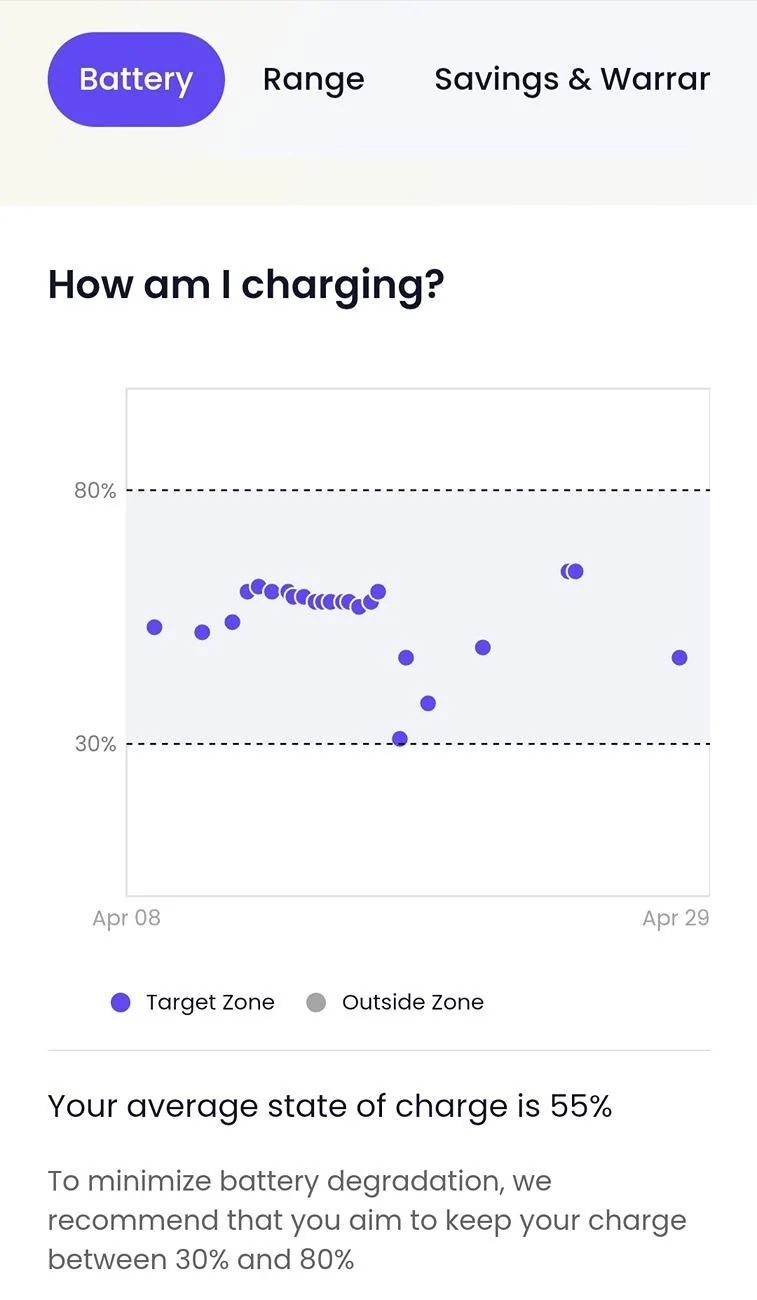
Same approach here. If truck is just being used around town I try to have it sitting between 30 and 60. Top off before trips, but try to avoid long charge sessions leading to high battery temps.
Rivian R1T R1S Rivian vs Tesla - battery degradation Screenshot_20250428_170604_Chrom
 

DayTripping

Well-Known Member
First Name
Timothy
Joined
Sep 12, 2024
Threads
13
Messages
1,544
Reaction score
2,133
Location
DFW
Vehicles
Gen1 R1T QM, S Plaid, Highland 3 Perf, 3 Long Range, R2 on order
Occupation
Consultant
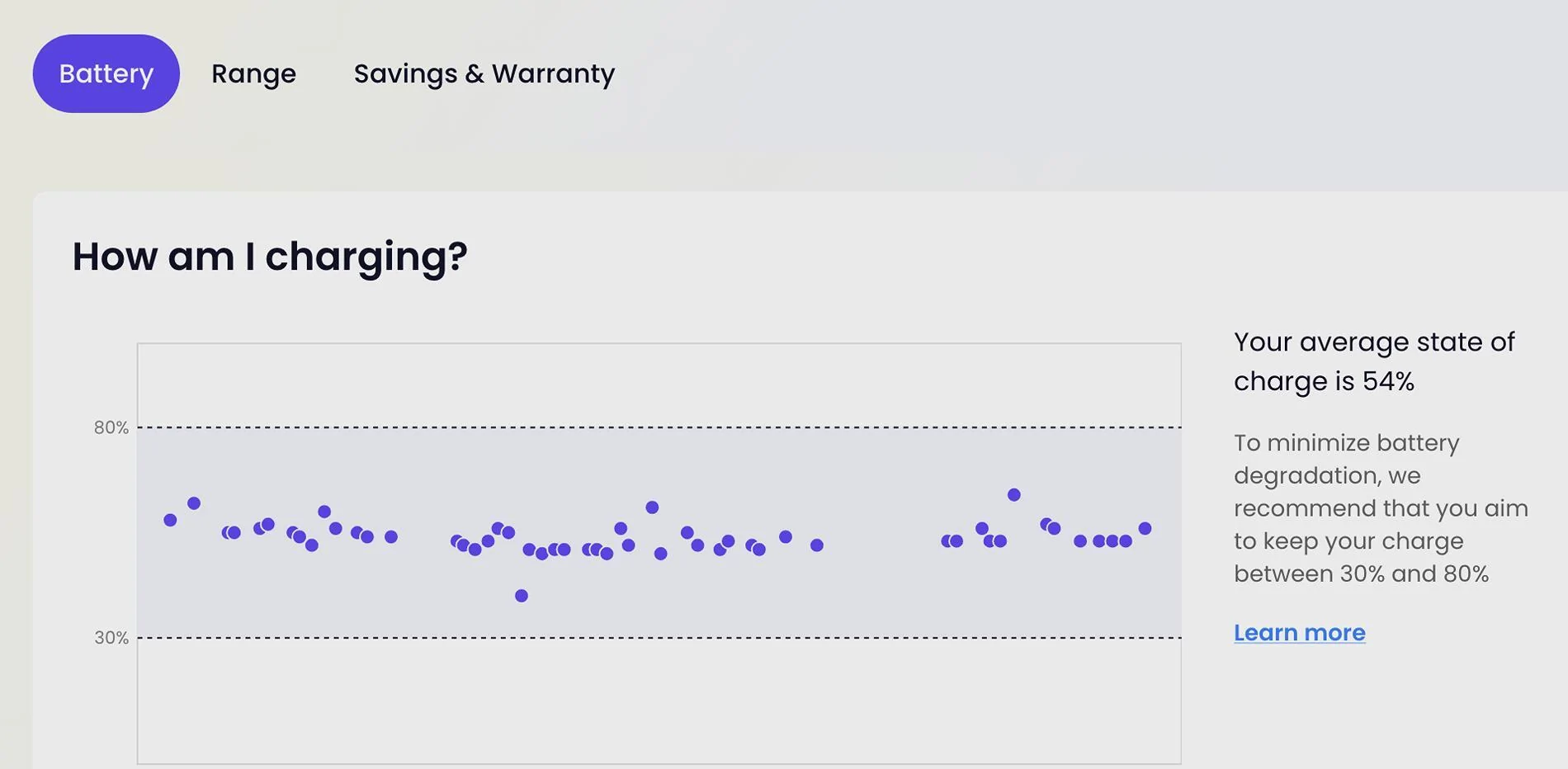
Pretty similar to mine. :like:

Rivian R1T R1S Rivian vs Tesla - battery degradation 1745875338926-71
 

ndmiller

Well-Known Member
First Name
Noah
Joined
Nov 19, 2023
Threads
15
Messages
1,391
Reaction score
1,750
Location
Atlanta
Vehicles
23 R1T Silver (The AG)
Occupation
Retailler
Clubs
 
It's about .5-1.5% per year for all EV's depending on how they are treated. Anything out of the normal, and that would increase. EV batteries have been around for over a decade, degradation is a know thing and it is meaningless. Recent studies and manufacturer testing shows EV batteries can last the equivalent of 300K miles or more.

I've driven EV's for almost 10 years and never once thought about or measured battery capacity. As long as it got me where I was going and I charged at home, nothing else mattered.

For example my daughter drove a 2017 Mercedes B250E (Tesla Powertrain) for 3 years It had a range of 82 miles when new and I charged it to 80 the day I dropped it off to Carvana. Meaningless difference..
 

DayTripping

Well-Known Member
First Name
Timothy
Joined
Sep 12, 2024
Threads
13
Messages
1,544
Reaction score
2,133
Location
DFW
Vehicles
Gen1 R1T QM, S Plaid, Highland 3 Perf, 3 Long Range, R2 on order
Occupation
Consultant
It's about .5-1.5% per year for all EV's depending on how they are treated. Anything out of the normal, and that would increase. EV batteries have been around for over a decade, degradation is a know thing and it is meaningless. Recent studies and manufacturer testing shows EV batteries can last the equivalent of 300K miles or more.

I've driven EV's for almost 10 years and never once thought about or measured battery capacity. As long as it got me where I was going and I charged at home, nothing else mattered.

For example my daughter drove a 2017 Mercedes B250E (Tesla Powertrain) for 3 years It had a range of 82 miles when new and I charged it to 80 the day I dropped it off to Carvana. Meaningless difference..
I care about degradation and have seen it really impact my range. I had a Ford Focus electric. It originally would go about 80 miles. Six years later, it would barely go 40. So degradation can be an issue.

High temps and high states of charge kill lithium batteries.

I'd suggest anyone who wants a quick primer to read through Battery University.

Here is a great link for an easy read about prolonging battery life.

https://batteryuniversity.com/article/bu-808-how-to-prolong-lithium-based-batteries
 

ndmiller

Well-Known Member
First Name
Noah
Joined
Nov 19, 2023
Threads
15
Messages
1,391
Reaction score
1,750
Location
Atlanta
Vehicles
23 R1T Silver (The AG)
Occupation
Retailler
Clubs
 
I care about degradation and have seen it really impact my range. I had a Ford Focus electric. It originally would go about 80 miles. Six years later, it would barely go 40. So degradation can be an issue.
That's a warranty issue, not the norm.

The Focus Electric battery is covered under Ford's electric vehicle warranty, which provides coverage for the high-voltage battery for 8 years or 100,000 miles, whichever comes first. This coverage includes protection against defects and excessive capacity loss.
 

Sponsored

DayTripping

Well-Known Member
First Name
Timothy
Joined
Sep 12, 2024
Threads
13
Messages
1,544
Reaction score
2,133
Location
DFW
Vehicles
Gen1 R1T QM, S Plaid, Highland 3 Perf, 3 Long Range, R2 on order
Occupation
Consultant
It was over 100k miles. Like most of them, they will allow up to 30% degradation and still be within spec.

A 30% hit is still huge. We were in the high 20's when in the 90k range, but not bad enough to get it replaced. At the end, 40 miles was on a good day. Run the heat and it turned into about 30 miles of range if lucky.
 
OP
OP
shap

shap

Well-Known Member
Joined
Nov 18, 2021
Threads
16
Messages
870
Reaction score
765
Location
Austin,TX
Vehicles
BMW 45e, R1T
Clubs
 
It's about .5-1.5% per year for all EV's depending on how they are treated. Anything out of the normal, and that would increase. EV batteries have been around for over a decade, degradation is a know thing and it is meaningless. Recent studies and manufacturer testing shows EV batteries can last the equivalent of 300K miles or more.

I've driven EV's for almost 10 years and never once thought about or measured battery capacity. As long as it got me where I was going and I charged at home, nothing else mattered.

For example my daughter drove a 2017 Mercedes B250E (Tesla Powertrain) for 3 years It had a range of 82 miles when new and I charged it to 80 the day I dropped it off to Carvana. Meaningless difference..
Not really. That's what I thought as well, but look at Tesla stats - average degradation is about 10% for the first two years. Many reporting 12-15%. This is not nothing. Yes, you can do 300k on a degraded battery, no question.
 

pamalabama

Banned
Well-Known Member
First Name
pablo
Joined
Jan 24, 2025
Threads
0
Messages
558
Reaction score
214
Location
birmingham, alabama
Vehicles
2021 mustang mach e select, model 3 performance
Not really. That's what I thought as well, but look at Tesla stats - average degradation is about 10% for the first two years. Many reporting 12-15%. This is not nothing. Yes, you can do 300k on a degraded battery, no question.
Average for a tesla is not 10. i think it's 5% the first year and 2.5 the second year if I remember correctly.

15% is possible in 2 years but that is a high temp place like arizona

With you living in austin, texas there is zero chance your degradation is low

I would almost guarantee it is at least 10% which means even if rivian is using a buffer, the numbers are lying to you

The only way for your degradation to be low is to cool the battery non-stop which is not happening. In tesla the battery cooling does not kick on until 120F
 
Last edited:
OP
OP
shap

shap

Well-Known Member
Joined
Nov 18, 2021
Threads
16
Messages
870
Reaction score
765
Location
Austin,TX
Vehicles
BMW 45e, R1T
Clubs
 
Average for a tesla is not 10. i think it's 5% the first year and 2.5 the second year if I remember correctly.

15% is possible in 2 years but that is a high temp place like arizona

With you living in austin, texas there is zero chance your degradation is low

I would almost guarantee it is at least 10% which means even if rivian is using a buffer, the numbers are lying to you

The only way for your degradation to be low is to cool the battery non-stop which is not happening. In tesla the battery cooling does not kick on until 120F
Well, if you look at my original post - that was exactly my question. Either numbers reported are incorrect or Rivian doing some magic with the buffers. My current battery capacity is shown as 130.4 kwh. Meaning basically no degradation. Lowest I got ever was 127kwh (aka 3% - but this was when I went to very low SoC). Anyway, it is not clear if this number is correct and if yes how they do that ...
 

pamalabama

Banned
Well-Known Member
First Name
pablo
Joined
Jan 24, 2025
Threads
0
Messages
558
Reaction score
214
Location
birmingham, alabama
Vehicles
2021 mustang mach e select, model 3 performance
Well, if you look at my original post - that was exactly my question. Either numbers reported are incorrect or Rivian doing some magic with the buffers. My current battery capacity is shown as 130.4 kwh. Meaning basically no degradation. Lowest I got ever was 127kwh (aka 3% - but this was when I went to very low SoC). Anyway, it is not clear if this number is correct and if yes how they do that ...
It's clear the number is incorrect. How much and/or why is the better question
Sponsored


Top