Sponsored

Towing Guidance please?

octo

Member
Joined
Nov 19, 2024
Threads
2
Messages
6
Reaction score
0
Location
U.S.
Vehicles
R1T 2025
Occupation
Farmer, Woodworker, Sea Kayaker, Writer.
Clubs
 
Hey Rivian Towing Aficionados! I'm a woodworker designing and building a 16' long Travel Trailer to tow behind my 2025 R1T (2nd gen with max battery pack).

I would appreciate any advice on: Trailer spec recommendations? Distance expectations? On-the-road driving tips for distance optimization? Recharging tips without unhinging?

Emerging Trailer Spec: double-axle, brakes on both axles, 6' wide, 16' long, #10k GVWR (tho expect build-out to be closer to #5k), using 5" tubed-framing, 48" tongue, 18" road clearance, corner leveling/stabilizer jacks, 6-lug nitrogen filled radial tires (225 D75 R15). Currently working with https://summittrailermfg.com/ for a quote.

Note:
1. I don't have trailer towing experience. I know my range will fall by half or so.
2. I will primarily tow to WA parks - Oregon and B.C too.
3. I can tweak my trailer spec w/ your good input before buying it.
4. Travel Trailer Design goals: writer's den, sleep haven, infrared sauna room.
5. Built all out of wood with aerodynamics, aesthetics, structural integrity and weight considerations - atop the steel trailer frame.


Thanks for any guidance? Really appreciate it!
-Octo
Sponsored
 

Fraslin

Active Member
Joined
Dec 7, 2023
Threads
2
Messages
42
Reaction score
62
Location
Pasadena
Vehicles
R1S
Most of the things you mentioned don't matter - will be mostly about your aerodynamics. Assume that you will lose 1/2 of your range but will probably be +/- 15 to 20% based on how boxy the trailer is
 

therealcmj

Well-Known Member
First Name
Chris
Joined
Oct 5, 2024
Threads
3
Messages
188
Reaction score
240
Location
Boston, MA
Vehicles
2025 R1S
I just sent this video to one of my friends who is thinking about buying an R1S. As the other commenter says, weight doesn’t matter as much as you would think. and in fact basically doesn’t matter. Aerodynamics is what impacts your range.


schlosrat

Well-Known Member
First Name
Steve
Joined
Jun 23, 2024
Threads
6
Messages
191
Reaction score
179
Location
Vancouver, WA
Vehicles
2024 R1T Dual Large
Occupation
Engineer
Great video! I definitely learned some things, plus he's a ton of fun to watch and listen to.

I've been planning to get a pop-up camper, and now I'm wondering what I can do to minimize the aerodynamic drag of such a thing. Since weight doesn't really matter, I'm wondering if it would be possible to de-boxify such a trailer by adding a bolt-on nose and tail to give it a more aerodynamic shape. Probably not really necessary, but if you could make it cheaply enough from something like fiberglass, and if you could cleverly use some of the enclosed space for storage, it might make sense as an adaptation for improved EV towing performance. Hmmm....
 

Sponsored

Donald Stanfield

Well-Known Member
First Name
Donald
Joined
Jul 31, 2022
Threads
59
Messages
8,308
Reaction score
16,656
Location
USA
Vehicles
2025 R1S Tri Ascend, 2024 i4 M50
Occupation
Stuff and things
Anyone new to towing should watch this video demonstrating the 60/40 rule.

60/40 Rule
I learned this lesson the hard way when I was much younger. I had a 6x12' trailer for construction work, and I was loading up bags of concrete. It made sense to me to pile all the concrete by the back door because being closer to the door = easier unloading. Above 55MPH on the freeway, and it started to sway on its own. Luckily my cousin who was an OTR semi driver talked me through what to do and we got off the freeway and adjusted the load.

This rule is no joke.
 

rhumbliner

Well-Known Member
First Name
thomas
Joined
Nov 8, 2020
Threads
12
Messages
335
Reaction score
527
Location
Bend
Vehicles
R1T & Model X
Occupation
Retired
… weight doesn’t matter as much as you would think. and in fact basically doesn’t matter. Aerodynamics is what impacts your range.
While this is true in most cases you have to use a little common sense when traveling in mountainous terrain. When climbing a steep grade weight makes a lot of difference. And don’t think you’ll regain all of that energy when going back downhill.

For example, I tow my 27’ Airstream with my 2023 DM R1T maxpack. When traveling from Bend OR (3600’) to Newport OR (basically sea level) I start with 100% SoC and can juuuuuuust make it to Newport without charging. On the return drive I’ll start with 100% SoC and have to charge back up to 90% at the halfway mark just to make it home. Same trailer. Same speed.
 

mudito

Well-Known Member
First Name
Aldo
Joined
Jul 30, 2024
Threads
18
Messages
1,011
Reaction score
1,414
Location
Texas
Vehicles
Rivian R1T
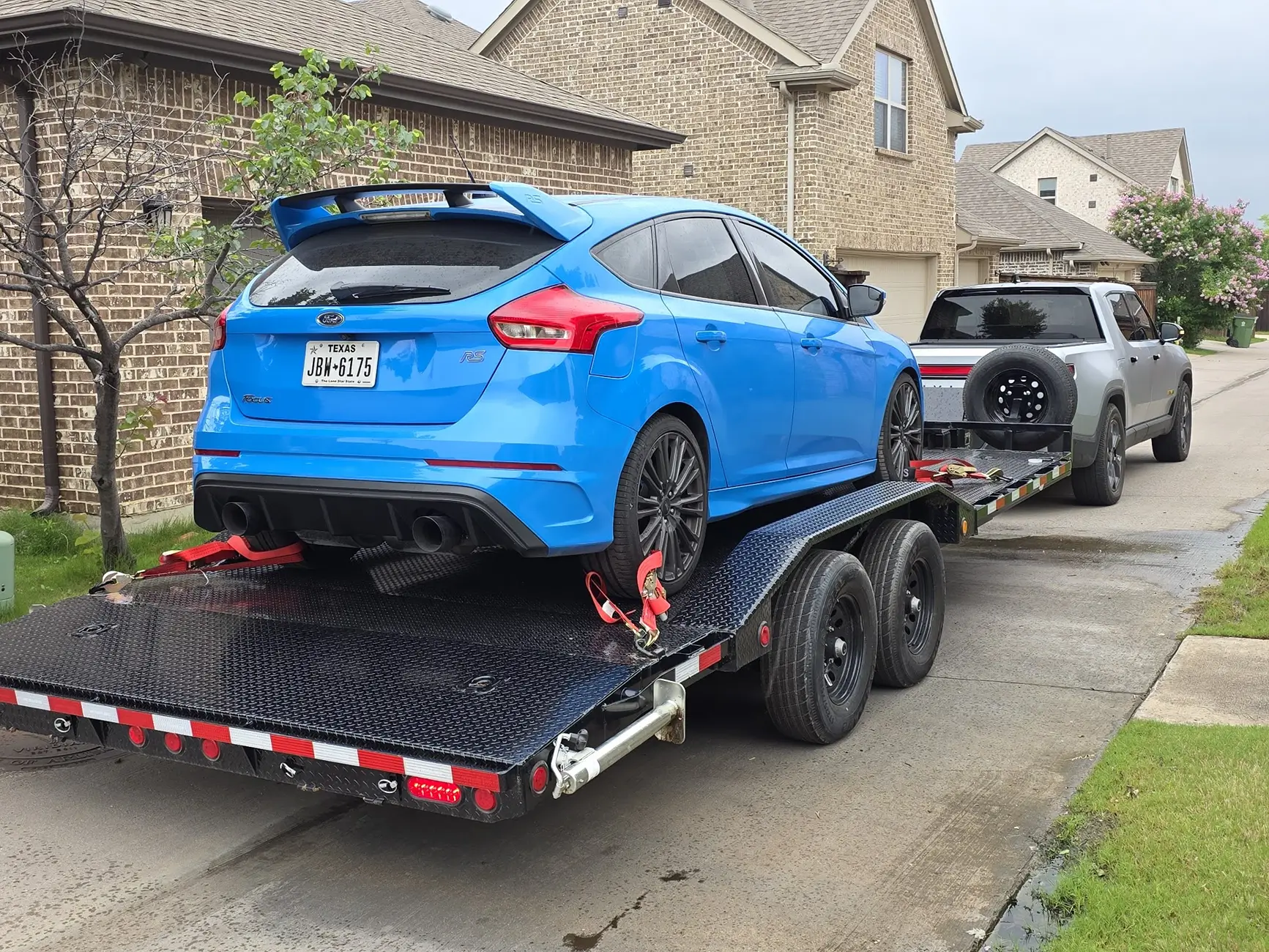
My first-ever time towing, was back in May with my R1T when I towed my other vehicle 1100mi north and came back home with an empty trailer:
Rivian R1T R1S Towing Guidance please? 1756049458919-48


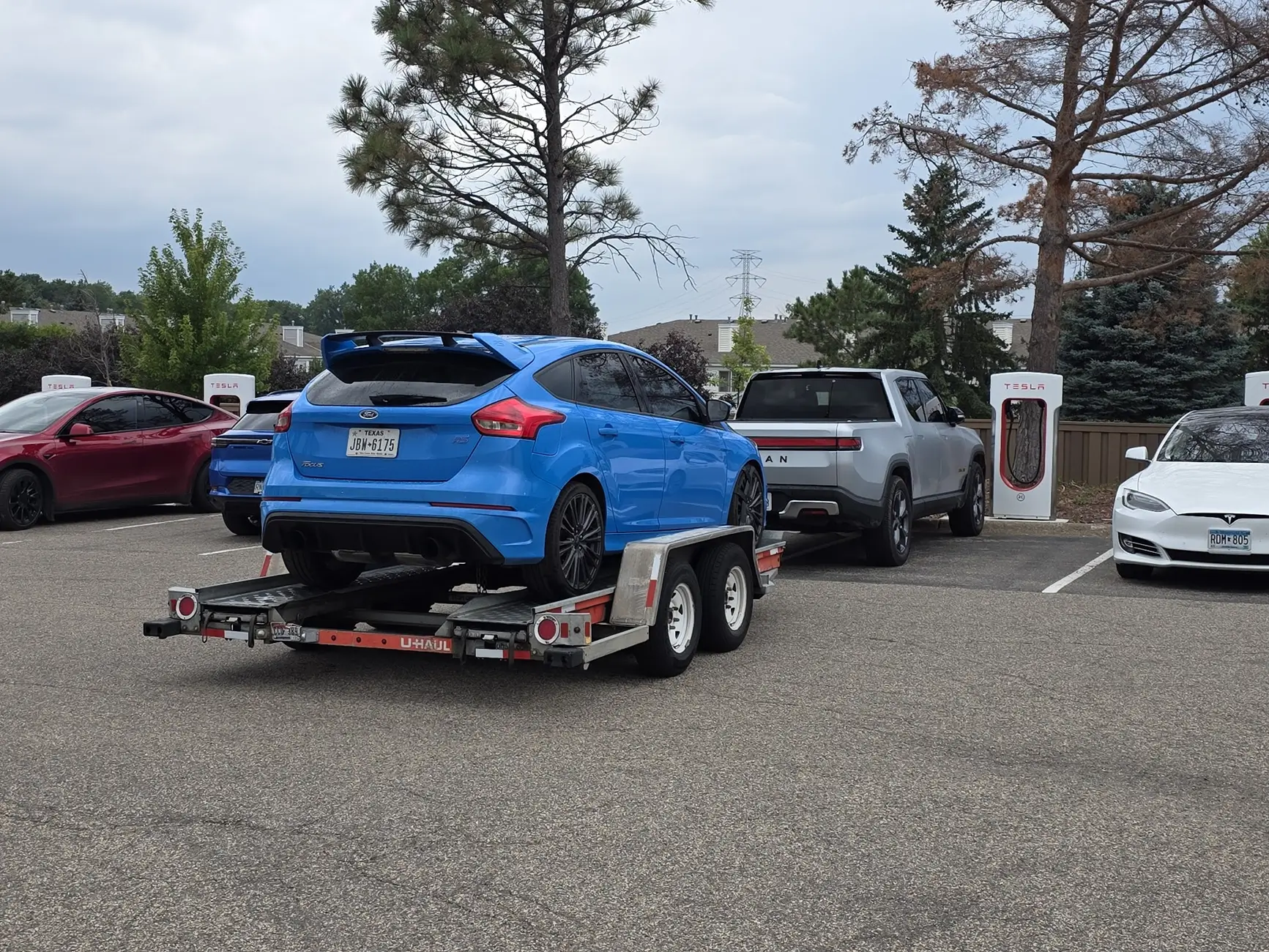
My 2nd and last time was a couple of weeks back when I travel w/no trailer up north and rented a U-Haul trailer and towed back home:
Rivian R1T R1S Towing Guidance please? 1756049534870-2


The few things I did learn about those trips are the following:
- Range cut by half is a pretty good overall assumption.
- Weigth matter less than Aero when towing. Towing an (heavy) empty trailer still showed a 1.3mi/kWh efficiency at 70mph
- Empty U-haul trailer (towed it empty for about 240 mi) was 1.6mi/kWh at 70mph (look at that spare wheel on the first trailer... it was like an Aero Parachute!).
- While towing, speeds are everything for range. I wanted to skip a certain charging spot that wasnt trailer friendly at all, so I did 53mph for about 178mi and made it (with 3% SoC remaining) perfectly at a 1.38mi/kWh efficiency (UHaul)
- Go long, don't go fast.. Our battery charging curve penalizes you heavily above 70%, I would avoid charging over that threshold and keep speeds down to travel further.
- Last but not least, towing with a Rivian (or any nice electric truck) is the best thing ever (minus range). Easy to drive, easy to get in and out of highways, it's just a bliss :)
 

Zoul

Active Member
Joined
Oct 16, 2024
Threads
1
Messages
35
Reaction score
61
Location
monticello, in
Vehicles
prospective r1t, ram 1500, dodge durango
Occupation
mechanic
As far as design goes, make sure your trailer company goes with electric or electric over hydraulic brakes and not surge brakes. Surge brakes will kill almost all benefit from regen on downhills. Also you mentioned the trailer being 10k lbs gvwr but might only weigh 5k lbs when finished. Make sure the braking system has enough variability for that. The trucks electric system can compensate for it, but being over braked is still possible and can have an affect on range.

Rolling resistance is also a factor to take in. You have some freedom here since you are starting from scratch. Trying to make the trailer wheels line up with the trucks will help, and you may have some options as far as different tire/wheel sizes to help as well. Also the type of hubs on the trailer can make a difference. Grease packed conical roller bearings are generally cheapest and most common, but have the most friction. Oil bath hubs and ball bearings(if available for your weight) are pricey, but roll easier.

Another factor regarding hubs is that you may see if the trailer manufacturer can match the bolt pattern to the rivian. This may allow you to run a spare tire/wheel size that matches on both, making a tire change less of a hassle. This is more common with smaller trailers, but it's worth checking.

All these are factors in addition to aerodynamics.

With You not having towed before, being prepared and proactive is the next biggest thing. Not just having an appropriate spare for truck and trailer, but also Jack and tools to change it. Storage for these things would be nice to design in. Tire chains/suitable tires if going into the mountains/snow. Properly set up weight distribution hitch. Good quality insurance that fully understands your custom build. Preventative maintenance down the road to minimize failures.
 

antimatter

Well-Known Member
First Name
Lloyd
Joined
Dec 27, 2024
Threads
4
Messages
112
Reaction score
156
Location
Minneapolis, MN
Vehicles
Honda Ridgeline, Honda CR-Z
Occupation
Chief Compliance Officer
Other folks have covered the important stuff, so I'll just mention a couple lessons I've learned over the years. First, if you need to cover distance - slow down. Going from 65 mph to 70 mph changed my consumption from 1.25 miles/kwh to 1 mile/kwh. Back roads and 60 mph are your friend, especially if you need to stretch your range.

The other is that towing a trailer is like dancing with a hippo; move slowly and be sure where you are at all time. Towing is really not the time to be checking your phone or navigating. If you need to take your eyes off the road, find a place to pull over. Finally, the first couple of times you head out, give yourself lots of daylight for set up when you stop for the night. Backing up with a trailer can be a challenge, especially at a campground with limited space. Plus, you've got to learn about leveling, hooking up, etc. Doing that at 9:30 PM when you're tired can be a challenge even for an experienced RVer, so plan to arrive with lots of time to get set.
 

Sponsored

CharonPDX

Well-Known Member
First Name
Charon
Joined
Jul 12, 2021
Threads
31
Messages
2,502
Reaction score
4,173
Location
Cascadia
Vehicles
'22 R1T LE, '16 Model S, '19 Arcimoto FUV
Occupation
InfoSec Geek
Clubs
 
You mention six feet wide - which is *SUPER* narrow for a travel trailer - but not height. If you're looking at something you can stand up in, with 18 inch ground clearance, I'm figuring at least 8.5 feet tall. That's still a reasonably small "frontal area". If you curve the front (instead of a flat sheet front) you can improve your efficiency a bit.

At only 16 feet long, that's a *SHORT* travel trailer. Being more than 50% height-to-length will cause some aerodynamic problems, unless you're doing a teardrop shape.

That said, for best aero, keep protrusions to a minimum. If you're doing to do AC, do an internal AC with a flush-side vent, not a rooftop AC.

Finally, that's a pretty small trailer, two axles are probably overkill, unless you are planning on loading it to 10,000 pounds (maybe you're making a toy hauler?)

In fact, at six feet wide and 16 feet long, I'd be surprised if you exceeded 4500 pounds loaded.

If you're willing to have "can't stand up straight", shorter will be a *SIGNIFICANT* benefit. If you keep the roof no higher than the Rivian's roof, you should barely see any range reduction at all. (Especially if single-axle.)

From your description of uses, you may want to consider doing something like the iCamp Elite - https://www.urvusa.com/elite_plan.html

Turn the bathroom into your IR sauna, keep the "curved front" where the sitting area is far enough back to have headroom when sitting, yet nice and aerodynamic. And again, maybe consider lowering the roof if you don't mind not being able to stand.
 

CharonPDX

Well-Known Member
First Name
Charon
Joined
Jul 12, 2021
Threads
31
Messages
2,502
Reaction score
4,173
Location
Cascadia
Vehicles
'22 R1T LE, '16 Model S, '19 Arcimoto FUV
Occupation
InfoSec Geek
Clubs


Top