Sponsored

Tow charging R1T/R1S

Max

Well-Known Member
Joined
Aug 31, 2021
Threads
35
Messages
1,534
Reaction score
2,351
Location
Maryland
Vehicles
Nissan Truck
I have had a few conversations in this regard in the wrong thread so I thought I should start it's own so any discussion stays relevant to the thread topic. Please share any information or experience that is in support of or in conflict with what you see here.

I just reached out to Rivian with the following questions:

-------------------
Subject: Tow Charging

If I am out in an adventure with my R1S off road (somewhere a tow truck would not go) with some of my ICE friends, if I run out of charge, for how many miles and at what speed is it safe for them to tow me?

What are the best practices as far as how to connect to the R1 if I do or don't have tow hooks?

What are the best settings to make sure nothing is damaged?

Are there any plans for tow charge mode to be added for emergencies?

-----------------------

This was the response:

"Thanks for reaching out, I am happy to help! While I hope you don't run into this problems, it is always good to be one step ahead!

Rivian vehicles can be tow charged but are otherwise not flat towable.

If you've run out of charge somewhere remote, it is possible to use a tow vehicle to pull the Rivian forward to add charge back to its battery. This is accomplished by tow charging. When tow charging, it uses the vehicle's regen braking feature to add charge to the battery. We wouldn't recommend this over long distances because it'd be like driving with brakes permanently applied to the tow vehicle and it could damage the inverters of the vehicle. Tow charging would need to be done by towing the Rivian behind a tow vehicle with both vehicles facing the same direction under 3 mph. The tow vehicle drives forward while the driver in the Rivian puts the Rivian into neutral or reverse to resist that forward motion (if in reverse, the Rivian driver does not accelerate so hard that it overpowers the forward motion that the tow vehicle is creating). The important thing to note here is that tow charging requires active drivers in both vehicles and is more about adding energy back into the Rivian than transporting the Rivian across long distances.

I hope this answers all of your questions. If you have any more questions, please do not hesitate to reach back out. We are grateful to have you on this adventure with us. "

-----------------
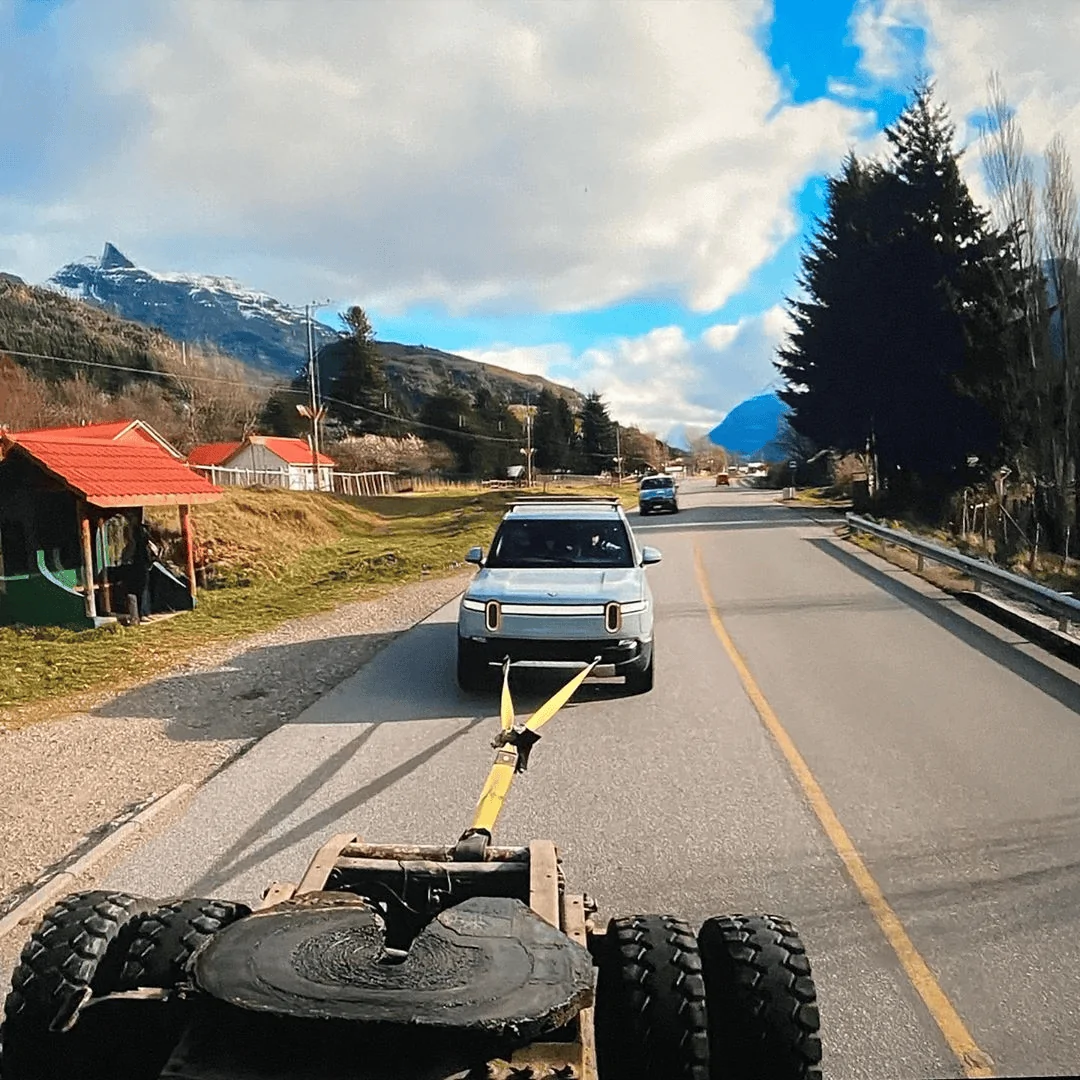
I think this may be from long way up (not sure):

Rivian R1T R1S Tow charging R1T/R1S 1645289447270
Sponsored


Ladiver

Well-Known Member
First Name
Jeff
Joined
Jan 23, 2021
Threads
52
Messages
969
Reaction score
1,824
Location
Ca
Vehicles
GMC 3500, Corvette Z06, Rivian R1T, Rivian R1S
Clubs
 
This will be interesting. The first item I’m a little surprised about is 3 mph. If the system is basically regen braking, then speed shouldn’t matter. The second issue is having the Rivian in neutral or reverse! I can’t imagine towing forward while the vehicle is in reverse is any good for the motors!
 
OP
OP
Max

Max

Well-Known Member
Joined
Aug 31, 2021
Threads
35
Messages
1,534
Reaction score
2,351
Location
Maryland
Vehicles
Nissan Truck
This will be interesting. The first item I’m a little surprised about is 3 mph. If the system is basically regen braking, then speed shouldn’t matter. The second issue is having the Rivian in neutral or reverse! I can’t imagine towing forward while the vehicle is in reverse is any good for the motors!
Yup, I am kinda cluless on the tech here and love to know what is happening when regen is engaged at 70 mph on the highway vs 20 mph behind the stop light. when it is on conserve mode with 2 motors disengaged, or when it is pulled at 3 mph neutral vs reverse. I have seen Tesla being towed on the highway. Wondering what is the tech difference there vs here. I know with all four motors engaged in R1, there is a lot of stress on the towing vehicle but I wonder if you can control the amount of regen, or does it have to be on max? I am a man of many questions and a few answers so anyone that knows what is going on under the hood with many of these systems please educate the unenlightened.

Edit: Does anyone know that if all motors can be disengaged? in other words, can you tow rivian at 60 mph without charging it / without having inverters involved over longer distance?
 
Last edited:

zefram47

Well-Known Member
First Name
Aaron
Joined
Feb 6, 2022
Threads
18
Messages
2,749
Reaction score
4,511
Location
Denver, CO
Vehicles
Rivian R1T, Alfa Romeo 4C
Occupation
Software Engineer
It's more than likely sustained regen that's the problem. I'm not sure what the max regen the truck does under braking, but one number I saw quoted was 150 kW, though I would've thought more than that. If it is more, sustained 150+ kW back into the battery could have thermal implications either in the motor, inverter, or battery. Remember, when using DCFC, the truck calls for however much power it wants at any given time depending on many variables. If you're tow charging, you need to make sure it won't exceed a safe amount of regen/charging into the battery. The 3 mph does seem very low though, as I'm pretty sure in Long Way Up they were tow charging closer to 20 mph or more, but it's been a long time since I saw it.
 

Zoidz

Well-Known Member
First Name
Gil
Joined
Feb 28, 2021
Threads
226
Messages
5,185
Reaction score
11,685
Location
PA
Vehicles
23 R1S Adv, Avalanche, BMWs-X3,330cic,K1200RS bike
Occupation
Engineer
Yup, I am kinda cluless on the tech here and love to know what is happening when regen is engaged at 70 mph on the highway vs 20 mph behind the stop light. when it is on conserve mode with 2 motors disengaged, or when it is pulled at 3 mph neutral vs reverse. I have seen Tesla being towed on the highway. Wondering what is the tech difference there vs here. I know with all four motors engaged in R1, there is a lot of stress on the towing vehicle but I wonder if you can control the amount of regen, or does it have to be on max? I am a man of many questions and a few answers so anyone that knows what is going on under the hood with many of these systems please educate the unenlightened.

Edit: Does anyone know that if all motors can be disengaged? in other words, can you tow rivian at 60 mph without charging it / without having inverters involved over longer distance?
From what I have read, only the rear motors have a mechanism to disconnect the motors from the half shafts, which is what happens in conserve mode. The front appears to be always engaged and does not have the disconnect mechanism.

Limited speed is probably recommended due to thermal concerns - overheating the batteries and/or inverter transistors.
 
  • Like
Reactions: Max

Sponsored

OP
OP
Max

Max

Well-Known Member
Joined
Aug 31, 2021
Threads
35
Messages
1,534
Reaction score
2,351
Location
Maryland
Vehicles
Nissan Truck
From what I have read, only the rear motors have a mechanism to disconnect the motors from the half shafts, which is what happens in conserve mode. The front appears to be always engaged and does not have the disconnect mechanism.

Limited speed is probably recommended due to thermal concerns - overheating the batteries and/or inverter transistors.
So what do you think neutral means? What is the difference between being in neutral and being in conserve mode?

Edit: I know Tesla’s even in relatively minor accidents have to be sitting ducks in the middle of a highway unable to drive the vehicle off the road because pyro fuse disconnects the main pack. After that they can’t even use neutral to push it off road and even getting it on a flat bed becomes an issue. I hope Rivian is smarter about use of neutral.
 
Last edited:
OP
OP
Max

Max

Well-Known Member
Joined
Aug 31, 2021
Threads
35
Messages
1,534
Reaction score
2,351
Location
Maryland
Vehicles
Nissan Truck
This dude was making 1KW /km in this Tesla at 30 km/hr. I am not sure if it was dual or single motor:


model S charging at 6.5 KW Around 50 mph:

 
Last edited:

E.S.

Well-Known Member
Joined
Jul 8, 2021
Threads
4
Messages
825
Reaction score
1,057
Location
Florida
Vehicles
Chevy Bolt
Occupation
Retired
The first item I’m a little surprised about is 3 mph. If the system is basically regen braking, then speed shouldn’t matter.
Supposedly going a greater speeds can potentially damage the inverters. I still wouldn't recommend it while the vehicle is under warranty.

However! -

- Rivian suggestion: "Do not tow charge for long distances and at speeds greater than 3 mph."
- 'Murica:
Rivian R1T R1S Tow charging R1T/R1S 1645385159449
 
  • Like
Reactions: Max

Tomgriff

Well-Known Member
First Name
Tom
Joined
Jan 18, 2022
Threads
0
Messages
82
Reaction score
116
Location
Camas, WA
Vehicles
2015 MS 70D, 2017 Chevy Bolt Premier, T700
Here is another tow charging video of a M3, they were definitely towing much faster than 3mph
 
  • Like
Reactions: Max
OP
OP
Max

Max

Well-Known Member
Joined
Aug 31, 2021
Threads
35
Messages
1,534
Reaction score
2,351
Location
Maryland
Vehicles
Nissan Truck
Here is another tow charging video of a M3, they were definitely towing much faster than 3mph
The same guy in THIS video (min 18) was saying with permanent magnets low speed gives you more Regen which may be why CS told me tow at 3 mph.
 

Sponsored

the long way downunder

Well-Known Member
First Name
Adam
Joined
Jan 15, 2021
Threads
3
Messages
944
Reaction score
998
Location
charging
Vehicles
Tesla
Occupation
WFH
That's some whacky, unexpected stuff from Rivian. The owner's manual says not to tow charge or "both vehicles" will be damaged. I think the 3mph is a precaution when the disabled vehicle is not sufficiently charged to be "on" and cooling its motors and battery. Once the towed vehicle is "on" then any speed is no different than rolling downhill under gravity or momentum; just be in Drive and apply the brakes moderately.
Rivian R1T R1S Tow charging R1T/R1S 1645409847493

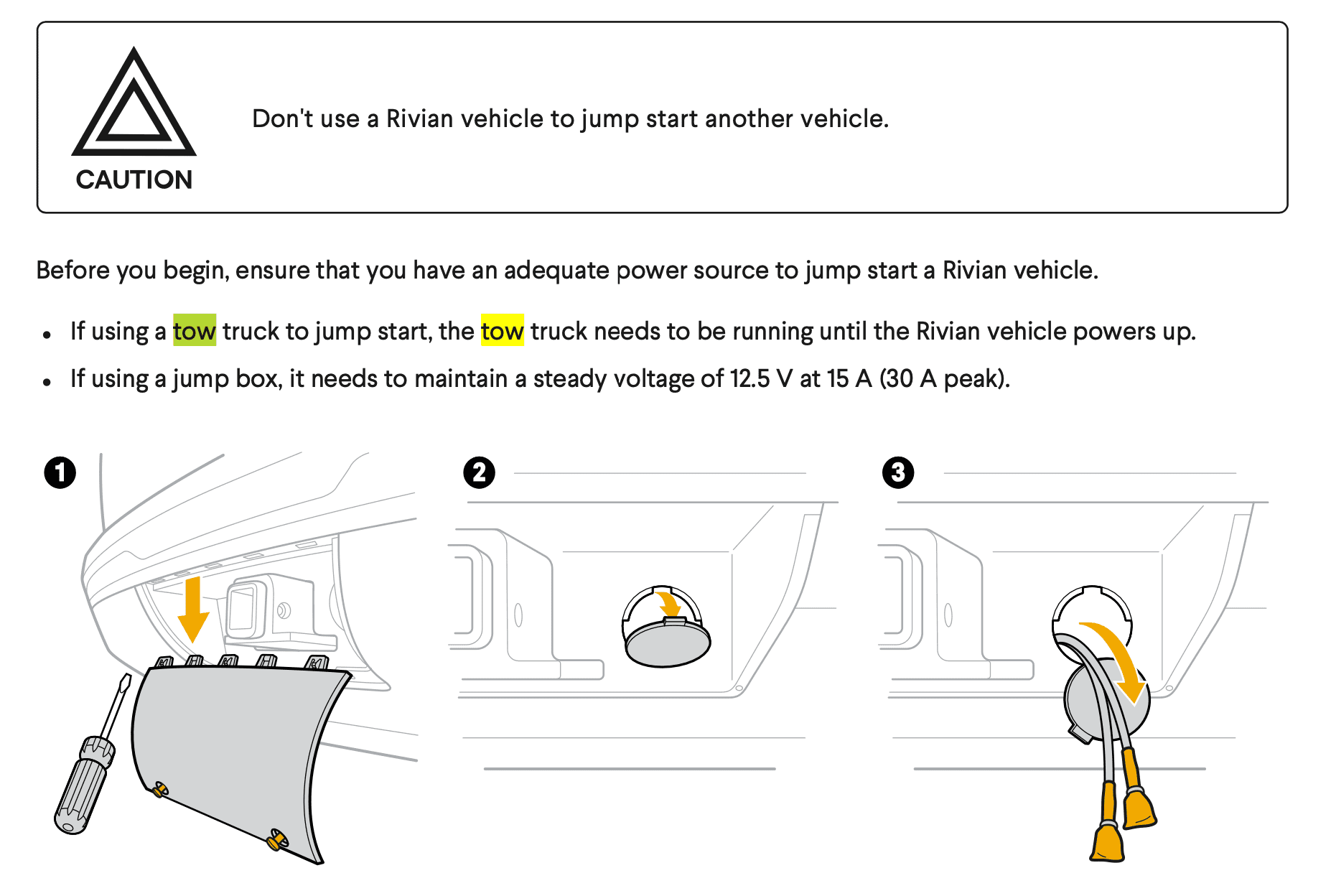
Here's how to "jump" an R1
Rivian R1T R1S Tow charging R1T/R1S 1645409878615


I wonder about the 30A "peak" … seems to me if you "jump" from a "tow truck" (why specify a tow truck) then the power source will be a starter battery (capable of 1000A.) A "jump box" is basically a battery in a convenient carry case and not voltage regulated or current limited.

All that in question, if/when my R1 is dead, I'll charge it V2V or from a gas generator or maybe from a small battery "solar" generator, but I'll be asking Mr Rivian to explain tow-charging more completely than this from their tech support.

The statement "We wouldn't recommend this over long distances because it'd be like driving with brakes permanently applied to the tow vehicle and it could damage the inverters of the vehicle." needs clarification – the onboard charger is capable of whatever max rate it can charge and is designed to fully charge the vehicle overnight from 0% to 100% for the life of the vehicle … if any component in the system reaches an operating limit (presumably thermal) then it would hold or reduce regen load at that limit and the vehicle would either accelerate (this is what a Tesla does) or increase friction braking.
 
  • Like
Reactions: Max

godfodder0901

Well-Known Member
First Name
Jared
Joined
Mar 12, 2019
Threads
27
Messages
5,748
Reaction score
10,137
Location
Washington
Vehicles
2022 Rivian R1T LE
Here's how to "jump" an R1
1645409878615.png


I wonder about the 30A "peak" … seems to me if you "jump" from a "tow truck" (why specify a tow truck) then the power source will be a starter battery (capable of 1000A.) A "jump box" is basically a battery in a convenient carry case and not voltage regulated or current limited.
That jumping procedure is for the dual 12v batteries only.
 

Dark-Fx

Well-Known Member
First Name
Brian
Joined
Jul 15, 2020
Threads
147
Messages
13,517
Reaction score
27,275
Location
Michigan
Vehicles
R1T, R1S, Livewire One, Sierra EV, R1S
Occupation
Engineering
Clubs
 
It's probably just covering their asses. It's probably fine to tow-charge at faster speeds but the inverters will probably overheat pretty quickly if you let off the accelerator fully to max regen out. The stress on the vehicle doing the towing could probably be even higher than pulling a loaded trailer up a long mountain pass. I don't know any of the specifics on how much the truck is able to regen but it probably requires 1.5x the output on the towing vehicle to regenerate 1x the power into the towed vehicle.
 
  • Like
Reactions: Max

Zoidz

Well-Known Member
First Name
Gil
Joined
Feb 28, 2021
Threads
226
Messages
5,185
Reaction score
11,685
Location
PA
Vehicles
23 R1S Adv, Avalanche, BMWs-X3,330cic,K1200RS bike
Occupation
Engineer
That's some whacky, unexpected stuff from Rivian. The owner's manual says not to tow charge or "both vehicles" will be damaged.
1645409847493.png
Definitely whacky. How does the RIvian tow vehicle "know" it's towing another EV, as opposed to a heavily loaded trailer within tow specs?

I think the 3mph is a precaution when the disabled vehicle is not sufficiently charged to be "on" and cooling its motors and battery. Once the towed vehicle is "on" then any speed is no different than rolling downhill under gravity or momentum; just be in Drive and apply the brakes moderately.
Conjecture - If "fully" dead, damage *might* occur before the vehicle can power up. And if charge towing, does the vehicle "power" up automatically when charge level permits, or do you have to stop, and put it in a specific mode?

1645409878615.png


I wonder about the 30A "peak" … seems to me if you "jump" from a "tow truck" (why specify a tow truck) then the power source will be a starter battery (capable of 1000A.) A "jump box" is basically a battery in a convenient carry case and not voltage regulated or current limited.
I read that as needing to supply 15A continuous, capable of supplying 30A peak load. A cheap jump box might not be capable of supplying 30A peak?

The statement "We wouldn't recommend this over long distances because it'd be like driving with brakes permanently applied to the tow vehicle and it could damage the inverters of the vehicle." needs clarification – the onboard charger is capable of whatever max rate it can charge and is designed to fully charge the vehicle overnight from 0% to 100% for the life of the vehicle … if any component in the system reaches an operating limit (presumably thermal) then it would hold or reduce regen load at that limit and the vehicle would either accelerate (this is what a Tesla does) or increase friction braking.
Isn't this a completely ambiguous statement? "...brakes permanently applied to the tow vehicle and it could damage the inverters of the vehicle." The tow vehicle would be the tow truck, etc, whatever is pulling the Rivian, and therefore may not even have an inverter. The only thing that makes any possible sense would be "...brakes permanently applied to the towed vehicle and it could damage the inverters of the (towed) vehicle." Maybe that's what they mean, but that's not what it says.

Rivian really needs to provide a detail, clear explanation regarding charge towing, jump starting, etc. Really, what does it mean to "Jump Start" a Rivian? Which battery is dead - 12V or Primary? If the 12v is dead, can you "jump start" the 12V and disconnect the jump starter to the 12V? Perhaps, --- if the Primary has a charge and recharges the 12V.... does it? What if both are dead? In that case the Primary could not recharge the 12V, so IMO the 12V jump start needs to be permanently connected until tow charging brings everything "back to life"?

Regarding inverter damage, the regen charging mode returns power to the onboard charging system through the same IGBTs (Insulated Gate Bipolar Transistors) that send power to the motors in propulsion mode. IGBTs can be damaged if the operating voltages, currents and temperatures are exceeded - which could happen if either 12V or Primary battery is dead and the control systems are not powered up. Even with the control systems powered up, depending on circuit design, there are still maximum operating parameters. It's entirely possible that charge towing over (for example) 10 mph for 30 minutes was not part of the design spec at Rivian.

Yes, there are too many unanswered questions on this topic....
 

the long way downunder

Well-Known Member
First Name
Adam
Joined
Jan 15, 2021
Threads
3
Messages
944
Reaction score
998
Location
charging
Vehicles
Tesla
Occupation
WFH
Definitely whacky. How does the RIvian tow vehicle "know" it's towing another EV, as opposed to a heavily loaded trailer within tow specs?


Conjecture - If "fully" dead, damage *might* occur before the vehicle can power up. And if charge towing, does the vehicle "power" up automatically when charge level permits, or do you have to stop, and put it in a specific mode?


I read that as needing to supply 15A continuous, capable of supplying 30A peak load. A cheap jump box might not be capable of supplying 30A peak?


Isn't this a completely ambiguous statement? "...brakes permanently applied to the tow vehicle and it could damage the inverters of the vehicle." The tow vehicle would be the tow truck, etc, whatever is pulling the Rivian, and therefore may not even have an inverter. The only thing that makes any possible sense would be "...brakes permanently applied to the towed vehicle and it could damage the inverters of the (towed) vehicle." Maybe that's what they mean, but that's not what it says.

Rivian really needs to provide a detail, clear explanation regarding charge towing, jump starting, etc. Really, what does it mean to "Jump Start" a Rivian? Which battery is dead - 12V or Primary? If the 12v is dead, can you "jump start" the 12V and disconnect the jump starter to the 12V? Perhaps, --- if the Primary has a charge and recharges the 12V.... does it? What if both are dead? In that case the Primary could not recharge the 12V, so IMO the 12V jump start needs to be permanently connected until tow charging brings everything "back to life"?

Regarding inverter damage, the regen charging mode returns power to the onboard charging system through the same IGBTs (Insulated Gate Bipolar Transistors) that send power to the motors in propulsion mode. IGBTs can be damaged if the operating voltages, currents and temperatures are exceeded - which could happen if either 12V or Primary battery is dead and the control systems are not powered up. Even with the control systems powered up, depending on circuit design, there are still maximum operating parameters. It's entirely possible that charge towing over (for example) 10 mph for 30 minutes was not part of the design spec at Rivian.

Yes, there are too many unanswered questions on this topic....
Spot on. Rivian just needs to take the two topics of "jump start" and "tow charge" and go through step-by-step plain instructions with details like mph or any precautions.
Sponsored

 
  • Like
Reactions: Max


Top