Sponsored

A Waymo Plowed Through a Construction Zone, Floored It, and Got Chased by the Cops With a Terrified Passenger Along for the Ride

TexasBob

Well-Known Member
First Name
Bob
Joined
Jan 15, 2022
Threads
49
Messages
1,250
Reaction score
2,824
Location
Houston
Vehicles
2024 R1T DM LRG, 2025 R1S Dune
Normally I do not care but so much of what you have written here is incorrect that I feel like I am obligated to try to correct the facts (I will leave the opinions alone, they are yours to enjoy)

These are not directly comparable and your logic is really terrible.

A L3 vehicle is almost certainly an extremely unsafe vehicle. You should never get into a vehicle with level 3 technology.

l3 vehicles are extremely restricted (lead car, weather, time of day, perfect lanes, mapping, etc.) and do not contain the necessary safety features of an autonomous vehicle (avoiding advanced accidents, minimum risk manuevers, performing the entire DDT)
Absolutely none of that is true. Go back and re-read the SAE definition then go read the UN Regulation 157 and the Chinese GB 44721 to get a lay of the regulatory landscape. Sticking to the SAE definition, there is only one difference between L3 and L4 and that is who is responsible for "fallback" if the system encounters a situation it is unable to handle. In an L4, the system is required to be failsafe and be its own fallback. In an L3, the human driver is the fallback or failsafe and must be able to take over in 10 - 15 seconds (depending jurisdiction).

Literally not a single one of the limitations you described above are L3 characteristics. The ODD (the geographies and circumstances in which the system is qualified to drive) is completely open for the manufacturer to specify in L3 or L4. There is absolutely no difference whatsoever in the SAE definition of the ODD for L3 or L4. The system you are sort-of describing is an example of one early system as it was implemented in one geography (the old Merc system) but it is not representative of an L3.

Level 3: "The sustained and ODD-specific performance by an ADS of the entire Dynamic Driving Task under routine/normal operation with the expectation that the DDT fallback-ready user is receptive to ADS-issued requests to intervene, as well as to DDT performance-relevant system failures in other vehicle systems, and will respond appropriately."

Level 4: "The sustained and ODD-specific performance by an ADS of the entire DDT and DDT fallback."

The issue with that is they put all risk on the lead car where all of the sudden a lead car can dodge a stationary vehicle and you are dead. you can have other issues like mechanical failures (where l3 is not responsible) and if you are reading a book or watching a movie this is extremely dangerous. No company should pursue any autonomy other than level 4. Level 4 can be restricted to only highways although that is likely not happening.
What you are describing is a Level 2 system (often called a L2++ system) which requires eyes on. The L3 system is, by definition, an eyes off system and the driver is not responsible for the vehicle's performance while the system is on. If the system needs the driver to take over, it must give him/her sufficient warning to allow them to look back at the road, re-orient, and take over (10-15 second depending on jurisdiction).

your logic also assumes that all L4 vehicles will have good accident avoidance. There was an AVride crash filmed by a world cup fan where it crashed into a vehicle that ran a stop sign. Tesla FSD would have prevented this 3 or 4 years ago
I am reading the data that tells me running on an autonomous system is much safer than operating the vehicle myself. I do assume that the L3 / L4 systems available for consumers will also have this improved safety. The odd incident here and there - though sometimes tragic - does not change that. Humans are involved in an accident every 250k mile +/-. Worth noting that according to the Dallas Morning News the Avride incidents you are describing is a vehicle with a human safety driver at the wheel.

Waymo statistics are not comparable because they avoid difficult intersections (seemingly even more than robotaxi) and drive at relatively low speeds. In that scenario where waymo was washed away for 2 days the person inside could have easily died if it were not for the fact that the car were empty. Waymo does not have enough miles to statistically say they are very safe yet.

This doesn't also account for some accidents they may or may not cause from doing things like driving the wrong way down roads. Waymo uses HD maps and they seemed to have loosened the usage of said maps. The cars are driving much worse because of it.
I won't debate the methodology on Waymo's driving statistics; you can read the report and the methodology and decide for yourself. I will opine that my reading indicates they have done a very good job of trying to make the data comparable. Even if they are overstating the case massively—I do not think they are—the autonomous vehicles are vastly safer than humans.

I will note a factual error: Waymo is becoming statistically safer, not less safe (c.f. its million-mile actuarial data). Also, your description on HD maps seems to reflect a dated understanding of how these vehicles navigate. While Waymo's production fleet still leverages HD maps as a baseline, the core architecture long ago left behind brittle, rules-based software. The industry is pretty much universally moving toward end-to-end neural networks and world models. Waymo's primary AI research—including its EMMA framework—utilizes Vision-Language-Action (VLA) models, while its actual production fleet relies on distilled generative machine-learning planners. Tesla is deploying parallel end-to-end neural networks (pure vision-to-control) with its current FSD v14 deployment and upcoming 10x-parameter v15 architecture. The industry is converging on these unified perception-to-action networks, meaning the vehicle actively calculates spatial physics in real time rather than primarily relying on a pre-mapped path against an HD map reference.
Sponsored

 

shandering

Well-Known Member
First Name
Shane
Joined
May 26, 2026
Threads
0
Messages
92
Reaction score
38
Location
Atlanta
Vehicles
Polestar 2
Occupation
Artist
Absolutely none of that is true. Go back and re-read the SAE definition then go read the UN Regulation 157 and the Chinese GB 44721 to get a lay of the regulatory landscape. Sticking to the SAE definition, there is only one difference between L3 and L4 and that is who is responsible for "fallback" if the system encounters a situation it is unable to handle. In an L4, the system is required to be failsafe and be its own fallback. In an L3, the human driver is the fallback or failsafe and must be able to take over in 10 - 15 seconds (depending jurisdiction).
This is 100% false. In L3 the car does not perform the entire DDT. You don't have 10-15 seconds to take over. You have to immediately take over for failures outside of the DDT. If your tire falls off, you have a mechanical failure such as suspension giving out, that is 100% on you. If your car hits a pothole and your tire blows out, you are responsible for everything that happens after your tire goes flat.


L3 puts all the risk on the user or the lead car. The 10-15 seconds is mentioned nowhere in the SAE document and they do not specify a time for handoff.

Anything outside of the DDT requires an immediate response. The car does not even have to notify you. You have to identify these things. Phil koopman who is a professor at carnegie mellon believes that you cannot even operate a level 3 car how the SAE document is written without looking straight out the windshield. You dont have to supervise lane centering or cruise but you have to look out the window.

What you are describing is a Level 2 system (often called a L2++ system) which requires eyes on. The L3 system is, by definition, an eyes off system and the driver is not responsible for the vehicle's performance while the system is on. If the system needs the driver to take over, it must give him/her sufficient warning to allow them to look back at the road, re-orient, and take over (10-15 second depending on jurisdiction).
That is incorrect. The driver is not responsible for lane centering and cruise control. Any failures outside of the car's DDT are your responsibility. You need to be receptive to mechanical failures. Hence they limit the ODD where the only crashes are either mechanical failures or the 1 in a billion scenario where the lead car dodges some stationary car at the very last minute. That's last one is on the car manufacturer but you would be dead.

Levels of autonomy are not performance metrics. You can have a level 3 system that is bad. You can have a level 3 system with split second reaction time. There would be no level 3 system with this level of intelligence that is not a level 4 system.

Level 3 is a bogus level that companies should never be allowed to use to get out of operating under level 4.


I am reading the data that tells me running on an autonomous system is much safer than operating the vehicle myself. I do assume that the L3 / L4 systems available for consumers will also have this improved safety. The odd incident here and there - though sometimes tragic - does not change that. Humans are involved in an accident every 250k mile +/-. Worth noting that according to the Dallas Morning News the Avride incidents you are describing is a vehicle with a human safety driver at the wheel.
Clearly data is not your forte. Human accidents are much often than 250K miles. Waymo accident rate is also very high. Currently it's roughly ever 50K miles and aligns with tesla robotaxi as well.

And waymo is significantly safer than all the other robotaxis (and accidents per mile are going up as the ODD increases). Presumably waymo was very restrictive in geofences at the beginning of operation.

The accident statistics of other L4 vehicles (even with safety monitors) is not good. If 50% of accidents are not at fault, your car needs to be very good at avoiding accidents. These other robotaxis are not.

I will note a factual error: Waymo is becoming statistically safer, not less safe (c.f. its million-mile actuarial data). Also, your description on HD maps seems to reflect a dated understanding of how these vehicles navigate. While Waymo's production fleet still leverages HD maps as a baseline, the core architecture long ago left behind brittle, rules-based software. reference.
Again if you didn't rely on AI you wouldn't get such bullshit answers.

Waymo accident rate is going up. Not down. It used to be very, very low in the days of Arizona and as they drive in more geofences, rack up more miles, the miles per accident is getting much worse.

For example, waymo has was stuck between train crossing gates. A near deadly failure where for about 5 years they would not cross a train track. Waymo has serious failures on freeways (running from police) likely because they have designed the system to not stop on the freeways. We still have dangerous freezing events on freeways which can easily get you rear ended. Waymo has deadly issues with flooding water, despite operating in these flooding areas for years. I suspect waymo was much more careful with geofencing and restricting all the areas they operate.

Waymo demonstrates EMMA models and VLA models but there is zero evidence that any of those can be used for high quality, unsupervised driving. VLA models may not have low enough latency to use for safety critical self driving tasks. The cars in china with 10x the compute of what tesla has have extremely slow reaction time.

What you're missing is every robotaxi on the market uses 360 spinning lidar and they synchronize the position of the lidar output to the HD maps stored in the car. You then have a centimeter accurate position of where you are within a map within an environment with no need to have camera visibility of lane markings, traffic signs, etc. If you have some way to sync to traffic lights, you don't need to see those either.

What most people are pursuing these days (outside of waymo/zoox) is HD mapless self driving where you no longer need 360 spinning lidar. There is no one remotely close to tesla doing this, camera only or not.
 
Last edited:

CharonPDX

Well-Known Member
First Name
Charon
Joined
Jul 12, 2021
Threads
31
Messages
2,558
Reaction score
4,285
Location
Cascadia
Vehicles
'22 R1T LE, '16 Model S, '19 Arcimoto FUV
Occupation
InfoSec Geek
Clubs
 
Sure, but imagine the abuse of it. They'd have to devise it in such a way that it couldn't be abused to hurt Waymo's business. And that would probably mean a process where it couldn't be used as quickly as actual emergencies require.
It can only be pushed from inside the vehicle while on a ride. The rider would be responsible for improper usage.
 

TexasBob

Well-Known Member
First Name
Bob
Joined
Jan 15, 2022
Threads
49
Messages
1,250
Reaction score
2,824
Location
Houston
Vehicles
2024 R1T DM LRG, 2025 R1S Dune
This is 100% false. In L3 the car does not perform the entire DDT. You don't have 10-15 seconds to take over. You have to immediately take over for failures outside of the DDT. If your tire falls off, you have a mechanical failure such as suspension giving out, that is 100% on you. If your car hits a pothole and your tire blows out, you are responsible for everything that happens after your tire goes flat.
Your ignorance in invincible. Peace to you.


Rivian R1T R1S A Waymo Plowed Through a Construction Zone, Floored It, and Got Chased by the Cops With a Terrified Passenger Along for the Ride Screenshot 2026-06-28 at 11.27.28
 

shandering

Well-Known Member
First Name
Shane
Joined
May 26, 2026
Threads
0
Messages
92
Reaction score
38
Location
Atlanta
Vehicles
Polestar 2
Occupation
Artist
Your ignorance in invincible. Peace to you.


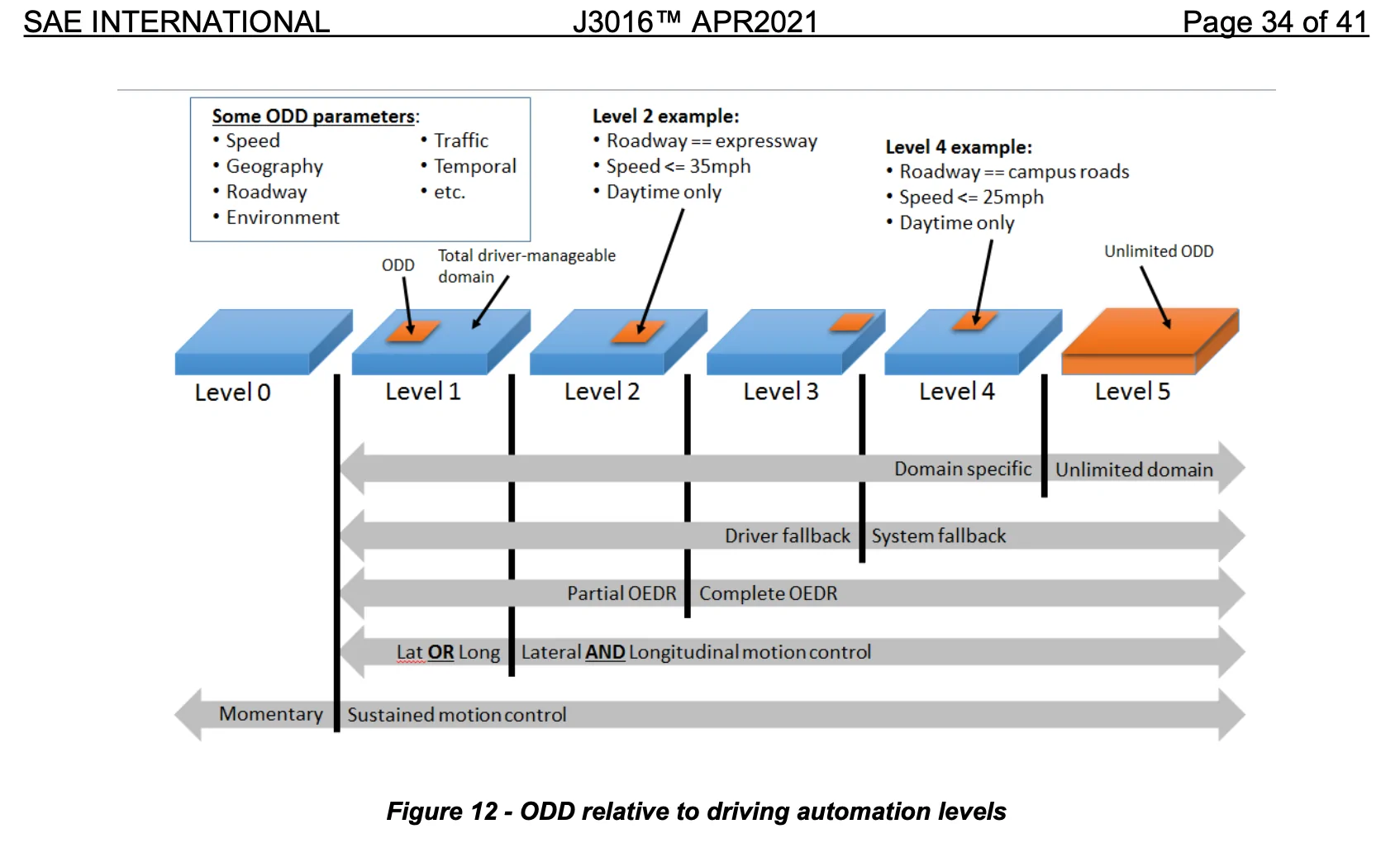
Screenshot 2026-06-28 at 11.27.28.webp
read SAE J3016

your chart does not mention DDT but only OEDR. As mentioned level 3 systems perform the entire OEDR within the ODD but not hte entire DDT. The DDT is the full set of tasks needed to drive a car. The difference between level 3 and level 4 is the car needs to perform the entire set of tasks related to accident recognition, handling mechanical issues, etc.

If you have a technology t hat can perform the entire DDT then you have a level 4 technology. If you are pursing autonomy there is no reason to not have level 4 unless you want to hide behind level 3.

Rivian R1T R1S A Waymo Plowed Through a Construction Zone, Floored It, and Got Chased by the Cops With a Terrified Passenger Along for the Ride 1782692226817-0m


Myth #7: SAE J3016 Level 3 means the driver can perform non-driving activities ("eyes off the road")
This topic is subtle, but makes a huge difference to human driver responsibilities for Level 3 operation.

To begin with, J3016 does not say that Level 3 means "eyes off road" anywhere. That is a concept that is entirely outside the scope of the standard. (A text search reveals the words "eye" or "eyes" only appears in 3.18.2 NOTE in the context of stating that a driver of a conventional vehicle sometimes takes eyes off road momentarily to tune the radio, etc. Nothing to do with Level 3 at all.)

J3016 considers the driver to be "receptive to vehicle conditions that adversely affect the performance of the DDT." (J3016 3.18.3 Note) and refers to the definition of Receptivity at 3.22. The gist of receptivity is that the driver is supposed to notice that an "evident" or "kinesthetically apparent" vehicle failure happens even if not specifically paying attention, as well as receptive to an annunciated request to intervene by the ADS. Neither "evident" nor "kinesthetically apparent" are concretely defined in the standard.

Relevant concrete examples of an "evident" vehicle system failure failure in J3016 include:

  • A "sudden tire blow-out, which causes the vehicle to handle very poorly, giving the fallback-ready user ample kinesthetic feedback indicating a vehicle malfunction necessitating intervention." (J3016 3.17 Example 3)
  • A trailer hitch falling off (J3016 3.18 Note 3, although this is not specifically in a Level 3 context)
  • A broken tie rod (J3016 3.22 Note 1)
  • The "left-front tire experiences a sudden blow-out … the kinesthetic cue of the vehicle pulling significantly to the left" (J3016 3.22 Example 1)
  • A side mirror glass falling out of the housing is said not to be evident (J3016 3.22 Example 2)
  • A "broken body or suspension component" (J3016 5.4 Note 3)
  • A "broken suspension component" (J3016 8.9)
J3016 3.18.1 Notes 1 & 2 taken together indicate the user monitoring (sometimes known as driver monitoring) is useful for Level 3 due to the potential of "misuse or abuse of driving automation technology" which includes over-reliance due to complacency. J3016 8.2 specifically designates the Level 3 driver falling asleep as "improper."

This means that if, for example, there is a broken tie rod, it is entirely on the driver to notice that the failure happened, presumably due to the car vibrating strangely or other "kinesthetic" cue. The driver must then intervene by immediately taking over operation of the vehicle to prevent a crash. Similarly a tire blow-out would require essentially instant take-over. As a practical matter, safety would likely require the driver to maintain situational awareness even when the ADS is driving to be able to react to the failure without hitting other vehicles or driving off the roadway due the vehicle suddenly becoming difficult to control.

Given the driver responsibilities of Level 3 it is difficult to see how safe operation can be achieved if the driver is continuously looking away from the road ("eyes off road") even if J3016 does not specifically require such attention. The potential for total consumption of driver attention by non-driving activities (e.g., engrossed in a mobile phone game or watching a movie) resulting in not noticing a potentially subtle "kinesthetic" cue gives further pause for thought.

Note: SAE J3016 uses the term "fallback-ready user" instead of "driver" while a Level 3 feature is engaged. I use "driver" here because I believe that being "receptive" is a task that requires the "fallback-ready" person to be performing an active monitoring rather than passive "receptivity" task, and thus is still a "driver." That having been said, precise standard terminology is "fallback-ready user."
 
Last edited:

Sponsored

mkhuffman

Well-Known Member
First Name
Mike
Joined
Nov 9, 2020
Threads
14
Messages
2,951
Reaction score
3,343
Location
Virginia
Vehicles
2025 R1T Tri-Max, Jeep GC-L, VW Jetta
You girly men and your little L3 and L4 vehicles. I am going for Level 9.


Top