
Sponsored

20in wheel worse range even with all season tires?

UnsungZero_OldTimeAdMan

Well-Known Member
First Name
Barnum
Joined
Mar 20, 2023
Threads
69
Messages
8,965
Reaction score
12,362
Location
SoCal
Vehicles
'23 GW Quad-Large R1T "Ghost"
Occupation
Advertising Circus
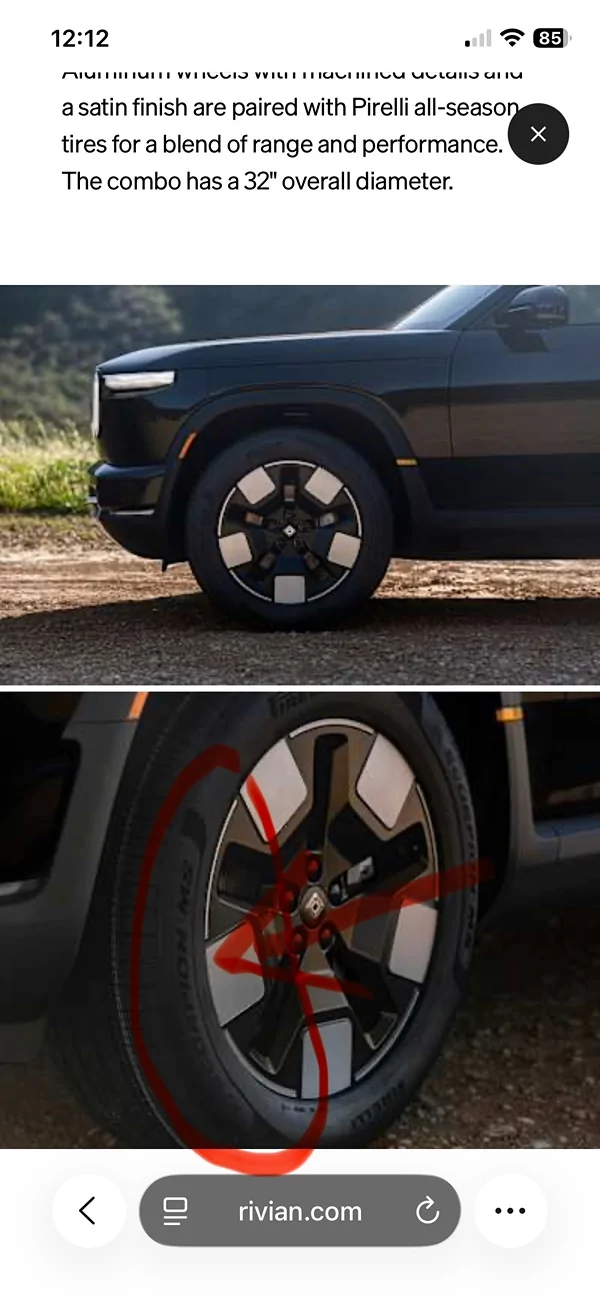
Keep in mind that you can’t just throw any 20” tire on and get better range. You need a low rolling resistance EV tire to get better range. Looking at what’s available at Tire Rack I’d venture to bet that most of the 20” tire offerings might get WORSE mileage than the stock AT tires. Pirelli list a 255/60/20 for the Scorpion MS which is the stock 21” tire. I’d assume that is what will come on the Premium 20” wheels. I searched and can’t find a price for it so I’m assuming that it isn’t in circulation yet. I’d really like to see how much they are before I make my decision. Fortunately I have 4-5 months before my order window opens so hopefully more information will be available by then.
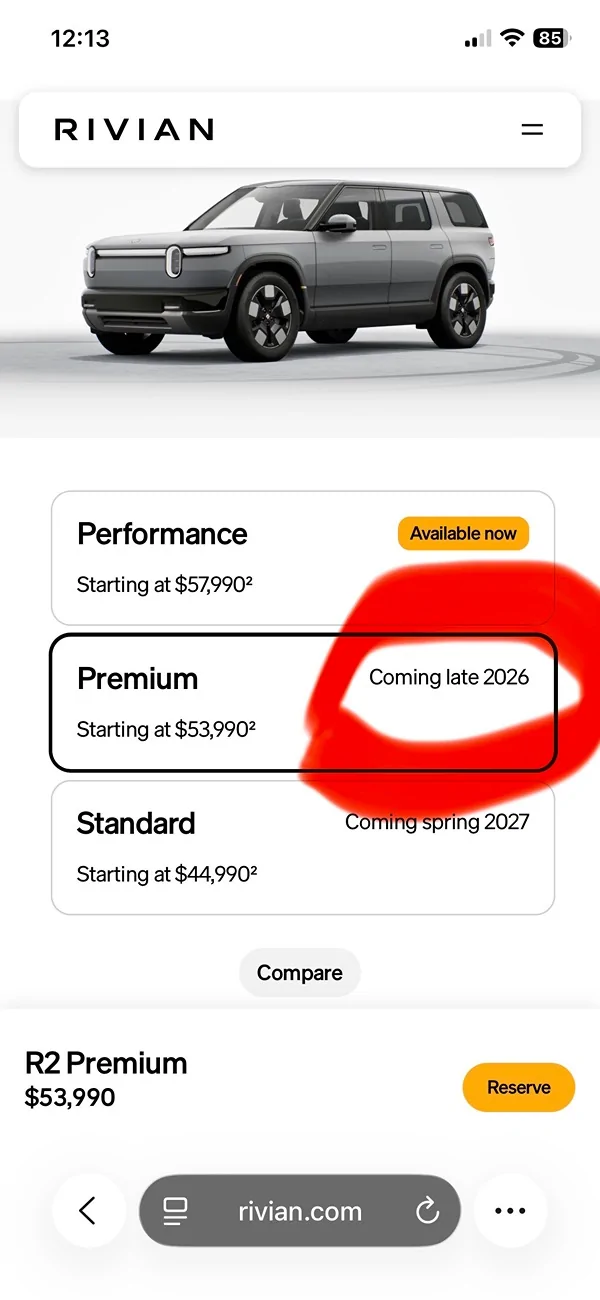
It’s a new size for the Scorpion MS model line. No one has it now. Again, don’t sweat it. You got weeks to months before you get your car. And years before you need new tires. And even if you pick 21”, by the time you need to replace tires there will be more available than the solo one now. Way too much analysis paralysis and it’s entirely unnecessary. I will say though, if you live in places that see severe winter conditions, you are more likely to find dedicated snow/ice tires for the 20”. But a second set of winter wheels/tires is always an option.

Rivian R1T R1S 20in wheel worse range even with all season tires? IMG_1065


Rivian R1T R1S 20in wheel worse range even with all season tires? IMG_1064
Sponsored

 
Last edited:

Supratachophobia

Well-Known Member
Joined
Apr 8, 2023
Threads
9
Messages
1,790
Reaction score
2,138
Location
Ohio
Vehicles
S
Clubs
 
From what I understand, generally, a smaller diameter wheel will provide better EV range than a larger diameter wheel assuming the same tire. This is why I assumed that many on this forum were going to go with the 20in wheel on the launch edition and then swap out the all terrain tire at some point for an all season (as well as the well discussed reason that there are many more tires available at the 20in wheel size). I would generally assume that the 20 in wheel would then match or exceed the 330 mi EPA range of the 21 in wheel.

However, a Rivian Service center rep told me that the 20 in wheel is also a heavier duty and heavier wheel than the 21 in wheel and will get worse range than the 21 in wheel, even if you put an all season on it. They said it was because the 20 in wheel was designed for more rigorous off road situation loading and the 21 in wheel was not.

Can anyone corroborate this as being a true situation? I really do not like the lack of tire selection for the 21 in wheel but also don't want reduced range if I pick the 20 in.

As many have said, it seems silly to choose a wheel size with no tire choice availability.
Kind of....

Smaller diameter = better range
However, the 20 and 22 should have about the same diameter because the wheels are different ratios to make that happen.

Lighter = better range
Size doesn't matter so much as composition. An XL tire will weigh more because it has more materials to make it stronger (more rubber, more metal)

Rim style = better range
Any rim that has less chance of air going through side to side will have better range. That's why aero wheels are they way they are. They usually block the passages where air can go through by making the whole rim a flat solid face.
 

Gigabit

Active Member
Joined
May 1, 2025
Threads
1
Messages
39
Reaction score
36
Location
Socal
Vehicles
R1T
Based on my observations, the 21in with Defender LTX m/S2 275/55R21 and the 20in Defender LTX m/S2 275/60R20 is the 20in gets better efficiency. After the swap I was getting a higher average 0.15mi/kWh efficiency.

I believe the 20in rim and tire weight less but what's most important with rotational mass is where the mass is located. I believe the mass of the 20in rim has a smaller moment of inertia than the 21in. Generally, cast rims need more material than forged rims to ensure structural integrity. This of course is based on non scientific measurements.
 

Zathras

Well-Known Member
First Name
Eric
Joined
Apr 29, 2026
Threads
0
Messages
298
Reaction score
307
Location
Carlsbad, CA
Vehicles
Subaru Crosstrek Plug-in Hybrid
Occupation
Retired
An issue for me getting 20 inch wheels is the fact that it costs $1,000 to upgrade while in the accessory store, the difference between the 21 and 20 inch sets is about $700.
 

Sponsored

mkhuffman

Well-Known Member
First Name
Mike
Joined
Nov 9, 2020
Threads
14
Messages
3,023
Reaction score
3,435
Location
Virginia
Vehicles
2025 R1T Tri-Max, Jeep GC-L, VW Jetta
Kind of....

Smaller diameter = better range
However, the 20 and 22 should have about the same diameter because the wheels are different ratios to make that happen.

Lighter = better range
Size doesn't matter so much as composition. An XL tire will weigh more because it has more materials to make it stronger (more rubber, more metal)

Rim style = better range
Any rim that has less chance of air going through side to side will have better range. That's why aero wheels are they way they are. They usually block the passages where air can go through by making the whole rim a flat solid face.
I completely disagree.

Wheel size has zero impact. This is what matters:

1. Rolling resistance. This is the most important factor. Rubber compound and tread design are the primary drivers. Of course tire pressure can have a huge impact on rolling resistance.

2. Aerodynamics. A wheel with a tire that had a larger sidewall will naturally have less rotational resistance. And the rim design has a significant impact. But the impact is speed dependent - the faster you go the more air resistance matters.

3. Weight. This only impacts acceleration resistance, so the impact is minor. So minor most car manufacturers ignore it. So I pretty much ignore it also.

Wheel diameter only matters if it impacts one of the factors above.
 

Jeremy3292

Well-Known Member
First Name
Jeremy
Joined
Apr 27, 2026
Threads
5
Messages
691
Reaction score
1,097
Location
South Carolina
Vehicles
R2
I completely disagree.

Wheel size has zero impact. This is what matters:

1. Rolling resistance. This is the most important factor. Rubber compound and tread design are the primary drivers. Of course tire pressure can have a huge impact on rolling resistance.

2. Aerodynamics. A wheel with a tire that had a larger sidewall will naturally have less rotational resistance. And the rim design has a significant impact. But the impact is speed dependent - the faster you go the more air resistance matters.

3. Weight. This only impacts acceleration resistance, so the impact is minor. So minor most car manufacturers ignore it. So I pretty much ignore it also.

Wheel diameter only matters if it impacts one of the factors above.
Im assuming #2 is referring to rotational inertia, bc saying rim size has “zero impact” would contradict rotational inertia. If two rims have the exact same weight, tires, and design the smaller diameter rim will go further every time due to rotational inertia. So I wouldn’t say it has “zero impact” bc it does.
 

mkhuffman

Well-Known Member
First Name
Mike
Joined
Nov 9, 2020
Threads
14
Messages
3,023
Reaction score
3,435
Location
Virginia
Vehicles
2025 R1T Tri-Max, Jeep GC-L, VW Jetta
Im assuming #2 is referring to rotational inertia, bc saying rim size has “zero impact” would contradict rotational inertia. If two rims have the exact same weight, tires, and design the smaller diameter rim will go further every time due to rotational inertia. So I wouldn’t say it has “zero impact” bc it does.
Good point.

It will have an impact that is similar to weight: larger wheels will increase acceleration resistance with zero impact on steady speed driving, and some of the impact recovered via regen when slowing down.

I have not seen testing regarding rotational inertia and wheels of the same weight but different sizes. My guess is it is a very minor impact compared to weight, and larger wheels typically weigh more.

The fact is the range impact from wheels is complicated. You can't just boil it down to one variable, like weight or size, while ignoring the other things that matter. Even a wheel that looks more aerodynamic than another might perform more poorly when installed on different vehicles. The position of the wheel inside the vehicle body can make a significant difference.

Rivian has wheel experts who pick tires and design rims to be the most efficient possible for the performance needed. Changing wheels and tires will almost certainly reduce efficiency, unless you are changing the performance requirements (like replacing AT tires with road tires).

That said, it is possible. I replaced the OEM tires on my Mach-e with Hankook iON SUV AS tires and was able to measure a 7% improvement in highway efficiency. But those tires were not available when the car was new, and they actually where slightly bigger.

I wish I had weighed them as I bet they also weighed more. Maybe one day I will look up the tire specs and see. Regardless, larger wheels were more efficient on my car. I think rolling resistance was the main reason, but also I credit better aerodynamics from the larger sidewall.
 

Sponsored

Jeremy3292

Well-Known Member
First Name
Jeremy
Joined
Apr 27, 2026
Threads
5
Messages
691
Reaction score
1,097
Location
South Carolina
Vehicles
R2
Good point.

It will have an impact that is similar to weight: larger wheels will increase acceleration resistance with zero impact on steady speed driving, and some of the impact recovered via regen when slowing down.

I have not seen testing regarding rotational inertia and wheels of the same weight but different sizes. My guess is it is a very minor impact compared to weight, and larger wheels typically weigh more.

The fact is the range impact from wheels is complicated. You can't just boil it down to one variable, like weight or size, while ignoring the other things that matter. Even a wheel that looks more aerodynamic than another might perform more poorly when installed on different vehicles. The position of the wheel inside the vehicle body can make a significant difference.

Rivian has wheel experts who pick tires and design rims to be the most efficient possible for the performance needed. Changing wheels and tires will almost certainly reduce efficiency, unless you are changing the performance requirements (like replacing AT tires with road tires).

That said, it is possible. I replaced the OEM tires on my Mach-e with Hankook iON SUV AS tires and was able to measure a 7% improvement in highway efficiency. But those tires were not available when the car was new, and they actually where slightly bigger.

I wish I had weighed them as I bet they also weighed more. Maybe one day I will look up the tire specs and see. Regardless, larger wheels were more efficient on my car. I think rolling resistance was the main reason, but also I credit better aerodynamics from the larger sidewall.
Agreed.

I would expect the 20" wheels on the premium trim to be much more "range-y" than the 20" wheels on the LE, even if you swap the AT tires for AS, as the premium trim wheels look more "aero-y". Hankook ION's are good tires; I've used them on all my EV's and have them currently.
 

mkhuffman

Well-Known Member
First Name
Mike
Joined
Nov 9, 2020
Threads
14
Messages
3,023
Reaction score
3,435
Location
Virginia
Vehicles
2025 R1T Tri-Max, Jeep GC-L, VW Jetta
Agreed.

I would expect the 20" wheels on the premium trim to be much more "range-y" than the 20" wheels on the LE, even if you swap the AT tires for AS, as the premium trim wheels look more "aero-y". Hankook ION's are good tires; I've used them on all my EV's and have them currently.
We are on the same page. If you can find a tire that has lower rolling resistance than OEM that fits on the 20" rim, it could potentially be better than the 21" OEM combo. Potentially. But Rivian knows what they are doing and IMO it will be almost impossible to beat their most efficient setup, whatever that turns out to be.

Huge fan of the iON Evo AS SUV tires also. I wish they made them in a size that fits the R1. From what I have seen posted here, the iON HT tires are not as efficient as the OEM 22s. Which is weird considering my experience with the SUV tires. It is just another proof point that Rivian knows better than us how to pick the best tires. LOL.
 

Megaman0025

Well-Known Member
First Name
Justin
Joined
Jun 8, 2023
Threads
0
Messages
108
Reaction score
93
Location
16066
Vehicles
Tesla Model 3 Performance
The service guy is likely wrong. See the video I linked.
The service guy is definitely wrong. The 20 inch wheels are probably heavier, but that would only affect range around town and not on the highway. Aero (and tires) matter much more when at highway speed.
 

Zathras

Well-Known Member
First Name
Eric
Joined
Apr 29, 2026
Threads
0
Messages
298
Reaction score
307
Location
Carlsbad, CA
Vehicles
Subaru Crosstrek Plug-in Hybrid
Occupation
Retired
The service guy is definitely wrong. The 20 inch wheels are probably heavier, but that would only affect range around town and not on the highway. Aero (and tires) matter much more when at highway speed.
Exactly. Many think it's a simple choice. But what I'm mulling over is how much highway driving will I do? I'm beginning to think it's going to be a lot. So the 21 inch tires are a better choice for me than the all-terrain 20s. The 21s are 55s, while the 20s are 60s. So doesn't that mean they are wider? So maybe they're heavier because they have more rubber on the road, not to mention bigger walls.
 

Megaman0025

Well-Known Member
First Name
Justin
Joined
Jun 8, 2023
Threads
0
Messages
108
Reaction score
93
Location
16066
Vehicles
Tesla Model 3 Performance
Exactly. Many think it's a simple choice. But what I'm mulling over is how much highway driving will I do? I'm beginning to think it's going to be a lot. So the 21 inch tires are a better choice for me than the all-terrain 20s. The 21s are 55s, while the 20s are 60s. So doesn't that mean they are wider? So maybe they're heavier because they have more rubber on the road, not to mention bigger walls.
No they are not wider. The 55 vs 60 refers to the sidewall height. It is a ratio OF the width of the tire. Both are the same width.
Sponsored


Top