
ksurfier
Well-Known Member
- Thread starter
- #1
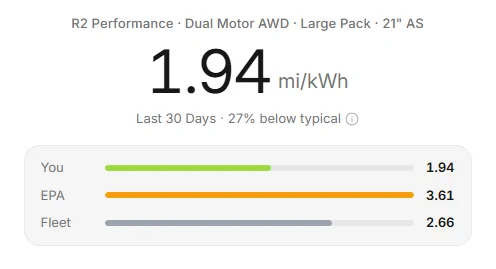
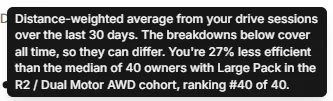
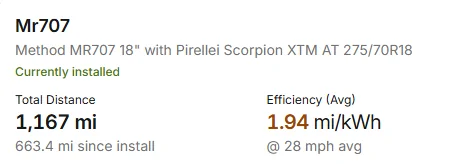
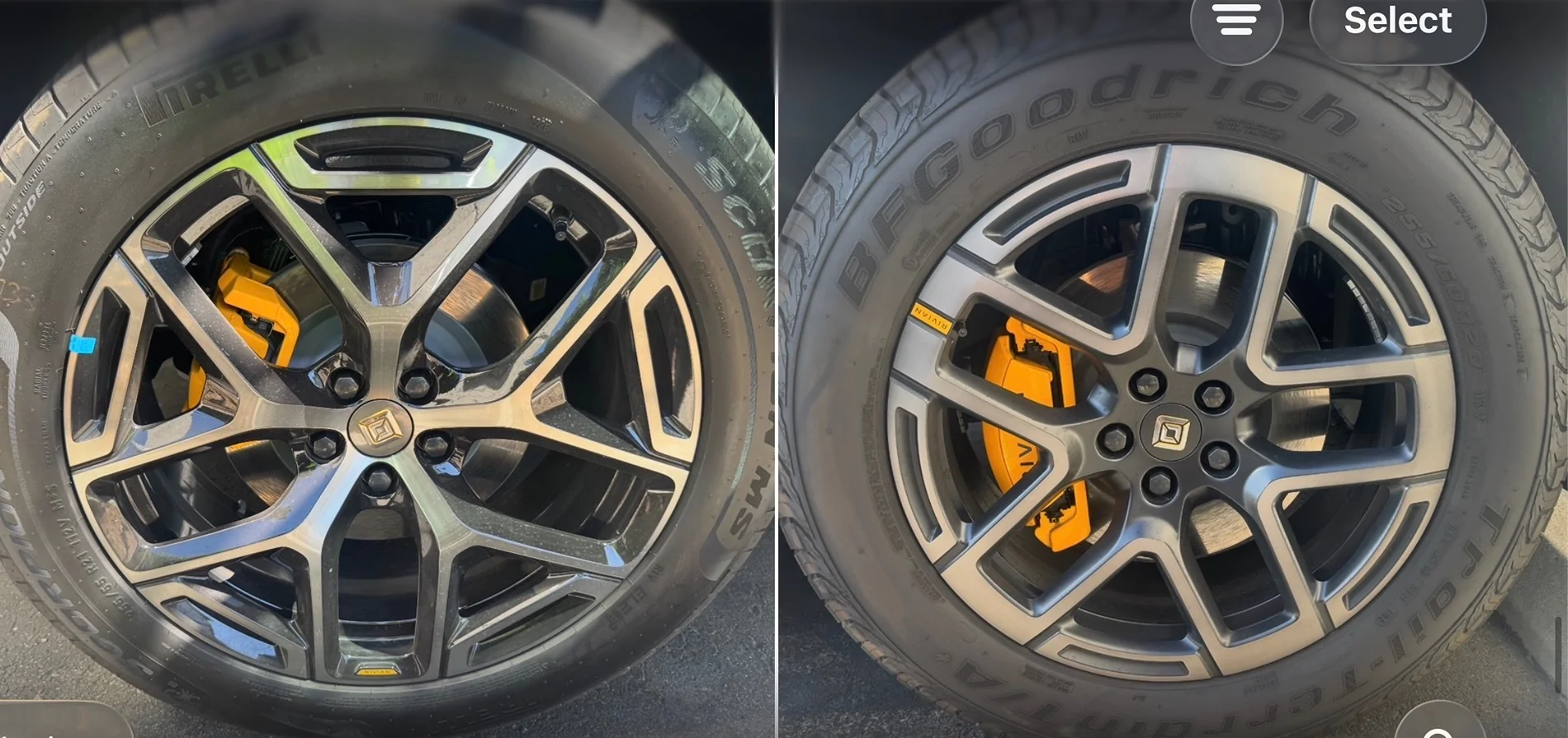
While anecdotal, it appears that the R2 with 20" wheels may in fact be slightly more efficient that the 21" setup. Some say that it's just the 21" crowd is driving faster, which might be true, interesting none-the-less:
As reported here: Rivian Tires: Compare & Review for R1T, R1S & R2
Update 2, August 17:
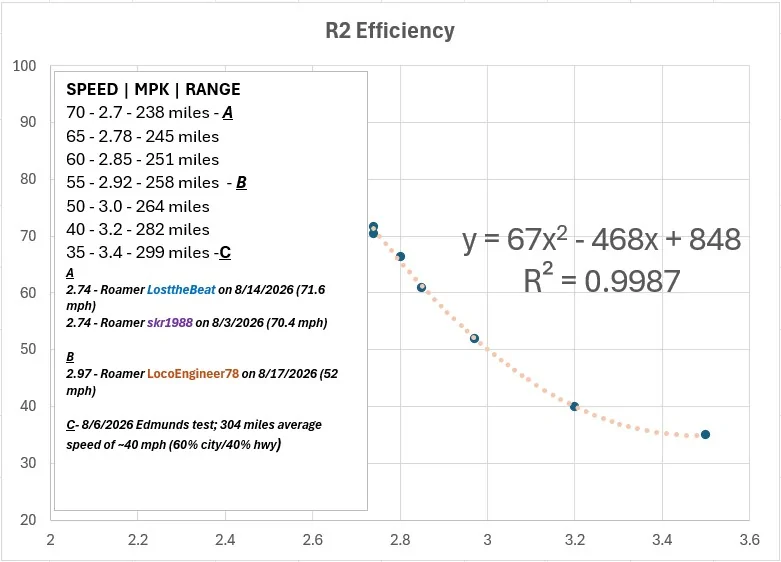
A month into R2 testing, the efficiency debate has narrowed considerably. My first test drive was around July 16, when the main question was simply how much real-world highway range the R2 loses relative to EPA estimates. Subsequent testing established a fairly consistent speed curve, with efficiency around 3.0+ mi/kWh near 60–65 mph, ~2.7 near 70 mph, and roughly 2.3 or less approaching 80 mph.
The discussion then shifted to 20-inch vs. 21-inch wheels. EPA data suggest the 21s should have roughly a 7–8% highway efficiency advantage, but the real-world tests collected so far have generally shown the two much closer than that, with some 20-inch results slightly better. The larger Rivian Roamer dataset has also not shown an obvious 21-inch advantage in its raw averages, although those data contain major uncontrolled variables.
Where things stand now: the key question is no longer whether speed matters; it clearly does. The remaining question is whether, after controlling for speed, elevation, trip length, weather, and other variables, the 21s actually deliver the ~7% freeway advantage suggested by EPA testing, or whether the real-world difference is materially smaller.
Update 1: The latest Rivian Roamer data now cover 82 R2s and more than 52,000 miles, with the 20” BFGoodrich Trail-Terrain setup averaging 2.73 mi/kWh versus 2.64 mi/kWh for the 21” Pirelli Scorpion MS, a 3.4% real-world efficiency advantage for the 20s; that is notable because it runs opposite to the EPA data, which imply roughly an 8% highway advantage for the 21s and an even larger advantage at sustained 70–80 mph based on the road-load coefficients. The gap has narrowed from the earlier smaller-sample data, which suggests some early noise is averaging out, but the 20” result has remained remarkably stable around 2.73 mi/kWh as the mileage has increased. Because the Roamer data are not controlled for speed, weather, elevation, HVAC use, or driving style, they cannot prove the 20” setup is inherently more efficient, but combined with the individual highway tests showing little or no clear 21” advantage, they increasingly suggest that the EPA/coastdown testing may overstate the real-world efficiency benefit of the 21” wheel/tire package, potentially because real-world wheel aerodynamics, turbulence, and yaw effects are not fully represented by the certification road-load model.
Any current owners willing to report in with tire size, total mileage, average speed, and efficiency?


As reported here: Rivian Tires: Compare & Review for R1T, R1S & R2
| Tire | Miles | Vehicles | MpV | MPK | Range |
| 20" | 9184 | 12 | 765 | 2.74 | 241 |
| 21" | 5579 | 11 | 507 | 2.53 | 223 |
Update 2, August 17:
A month into R2 testing, the efficiency debate has narrowed considerably. My first test drive was around July 16, when the main question was simply how much real-world highway range the R2 loses relative to EPA estimates. Subsequent testing established a fairly consistent speed curve, with efficiency around 3.0+ mi/kWh near 60–65 mph, ~2.7 near 70 mph, and roughly 2.3 or less approaching 80 mph.
The discussion then shifted to 20-inch vs. 21-inch wheels. EPA data suggest the 21s should have roughly a 7–8% highway efficiency advantage, but the real-world tests collected so far have generally shown the two much closer than that, with some 20-inch results slightly better. The larger Rivian Roamer dataset has also not shown an obvious 21-inch advantage in its raw averages, although those data contain major uncontrolled variables.
Where things stand now: the key question is no longer whether speed matters; it clearly does. The remaining question is whether, after controlling for speed, elevation, trip length, weather, and other variables, the 21s actually deliver the ~7% freeway advantage suggested by EPA testing, or whether the real-world difference is materially smaller.
Update 1: The latest Rivian Roamer data now cover 82 R2s and more than 52,000 miles, with the 20” BFGoodrich Trail-Terrain setup averaging 2.73 mi/kWh versus 2.64 mi/kWh for the 21” Pirelli Scorpion MS, a 3.4% real-world efficiency advantage for the 20s; that is notable because it runs opposite to the EPA data, which imply roughly an 8% highway advantage for the 21s and an even larger advantage at sustained 70–80 mph based on the road-load coefficients. The gap has narrowed from the earlier smaller-sample data, which suggests some early noise is averaging out, but the 20” result has remained remarkably stable around 2.73 mi/kWh as the mileage has increased. Because the Roamer data are not controlled for speed, weather, elevation, HVAC use, or driving style, they cannot prove the 20” setup is inherently more efficient, but combined with the individual highway tests showing little or no clear 21” advantage, they increasingly suggest that the EPA/coastdown testing may overstate the real-world efficiency benefit of the 21” wheel/tire package, potentially because real-world wheel aerodynamics, turbulence, and yaw effects are not fully represented by the certification road-load model.
Any current owners willing to report in with tire size, total mileage, average speed, and efficiency?
Sponsored
Last edited: