Sponsored

Real World 70 MPH Test Might not be so real world?

cpf

New Member
Joined
Jul 2, 2026
Threads
1
Messages
4
Reaction score
2
Location
GA
Vehicles
None
Hey everyone,

I've been following all the chat around the R2's 70mph range tests, and I'm really curious to get people's thoughts on a specific detail that might be causing the variation in results.

Looking at the "real world" 70mph tests we've seen so far, there's a pretty noticeable gap in the data:

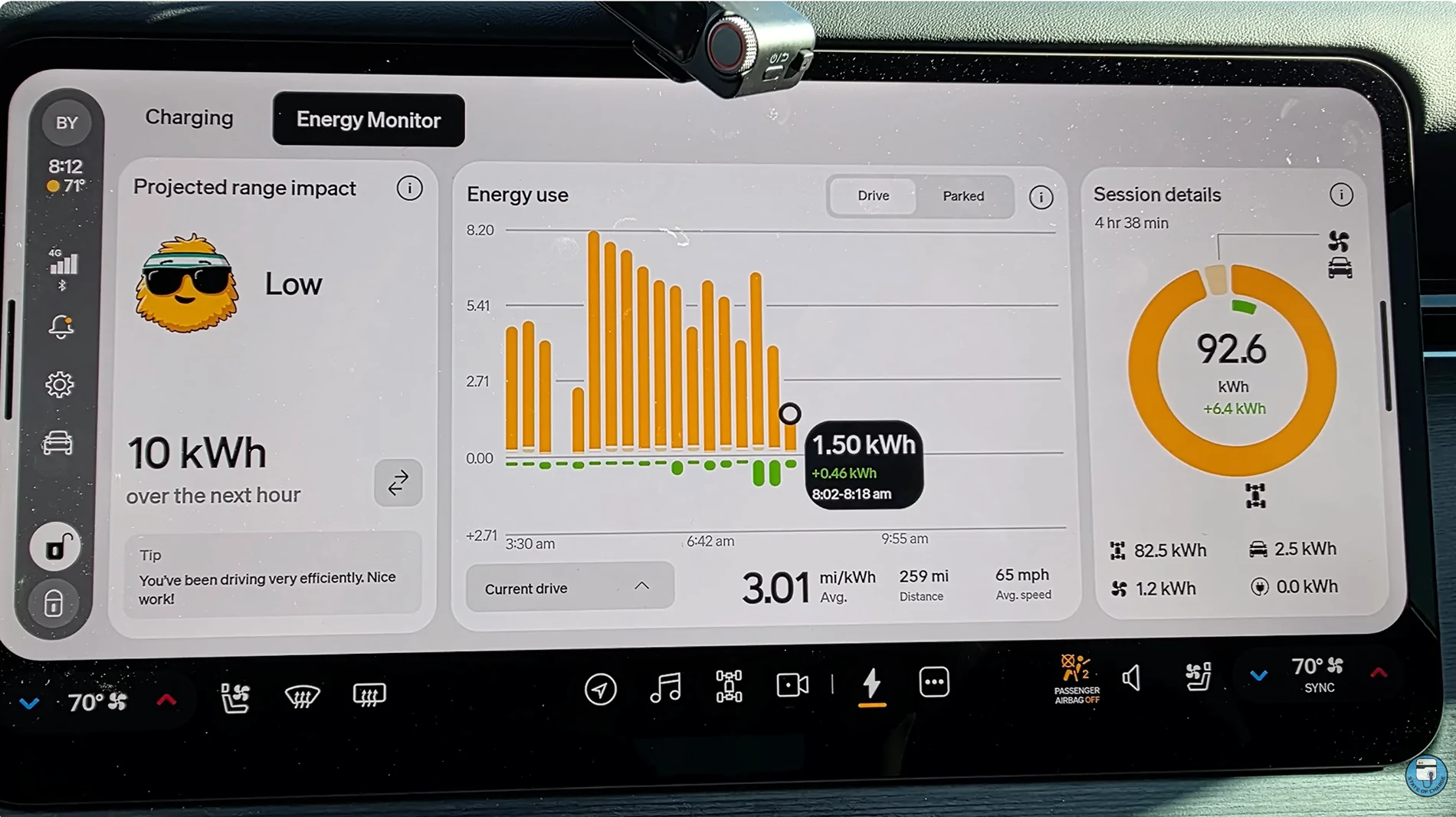
  • State of Charge got around 3.0 mi/kWh (on off-road tires).
  • Out of Spec came in around 2.8 mi/kWh (on all-seasons).
  • David Vaught got 2.54 mi/kWh (on the exact same off-road tires as SoC).
What really caught my eye is the difference between State of Charge and David Vaught. They were on the same off-road tires, but SoC got noticeably better efficiency. From what I can tell, David ran one continuous test start to finish, while the SoC team stopped mid-drive — I believe because they were getting sleepy, though if anyone has the timestamp on that I'd love to confirm it.

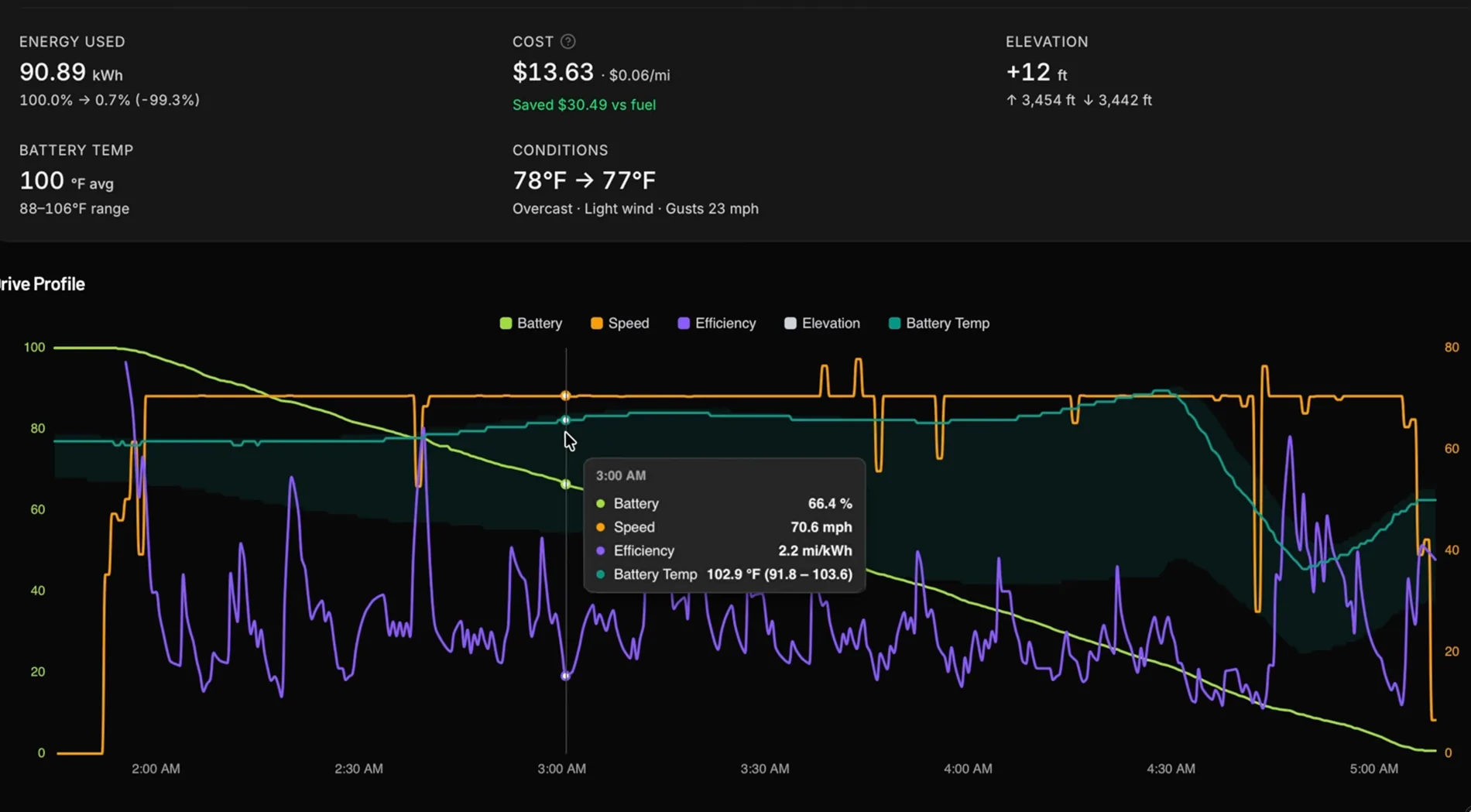
Looking at the OBD data David shared, battery temp climbs pretty steadily through the drive, and I think I can see the efficiency line getting rougher in that same window — though I'll be honest, it's noisy enough for most of the drive that I'm not fully sure how much to read into that. Curious if others who watch it see the same thing or think I'm reaching. My theory: the R2 reportedly uses thicker 4695 cells, which hold onto thermal mass more than the older 2170 format. If they heat-soak after hours of continuous highway driving, the active chiller has to work harder to pull temps back down, and that's pulling kW straight out of the pack.

Which makes me wonder — did that nap the SoC guys took give the pack enough time to passively cool off, and maybe kept the chiller from having to kick on hard once they got back on the highway?

A couple of open questions for the group:

  1. Do you think thermal management and cell heat-soak are playing a bigger role in these continuous 100–0% runs than people realize?
  2. Since most of us road trip in 10–80% or 15–75% legs (where the car would likely stop to charge right around the time heat-soak sets in anyway), do you think continuous 100–0% tests are triggering an active cooling penalty that most drivers will never actually see?
Would love to hear what you guys think, or if anyone else has been digging into the thermal data on these runs!

Rivian R1T R1S Real World 70 MPH Test Might not be so real world? David Vaught 70 mph test


Rivian R1T R1S Real World 70 MPH Test Might not be so real world? state of charge 70 test
Sponsored


lordsutch

Member
First Name
Chris
Joined
Jul 9, 2026
Threads
0
Messages
15
Reaction score
35
Location
Georgia
Vehicles
2021 Volkswagen ID.4 RWD
A couple of open questions for the group:
  1. Do you think thermal management and cell heat-soak are playing a bigger role in these continuous 100–0% runs than people realize?
  2. Since most of us road trip in 10–80% or 15–75% legs (where the car would likely stop to charge right around the time heat-soak sets in anyway), do you think continuous 100–0% tests are triggering an active cooling penalty that most drivers will never actually see?
Would love to hear what you guys think, or if anyone else has been digging into the thermal data on these runs!
It's possible that pack temperatures are having an effect; the SoC test (just Tom Moloughney, no team involved) was run in cooler ambient temperatures and lower humidity than either OOS or Vaught's—looking at the clips of the display shown in Tom's video, the outside temperature was between the 50s and low 70s during his run. But charging isn't going to give the pack a temperature break like simply parking and taking a nap would, so the same issues could still show up during continuous driving; the only real benefit is that the active pack cooling would be drawing net power from the charger rather than the battery pack while plugged in.

However, software updates might be able to improve the pack cooling algorithm's performance over time, which at least could improve real-world range without modifying the aero or other hardware changes.
 

R1Thrilled

Well-Known Member
Joined
Jun 2, 2022
Threads
3
Messages
87
Reaction score
276
Location
Nashville
Vehicles
2027 Rivian R2 Performance Launch Package
Hey, I’ll add some info that a friend of mine pointed out after looking at my data re: battery temps. There was a slight uphill section during the time when the battery temps climbed which may have caused the cooling to kick in aggressively. It wasn’t a steep grade or anything but it may have just been enough to push it over the edge.
 
OP
OP

cpf

New Member
Joined
Jul 2, 2026
Threads
1
Messages
4
Reaction score
2
Location
GA
Vehicles
None
It's possible that pack temperatures are having an effect; the SoC test (just Tom Moloughney, no team involved) was run in cooler ambient temperatures and lower humidity than either OOS or Vaught's—looking at the clips of the display shown in Tom's video, the outside temperature was between the 50s and low 70s during his run. But charging isn't going to give the pack a temperature break like simply parking and taking a nap would, so the same issues could still show up during continuous driving; the only real benefit is that the active pack cooling would be drawing net power from the charger rather than the battery pack while plugged in.

However, software updates might be able to improve the pack cooling algorithm's performance over time, which at least could improve real-world range without modifying the aero or other hardware changes.

Yes, I was wondering about a software update too. The fact that the pack temps dropped so fast in the video David posted makes me think the cooling system has real capacity, but it also looks like the system threw the kitchen sink at it — temps dropped pretty sharply, though I couldn't tell you for sure if it hit the coldest point of the whole test.

I agree with your point about heat while charging, and that the cooling system can draw power while the car is still plugged in. If the car could cool the battery more aggressively near the end of a leg, it might put you in a better spot for the next one.
 
OP
OP

cpf

New Member
Joined
Jul 2, 2026
Threads
1
Messages
4
Reaction score
2
Location
GA
Vehicles
None
Hey, I’ll add some info that a friend of mine pointed out after looking at my data re: battery temps. There was a slight uphill section during the time when the battery temps climbed which may have caused the cooling to kick in aggressively. It wasn’t a steep grade or anything but it may have just been enough to push it over the edge.
OK. I saw a label for elevation, but did not see data at all. Dropping the temps well below any point in the test after active cooling is interesting.
 

Sponsored

R1Thrilled

Well-Known Member
Joined
Jun 2, 2022
Threads
3
Messages
87
Reaction score
276
Location
Nashville
Vehicles
2027 Rivian R2 Performance Launch Package
Rivian R1T R1S Real World 70 MPH Test Might not be so real world? IMG_2572
Rivian R1T R1S Real World 70 MPH Test Might not be so real world? IMG_2574

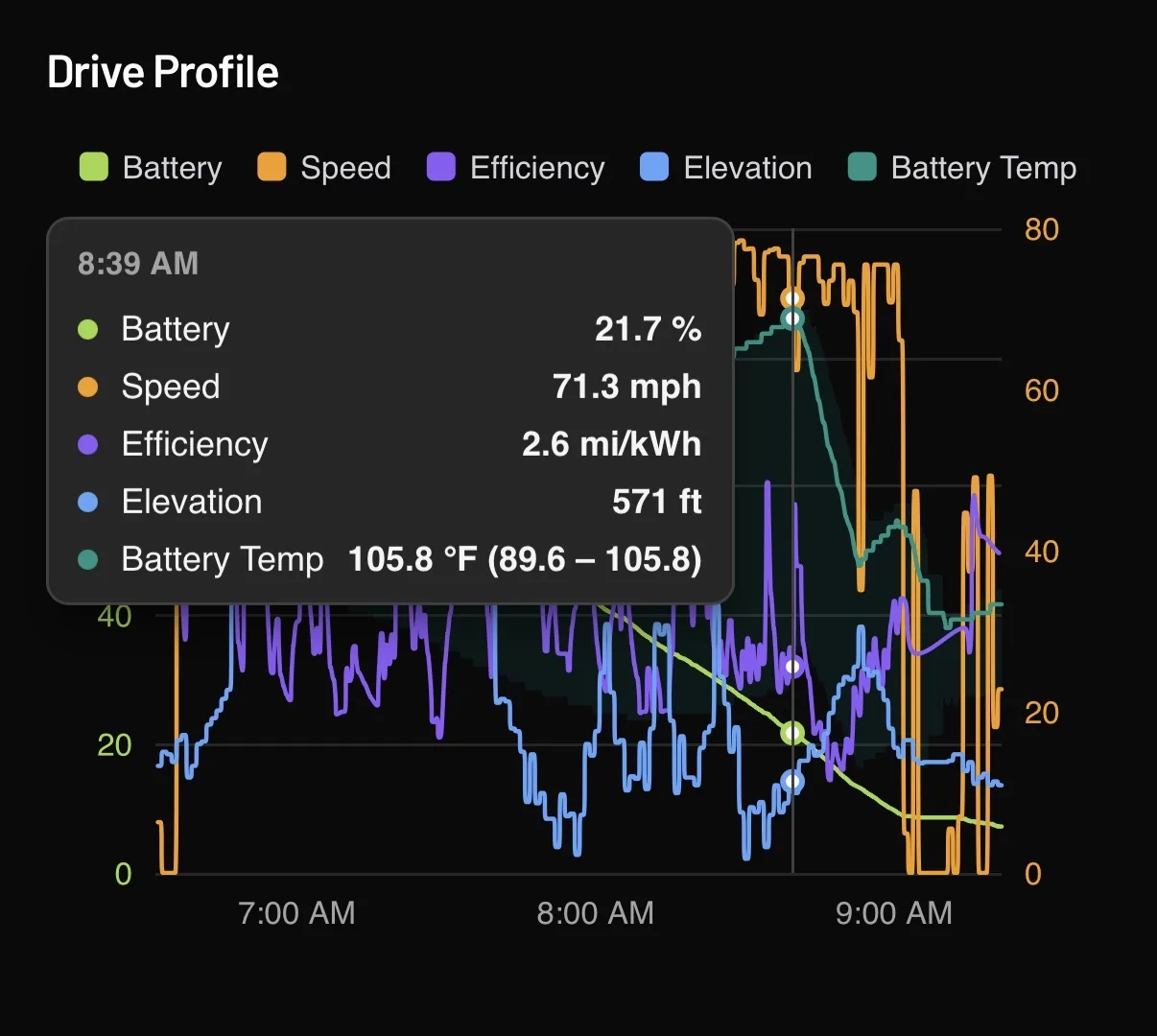
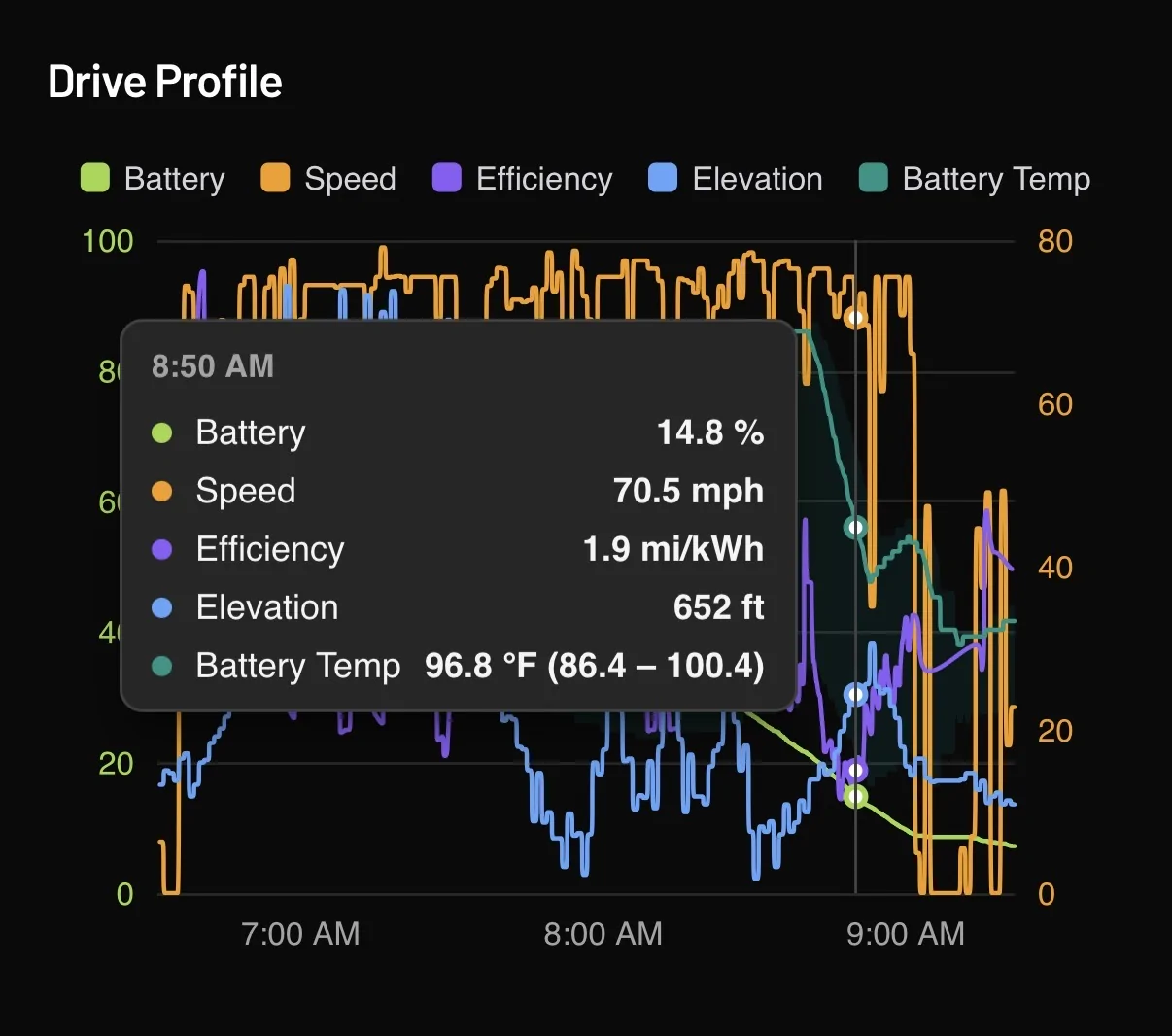
I did another drive and observed the same behavior. It seems the battery pack doesn’t want to be above 105.8 and just aggressively cools. What’s curious is leading up to that, it is allowed to slowly climb from ~102.x to the 105.8 without intervention. I think they can smooth this cooling behavior out a bit to spread the climate usage over more time, or at least account for this massive surge in climate usage into the trip planner, if it isn’t already (it doesn’t feel like it is based on the estimated arrival percentage dropping a couple percentage points during this time)
 

RickRivian

Well-Known Member
Joined
Dec 16, 2025
Threads
1
Messages
68
Reaction score
73
Location
SE MI
Vehicles
'22 Lightning ER Lariat,'22 Mach-E Premium 4X
In addition, unless the weather conditions and the road conditions / topography are identical, results are going to be different. 10mph wind has an impact.

People who live in Florida talk about the tremendous efficiency their EVs get, efficiencies that people who live in the midwest never get - unless they travel to Florida...

I can tell you that I track my efficiency (non-Rivian) on every leg of a trip, and if we head south it climbs the further south we get. And we don't live in the mountains, or travel on hilly roads. But flat like a pancake and 80 degrees are the best conditions.

As a potential R2 owner with a slot in Nov/Dec, I look forward to seeing Rivian tweaking things. I was surprised at the efficiency ABRP was showing compared to the Mach-E, but it appears it's real based on the results on off-road tires above.
 

tivoboy

Well-Known Member
First Name
Paul
Joined
Nov 8, 2025
Threads
3
Messages
477
Reaction score
609
Location
Palo Alto, CA
Vehicles
M3
IMG_2572.webp
IMG_2574.webp

I did another drive and observed the same behavior. It seems the battery pack doesn’t want to be above 105.8 and just aggressively cools. What’s curious is leading up to that, it is allowed to slowly climb from ~102.x to the 105.8 without intervention. I think they can smooth this cooling behavior out a bit to spread the climate usage over more time, or at least account for this massive surge in climate usage into the trip planner, if it isn’t already (it doesn’t feel like it is based on the estimated arrival percentage dropping a couple percentage points during this time)
Is this your video of this? Why would they want to cool the battery at that point? Is it pre-conditioning expectation even though one isn’t routing to a charger?
 

R1Thrilled

Well-Known Member
Joined
Jun 2, 2022
Threads
3
Messages
87
Reaction score
276
Location
Nashville
Vehicles
2027 Rivian R2 Performance Launch Package
Is this your video of this? Why would they want to cool the battery at that point? Is it pre-conditioning expectation even though one isn’t routing to a charger?
Yep that’s my video.
If it is somehow secretly preconditioning it isn’t showing that to me. My guess is there is just some thermal upper bounds that get hit and it goes into overkill mode. I get that lower SoC and low voltage could mean more heat but it seems like there is a middle ground somewhere.
 

Sponsored

Jeremy3292

Well-Known Member
First Name
Jeremy
Joined
Apr 27, 2026
Threads
6
Messages
1,100
Reaction score
1,967
Location
South Carolina
Vehicles
R2
105.8F is exactly 41C. Not a coincidence I bet. That appears to be the upper limit you want for EV battery pack temps per a quick Google search, outside of DC fast charging where you can get up to 55C.
 

hammick

Well-Known Member
Joined
Sep 8, 2024
Threads
29
Messages
659
Reaction score
633
Location
Montana
Vehicles
25 R1S Tri; '26 Sierra EV AT4 ER
Occupation
retired
Remember when Kyle trashed the G2 R1 so bad over a year ago on his early morning range test. We've had our '25 R1S since Jan of '25 and it's a much better car now thanks to OTAs. I'm confident the R2 will improve as well.
 
OP
OP

cpf

New Member
Joined
Jul 2, 2026
Threads
1
Messages
4
Reaction score
2
Location
GA
Vehicles
None
@R1Thrilled Saw the update. Looks like you mostly did 75 MPH when you could, and the screen at the end showed 2.85 vs. the lower 2.58 from your first video.

I do think the battery cooler was running for much less time, and it looked like it only kicked in at the tail end. My question would be: how does it handle battery cooling during DC fast charging? Does it cool the battery down a little more than it needs to while connected to the charger? In each of the graphs, the battery always looks to be at its coolest point afterward — noticeably lower than even the starting temp of the test.

Have you ever looked at end-of-fast-charging temps?

Overall it's great to see it get better miles per kw at the 75 than the older 70 mile per hour test. I do solidly think the 10-80% is more close to real world use.
 

R1Thrilled

Well-Known Member
Joined
Jun 2, 2022
Threads
3
Messages
87
Reaction score
276
Location
Nashville
Vehicles
2027 Rivian R2 Performance Launch Package
@R1Thrilled Saw the update. Looks like you mostly did 75 MPH when you could, and the screen at the end showed 2.85 vs. the lower 2.58 from your first video.

I do think the battery cooler was running for much less time, and it looked like it only kicked in at the tail end. My question would be: how does it handle battery cooling during DC fast charging? Does it cool the battery down a little more than it needs to while connected to the charger? In each of the graphs, the battery always looks to be at its coolest point afterward — noticeably lower than even the starting temp of the test.

Have you ever looked at end-of-fast-charging temps?

Overall it's great to see it get better miles per kw at the 75 than the older 70 mile per hour test. I do solidly think the 10-80% is more close to real world use.
So far I’ve been happy with DC fast charging and have not run into any thermal limits on the car side. I do plan to do a sort of “charge drive charge” test when it’s hot to see if we can hit any thermal de-rates. The few times I’ve looked at temps at the end of fast charging it allows the battery to get quite warm compared to when driving, but of course that’s at high SoC so probably not as big of a deal. I’ve seen it in the 120s after charging before, but hasn’t slowed charging due to heat yet.
 

Jeremy3292

Well-Known Member
First Name
Jeremy
Joined
Apr 27, 2026
Threads
6
Messages
1,100
Reaction score
1,967
Location
South Carolina
Vehicles
R2
So far I’ve been happy with DC fast charging and have not run into any thermal limits on the car side. I do plan to do a sort of “charge drive charge” test when it’s hot to see if we can hit any thermal de-rates. The few times I’ve looked at temps at the end of fast charging it allows the battery to get quite warm compared to when driving, but of course that’s at high SoC so probably not as big of a deal. I’ve seen it in the 120s after charging before, but hasn’t slowed charging due to heat yet.
Put it in service mode and check when DCFC. 56C is the top limit I believe before derating. Will likely need it to be sunny and hot outside to hit.
Sponsored


Top