Sponsored

Ford/Tesla Deal: Access to Superchargers, adapter coming, future EVs will have NACS (Tesla) port

First Name
Matt
Joined
Jul 25, 2022
Threads
0
Messages
23
Reaction score
18
Location
SoCal
Vehicles
2022 Tesla model 3, 2016 Toyota Highlander
It requires extra control board hardware on the vehicle side (eg in Tesla cars) to prevent bad things from sharing pins. With CCS, because the pins are separate, there isn’t a need for this extra control board.

NACS to CCS adapter is actually quite straightforward. They actually use same communications protocols on DCFCs.

https://www.amp.tech/tesla-nacs/
Technically that isn't quite correct but yes, it does require extra electronics.

One single control circuit/board can be used to talk to DC and AC connection types. You do have to route the AC and DC current differently when it arrives on the vehicle so that requires an extra circuit/board. The HUGE advantage with AC and DC running on the same pins is it means only one run of wires for power from the plug instead of two runs of wires. Copper and/or aluminum to get the power from the plug to the battery is expensive.

Whether charging AC or DC in a Rivian the communication pins are the same, it is the power pins that are different. That is the reason the DC chargers have both the J1772 connector AND the two massive power pins below.
Sponsored


 

Spork8

Well-Known Member
First Name
Trevor
Joined
Feb 18, 2022
Threads
1
Messages
134
Reaction score
148
Location
KZoo
Vehicles
2022 R1T
Occupation
Engineer
Clubs
 
That is comparing apples and oranges.

Even Rivians RAN chargers require a handshake before current will flow.

Phone charging does not require a handshake.

If you probe a phone charger there is a voltage on the pins at all times. If you probe a vehicle charger (CCS, RAN, Tesla, J1772) there is no voltage on the the power pins until the handshake is made.
100% disagree. It isn't an apples to oranges comparison, just an analogy that might help you understand why having AC and DC on the same pins is a safety risk.

Despite what you might think of handshakes, there is no fail safe with them and that's why they need to be isolated. Would you attempt to change a light fixture at home by simply leaving the light switch in the off position? Perhaps but that doesn't remove the risk and that's why you need to turn off electricity at the breaker/disconnect. With the light switch off you can probe the contacts and see no voltage, and I feel like a broken record here but that does not remove the safety risk.
 

scottf200

Well-Known Member
First Name
Scott
Joined
Nov 25, 2019
Threads
6
Messages
432
Reaction score
296
Location
WNC
Vehicles
Past Ford Exped; curr TMX 100D; future BEV truck/SUV
Occupation
sw engineer
Last edited:

DuoRivians

Well-Known Member
Joined
Dec 30, 2022
Threads
258
Messages
3,814
Reaction score
9,091
Location
California
Vehicles
R1T, R1S
Technically that isn't quite correct but yes, it does require extra electronics.

One single control circuit/board can be used to talk to DC and AC connection types. You do have to route the AC and DC current differently when it arrives on the vehicle so that requires an extra circuit/board. The HUGE advantage with AC and DC running on the same pins is it means only one run of wires for power from the plug instead of two runs of wires. Copper and/or aluminum to get the power from the plug to the battery is expensive.

Whether charging AC or DC in a Rivian the communication pins are the same, it is the power pins that are different. That is the reason the DC chargers have both the J1772 connector AND the two massive power pins below.
Afaik, DCFC on CCS don’t install the wiring needed for the AC current—they primarily install wiring for the DC pins and whatever might be necessary for communications. So I don’t think it’s the case that extra copper wires are needed.

You can’t use aluminum for DC wires
 
Last edited:
  • Like
Reactions: VSG

scottf200

Well-Known Member
First Name
Scott
Joined
Nov 25, 2019
Threads
6
Messages
432
Reaction score
296
Location
WNC
Vehicles
Past Ford Exped; curr TMX 100D; future BEV truck/SUV
Occupation
sw engineer
The HUGE advantage with AC and DC running on the same pins is it means only one run of wires for power from the plug instead of two runs of wires. Copper and/or aluminum to get the power from the plug to the battery is expensive.
100% and that is talked about in this break down video:
Ford's Bold Move: Embracing Tesla's Charging Standard for Electric Vehicles
 

Sponsored

First Name
Matt
Joined
Jul 25, 2022
Threads
0
Messages
23
Reaction score
18
Location
SoCal
Vehicles
2022 Tesla model 3, 2016 Toyota Highlander
100% disagree. It isn't an apples to oranges comparison, just an analogy that might help you understand why having AC and DC on the same pins is a safety risk.

Despite what you might think of handshakes, there is no fail safe with them and that's why they need to be isolated. Would you attempt to change a light fixture at home by simply leaving the light switch in the off position? Perhaps but that doesn't remove the risk and that's why you need to turn off electricity at the breaker/disconnect. With the light switch off you can probe the contacts and see no voltage, and I feel like a broken record here but that does not remove the safety risk.
I will respectfully agree to disagree then. The Tesla system is much more elegant and less cost...and NACS will continue to be on most EVs in north America for the foreseeable future so I guess we will have to just live with your perceived safety risk.
 

DuoRivians

Well-Known Member
Joined
Dec 30, 2022
Threads
258
Messages
3,814
Reaction score
9,091
Location
California
Vehicles
R1T, R1S
I will respectfully agree to disagree then. The Tesla system is much more elegant and less cost...and NACS will continue to be on most EVs in north America for the foreseeable future so I guess we will have to just live with your perceived safety risk.
If “most” EVs means Teslas, then yes. But that’s because Tesla controls their entire ecosystem. If you break it down by count of manufacturers using NACS, it’s only Tesla now and maybe Ford later. GM, Volvo/Polestar, Hyundai/Kia, Mercedes, VW/Audi/Porsche/etc, Rivian, Lucid, and other oems use CCS.

I disagree it costs less when you factor in the costs of extra logic, chips necessary on the vehicle side.
 
Last edited:

Spork8

Well-Known Member
First Name
Trevor
Joined
Feb 18, 2022
Threads
1
Messages
134
Reaction score
148
Location
KZoo
Vehicles
2022 R1T
Occupation
Engineer
Clubs
 
I will respectfully agree to disagree then. The Tesla system is much more elegant and less cost...and NACS will continue to be on most EVs in north America for the foreseeable future so I guess we will have to just live with your perceived safety risk.
Ignorance is bliss I guess.
 

Dark-Fx

Well-Known Member
First Name
Brian
Joined
Jul 15, 2020
Threads
148
Messages
13,583
Reaction score
27,430
Location
Michigan
Vehicles
R1T, R1S, Livewire One, Sierra EV, R1S
Occupation
Engineering
Clubs
 
It shows that they are currently profitable, but not what it was designed for.
I read the "has become" meaning that wasn't the goal to begin with.
 

Sponsored

First Name
Matt
Joined
Jul 25, 2022
Threads
0
Messages
23
Reaction score
18
Location
SoCal
Vehicles
2022 Tesla model 3, 2016 Toyota Highlander
Afaik, DCFC on CCS don’t install the wiring needed for the AC current—they primarily install wiring for the DC pins and whatever might be necessary for communications. So I don’t think it’s the case that extra copper wires are needed.

You can’t use aluminum for DC wires
You are 100% correct on your first point. They don't need to populate the AC power pins on DCFC but they do need the communication pins from the J1772.

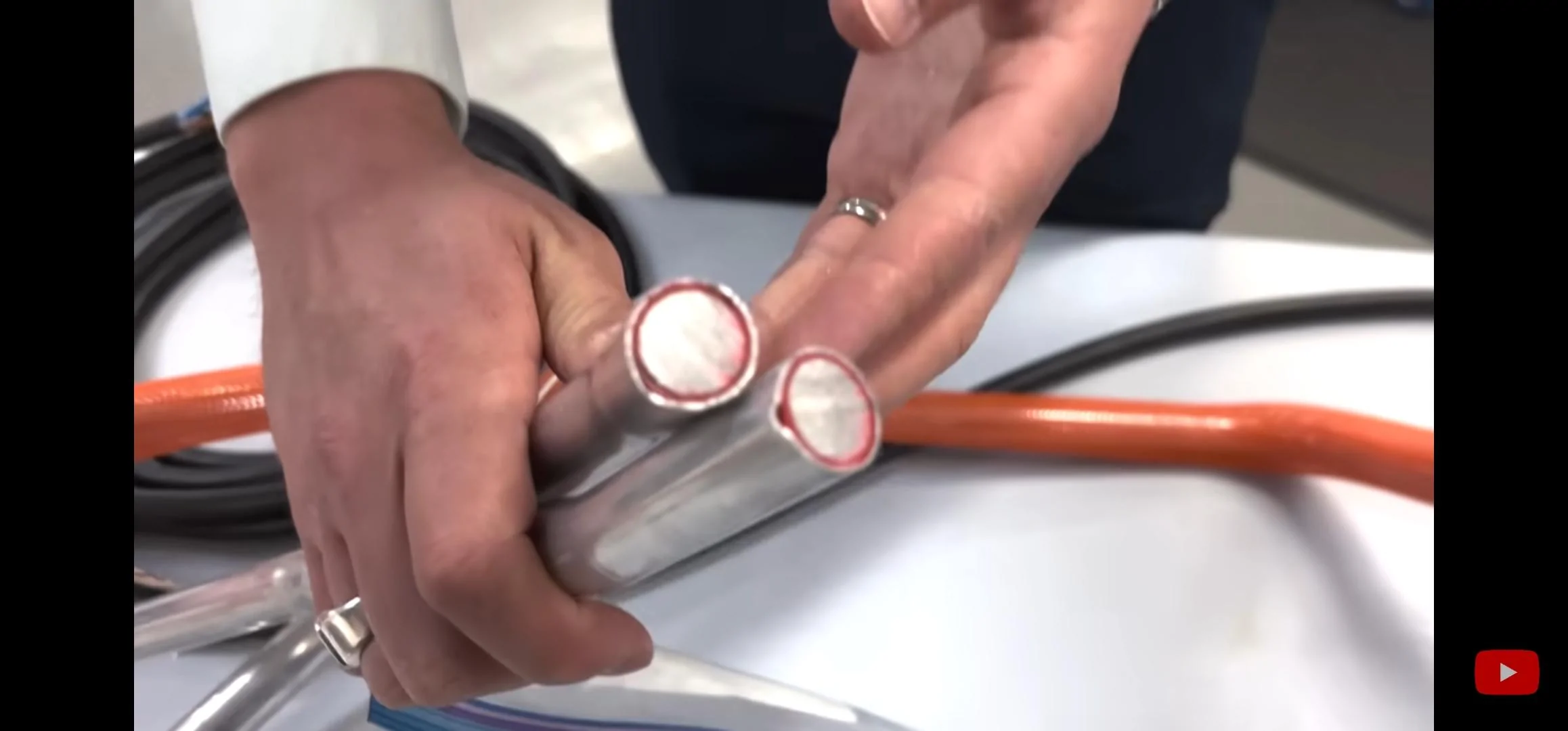
You are 100% wrong about aluminum wires carrying DC. The super dangerous Tesla configuration uses Aluminum for the AC and DC on the same bus bars. See picture of a cross section of the Tesla Model S bus bars.
Rivian R1T R1S Ford/Tesla Deal: Access to Superchargers, adapter coming, future EVs will have NACS (Tesla) port Screenshot_20230529_115759_YouTu
 

Dark-Fx

Well-Known Member
First Name
Brian
Joined
Jul 15, 2020
Threads
148
Messages
13,583
Reaction score
27,430
Location
Michigan
Vehicles
R1T, R1S, Livewire One, Sierra EV, R1S
Occupation
Engineering
Clubs
 
What is wrong with having AC and DC on the same pins?

The current doesn't flow until the handshake from plug to car is made.
Sometimes contactors get welded shut. The way Tesla implements it means you can't AC charge if one of the contactors involved in DC charging gets welded shut, because it's the same wire. There's nothing to prevent you from plugging in to the vehicle which will then expose whatever is plugged in directly to battery voltage.
 

Spork8

Well-Known Member
First Name
Trevor
Joined
Feb 18, 2022
Threads
1
Messages
134
Reaction score
148
Location
KZoo
Vehicles
2022 R1T
Occupation
Engineer
Clubs
 
If holding a Electrical Engineering degree and working in the design and manufacturing of electronics counts then yes, I'm ignorant.
You say you hold a degree but lack basic electrical circuit knowledge. It's a freshman level course. So, no, what you claim does not count. But you get points for trying.

Might want to brush up on your NFPA 70 if you're going to claim to be a EE.
 
First Name
Matt
Joined
Jul 25, 2022
Threads
0
Messages
23
Reaction score
18
Location
SoCal
Vehicles
2022 Tesla model 3, 2016 Toyota Highlander
Sometimes contactors get welded shut. The way Tesla implements it means you can't AC charge if one of the contactors involved in DC charging gets welded shut, because it's the same wire. There's nothing to prevent you from plugging in to the vehicle which will then expose whatever is plugged in directly to battery voltage.
If this happens the pyro fuse will blow and disable the car. You will have a non-operational vehicle but you also will be safe.
Sponsored


Top