Sponsored

Efficiency Questions M/KWH

BCondrey

Well-Known Member
First Name
Barry
Joined
Dec 12, 2021
Threads
0
Messages
695
Reaction score
696
Location
Richmond, VA
Vehicles
R1T
Occupation
IT
They aren't hiding anything, they are using the EPA estimates for the total range. I have a lifetime of 2.4 or so, and can get 2.5 - 2.6 on most highway road trips. That on a G1 DM large with 21" tires. I would have to get 2.7 consistently to reach the range the truck shows. And, I could do that if I wanted to drive it like they did during the EPA test. This is no different than any other EPA rating for an ICE vehicle. They are all very optimistic. I have become very adept and mental math and ignore the stated range in the truck. Every 10% of battery is about 30 miles of range for me.
Sponsored

 

Golfer04

Well-Known Member
First Name
Mike
Joined
Aug 21, 2023
Threads
11
Messages
568
Reaction score
599
Location
Illinois
Vehicles
R1T
Occupation
Finance
When I got my first T (on my 3rd now) I was range/efficiency obsessed. Now I don't even keep track. If you do track it another big factor is using conserve mode, and dropping the suspension to low. I don't want to tear up my tires so I only use conserve on the highway and never drop suspension to low. On a recent 100 mile trip in my Tri Max on I-74 in central Illinois I did track efficiency via the trip meter. It was perfect conditions with cruise set at 73 mph. I was stunned to see I got 2.74. If I got 2.0 in this cooler weather I would be satisfied. The bigger issue is dcfc charging speed. Don't get me started..........
 

mpshizzle

Well-Known Member
Joined
Jun 16, 2024
Threads
76
Messages
1,307
Reaction score
2,179
Location
Utah
Vehicles
2025 R1S Dual Max (Baymax)
They aren't hiding anything, they are using the EPA estimates for the total range. I have a lifetime of 2.4 or so, and can get 2.5 - 2.6 on most highway road trips. That on a G1 DM large with 21" tires. I would have to get 2.7 consistently to reach the range the truck shows. And, I could do that if I wanted to drive it like they did during the EPA test. This is no different than any other EPA rating for an ICE vehicle. They are all very optimistic. I have become very adept and mental math and ignore the stated range in the truck. Every 10% of battery is about 30 miles of range for me.
I suspect a lot of people don't realize just how much influence automakers have over the "EPA" rating. The EPA has guidelines on how to do the ratings, with different options of testing procedures and there is room for variance. This is why some automakers will consistently hit their EPA range, and some automakers will never hit their EPA range.

You can see this with Rivian's own ratings. Gen 1 ratings all assume something in the neighborhood of 2.5mi/kWh. With the new "stricter" EPA standards for 2025, they're assuming 2.9mi/kWh.

So while the EPA range is helpful, it's certainly not as strict or universal as people might assume.
 

Hereforthesnacks

Well-Known Member
Joined
Jun 6, 2024
Threads
3
Messages
1,240
Reaction score
1,469
Location
West Coast
Vehicles
Ford Bronco
I don’t think Rivian is hiding anything. In fact, most reviews will say that Rivian is at the top of true range vs EPA range. Tesla is near the bottom with EPA ranges being wildly optimistic.

Efficiency is done on controller surfaces in favorable conditions. If you are buying an EV, you should know that ranges are very variable.

I started at an 84 mi range on a 24 kwHr battery! That was tough.
 

mpshizzle

Well-Known Member
Joined
Jun 16, 2024
Threads
76
Messages
1,307
Reaction score
2,179
Location
Utah
Vehicles
2025 R1S Dual Max (Baymax)
I don’t think Rivian is hiding anything. In fact, most reviews will say that Rivian is at the top of true range vs EPA range. Tesla is near the bottom with EPA ranges being wildly optimistic.

Efficiency is done on controller surfaces in favorable conditions. If you are buying an EV, you should know that ranges are very variable.

I started at an 84 mi range on a 24 kwHr battery! That was tough.
I think this holds true for gen 1. But probably not so much for gen 2
 

Sponsored

DayTripping

Well-Known Member
First Name
Timothy
Joined
Sep 12, 2024
Threads
13
Messages
1,544
Reaction score
2,133
Location
DFW
Vehicles
Gen1 R1T QM, S Plaid, Highland 3 Perf, 3 Long Range, R2 on order
Occupation
Consultant
I was stuck in some highway construction instead of my normal 75-85 mph on Texas roads. I had a few stops in about a 35 mile stretch of road. My G1 R1T quad was getting about 3.75 m/kwh at about a steady 50 mph. Sometimes the 15 minute graph was reading 4 m/wkh. I am running on the factory 21s. So based on those numbers, I could go 487-520 miles at that speed. I was in conserve mode.

I think Rivian made a mistake shrinking the G2 large pack so much. I know it was to encourage you to upgrade over the large. If you have a G1 truck the extra 7k or so they charge over a large pack to get a max pack seems to be a total ripoff.

Everyone needs to remember that Rivian has a lot of flexibility in how they have their trucks test with the EPA. The EPA highway test is limited to a max of 60 mph! Average speed is 48 mph. Maybe if you are in New Jersey or Massachusetts, this might apply to you. In Texas or Florida, not even remotely close to highway.

https://en.wikipedia.org/wiki/FTP-75

Let's talk about efficiency a bit. I don't see the G2 trucks being that much more than the G1 at higher speeds regardless of what Rivian says. From a drag perspective, we have two types we are dealing with. Rolling resistance and aerodynamic drag.

  • Rolling resistance
    The force required to move a vehicle on a level surface at a constant speed when there is no aerodynamic drag or traction. Rolling resistance is caused by the deformation of tires, and friction with the ground. Tires with a harder rubber compound have lower rolling resistance, while softer tires have higher rolling resistance (also more aggressive tread styles).

  • Aerodynamic drag
    The mechanical force that occurs when a vehicle moves through the air. It's similar to air resistance and is the opposing force that a vehicle needs to overcome to move forward.
Rolling resistance (and other drivetrain loses) are more linear as speed rises than aero drag. Aero drag increase by the square of speed and HP required goes up by the cube. The loses due to rolling resistance are greater at lower speeds than aero, but typically around 30-40 mph, aero becomes greater.

So whatever tiny improvements Rivian may do behind the scenes to improve motor efficiency will likely be dwarfed by the aerodynamic drag at higher speeds. At lower speeds, where aero isn't as much of a factor (such as the EPA test), G2 may seem better, but at higher speeds a lot of that gain won't matter as much due to aero. On a G1 R1T, a tonneau cover might help you more at higher speeds than the improvements Rivian did to the G2.

You can see some of that at play in the Edmunds test of a 2022 quad and 2025 dual RITs but not at higher speeds. The PDM had about 12% more range with about a 9% larger pack. Not a huge gain in my book especially considering it was a dual motor. I don't see how a G2 truck with the large pack is going to hit its claimed 330 mile with the large pack that shrunk vastly from the G1. Edmunds wasn't going that fast on their range tests either. So at higher speeds, I doubt there would be much difference between a G1 or G2 truck in the real world.
  • 2022 Rivian R1T
    In Edmunds' real-world range test, the R1T Adventure with a 135-kW battery pack achieved 317 miles of range, which is slightly better than the EPA-estimated 314 miles. The R1T's average lifetime consumption was 54.6 kWh/100 miles.

  • 2025 Rivian R1T
    In Edmunds' testing, the Dual-Motor Performance with the Max battery pack and 22-inch wheels achieved 357 miles of range, which was less than the EPA-estimated 380 miles.
 

LL75

Well-Known Member
First Name
lance
Joined
Sep 21, 2022
Threads
44
Messages
1,756
Reaction score
1,282
Location
Dallas
Vehicles
R1S, R1T, Silverado, F150, RangeRover Evoque
I was stuck in some highway construction instead of my normal 75-85 mph on Texas roads. I had a few stops in about a 35 mile stretch of road. My G1 R1T quad was getting about 3.75 m/kwh at about a steady 50 mph. Sometimes the 15 minute graph was reading 4 m/wkh. I am running on the factory 21s. So based on those numbers, I could go 487-520 miles at that speed. I was in conserve mode.

I think Rivian made a mistake shrinking the G2 large pack so much. I know it was to encourage you to upgrade over the large. If you have a G1 truck the extra 7k or so they charge over a large pack to get a max pack seems to be a total ripoff.

Everyone needs to remember that Rivian has a lot of flexibility in how they have their trucks test with the EPA. The EPA highway test is limited to a max of 60 mph! Average speed is 48 mph. Maybe if you are in New Jersey or Massachusetts, this might apply to you. In Texas or Florida, not even remotely close to highway.

https://en.wikipedia.org/wiki/FTP-75

Let's talk about efficiency a bit. I don't see the G2 trucks being that much more than the G1 at higher speeds regardless of what Rivian says. From a drag perspective, we have two types we are dealing with. Rolling resistance and aerodynamic drag.

  • Rolling resistance
    The force required to move a vehicle on a level surface at a constant speed when there is no aerodynamic drag or traction. Rolling resistance is caused by the deformation of tires, and friction with the ground. Tires with a harder rubber compound have lower rolling resistance, while softer tires have higher rolling resistance (also more aggressive tread styles).

  • Aerodynamic drag
    The mechanical force that occurs when a vehicle moves through the air. It's similar to air resistance and is the opposing force that a vehicle needs to overcome to move forward.
Rolling resistance (and other drivetrain loses) are more linear as speed rises than aero drag. Aero drag increase by the square of speed and HP required goes up by the cube. The loses due to rolling resistance are greater at lower speeds than aero, but typically around 30-40 mph, aero becomes greater.

So whatever tiny improvements Rivian may do behind the scenes to improve motor efficiency will likely be dwarfed by the aerodynamic drag at higher speeds. At lower speeds, where aero isn't as much of a factor (such as the EPA test), G2 may seem better, but at higher speeds a lot of that gain won't matter as much due to aero. On a G1 R1T, a tonneau cover might help you more at higher speeds than the improvements Rivian did to the G2.

You can see some of that at play in the Edmunds test of a 2022 quad and 2025 dual RITs but not at higher speeds. The PDM had about 12% more range with about a 9% larger pack. Not a huge gain in my book especially considering it was a dual motor. I don't see how a G2 truck with the large pack is going to hit its claimed 330 mile with the large pack that shrunk vastly from the G1. Edmunds wasn't going that fast on their range tests either. So at higher speeds, I doubt there would be much difference between a G1 or G2 truck in the real world.
  • 2022 Rivian R1T
    In Edmunds' real-world range test, the R1T Adventure with a 135-kW battery pack achieved 317 miles of range, which is slightly better than the EPA-estimated 314 miles. The R1T's average lifetime consumption was 54.6 kWh/100 miles.

  • 2025 Rivian R1T
    In Edmunds' testing, the Dual-Motor Performance with the Max battery pack and 22-inch wheels achieved 357 miles of range, which was less than the EPA-estimated 380 miles.

Yeap. I got stuck in traffic going from austin to dallas not too long ago on my dual R1T. I see 3.8 on the 15 mins screen for almost 45 mins or so going average 40 mph. Max range can definitely be done if you want to.
 

Golfer04

Well-Known Member
First Name
Mike
Joined
Aug 21, 2023
Threads
11
Messages
568
Reaction score
599
Location
Illinois
Vehicles
R1T
Occupation
Finance
You can't believe the 15 minute screen though. If you want a close to accurate number you have to use the trip meter. If you don't believe me reset your vehicle, then reset trip A and drive 15 minutes. You will see to very different numbers (or I did). The 15 minute screen is high.
 

ElGuano

Well-Known Member
Joined
Oct 9, 2024
Threads
47
Messages
857
Reaction score
1,217
Location
Cali
Vehicles
R1T Trimax - Storm Blue, Driftwood, Sport Dark
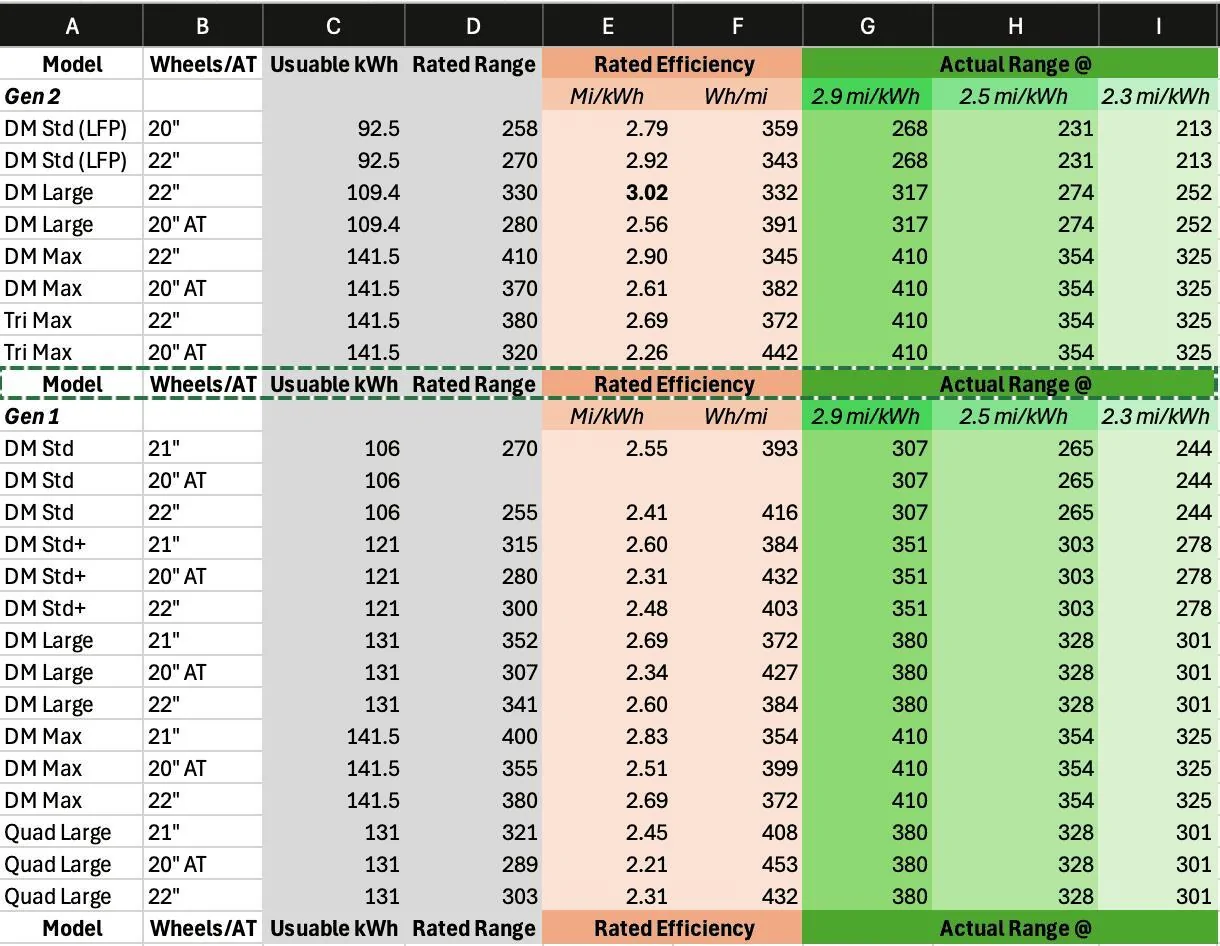
Reference chart I made for efficiency of Gen 1 and 2. All Gen 2 EPA range numbers are very optimistic, the large pack most egregiously so:

1732513689239-sr.jpg
I think Trimax with 22" is rated at 370, not 380?
 

Singletracker

Well-Known Member
Joined
Mar 10, 2022
Threads
39
Messages
1,304
Reaction score
1,275
Location
NV
Vehicles
2023 R1T QM w/20” A/T’s
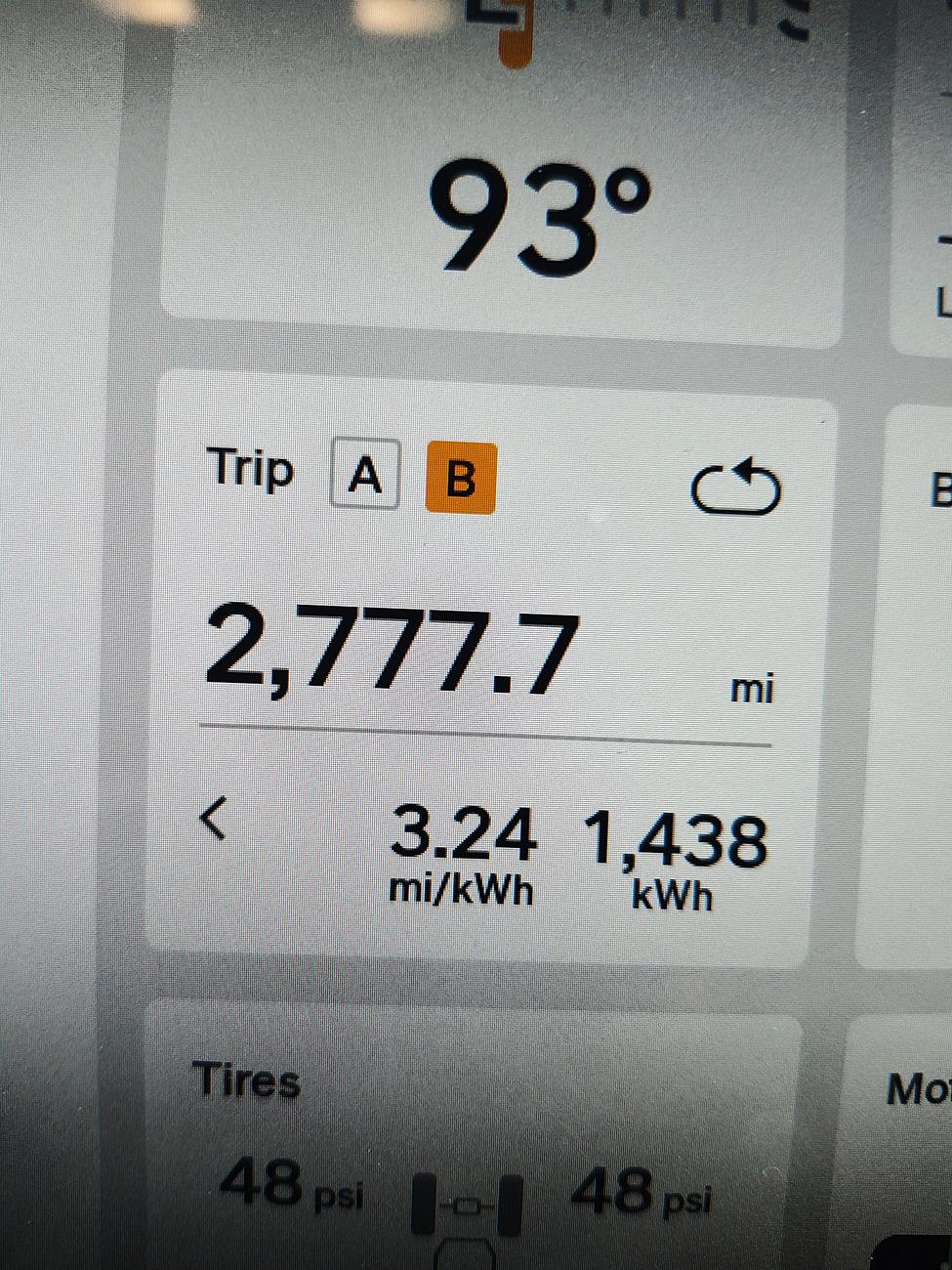
Yes, how it's driven. My performance dual motor large pack R1T.

1000001637.jpg
What am I missing? How does this vehicle calculated m/kWh? Seems to me, if you drive 2777 miles and consume 1438 kWh, your actual m/kWh is more like 1.9, not 3.24.
 

Sponsored

SANZC02

Well-Known Member
First Name
Bob
Joined
Feb 11, 2021
Threads
50
Messages
7,409
Reaction score
12,702
Location
California
Vehicles
Tesla Model S, LE - R1S
Occupation
Retired
It is all in driving style. If you are going arounrd 50 to 60 mph in ideal condition, you can get very close to it.
A lot of truth in this statement. When I was in MA a few months ago driving around on the back roads in the 35-50 mph range I was getting close to 2.7 m/kWh in my G1 quad. Can’t get close to that in SoCal where all the road are open with speed limits north of 50.
 

Treebeard

Well-Known Member
First Name
Matthew
Joined
Mar 9, 2024
Threads
0
Messages
216
Reaction score
132
Location
Vermont
Vehicles
R1T
Clubs
 
I thought the Gen2 large packs were smaller than the Gen1. Rivian was relying on vastly increased efficiency to offset them shrking the pack sizes on the Standard and Large Packs.

Here are the sized from another post on this forum.

Gen 2
  • STANDARD 92.5-kWh pack with a maximum charging speed of 200 kW;
  • LARGE 109.4-kWh pack with a maximum charging speed of 220 kW;
  • MAX 141.5-kWh pack with a maximum charging speed of 220 kW.

Gen 1
  • Standard: 106 kWh
  • Standard+: 121 kWh
  • Large: 131 kWh
  • Max: 141 kWh
My large pack gen 1 is 135 kWh. Says it right on the info sheet.
 

Treebeard

Well-Known Member
First Name
Matthew
Joined
Mar 9, 2024
Threads
0
Messages
216
Reaction score
132
Location
Vermont
Vehicles
R1T
Clubs
 
What am I missing? How does this vehicle calculated m/kWh? Seems to me, if you drive 2777 miles and consume 1438 kWh, your actual m/kWh is more like 1.9, not 3.24.
Well energy goes to more than just the motors and yes I do t see anyway you are actually averaging 3.24 unless you drive very slow and steady.
 

Treebeard

Well-Known Member
First Name
Matthew
Joined
Mar 9, 2024
Threads
0
Messages
216
Reaction score
132
Location
Vermont
Vehicles
R1T
Clubs
 
That's a drastic oversimplification.

The first factor is weather. Rivians are extremely weak to cold weather and you will see 35%+ battery loss at freezing.

2nd is speed. 50ish is ideal. True highway speeds (75-80) will result in another 25%+ loss.

3rd is wind. Rivians are extremely susceptible to wind and I've noticed significant range loss in windy weather.

4th is elevation. The Rivian is going to be extra inefficient going up in elevation, ie mountains.

So people reply on here "it's the way you drive!" when someone in Florida is always going to vastly outrange someone in cooler weather.

2.35 in cooler weather is normal. I often get sub 2.
The way you drive is important. Some people have told me they go from stop to stop light as fast as they can all the time. Average speed is also important along with tire type. I’m seeing some amazing numbers in this thread and have a hard time believing some of them. But as you stated every area is different and everybody will have different results.
 

DayTripping

Well-Known Member
First Name
Timothy
Joined
Sep 12, 2024
Threads
13
Messages
1,544
Reaction score
2,133
Location
DFW
Vehicles
Gen1 R1T QM, S Plaid, Highland 3 Perf, 3 Long Range, R2 on order
Occupation
Consultant


Top