
Sponsored

EVs Mooch Off, Do Not Pay Fair Share for Road Usage

Donald Stanfield

Well-Known Member
First Name
Donald
Joined
Jul 31, 2022
Threads
59
Messages
8,307
Reaction score
16,656
Location
USA
Vehicles
2025 R1S Tri Ascend, 2024 i4 M50
Occupation
Stuff and things
While the weight may be 10x, it's spread across between 5 and 9 axles, making the per-axle load only about 2x.
The engine alone weighs more than 2K lbs so the drive axle is much heavier.


Small point of clarification. 20k lbs is the max for a steer-axle, per federal regulations. And generally that is the most weight allowed on any single axle. But most tractor-trailers are not loaded to 80k. I drove for more than a decade and never had a load over 45k.
As you just said here. Assuming that single axle is 20K lbs it is doing over twice the load of my entire truck. That's significantly more damaging. Not to mention the box trucks, dump trucks, concrete mixer trucks, crane trucks ect that are driving down the road daily in the millions of vehicles. Passenger vehicles, even EVs, aren't what is wearing down the roadways.
Sponsored


godfodder0901

Well-Known Member
First Name
Jared
Joined
Mar 12, 2019
Threads
27
Messages
5,748
Reaction score
10,138
Location
Washington
Vehicles
2022 Rivian R1T LE
Passenger vehicles, even EVs, aren't what is wearing down the roadways.
I mean, they are. Just at a significantly lower rate then commercial traffic, a contention I have held from the beginning of this conversation. But this only holds true for major roadways. There are millions of miles of interior and surface streets that are very rarely (if ever) touched by commercial vehicles. One these roads, the majority of the damage is caused by passenger traffic.
 

Rivdog

Well-Known Member
First Name
Chris
Joined
Nov 14, 2022
Threads
12
Messages
631
Reaction score
1,616
Location
Oregon
Vehicles
2023 R1T
What we should also be talking about is we are getting double taxed. We are paying taxes on the electricity we buy. Just like what a gasoline tax would be.
This is such a good point and the first time I’ve seen it made.

Also, for anyone saying we should move away from fuel taxes and just make it a registration fee, I understand that argument. But everyone who drives has to buy fuel, so the taxes will be paid if the vehicle is on the road. A significant number of vehicles on the road do not have current registration, so if that was the entirety of the tax revenue stream, it would be an extra reward for those who choose to ignore the law. I see how this argument can be applied to the EV owner, however, in that if they don’t pay the registration fee then no taxes for road maintenance can ever be collected. It’s a flawed system either way.
 

Yossarian

Well-Known Member
Joined
Oct 20, 2020
Threads
45
Messages
934
Reaction score
922
Location
SE Pennsylvania
Vehicles
R1T,Telluride, Wee-Strom, Lynskey Cooper
I mean, they are. Just at a significantly lower rate then commercial traffic, a contention I have held from the beginning of this conversation. But this only holds true for major roadways. There are millions of miles of interior and surface streets that are very rarely (if ever) touched by commercial vehicles. One these roads, the majority of the damage is caused by passenger traffic.
This is true to some extent. I would like to suggest however, that those roadways, most of which are residential, are in much better shape than those like county roads that regularly see 18-wheelers and other commercial traffic, and that they also tend to go far longer before needing repair due to vehicle use. The roads in my neighborhood for example have been repaved one time in their 70+ year existence, due not so much to traffic wear and tear, but to having been dug up for replacement of sewer lines. This seems to suggest that the damage to residential roads from use by passenger vehicles while real, is relatively small.

I would also suggest that nearly all residential roads see at least some some heavy vehicle traffic. The sources are many: the dump trucks used for winter sanding and snow removal, heavy vehicles used in construction/home remodeling (e. g., flatbeds and cement trucks ), and an occasional 18-wheeler doing a delivery. Moreover, these roads also see a significant amount of traffic from somewhat lighter commercial vehicles such as UPS, FedEx and Amazon delivery trucks.
 

SRO

Well-Known Member
First Name
Steve
Joined
Mar 21, 2023
Threads
3
Messages
299
Reaction score
142
Location
Carson City nv
Vehicles
R1T
Occupation
retired
This is such a good point and the first time I’ve seen it made.

Also, for anyone saying we should move away from fuel taxes and just make it a registration fee, I understand that argument. But everyone who drives has to buy fuel, so the taxes will be paid if the vehicle is on the road. A significant number of vehicles on the road do not have current registration, so if that was the entirety of the tax revenue stream, it would be an extra reward for those who choose to ignore the law. I see how this argument can be applied to the EV owner, however, in that if they don’t pay the registration fee then no taxes for road maintenance can ever be collected. It’s a flawed system either way.
There is a factor that I didn’t mention. The bigger need for gas taxes is for capacity improvements caused by the shear volume of vehicles. To add lanes or build new highways. This is the bigger reason to tax all vehicles including EVs of all sizes. I am not against taxing EVs to help pay for vehicle capacity improvements. The tax would be based on VMT (vehicle miles travelled). That is fair but hard to compute. Plus there are privacy issues I think DOTs are wrestling with. That was being discussed when I was at the DOT and still no resolution. I left the DOT in 2000. I think it is easy for commercial vehicles but not personal cars and trucks. Also the VMT would need to be broken up by state when you cross state lines due to local taxes.
 

Sponsored

Donald Stanfield

Well-Known Member
First Name
Donald
Joined
Jul 31, 2022
Threads
59
Messages
8,307
Reaction score
16,656
Location
USA
Vehicles
2025 R1S Tri Ascend, 2024 i4 M50
Occupation
Stuff and things
I mean, they are. Just at a significantly lower rate then commercial traffic, a contention I have held from the beginning of this conversation. But this only holds true for major roadways. There are millions of miles of interior and surface streets that are very rarely (if ever) touched by commercial vehicles. One these roads, the majority of the damage is caused by passenger traffic.
Those interior streets last longer around here than the plan to replace them takes so our roads are pristine. The roads that take the beating are due to commercial traffic. In areas where the roads are bad, weather's usually the primary wear factor. The freeze-thaw cycle and snowplows with salt are the huge wear factor there.
 

Lord Leroy

Well-Known Member
Joined
Feb 7, 2024
Threads
10
Messages
130
Reaction score
188
Location
Boise
Vehicles
R1t
I still maintain that EV’s should not be paying such a high registration tax “because we don’t pay the gas tax”

gas tax and taxes I pay on my electrons from the grid are taxes. Not our fault the government doesn’t use the taxes to where the money “should go”.

EV’s are then taxed again with a large registration fee. $1260 this year for my R1T in Cali for a renewal vs $250 for my ICE minivan.

That $1000 from registration and taxes on my electrons are by far and away more than our “fair share” for the negligible amount of more damage we do to roads. And is much more than an ICE would pay with registration and gas tax.
 

godfodder0901

Well-Known Member
First Name
Jared
Joined
Mar 12, 2019
Threads
27
Messages
5,748
Reaction score
10,138
Location
Washington
Vehicles
2022 Rivian R1T LE
This is true to some extent. I would like to suggest however, that those roadways, most of which are residential, are in much better shape than those like county roads that regularly see 18-wheelers and other commercial traffic, and that they also tend to go far longer before needing repair due to vehicle use. The roads in my neighborhood for example have been repaved one time in their 70+ year existence, due not so much to traffic wear and tear, but to having been dug up for replacement of sewer lines. This seems to suggest that the damage to residential roads from use by passenger vehicles while real, is relatively small.

I would also suggest that nearly all residential roads see at least some some heavy vehicle traffic. The sources are many: the dump trucks used for winter sanding and snow removal, heavy vehicles used in construction/home remodeling (e. g., flatbeds and cement trucks ), and an occasional 18-wheeler doing a delivery. Moreover, these roads also see a significant amount of traffic from somewhat lighter commercial vehicles such as UPS, FedEx and Amazon delivery trucks.
From my vantage point, we are saying the same thing.
 

beatle

Well-Known Member
Joined
Jun 20, 2024
Threads
17
Messages
1,143
Reaction score
1,561
Location
Springfield, VA
Vehicles
'23 R1T PDM Max, '97/'25 Miatas, '19 Monkey
Occupation
IT
Clubs
 
Regarding axle load and road stress (wear) check out the fourth power law.

2 ton car / 2 axles = 1 ton per axle
3 1/2 ton R1T / 2 axles = 1.75 ton per axle

The R1T has 1.75x the load per axle so we calculate stress: 1.75 * 1.75 * 1.75 * 1.75 = 9.37x more stress on the road than a 2 ton vehicle.

A 60k truck may spread its load over 5 axles, so 6 tons per axle which is 3.42x the R1T: 3.42 * 3.42 * 3.42 * 3.42 = 136.8x more load than the R1T, and there are 2.5x as many axles, so 342x more load than the R1T, and 1,296x more than a 2 ton vehicle.

Taxing purely based on weight and miles would put trucking out of business without some kind of change, and nobody wants to spend $20 to send someone a letter either. I think tying vehicle taxes to gasoline/diesel to recoup road costs needs an overhaul, but oversimplifying it would have some nasty ripple effects.
 

BTOR

Well-Known Member
First Name
Brad
Joined
Dec 2, 2024
Threads
14
Messages
211
Reaction score
133
Location
Oregon
Vehicles
2023 Bolt, 2025 R1S
So the myth goes.

While EVs do not pay gasoline taxes, states do make sure that EVs still pay a so-called fair share through much higher annual registration fees levied on EVs only.

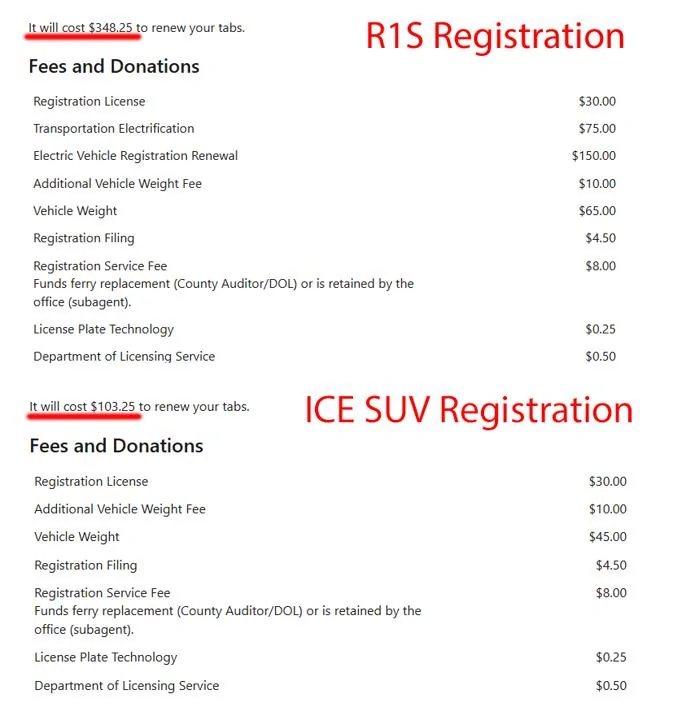
Comparing auto registration costs for my R1S to those for a typical ICE SUV, and eliminating commonalities, e.g., weight, it costs $225 more to register my R1S.

Looking at gasoline excise taxes in the area, the $225 additional EV registration tax would buy you 500 gallons of gasoline.

From the nerdy point of view, this means I would have had to charge north of 16,700 kWh on my Rivian to "break even"; I actually charged 3,400 kWh in 2024.

From the mileage point of view, overall consumption on my R1S for 2024 was 1.8 mi/kWh. That is 60 MPGe, which means that I would have to drive 30k miles in a given year to once again "break even"; I actually drove 6,300 miles in 2024.

And should I not drive my R1S at all; and it will be in winter storage for at least 6 months, I still pay the same for registration. No prorating. The same will go for my other two EVs. By comparison, ICE does not drive=ICE does not purchase gas=ICE does not pay taxes. Fair.

Registration fees on EVs seem capricious and arbitrary at best and can never begin to address the much-needed fairness. We all must pay our fair share for road usage. I am thinking ditch the excise tax on gasoline and make everybody pay annual registration according to mileage driven and throw in vehicle weight tax for good measure also. That would be very fair.

A side-by-side comparison on the R1S registration and an ICE SUV registration. The $75.00 EV tax "funds electric vehicle infrastructure." There is no such similar thing for the ICE SUV registration. In my days of driving ICE, I do not recall ever paying a tax for gasoline vehicle infrastructure, either.

Just a reality check.

EV-ICE registration.jpg
bigsky: We have a similar EV registration fee in our state. Our registration is good for 2 years. Annualized, it seems comparable to your's (~$158/yr). There are other fees on top of this but they apply to all vehicles (ICE & EV's). EV's are obviously exempt from the $25 emission tests which is required in certain counties. There is no GVW charge in our state for "light duty" vehicles.

So all added up, our ICE cost ~$104/yr to register and our EV, $188. So a surcharge of $84/yr. for owning an EV.

This past year, we replaced two ICE SUV's with two EV's. We kept our high mileage hybrid. Our gas tax is $0.50/gal. ($0.40 state + $0.10 local) which is high relative to most states. But for us, it is the decrease in carbon emission that justifies any potential increase in EV operating cost (~ 6 metric tons less CO2e/yr). BTW, we pay ~ $0.075 per kWh. Most all of that is hydro generated, although very small percentage is from solar, wind & NG.
 

Sponsored

SRO

Well-Known Member
First Name
Steve
Joined
Mar 21, 2023
Threads
3
Messages
299
Reaction score
142
Location
Carson City nv
Vehicles
R1T
Occupation
retired
Regarding axle load and road stress (wear) check out the fourth power law.

2 ton car / 2 axles = 1 ton per axle
3 1/2 ton R1T / 2 axles = 1.75 ton per axle

The R1T has 1.75x the load per axle so we calculate stress: 1.75 * 1.75 * 1.75 * 1.75 = 9.37x more stress on the road than a 2 ton vehicle.

A 60k truck may spread its load over 5 axles, so 6 tons per axle which is 3.42x the R1T: 3.42 * 3.42 * 3.42 * 3.42 = 136.8x more load than the R1T, and there are 2.5x as many axles, so 342x more load than the R1T, and 1,296x more than a 2 ton vehicle.

Taxing purely based on weight and miles would put trucking out of business without some kind of change, and nobody wants to spend $20 to send someone a letter either. I think tying vehicle taxes to gasoline/diesel to recoup road costs needs an overhaul, but oversimplifying it would have some nasty ripple effects.
Agreed but stress damage isn’t linear. But you capture the essence. They design pavements based on ESALs which take into consideration the total vehicle mix and their predicted volumes except motor cycles. The pavement section and therefore cost is mostly affected by semi’s.
 

JohnB R1T

Well-Known Member
First Name
John
Joined
Jan 27, 2023
Threads
5
Messages
224
Reaction score
302
Location
Comfort, TX
Vehicles
Rivian R1T
Occupation
Certified Public Accountant
All you people trying to make your point by comparing an R1T to some tiny little thing like a Smart Car...do you not realize that the best selling vehicle in America is, and has been for a LONG time...the Ford F Series pickup truck? Roughly 751,000 in 2023 alone. Between the Chevy Silverado and the Ram 1500, you can add another MILLION units to that one year's sales.

Let's talk apples-to-apples when comparing GVWR, shall we?
 

Hereforthesnacks

Well-Known Member
Joined
Jun 6, 2024
Threads
3
Messages
1,232
Reaction score
1,460
Location
West Coast
Vehicles
Ford Bronco
Kill the gas tax and tax people for road maintenance. End of story.

We have too many complicated ways to do simple things.
 

runwithscissors

Well-Known Member
Joined
Feb 10, 2021
Threads
2
Messages
466
Reaction score
497
Location
NY
Vehicles
XC90, MDX, R1S
There are taxes on my electricity bill that are calculated based on the amount of electricity I consume, even though they don't go towards maintaining the electric infrastructure. There are other "delivery charges" that are also calculated based on how much electricity I consume, but those go directly to the (investor owned, not public) utility. I'm not talking about those. I'm specifically talking about the taxes that go to the state/county/city government. They're getting that extra tax revenue only because my car runs on electricity rather than on gas. That extra tax revenue they receive from EV owners should not go to the general fund, it should go towards paying for the shortfall in the roads budget that was created when I switched from powering my car with gas to electric.
Same in NY, we get hit with delivery & system charges that ramp with increased usage. We're all going to be switched to Time-of-Day (TOD) Rates at some point. In the meantime they give you the illusion of choice with all their convoluted rate programs.

NY Delivery & System Charges
The cost to deliver electricity: includes operation and maintenance of
the electric system and certain transition charges of $0.020031/kWh on
behalf of the Utility Debt Securitization Authority, the owner of such
transition charges.

Misc taxes/Fees
DER Charge $ .004675
Delivery Service Adjustment 0.59
Revenue Decoupling Adjustment 0.04
NY State Assessment 0.40
Revenue-Based PILOTS 2.63


Top