
Sponsored

Owner experience with Fast Charging stations?

MountainBikeDude

Well-Known Member
First Name
Adam
Joined
Jun 20, 2019
Threads
54
Messages
3,334
Reaction score
7,088
Location
Vancouver
Vehicles
2023 El Cap Quad Motor R1T (Selling the Xterra)
Clubs
 
I think that you are getting lost in the weeds. One can make a similar argument therefore that because all EVs charging rate dramatically drops to trickle as 100% gets near, no EV should ever tie up or use any DCFC, then.
Thermal issues aside, or anything else for that matter, amy and all EV when fast charging always should use the DCFC that will afford the capacity for that EV to charge at the maximum advetised peak rate. Nothing DCFC higher, nothing DCFC lower; ergo, my point of saying that a 150 kW DCFC for a Rivian is not ideal. To me, that makes as much sense as saying that a 300 kW DCFC is ideal for a Bolt.
My point at the start was there's no point in waiting for a 350kW charger that's currently being used, when there is a 150kW charger that's available. I've seen some of the slowest charging vehicles literally sit and wait for a 350kW charger, for no other reason than it says HYPER FAST with 4 lightning bolts, only to plug in and get 49kW and think they're flying.

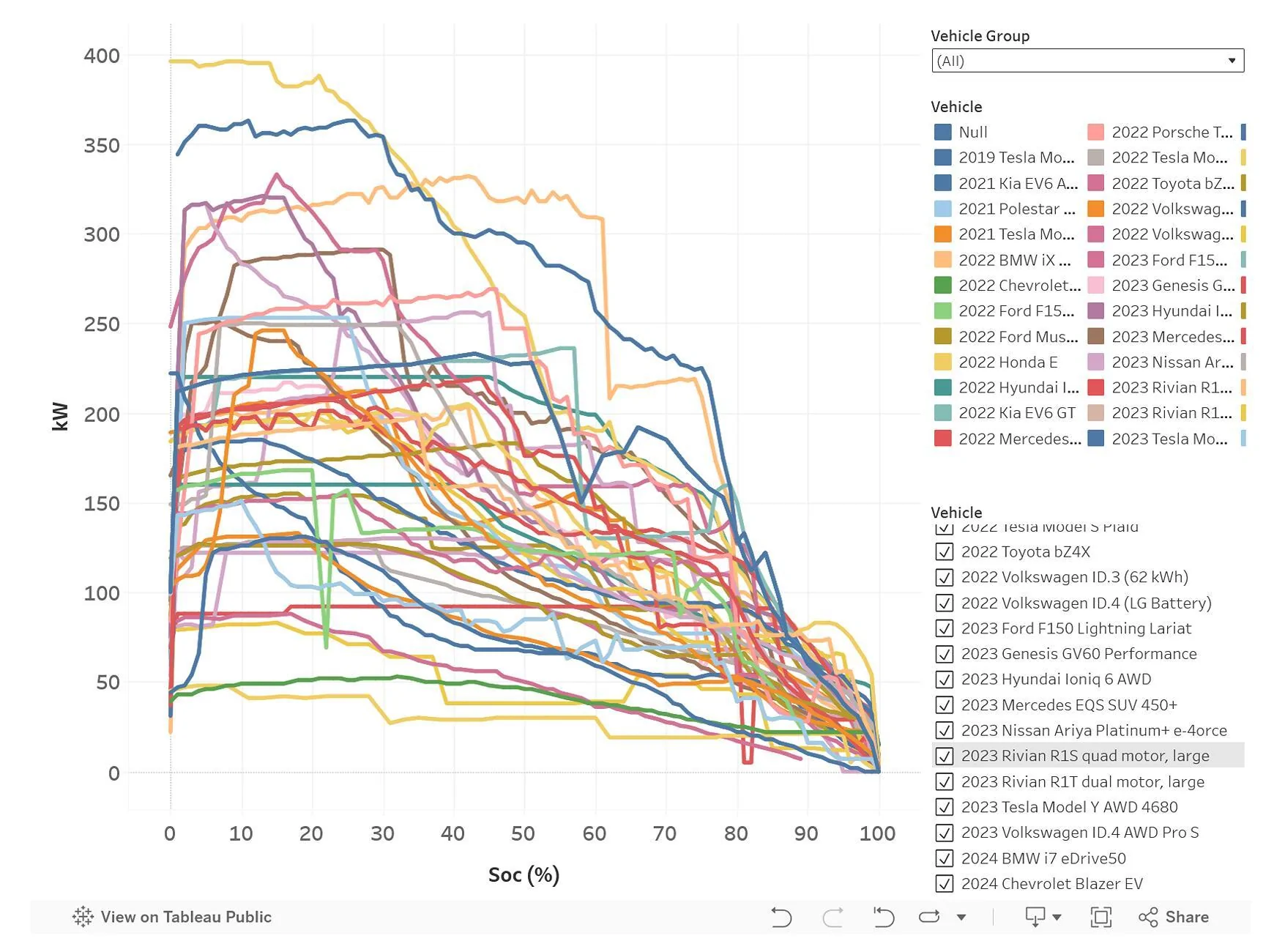
Going deeper in the weeds, In my experience, people are rocking up to DCFC's with 40% or more battery, and charge either to around 90 or 100%. When you're around the 50% mark, your C rate starts to drop, in some vehicles more than others, but the advantage of a 350 over a 150 falls off pretty quickly, after say 10% (now at 50% SOC), and really getting up that 10% between the two translates to around a 1 minute difference. then they equalize and follow the sub 150 charge profile.
Rivian R1T R1S Owner experience with Fast Charging stations? 1749232420875-22
Sponsored


MountainBikeDude

Well-Known Member
First Name
Adam
Joined
Jun 20, 2019
Threads
54
Messages
3,334
Reaction score
7,088
Location
Vancouver
Vehicles
2023 El Cap Quad Motor R1T (Selling the Xterra)
Clubs
 
@bigsky: You're missing the context.

Which is, that the 150kW EA chargers will provide >190kW to a Rivian, so that you spend almost the same amount of time charging at a 150kW EA charger as at a 350kW EA charger. This has been discussed quite frequently in this forum, with videos and graphs and all sorts of accounts from actual users.

Because EVs can only maintain their peak charging rate for a portion of their charging curve, once the charging curve falls below ~190kW there is no difference in the amount of power you will get from a 150kW EA charger (giving ~190kW peak) and a 350kW EA charger (giving ~220kW peak). This crossover point is at 40%-45% SoC on a Rivian.

Plus, the 350kW EA chargers tend to have more problems, while the 150kW EA chargers are pretty reliable.

Additionally, people think big numbers are better, so the 350kW chargers seem to be the first choice for everyone driving up to a station, meaning they are usually the first stall occupied.

So, many Rivian drivers find that deliberately choosing the 150kW chargers means you're less likely to find them occupied, they're more likely to work, and they're less likely to derate as the 350kW chargers are prone to do. And if it takes 2-3 minutes longer to charge, who cares - you will waste five to ten times that if you pull up to a 350kW charger and it won't start or if it derates after you've started your charge and walked into the Walmart to use the bathroom ...

The advice from @MountainBikeDude is very practical. Of course you're welcome to follow whatever strategy you desire, but that doesn't make his advice wrong.
Good points on the beyond 150 rate Rivians get on the 150 chargers, and the amount of dicking around on the 350's you have to do most times. I forgot about both of those nuances
 

bigsky

Banned
Well-Known Member
Joined
Jan 8, 2024
Threads
12
Messages
1,098
Reaction score
740
Location
MUM
Vehicles
MUM
@bigsky: You're missing the context.

Which is, that the 150kW EA chargers will provide >190kW to a Rivian, so that you spend almost the same amount of time charging at a 150kW EA charger as at a 350kW EA charger. This has been discussed quite frequently in this forum, with videos and graphs and all sorts of accounts from actual users.

Because EVs can only maintain their peak charging rate for a portion of their charging curve, once the charging curve falls below ~190kW there is no difference in the amount of power you will get from a 150kW EA charger (giving ~190kW peak) and a 350kW EA charger (giving ~220kW peak). This crossover point is at 40%-45% SoC on a Rivian.

Plus, the 350kW EA chargers tend to have more problems, while the 150kW EA chargers are pretty reliable.

Additionally, people think big numbers are better, so the 350kW chargers seem to be the first choice for everyone driving up to a station, meaning they are usually the first stall occupied.

So, many Rivian drivers find that deliberately choosing the 150kW chargers means you're less likely to find them occupied, they're more likely to work, and they're less likely to derate as the 350kW chargers are prone to do. And if it takes 2-3 minutes longer to charge, who cares - you will waste five to ten times that if you pull up to a 350kW charger and it won't start or if it derates after you've started your charge and walked into the Walmart to use the bathroom ...

The advice from @MountainBikeDude is very practical. Of course you're welcome to follow whatever strategy you desire, but that doesn't make his advice wrong.
Clearly, you are attempting to justify the premise that 150 kW dispensers are more ideal than, say a 350 kW dispensers for all the wrong reasons, hardly on the merits.
A given charging rate depends on several factors, anyway, not just on the nominal peak rating a dispenser provides.
Can't speak for any of the other lesser DCFC networks out there compared to Tesla, but 5 years in using Tesla DCFCs never, even once, have I seen a, say xxx kW dispenser pump out more than that nominal xxx peak rate, or anything significantly higher than what you purportedly indicate happens with those other dispensers. Quite the contrary, for design reasons, and other things remaining the same, a Tesla dispenser, and dare say others, may provide less than the advertised rate.

It all depends on how much you want to charge and how much time you want to spend charging. At the end of the day, one need not be Albert Eistein or a rocket scientist to figure out that a Rivian will get to any desired SOC % faster using a DCFC dispenser that outputs more than 150 kW, full stop. Reasons why I consider this notion that a 150 kW dispenser is more ideal for a Rivian, pure, unadulterated, bona fide rubbish. Might be well-meaning, but flat out nonsense nonetheless.
 

bigsky

Banned
Well-Known Member
Joined
Jan 8, 2024
Threads
12
Messages
1,098
Reaction score
740
Location
MUM
Vehicles
MUM
My point at the start was there's no point in waiting for a 350kW charger that's currently being used, when there is a 150kW charger that's available. I've seen some of the slowest charging vehicles literally sit and wait for a 350kW charger, for no other reason than it says HYPER FAST with 4 lightning bolts, only to plug in and get 49kW and think they're flying.

Going deeper in the weeds, In my experience, people are rocking up to DCFC's with 40% or more battery, and charge either to around 90 or 100%. When you're around the 50% mark, your C rate starts to drop, in some vehicles more than others, but the advantage of a 350 over a 150 falls off pretty quickly, after say 10% (now at 50% SOC), and really getting up that 10% between the two translates to around a 1 minute difference. then they equalize and follow the sub 150 charge profile.
1749232420875-22.jpg
Yes, yes, yes!
I could not agree with you more in your initial paragraph. EV education is badly needed.
One of my points being that a let's call it EV uneducated person using a 350 kW charger whose vehicle charges at a much lower maximum rate DOES not a 150 kW dispenser is therefore better make.
 

Revelation

Well-Known Member
Joined
Nov 28, 2018
Threads
4
Messages
288
Reaction score
500
Location
North Carolina
Vehicles
Rivian Blue R1T
Occupation
IT Solutions Architect
Clearly, you are attempting to justify the premise that 150 kW dispensers are more ideal than, say a 350 kW dispensers for all the wrong reasons, hardly on the merits.
A given charging rate depends on several factors, anyway, not just on the nominal peak rating a dispenser provides.
Can't speak for any of the other lesser DCFC networks out there compared to Tesla, but 5 years in using Tesla DCFCs never, even once, have I seen a, say xxx kW dispenser pump out more than that nominal xxx peak rate, or anything significantly higher than what you purportedly indicate happens with those other dispensers. Quite the contrary, for design reasons, and other things remaining the same, a Tesla dispenser, and dare say others, may provide less than the advertised rate.

It all depends on how much you want to charge and how much time you want to spend charging. At the end of the day, one need not be Albert Eistein or a rocket scientist to figure out that a Rivian will get to any desired SOC % faster using a DCFC dispenser that outputs more than 150 kW, full stop. Reasons why I consider this notion that a 150 kW dispenser is more ideal for a Rivian, pure, unadulterated, bona fide rubbish. Might be well-meaning, but flat out nonsense nonetheless.
What you missed, or maybe wasn't explained well enough...

If you hit up a charger and hit the max charge of 220kW on a Rivian, due to heat it will derate to a lower charging speed than a 150kW charger will. So you charger longer, at higher charging rates on a 150kW than at 220kW.

Out of Spec Motoring did tests on this. It turns out charging at a 220kW capable station versus 150kW capable station resulted in a total charging difference of around 2 minutes if memory serves me correctly.

If the battery thermals were better designed then the 220kW capable station would always be better.
 

Sponsored

bigsky

Banned
Well-Known Member
Joined
Jan 8, 2024
Threads
12
Messages
1,098
Reaction score
740
Location
MUM
Vehicles
MUM
What you missed, or maybe wasn't explained well enough...

If you hit up a charger and hit the max charge of 220kW on a Rivian, due to heat it will derate to a lower charging speed than a 150kW charger will. So you charger longer, at higher charging rates on a 150kW than at 220kW.

Out of Spec Motoring did tests on this. It turns out charging at a 220kW capable station versus 150kW capable station resulted in a total charging difference of around 2 minutes if memory serves me correctly.

If the battery thermals were better designed then the 220kW capable station would always be better.
Suppose I pull out to a Tesla Level 4 charger with my Rivian having hardly any charge left.
The Tesla dispenser practically starts pumping out 220 kW into my Rivian from the get-go,
Further suppose I decide to quit charging when my Rivian hits 40%.
Regardless of how lousy or good the Rivian thermals are, I will go out on a limb here and submit that I will finish charging, be back on the road, gone much sooner than a Rivian with a similar SOC pulling up to a 150 kW Tesla charger (oh, wait, Tesla 150 kW chargers do not support Rivians), but other things remaining the same for the sake of the argument.
 

Revelation

Well-Known Member
Joined
Nov 28, 2018
Threads
4
Messages
288
Reaction score
500
Location
North Carolina
Vehicles
Rivian Blue R1T
Occupation
IT Solutions Architect
Suppose I pull out to a Tesla Level 4 charger with my Rivian having hardly any charge left.
The Tesla dispenser practically starts pumping out 220 kW into my Rivian from the get-go,
Further suppose I decide to quit charging when my Rivian hits 40%.
Regardless of how lousy or good the Rivian thermals are, I will go out on a limb here and submit that I will finish charging, be back on the road, gone much sooner than a Rivian with a similar SOC pulling up to a 150 kW Tesla charger (oh, wait, Tesla 150 kW chargers do not support Rivians), but other things remaining the same for the sake of the argument.
Why do you keep bringing up Tesla 150kW chargers? There a plenty of other chargers that limit to 150kW, that is what we have been discussing.

Yes if you only charge to 40% then you may charge faster than someone on a 150kW charger unless your thermals are bad your Rivian de-rates your speeds.
 

MountainBikeDude

Well-Known Member
First Name
Adam
Joined
Jun 20, 2019
Threads
54
Messages
3,334
Reaction score
7,088
Location
Vancouver
Vehicles
2023 El Cap Quad Motor R1T (Selling the Xterra)
Clubs
 
Suppose I pull out to a Tesla Level 4 charger with my Rivian having hardly any charge left.
The Tesla dispenser practically starts pumping out 220 kW into my Rivian from the get-go,
Further suppose I decide to quit charging when my Rivian hits 40%.
Regardless of how lousy or good the Rivian thermals are, I will go out on a limb here and submit that I will finish charging, be back on the road, gone much sooner than a Rivian with a similar SOC pulling up to a 150 kW Tesla charger (oh, wait, Tesla 150 kW chargers do not support Rivians), but other things remaining the same for the sake of the argument.
Ofcourse you'd be out of there sooner. but typically 10-80% there is only a marginal 2-3 minute difference between 220peak and 150 flat.
 

bigsky

Banned
Well-Known Member
Joined
Jan 8, 2024
Threads
12
Messages
1,098
Reaction score
740
Location
MUM
Vehicles
MUM
Ofcourse you'd be out of there sooner. but typically 10-80% there is only a marginal 2-3 minute difference between 220peak and 150 flat.
And for anybody with an ICE mentality to charge to 100% all the time, that will quickly add up to eternity.
Going through my extensive DCFC charging logs, I rarely have charged to 80%, even with my Model S that has free juice for life.
This fatally flawed notion that the 150 kW dispenser is better. Ladies, gentlemen, you proponents and defenders of this absurdity have gotten yourselves into a deep hole today shovel in hand. For the love of god, stop digging!
 

Revelation

Well-Known Member
Joined
Nov 28, 2018
Threads
4
Messages
288
Reaction score
500
Location
North Carolina
Vehicles
Rivian Blue R1T
Occupation
IT Solutions Architect
And for anybody with an ICE mentality to charge to 100% all the time, that will quickly add up to eternity.
Going through my extensive DCFC charging logs, I rarely have charged to 80%, even with my Model S that has free juice for life.
This fatally flawed notion that the 150 kW dispenser is better. Ladies, gentlemen, you proponents and defenders of this absurdity have gotten yourselves into a deep hole today shovel in hand. For the love of god, stop digging!
I disagree, no one has said to hit a DC Charger and charge to 80%+ every time - no one. You keep adding your own context to what others have typed.
 

Sponsored

bigsky

Banned
Well-Known Member
Joined
Jan 8, 2024
Threads
12
Messages
1,098
Reaction score
740
Location
MUM
Vehicles
MUM
I disagree, no one has said to hit a DC Charger and charge to 80%+ every time - no one. You keep adding your own context to what others have typed.
You are making the mistake of fixating your thinking on a given SOC percentage, namely 80% this time.
Again, you need not be Einstein, or an electrical engineer, or a rocket scientist to figure out that a higher-capacity DCFC will charge faster than a lower-capacity DCFC. Whether or not the difference matters to you or not, that altogether becomes your subjective and capricious opinion, irrelevant at best to the fundamental argument at hand.
 

VSG

Well-Known Member
Joined
Oct 3, 2022
Threads
4
Messages
3,227
Reaction score
6,024
Location
WA
Vehicles
R1T LE/RB/OC/20
@bigsky: What is your objective here? How is being a dick helping the original poster, who is a prospective EV owner trying to learn more about the practicalities of charging?

This is what was asked:
I understand Rivian's Charging Network plus the Tesla partnership provides a lot of coverage along popular routes for long roadtrips, but what kind of kW capacity do I need to be on the lookout for when I'm looking for charge from 10-20% up to 70-80% in 20-30 minutes time?
 

MountainBikeDude

Well-Known Member
First Name
Adam
Joined
Jun 20, 2019
Threads
54
Messages
3,334
Reaction score
7,088
Location
Vancouver
Vehicles
2023 El Cap Quad Motor R1T (Selling the Xterra)
Clubs
 
@bigsky: What is your objective here? How is being a dick helping the original poster, who is a prospective EV owner trying to learn more about the practicalities of charging?

This is what was asked:
There's a shadow slowly being cast over him from above, it appears to be a bridge being constructed... a cozy new home for the troll 😜
 

Revelation

Well-Known Member
Joined
Nov 28, 2018
Threads
4
Messages
288
Reaction score
500
Location
North Carolina
Vehicles
Rivian Blue R1T
Occupation
IT Solutions Architect
You are making the mistake of fixating your thinking on a given SOC percentage, namely 80% this time.
Again, you need not be Einstein, or an electrical engineer, or a rocket scientist to figure out that a higher-capacity DCFC will charge faster than a lower-capacity DCFC. Whether or not the difference matters to you or not, that altogether becomes your subjective and capricious opinion, irrelevant at best to the fundamental argument at hand.
No, you mentioned 80%.

And for anybody with an ICE mentality to charge to 100% all the time, that will quickly add up to eternity.
Going through my extensive DCFC charging logs, I rarely have charged to 80%, even with my Model S that has free juice for life.
It's funny that you only reference 40% SOC as ideal as you know the Rivian begins to drop around that time. What you want to ignore is that most people are charging more than 40% on road trips, especially if they follow the built-in navigation.

The "argument" is one where you fail to acknowledge the poor design of battery thermal management in the Rivian. When you charge at a higher-rated charger you will get derated in your charging speed well before a lower charging station. Thus the charging time is negligible between the two. That is a proven fact. You want to limit the SOC to 40% to avoid that conversation to make it seem like you know more than others.
Sponsored


Top