
Sponsored

iansriv

Well-Known Member
Joined
Feb 12, 2022
Threads
20
Messages
2,795
Reaction score
3,809
Location
US
Vehicles
R1S
A couple of thoughts here. I recently put in an inverter and batteries. After going through this adventure my perspective on V2H has changed.

I didn't go with the SigEnergy solution as their inverter only works with their proprietary batteries, so if they go belly up or they decide to gouge for their batteries you are stuck with them. Other solutions on the market will work with any current 48V battery so you aren't locked into a single vendor for your batteries. I've learned over time that single vendor solutions can be very painful.

I don't currently have V2H bidi charging with the inverter I selected but I'm hopeful that solutions will become available down the road, maybe. I have had a solar array on the roof for over 10 years with micro-inverters so the inverter I went with had to be able to accept the AC from the panels and be able to do the frequency shifting necessary to keep the panels producing in a grid down situation.

I added batteries (32kwh storage at this time) mostly for grid down situations. I had an e-panel installed to automatically reduce my loads if the grid fails, and I do some load shedding through home automation to further reduce loads. I bring this up because the installer of the inverter didn't have a clue about home automation and how to manage loads (if you are looking, consider your installer's technical expertise on controlling the whole house, not just slapping an inverter and some batteries on the wall).

Because I had the foresight to put in solar panels when the power company was offering 1 to 1 net metering I get a KWh back for each KWh I send to them, which reduces my incentives to use the batteries for Time of Use (TOU) to reduce my power bills. I have however learned a lot about the flexibility of modern inverters and how to configure them.

My inverter is fully capable of setting all sorts of parameters for how TOU would work if I were to go that direction, whether I were able to use V2H or not. One mention, you'd never run your batteries to 0% and through the Battery Management System (BMS) you can adjust things like the charge curve so once you get to a certain level the BMS will slow the charge so as you approach 100% you aren't cooking the batteries being charged. Another thing to keep in mind is your loads in your house rarely run at peak demand all day long, so even if you can put say, 200 amps through your electrical panel most of the day your load is much less.

Even if I had a financial incentive to use TOU and I had V2H bidi abilities, I'm not sure I'd use my batteries and drain them to the max to help the power company handle peak loads. Because the grid can fail, my primary goal is to keep the house running without the maintenance costs and headaches of a generator, so there is some incentive to not sell all my stored power to the power company, whether that power comes from my on-site batteries or from my vehicle. Additionally, if the TOU incentives were lucrative enough, I'd probably just go with more batteries and a bigger solar array rather than using my EV as the batteries are less costly to replace if one goes bad, they are warranted for over 8000 charge discharge cycles which is about 21 years of charge/discharge cycles if you were to have one cycle every day, and I can more closely monitor their parameters through the BMS software on the inverter and the battery packs. The batteries are always at the house whereas I drive my Rivian, so the vehicle wouldn't always be available to cover my house loads or fill in when TOU rates are the highest.

It would be nice to have the Rivian able to send juice back to my house in grid down situations when my fixed batteries are discharged and the sky is cloudy but I'm not about to drain the Rivian's battery to the point where I have to seek out a DCFC before I can drive anywhere as there is a chance the DCFC would be down as well, just to make some bucks on sellig power back to the power company. Stand alone batteries continue to get less expensive and more durable. A couple of years ago I would have told you the solution is V2H, now with some experience with a stand alone solution I'm less concerned with V2H solutions.
Mark-brilliant note! I'm a few steps behind you. I absolutely agree with you. My solar panels are connected to the grid and I get 1-1 net metering. So, I've been a bit lazy about adding batteries. I also dont fancy using the Rivian as a constant battery for the home. My current inverter is a Growatt. It's "cheap" and does the job well. However, my choices are limited IF I choose to add batteries. At some point, I will probably add batteries even if it means switching to a different inverter. Cheers.
Sponsored


Virtio

Well-Known Member
First Name
Steve
Joined
Apr 4, 2022
Threads
7
Messages
170
Reaction score
248
Location
Santa Cruz Mountains
Vehicles
Rivian R1S
Occupation
Engineer
Clubs
 
I'd like to be able to use my R1S for back-up power during outages. A friend has a Lightning with the 220V output and it's super handy. He just plugs his house into the truck when the power goes out. We both have the transfer switches integrated into our meters. I need about 5kW to run the house and was thinking about getting a solar inverter to convert the high voltage DC from the R1S to split-phase 220V to run the house. Has anyone used a device like this to do that?

https://www.sun-boost.com/products/ixceed-5-5kw-6-2kw-d120?variant=45482762535102

Basically I would connect the R1S to the solar panel high voltage DC input on the inverter (rated up to 450VDC) and connect the AC output to the transfer switch. I know it wouldn't be instant. I'd have to go plug it in but it's fairly inexpensive.
 

mkhuffman

Well-Known Member
First Name
Mike
Joined
Nov 9, 2020
Threads
14
Messages
2,882
Reaction score
3,230
Location
Virginia
Vehicles
2025 R1T Tri-Max, Jeep GC-L, VW Jetta
I'd like to be able to use my R1S for back-up power during outages. A friend has a Lightning with the 220V output and it's super handy. He just plugs his house into the truck when the power goes out. We both have the transfer switches integrated into our meters. I need about 5kW to run the house and was thinking about getting a solar inverter to convert the high voltage DC from the R1S to split-phase 220V to run the house. Has anyone used a device like this to do that?

https://www.sun-boost.com/products/ixceed-5-5kw-6-2kw-d120?variant=45482762535102

Basically I would connect the R1S to the solar panel high voltage DC input on the inverter (rated up to 450VDC) and connect the AC output to the transfer switch. I know it wouldn't be instant. I'd have to go plug it in but it's fairly inexpensive.
How do you plan to tap into the high voltage battery?
 

Sponsored

Virtio

Well-Known Member
First Name
Steve
Joined
Apr 4, 2022
Threads
7
Messages
170
Reaction score
248
Location
Santa Cruz Mountains
Vehicles
Rivian R1S
Occupation
Engineer
Clubs
 
How will you communicate with the vehicle to open the DC contacts?
Yeah, that's the part that I don't know about. Hopefully once they enable V2X then I can use something like this. Was curious to know if anyone has tried to get DC out this way. The handshake required to enable charging is well defined (SAE J1772/IEC 61851) and common among EVs but the V2X standards are pretty much proprietary for now.
 
Last edited:

mkhuffman

Well-Known Member
First Name
Mike
Joined
Nov 9, 2020
Threads
14
Messages
2,882
Reaction score
3,230
Location
Virginia
Vehicles
2025 R1T Tri-Max, Jeep GC-L, VW Jetta
Yeah, that's the part that I don't know about. Hopefully once they enable V2X then I can use something like this. Was curious to know if anyone has tried to get DC out this way.
Technically it is already enabled if you have an inverter that can communicate with the truck and connect to the DCHV battery. I think what Rivian has not released yet is their own V2X equipment.

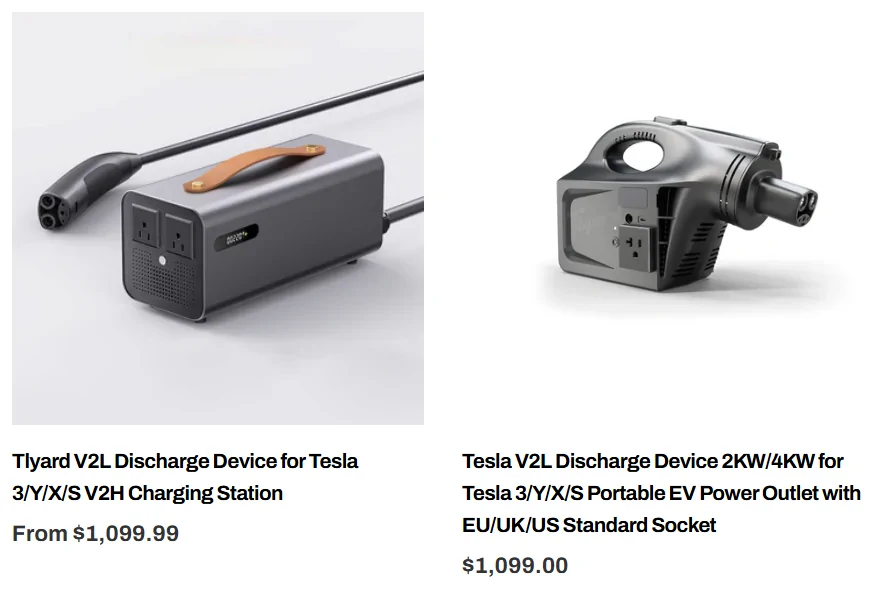
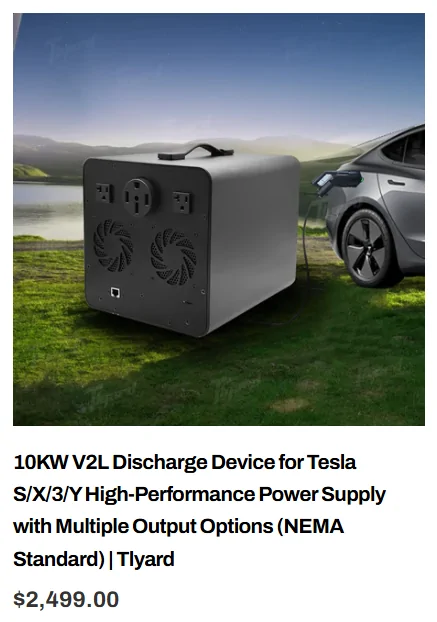
The Sigenergy V2X module costs about $3500, but it is up to 25 kWh. Tlyard has three solutions that are designed for V2X but at a lower power; however, I have not seen any tests with Rivian to confirm they actually work.

The Tlyard options are much more reasonably priced, and in line with what you are trying to do. Maybe the cost of these solutions will drop over time as more competition emerges, but I expect the cost will never drop down to the price of that Sunboost inverter.


Rivian R1T R1S Rivian V2X V2H Solution available now using PointGuard/Sigenergy BiDirectional? 1772652766794-14

Rivian R1T R1S Rivian V2X V2H Solution available now using PointGuard/Sigenergy BiDirectional? 1772652823453-1u


The 10 kW version follows the NEMA standard for V2X, so it is the one that is most likely to work with a Rivian. The other two are definitely questionable, and are designed for use with a Tesla. If I had the time, I would buy one of the $1k versions and see if it works or not. Maybe this summer unless someone else beats me to it.
 

Virtio

Well-Known Member
First Name
Steve
Joined
Apr 4, 2022
Threads
7
Messages
170
Reaction score
248
Location
Santa Cruz Mountains
Vehicles
Rivian R1S
Occupation
Engineer
Clubs
 

mudito

Well-Known Member
First Name
Aldo
Joined
Jul 30, 2024
Threads
18
Messages
1,011
Reaction score
1,414
Location
Texas
Vehicles
Rivian R1T
I'd like to be able to use my R1S for back-up power during outages. A friend has a Lightning with the 220V output and it's super handy. He just plugs his house into the truck when the power goes out. We both have the transfer switches integrated into our meters. I need about 5kW to run the house and was thinking about getting a solar inverter to convert the high voltage DC from the R1S to split-phase 220V to run the house. Has anyone used a device like this to do that?

https://www.sun-boost.com/products/ixceed-5-5kw-6-2kw-d120?variant=45482762535102

Basically I would connect the R1S to the solar panel high voltage DC input on the inverter (rated up to 450VDC) and connect the AC output to the transfer switch. I know it wouldn't be instant. I'd have to go plug it in but it's fairly inexpensive.
My stopgap solution :)
https://www.rivianforums.com/forum/threads/how-to-use-your-rivian-as-a-power-bank-safe-way.56535/
Sponsored


Top