Sponsored

L1 Wall Charger Outlet Discoloration

s00n

Well-Known Member
Joined
Sep 28, 2022
Threads
13
Messages
199
Reaction score
314
Location
CO
Vehicles
R1S - Cayenne S - Jeep LJ Rubicon Turbo
We recently bought a newish cabin and have been L1 charging with the Rivian portable charger on an exterior outlet maybe 30 times (always used the top outlet). Never noticed any excessive heat/errors, but I just noticed the outlet is visibly discolored now. Being newish and only using it to charge, I have is assume the Rivian charger is causing this. How concerned should we be? TIA

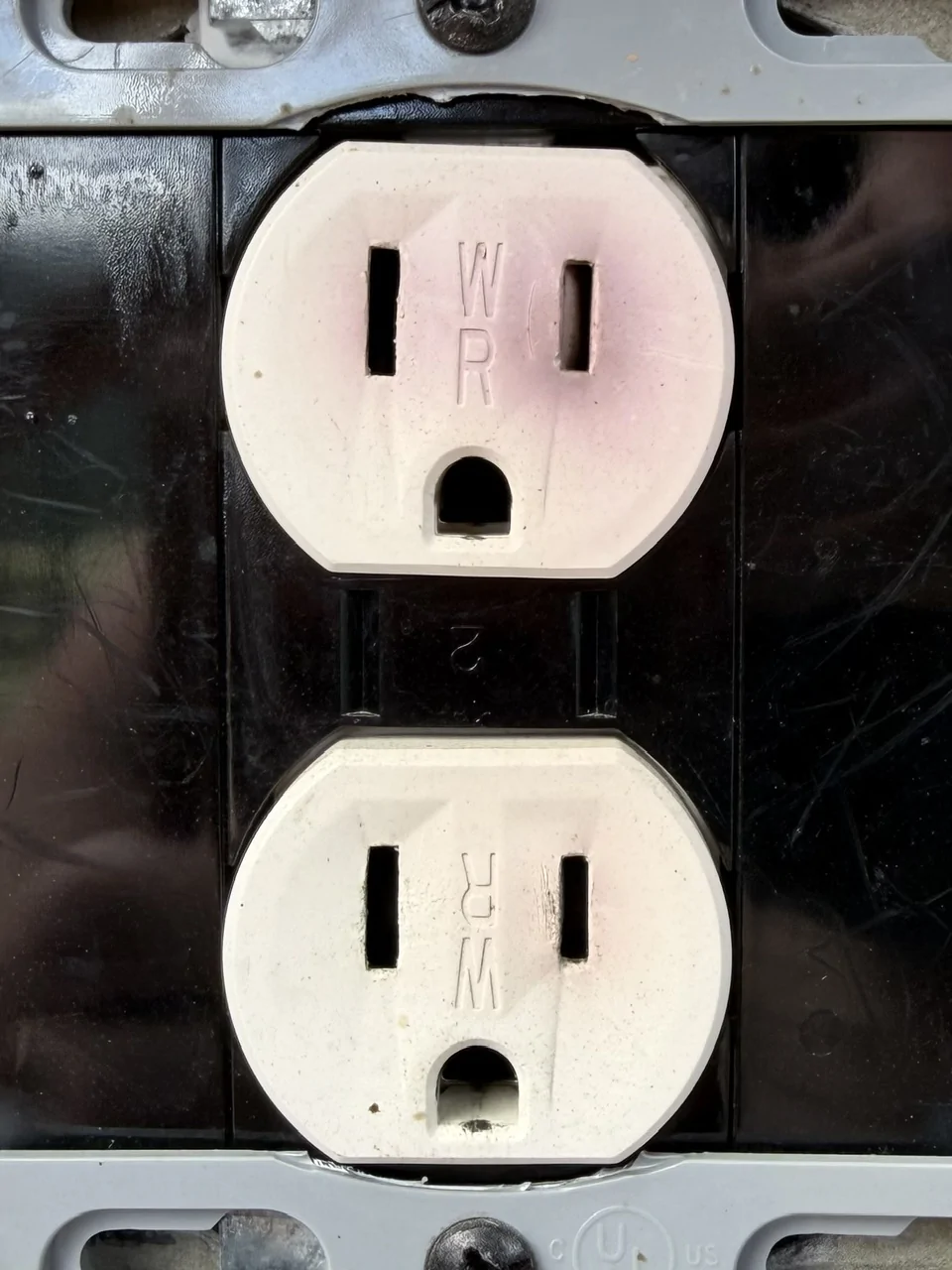
Rivian R1T R1S L1 Wall Charger Outlet Discoloration IMG_1611
Sponsored


VSG

Well-Known Member
Joined
Oct 3, 2022
Threads
4
Messages
3,233
Reaction score
6,039
Location
WA
Vehicles
R1T LE/RB/OC/20
You need to replace that outlet now, before you use it again, and check the circuit to make sure the correct size wiring is used.

It's unlikely to be a problem with the mobile charger - if the mobile charger failed and was drawing too much power the breaker would trip (and check the breaker too for correct size - this should be a 15A breaker, and almost certainly should be a GFCI breaker by code). It's far more likely that a poor quality outlet was used, or the person who installed the outlet did a sloppy job of securing the wires. Not uncommon in new(er) construction.
 
OP
OP
s00n

s00n

Well-Known Member
Joined
Sep 28, 2022
Threads
13
Messages
199
Reaction score
314
Location
CO
Vehicles
R1S - Cayenne S - Jeep LJ Rubicon Turbo
You need to replace that outlet now, before you use it again, and check the circuit to make sure the correct size wiring is used.

It's unlikely to be a problem with the mobile charger - if the mobile charger failed and was drawing too much power the breaker would trip (and check the breaker too for correct size - this should be a 15A breaker). It's far more likely that a poor quality outlet was used, or the person who installed the outlet did a sloppy job of securing the wires. Not uncommon in new(er) construction.
Thanks, I'll check the breaker and swap out the outlet next time we're up there. Being exterior, should it be replaced with a GFCI?
 

VSG

Well-Known Member
Joined
Oct 3, 2022
Threads
4
Messages
3,233
Reaction score
6,039
Location
WA
Vehicles
R1T LE/RB/OC/20
I don't know what the rules are where you live, but I believe as an external outlet that would usually require GFCI and also probably a cover of some sort.
 

MF Spaceship

Member
First Name
Brad
Joined
Apr 14, 2025
Threads
5
Messages
20
Reaction score
5
Location
CA
Vehicles
R1S
Occupation
Real Estate
When I used a 110 outlet with my R1S portable charger I did not even get a charge that was worth the effort. I was plugged in for hours and only got one mile… is this normal?
 

Sponsored

stormbreaker

Well-Known Member
First Name
Ettore
Joined
Sep 13, 2024
Threads
32
Messages
184
Reaction score
206
Location
Connecticut
Vehicles
23 R1T Dual/Large, 94 Z28
Occupation
SE
First off, call an electrician before doing anymore level 1.

Second, I only tried L1 when I first got the truck and before I got my EVSE installed and it was a waste of time. 1 mile per hour is just plain silly.
 

VandalSibs

Well-Known Member
First Name
Andrew
Joined
Dec 27, 2023
Threads
15
Messages
1,403
Reaction score
2,430
Location
Eastern Washington State
Website
www.sibulskymusic.com
Vehicles
R1T Dual Motor Large Pack
Occupation
Composer, IT Service Desk Analyst
Clubs
 
When I used a 110 outlet with my R1S portable charger I did not even get a charge that was worth the effort. I was plugged in for hours and only got one mile… is this normal?
The R1 vehicles have very big batteries, which when using a standard 120v, 15amp outlet (aka 'Level 1') will take a long time to charge.

It's best to stop thinking in "miles", as it's not a unit of capacity. Gas tanks aren't measured in miles, they are measured in gallons. The unit of capacity for a battery on the scale of an EV is the kilowatt hour (kWh). Current R1 vehicles have a battery no smaller than 100kWh.

The unit used to measure how fast an outlet is delivering power is the kW (which leads to the capacity unit being how much power was stored in an hour of charging, hence kWh.). A standard home outlet in the US & Canada is 120volts, and 15 amps. Multiply those together and you get the kW rating for an outlet. (120v X 15amp = 1,800w, or 1.8 kW). For safety, EV chargers only draw 80% of an outlet's max capacity, so the above equation would be 120v X 12 amps = 1.4 kW. EVs use some power while charging to run the battery management systems, and to warm up the batteries themselves if they need to - so that cuts into that 1.4 kW rate.

So, on a L1 outlet you're barely filling up the battery. It'll get there, but it's slow.

Thanks for attending my lecture, alas it won't grant you any college credits...
 

ElGuano

Well-Known Member
Joined
Oct 9, 2024
Threads
49
Messages
865
Reaction score
1,227
Location
Cali
Vehicles
R1T Trimax - Storm Blue, Driftwood, Sport Dark
12+ amp continuous from a standard 120v receptacle is a LOT of heat. The wires are typically rated for 15A (at most 20A) and normally they have a sizeable buffer for continusous load. Over time it's not uncommon to get discoloration.

I've been doing L1 charging for over 9 years, including a year and a half on the R1. L2 finally coming in next week, but yeah, many a night I double-check to make sure the breaker on that circuit is OK :)
 

Dasoss

Well-Known Member
First Name
David
Joined
Jul 10, 2025
Threads
2
Messages
139
Reaction score
66
Location
Utah
Vehicles
RIVIAN R1S Quad Max Launch
Occupation
Retired engineer
Thanks, I'll check the breaker and swap out the outlet next time we're up there. Being exterior, should it be replaced with a GFCI?
Yes, outlets do vary in quality. The connections have to be properly secured. Looping the wires around the screws properly and tightening the the proper torque, etc. Use the proper wire size on push in connections. The socket and plug contacts nead ro be clean and bright.
If the outlet is outside, it should be a GFCI or on a GFCI protected circuit. It should also be W rated. Look for a small W on the face. If it's not in a protected area, it needs a weatherproof cover. There are two types--one for temporary use and the other for continuous use. The difference is whether you are going to leave something plugged in and unattended on a semi-permanent basis.
 

Bob R1T

Well-Known Member
First Name
Bob
Joined
Feb 16, 2023
Threads
2
Messages
64
Reaction score
48
Location
Virginia
Vehicles
R1T, Model S
Occupation
architect
Clubs
 
You need to replace that outlet now, before you use it again, and check the circuit to make sure the correct size wiring is used.

It's unlikely to be a problem with the mobile charger - if the mobile charger failed and was drawing too much power the breaker would trip (and check the breaker too for correct size - this should be a 15A breaker, and almost certainly should be a GFCI breaker by code). It's far more likely that a poor quality outlet was used, or the person who installed the outlet did a sloppy job of securing the wires. Not uncommon in new(er) construction.
Shouldn't that be a 20Amp breaker, gfci at the breaker or the outlet? And of course a weatherproof in-use cover.
 

Sponsored

OP
OP
s00n

s00n

Well-Known Member
Joined
Sep 28, 2022
Threads
13
Messages
199
Reaction score
314
Location
CO
Vehicles
R1S - Cayenne S - Jeep LJ Rubicon Turbo
Thanks for the responses! The pic is zoomed in too far to see it is in a weatherproof box (can fully close when plugged in.).

Cabin is on the grid and with it plugged in the whole time we're there, usually charges ~2 mi/hr or about 50 miles a day, no problem reaching 90%
 

VSG

Well-Known Member
Joined
Oct 3, 2022
Threads
4
Messages
3,233
Reaction score
6,039
Location
WA
Vehicles
R1T LE/RB/OC/20
Shouldn't that be a 20Amp breaker, gfci at the breaker or the outlet? And of course a weatherproof in-use cover.
The outlet in the picture is a 15A outlet, NEMA 5-15. A 20A outlet looks different. I think code allows 15A outlets to be used on a 20A circuit, but the wire would have to be sized for 20A in that case.

With a burned outlet I personally would just get an electrician to do the work, for peace of mind. I think we all are capable of screwing in a new outlet we picked up at Home Depot, but in this case I think it's important to check to make sure the circuit is safe.

I think it's most likely just a bad outlet, maybe due to corroded or loose internal contacts, which resulted in a higher resistance at the contact between the outlet and the plug. The higher resistance converts the power to heat, and the plastic gets discolored. The fact that its discolored means that there's more heat than it was designed for, which is bad, and there could also be some internal melting you can't see. That will only progress, and eventually worst case cause a fire.
 

carsly

Well-Known Member
Joined
Apr 19, 2023
Threads
47
Messages
751
Reaction score
1,028
Location
Princeton, NJ
Vehicles
LR Defender, Tesla Model S
I"d get an electrician to take a look at the wiring leading to the outlet and also replace that outlet with a GFCI and weatherproof cover. Even so, I wouldn't recommend pulling more than 10-12 amps continuous and if you're there for a while it never hurts to turn it off for an hour in the middle of your charging session limiting it to 3-4 hours at a stretch. heat soak is a thing.

Right answer is probably have the same electrician wire up a proper NEMA 14-50 (or even 14-30) at 240 volts. 24 amps at 240 volts will give you 5.7kw instead of the 1.44kw you're getting now while frying your outlet.
 

VSG

Well-Known Member
Joined
Oct 3, 2022
Threads
4
Messages
3,233
Reaction score
6,039
Location
WA
Vehicles
R1T LE/RB/OC/20
Cabin is on the grid and with it plugged in the whole time we're there, usually charges ~2 mi/hr or about 50 miles a day, no problem reaching 90%
Yup, I do the same. I've been charging my R1T from a 120V outlet for four years at my other property. Based on literally thousands of hours of charging, I can say with confidence that slightly over 2 miles per hours / 50 miles per day is what you can expect. (I agree with @VandalSibs that this is a poor measure, and I am loathe to contribute to this practice of quoting miles of range. But I use it only for L1 charging discussions - really - to point out that L1 is usable and useful in many situations.)

When I used a 110 outlet with my R1S portable charger I did not even get a charge that was worth the effort. I was plugged in for hours and only got one mile… is this normal?
Second, I only tried L1 when I first got the truck and before I got my EVSE installed and it was a waste of time. 1 mile per hour is just plain silly.
Again, in practice you get slightly more than 2 "miles of range", not 1.

I think it's a perfectly reasonable thing to do, and I think a lot of people waste money on an L2 charger (+ expensive install) when they really don't need that capacity. Of course if you need it, go with L2, but since the average commute is 25 miles a day or so, I think most people can have most of their needs met by L1 charging, and it's something people should try before dismissing it so quickly.


Top