
ksurfier
Well-Known Member
- Thread starter
- #1
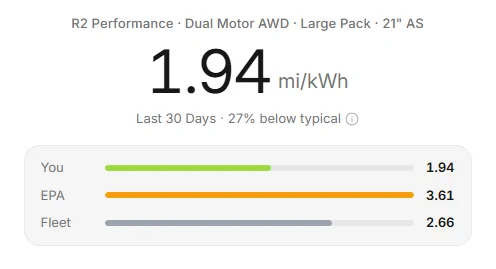
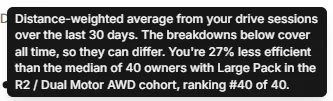
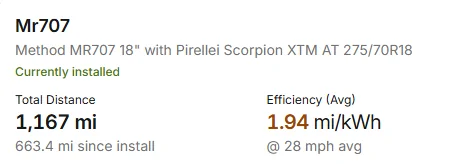
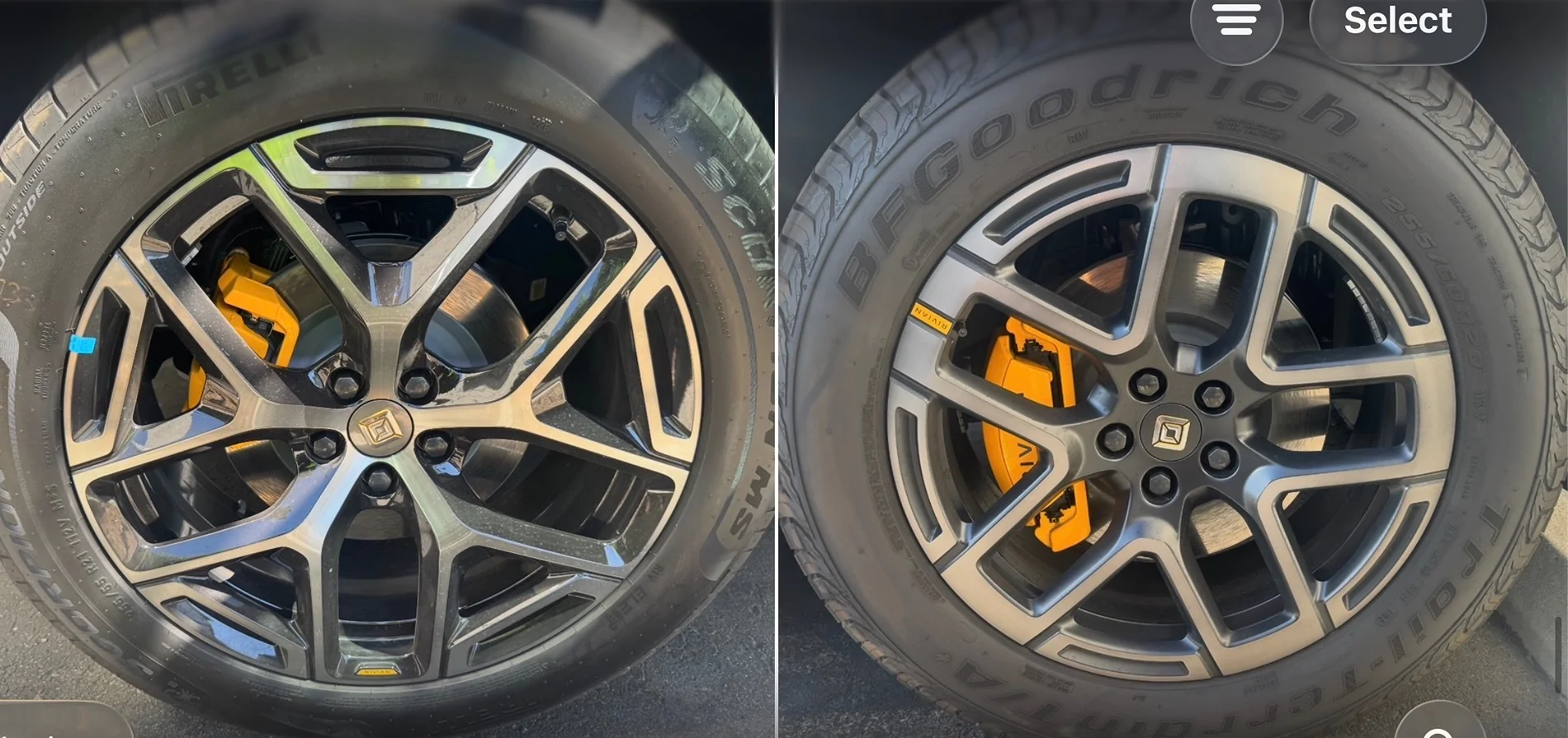
While anecdotal, it appears that the R2 with 20" wheels may in fact be slightly more efficient that the 21" setup. Some say that it's just the 21" crowd is driving faster, which might be true, interesting none-the-less:
As reported here: Rivian Tires: Compare & Review for R1T, R1S & R2
Update 3, August 19: Will the 21" R2 Catch Up with the 20"?
A month into this little tire science experiment, the good news is that the picture is getting clearer. The bad news is that our famous “70 mph” test was apparently a 66 mph test wearing a 70 mph nametag.
The RivianTracker/Out of Spec run took 3 hr 51 min, which works out to about 65.7 mph. Its 2.80 mi/kWh result actually fits the developing speed curve very well and points to roughly 250 to 260 miles at 65 to 66 mph and around 235 to 245 miles at a true 70 mph.
That mostly settles the bigger range question. The R2 appears capable of roughly 240 to 250 miles of real highway range, with normal interstate charging legs more like 210 to 225 miles. July’s 256 mile runs look more like deliberate range demonstrations, while August owner data around 200 to 225 miles probably better represents how people will actually road trip.
Which brings us back to the increasingly silly tire mystery.
EPA certification says the 21s should be roughly 7 to 8% more efficient on the highway. So far, the real world has stubbornly declined to cooperate. Roamer still has the 20s slightly ahead overall, although those averages mix speed, elevation, weather, HVAC, trip length, driving style, tire mileage and probably the phase of the moon.
That does not prove the 20s are inherently more efficient. But we also haven't seen convincing evidence yet that the 21s are actually 7 to 8% better at freeway speeds.
At this point I think the realistic question has narrowed considerably: Are the 21s actually 2 to 3% better, maybe 5%, or will they eventually reveal the full EPA predicted 7 to 8% advantage?
If speed matched data eventually show the 21s winning by several percent, great. I'll update the conclusion. If more real world testing keeps putting the two packages surprisingly close together, that gets harder to explain away too.
Either way, more comparable highway runs with actual average speed, tire mileage and conditions will tell us far more than another fleet average or another “70 mph” test conducted at 65.
Update 2, August 17:
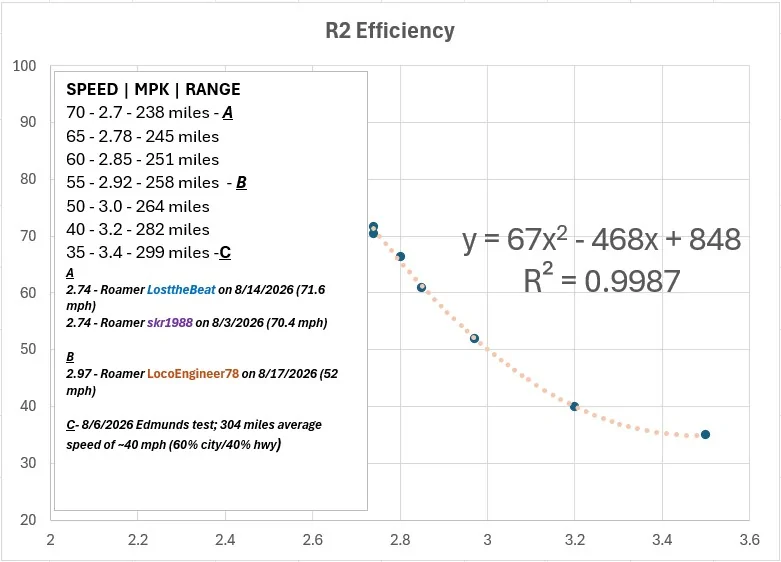
A month into R2 testing, the efficiency debate has narrowed considerably. My first test drive was around July 16, when the main question was simply how much real-world highway range the R2 loses relative to EPA estimates. Subsequent testing established a fairly consistent speed curve, with efficiency around 3.0+ mi/kWh near 60–65 mph, ~2.7 near 70 mph, and roughly 2.3 or less approaching 80 mph.
The discussion then shifted to 20-inch vs. 21-inch wheels. EPA data suggest the 21s should have roughly a 7–8% highway efficiency advantage, but the real-world tests collected so far have generally shown the two much closer than that, with some 20-inch results slightly better. The larger Rivian Roamer dataset has also not shown an obvious 21-inch advantage in its raw averages, although those data contain major uncontrolled variables.
Where things stand now: the key question is no longer whether speed matters; it clearly does. The remaining question is whether, after controlling for speed, elevation, trip length, weather, and other variables, the 21s actually deliver the ~7% freeway advantage suggested by EPA testing, or whether the real-world difference is materially smaller.
Update 1: The latest Rivian Roamer data now cover 82 R2s and more than 52,000 miles, with the 20” BFGoodrich Trail-Terrain setup averaging 2.73 mi/kWh versus 2.64 mi/kWh for the 21” Pirelli Scorpion MS, a 3.4% real-world efficiency advantage for the 20s; that is notable because it runs opposite to the EPA data, which imply roughly an 8% highway advantage for the 21s and an even larger advantage at sustained 70–80 mph based on the road-load coefficients. The gap has narrowed from the earlier smaller-sample data, which suggests some early noise is averaging out, but the 20” result has remained remarkably stable around 2.73 mi/kWh as the mileage has increased. Because the Roamer data are not controlled for speed, weather, elevation, HVAC use, or driving style, they cannot prove the 20” setup is inherently more efficient, but combined with the individual highway tests showing little or no clear 21” advantage, they increasingly suggest that the EPA/coastdown testing may overstate the real-world efficiency benefit of the 21” wheel/tire package, potentially because real-world wheel aerodynamics, turbulence, and yaw effects are not fully represented by the certification road-load model.


As reported here: Rivian Tires: Compare & Review for R1T, R1S & R2
| Tire | Miles | Vehicles | MpV | MPK | Range |
| 20" | 9184 | 12 | 765 | 2.74 | 241 |
| 21" | 5579 | 11 | 507 | 2.53 | 223 |
Update 3, August 19: Will the 21" R2 Catch Up with the 20"?
| Tire | Miles | Vehicles | MpV | MPK | Range |
| 20" | 36820 | 49 | 751 | 2.77 | 244 |
| 21" | 30482 | 49 | 622 | 2.70 | 238 |
The RivianTracker/Out of Spec run took 3 hr 51 min, which works out to about 65.7 mph. Its 2.80 mi/kWh result actually fits the developing speed curve very well and points to roughly 250 to 260 miles at 65 to 66 mph and around 235 to 245 miles at a true 70 mph.
That mostly settles the bigger range question. The R2 appears capable of roughly 240 to 250 miles of real highway range, with normal interstate charging legs more like 210 to 225 miles. July’s 256 mile runs look more like deliberate range demonstrations, while August owner data around 200 to 225 miles probably better represents how people will actually road trip.
Which brings us back to the increasingly silly tire mystery.
EPA certification says the 21s should be roughly 7 to 8% more efficient on the highway. So far, the real world has stubbornly declined to cooperate. Roamer still has the 20s slightly ahead overall, although those averages mix speed, elevation, weather, HVAC, trip length, driving style, tire mileage and probably the phase of the moon.
That does not prove the 20s are inherently more efficient. But we also haven't seen convincing evidence yet that the 21s are actually 7 to 8% better at freeway speeds.
At this point I think the realistic question has narrowed considerably: Are the 21s actually 2 to 3% better, maybe 5%, or will they eventually reveal the full EPA predicted 7 to 8% advantage?
If speed matched data eventually show the 21s winning by several percent, great. I'll update the conclusion. If more real world testing keeps putting the two packages surprisingly close together, that gets harder to explain away too.
Either way, more comparable highway runs with actual average speed, tire mileage and conditions will tell us far more than another fleet average or another “70 mph” test conducted at 65.
Update 2, August 17:
A month into R2 testing, the efficiency debate has narrowed considerably. My first test drive was around July 16, when the main question was simply how much real-world highway range the R2 loses relative to EPA estimates. Subsequent testing established a fairly consistent speed curve, with efficiency around 3.0+ mi/kWh near 60–65 mph, ~2.7 near 70 mph, and roughly 2.3 or less approaching 80 mph.
The discussion then shifted to 20-inch vs. 21-inch wheels. EPA data suggest the 21s should have roughly a 7–8% highway efficiency advantage, but the real-world tests collected so far have generally shown the two much closer than that, with some 20-inch results slightly better. The larger Rivian Roamer dataset has also not shown an obvious 21-inch advantage in its raw averages, although those data contain major uncontrolled variables.
Where things stand now: the key question is no longer whether speed matters; it clearly does. The remaining question is whether, after controlling for speed, elevation, trip length, weather, and other variables, the 21s actually deliver the ~7% freeway advantage suggested by EPA testing, or whether the real-world difference is materially smaller.
Update 1: The latest Rivian Roamer data now cover 82 R2s and more than 52,000 miles, with the 20” BFGoodrich Trail-Terrain setup averaging 2.73 mi/kWh versus 2.64 mi/kWh for the 21” Pirelli Scorpion MS, a 3.4% real-world efficiency advantage for the 20s; that is notable because it runs opposite to the EPA data, which imply roughly an 8% highway advantage for the 21s and an even larger advantage at sustained 70–80 mph based on the road-load coefficients. The gap has narrowed from the earlier smaller-sample data, which suggests some early noise is averaging out, but the 20” result has remained remarkably stable around 2.73 mi/kWh as the mileage has increased. Because the Roamer data are not controlled for speed, weather, elevation, HVAC use, or driving style, they cannot prove the 20” setup is inherently more efficient, but combined with the individual highway tests showing little or no clear 21” advantage, they increasingly suggest that the EPA/coastdown testing may overstate the real-world efficiency benefit of the 21” wheel/tire package, potentially because real-world wheel aerodynamics, turbulence, and yaw effects are not fully represented by the certification road-load model.
| R2 >130 mi (6 trips) | Out of Spec R2 | Out of Spec R1S Dual Max | |
| Distance | 139 mi avg | 253 mi | 359 mi |
| Time | ~2h 18m | 3h 51m | 5h 25m |
| Implied avg speed | 61.2 mph | 65.7 mph | 66.3 mph |
| Efficiency | 2.60 | 2.77 | 2.51 |
| Energy used | 53.7 kWh | 91.4 kWh | 143.0 kWh |
Sponsored
Last edited: