Sponsored

275/60R20 Air Pressure

Brian A

Well-Known Member
First Name
Brian
Joined
May 20, 2024
Threads
0
Messages
89
Reaction score
41
Location
Pueblo West, CO
Vehicles
2024 R1T, 2022 Tucson PHEV, 2017 Sonata Hybrid, 2007 SLK350, 1979 Camaro
Occupation
Electrical Engineer
Smaller tire = smaller contact patch. For equivalent contact patch to OEM 20’s, you would slightly lower tire pressure vs OEM recommendation. However, the size difference is pretty minimal in this case, so personally I’d be inclined to just keep running at 48 for the potential efficiency bump. I would then adjust if I noticed any negative impact on driving dynamics Or ride comfort.
The tire he is using is smaller in diameter the contact patch should be the same 275mm.
Sponsored


cohall

Well-Known Member
Joined
Mar 30, 2020
Threads
76
Messages
1,606
Reaction score
5,676
Location
Denver
Vehicles
2022 R1T, 2023 R1S
The tire he is using is smaller in diameter the contact patch should be the same 275mm.
The width of the contact patch is the same 275mm, but the overall area of the contact patch is smaller due to the smaller diameter/circumference of the new tire. But that changes, as others have stated, based on air pressure.

But I’m way over my skis here, so I will defer to others with better, and likely more accurate advice. Sounds like the chalk test is the way to go.
 

R1Thor

Well-Known Member
First Name
Joe
Joined
Aug 9, 2023
Threads
8
Messages
1,536
Reaction score
2,421
Location
Lancaster, PA
Vehicles
23QM R1T, Limestone + Ocean Coast, 21" & UBS
Occupation
Mechanical Engineering Lead
Clubs
 
The tire he is using is smaller in diameter the contact patch should be the same 275mm.
These are all incorrect.
Contact patch is a factor based on pressure as a consequence of weight. Period.

You can under inflate 'thinner' and smaller diameter tires and have a larger contact patch than overinflated wider+larger diameter tires.

This is not a sole metric to base your pressures on
 

mikehmb

Well-Known Member
First Name
Mike
Joined
Jan 12, 2022
Threads
154
Messages
2,303
Reaction score
5,224
Location
SF Bay Area
Vehicles
My name is Mike, and I have a (car) problem
80psi is max psi for new tires. I'm looking for the correct air pressure to ensure proper tire wear.
I have the LTX MS2 on my truck in the same size, and the shop set them at 48. I upped it to 50 but need to do a chalk test to verify it's the right setting.

From an efficiency standpoint, they're great, and wear so far has been normal over 2k miles.
 

Brian A

Well-Known Member
First Name
Brian
Joined
May 20, 2024
Threads
0
Messages
89
Reaction score
41
Location
Pueblo West, CO
Vehicles
2024 R1T, 2022 Tucson PHEV, 2017 Sonata Hybrid, 2007 SLK350, 1979 Camaro
Occupation
Electrical Engineer
These are all incorrect.
Contact patch is a factor based on pressure as a consequence of weight. Period.

You can under inflate 'thinner' and smaller diameter tires and have a larger contact patch than overinflated wider+larger diameter tires.

This is not a sole metric to base your pressures on
You are correct about pressure/weight. I said what I said based on the assumption of that ratio being the same between the tires. The point was a 275mm wide tire is 275mm wide no matter how tall it is (aspect ratio 60 vs factory 65). Pressure/weight will always be the final deciding factor in the size of the contact patch.
 

Sponsored

R1Thor

Well-Known Member
First Name
Joe
Joined
Aug 9, 2023
Threads
8
Messages
1,536
Reaction score
2,421
Location
Lancaster, PA
Vehicles
23QM R1T, Limestone + Ocean Coast, 21" & UBS
Occupation
Mechanical Engineering Lead
Clubs
 
You are correct about pressure/weight. I said what I said based on the assumption of that ratio being the same between the tires. The point was a 275mm wide tire is 275mm wide no matter how tall it is (aspect ratio 60 vs factory 65). Pressure/weight will always be the final deciding factor in the size of the contact patch.
Except that's false.

Pounds per SQUARE inch is Pressure/area.

If you're talking about WIDTH alone, you're correct.

But you keep stating "CONTACT PATCH' which infers as "TOTAL AREA"

If the width is less, the length will increase because it's literally an algebraic expression.

TL;DR: Basic physics. Area will be the same regardless.

As a though experiment.

Let's say you have a 7000lb-m vehicle.
Let's say you measure how much rubber is in contact with the floor.
Let's say it's running 48psi and the tire is 275mm wide.

7000/4 (4 tires; assume balance for the sake of calculation) = 1750

1750 lbs-m / 48 lbs-m / in^2 = 36.46 in^2 (always remember your units!)
275mm wide = 10.83 in

36.46/10.83 = 3.37 inches of tire (looking at it from the side) will be in contact with the ground.


Take a smaller tire, say 255 (why not?)
It's still inflated to 48 psi

The only thing that just changed is the width
255mm wide = 10.04 in

36.46/10.04 = 3.63 in

THE ONLY THING that just changed was how much (front to back) the tire has in contact with the ground.


Overall point being: it quite frankly makes zero difference when figuring out your chalk test.
In fact, one would argue that measuring contact area might be a good place to start, all things being equal. Due to the fact that the vehicles tire contact patch was engineered to maximize grip, and that grip is a product of the durometer of the wheel, the geometry of the treads, and the overall contact patch (read: cross sectional area). Physics always wins.


ALL this said, if you want a fun science experiment, go put 4 pieces of paper under your tires (obviously lay the paper/cardboard on the ground, drive onto said paper).
Now draw lines as close to the tire as possible.

Measure your rectangles.
Use a tire pressure gauge to check the PSI for each of your tires.

Now do the math in reverse.
Multiple LxW on your rectangles to get your cross sectional area.
Then determine the lbs-m (pounds of mass) sitting on the tire by multiplying your pressure and area (square inches x pounds/square inch) = pounds mass/ weight sitting on that tire. Add up all 4 corners and you'll have the weight of your vehicle. Do this with the kids; it's educational!
 

Type_R

Well-Known Member
First Name
Martin
Joined
Apr 29, 2024
Threads
0
Messages
100
Reaction score
60
Location
Washington
Vehicles
24' R1T(6/1/24), 25' R1S Tri-Motor(12/20/24)
This is the right answer.

There's a lot of other misinformation on this thread that I'd...caution you to heed.

Some individuals have also had success reaching out to the tire manufacturer and explaining "I'm putting your tire on this vehicle" and they've provided guidance.

But ultimately, chalk test is the best option. There are some online calculators to compare load ratings of your tires to your vehicle GVWR and that gives you a general pressure, but they only work within a small window of accuracy (example: mine math'd to 36psi. WAY to low). That said, it WILL vary based on the tire you chose, its load ratings and ply.

Here's a quick guide:

Chalk Test for Determining Optimal Tire Pressure
  1. Gather Materials
    • White chalk (preferably sidewalk chalk)
    • Tire pressure gauge
    • Air compressor or access to a pump
  2. Prepare the Vehicle
    • Park the vehicle on a flat, level surface
    • Ensure tires are cold before starting the test
  3. Mark the Tires
    • Use chalk to draw a thick, straight line across the tire tread (from one side to the other)
  4. Drive the Vehicle
    • Slowly drive the vehicle forward for about 50–100 feet on a dry, even road
    • Try to maintain a straight path
  5. Inspect the Chalk Wear
    • Even wear across the tread → Tire pressure is correct
    • Worn off in the center only → Overinflated; reduce pressure slightly
    • Worn off on the edges but not the center → Underinflated; increase pressure slightly
  6. Adjust and Repeat if Necessary
    • Adjust tire pressure in small increments (2–3 PSI at a time)
    • Reapply chalk and retest until even wear is achieved
  7. Final Check
    • Once optimal pressure is found, check and adjust all tires to match
    • Record the pressure for future reference
This method ensures even tire contact with the road, improving traction, handling, and tire longevity.
I’ll add using an IR temp gun to read temperatures across the tread of all four tires as another method as well.
 

R1Thor

Well-Known Member
First Name
Joe
Joined
Aug 9, 2023
Threads
8
Messages
1,536
Reaction score
2,421
Location
Lancaster, PA
Vehicles
23QM R1T, Limestone + Ocean Coast, 21" & UBS
Occupation
Mechanical Engineering Lead
Clubs
 
I’ll add using an IR temp gun to read temperatures across the tread of all four tires as another method as well.
Rubber is an INSULATOR.
Any readings you get are not going to be accurately representative, in my opinion, to gauge correct pressure set.

The other thing to consider: the chalk test can be completed in ~100 feet.
Even IF we can assume there's some thermal reality to an insulated material, it'd likely be due to consistency across the tarmac it's sitting atop.... you know what, the more I'm thinking through this exercise, I'm going to go back to my initial posit. Don't do IR testing. Rubber is an insulator. I'd bet a lot of money you can get perfectly consistent IR across a not well inflated tire just as easily as you'd get 'bad' readings across a perfectly inflated tire.
EDIT: just did a quick Google search and it looks like a lot of people agree with this thought process, and not many have seemingly had any success with IR testing.
 

Type_R

Well-Known Member
First Name
Martin
Joined
Apr 29, 2024
Threads
0
Messages
100
Reaction score
60
Location
Washington
Vehicles
24' R1T(6/1/24), 25' R1S Tri-Motor(12/20/24)
Rubber is an INSULATOR.
Any readings you get are not going to be accurately representative, in my opinion, to gauge correct pressure set.

The other thing to consider: the chalk test can be completed in ~100 feet.
Even IF we can assume there's some thermal reality to an insulated material, it'd likely be due to consistency across the tarmac it's sitting atop.... you know what, the more I'm thinking through this exercise, I'm going to go back to my initial posit. Don't do IR testing. Rubber is an insulator. I'd bet a lot of money you can get perfectly consistent IR across a not well inflated tire just as easily as you'd get 'bad' readings across a perfectly inflated tire.
EDIT: just did a quick Google search and it looks like a lot of people agree with this thought process, and not many have seemingly had any success with IR testing.
Seems to have been working for me over the last 10 years, on all of the vehicles I’ve owned with no issues of uneven tread wear. But, I’ll keep the method you’ve described in mind as another tool to use.
 

Sponsored

R1Thor

Well-Known Member
First Name
Joe
Joined
Aug 9, 2023
Threads
8
Messages
1,536
Reaction score
2,421
Location
Lancaster, PA
Vehicles
23QM R1T, Limestone + Ocean Coast, 21" & UBS
Occupation
Mechanical Engineering Lead
Clubs
 
Seems to have been working for me over the last 10 years, on all of the vehicles I’ve owned with no issues of uneven tread wear. But, I’ll keep the method you’ve described in mind as another tool to use.
Just a caution that anecdote isn't equivalent to data.
I'm happy you've had success with your method, and I'm not dismissing your success.
I know people who smoked into their 80s. I'm still not going to ever pick up a cigar.

However, if something cannot be validated to be a universal and consistently (safely demonstrated) methodology, it shouldn't be touted as a suggestion or solution. All it takes is one person to use this erroneously and with incorrectly inflated tires result in an incident which at the very least means a damaged vehicle. Even IF there was a relatively moderate argument for using your method, there are too many other variables we haven't even discussed (quality of IR thermometer, environmental conditions, thermal runway from brakes, consistency of roadway, etc).

When it comes to safety, stick to proven methods. Anything that separates you from the ground and maintaining optimized traction and control with the ground shouldn't be messed with.

That's my .02. We're all adults here. Just stay informed.
 

rhumbliner

Well-Known Member
First Name
thomas
Joined
Nov 8, 2020
Threads
12
Messages
335
Reaction score
527
Location
Bend
Vehicles
R1T & Model X
Occupation
Retired
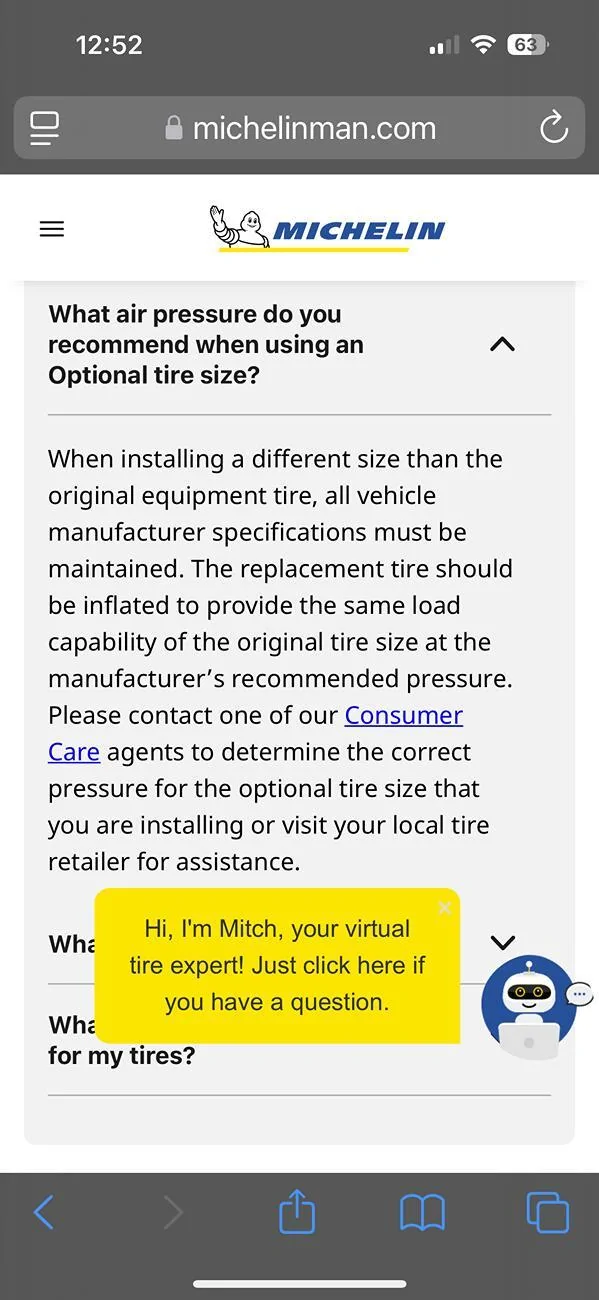
Anyone know what the proper air pressure would be for 275/60R20 tires on my R1T? I'm going with a slightly smaller tire than stock and wanted to know the correct tire pressure.
When I installed my Nokian One HT’s I contacted Nokian with the exact same question. They got back to me right away with a table of tire pressure vs load weight — with the caveat not to go below Rivian’s recommended pressure.
 

Type_R

Well-Known Member
First Name
Martin
Joined
Apr 29, 2024
Threads
0
Messages
100
Reaction score
60
Location
Washington
Vehicles
24' R1T(6/1/24), 25' R1S Tri-Motor(12/20/24)
Just a caution that anecdote isn't equivalent to data.
I'm happy you've had success with your method, and I'm not dismissing your success.
I know people who smoked into their 80s. I'm still not going to ever pick up a cigar.

However, if something cannot be validated to be a universal and consistently (safely demonstrated) methodology, it shouldn't be touted as a suggestion or solution. All it takes is one person to use this erroneously and with incorrectly inflated tires result in an incident which at the very least means a damaged vehicle. Even IF there was a relatively moderate argument for using your method, there are too many other variables we haven't even discussed (quality of IR thermometer, environmental conditions, thermal runway from brakes, consistency of roadway, etc).

When it comes to safety, stick to proven methods. Anything that separates you from the ground and maintaining optimized traction and control with the ground shouldn't be messed with.

That's my .02. We're all adults here. Just stay informed.
Thanks for your insight and I’ve been informed. We can move on now
 

mkg3

Well-Known Member
Joined
Nov 19, 2021
Threads
91
Messages
2,806
Reaction score
3,736
Location
SoCal
Vehicles
R1S, Model 3, Outback, Artura
Clubs
 
80psi is max psi for new tires. I'm looking for the correct air pressure to ensure proper tire wear.
Looks like you've given up taking feedback from the forum.

As many have said, the max load case is the highest rated tire pressure. In terms of what's best, its a tradeoff.

Your ride will be better at lower pressure than high. Your rolling resistance is lower when the pressure is higher (better range).

EVs are sensitive to tire pressure more than ICE vehicles. So I have the same tires in a different size and lower load index (mine is 275/50/22 115). Michelin makes a tire in 119 load index but that tire weight much heavier and I didn't want the consequence of heavier unsprung weight that reduced the range, since I never come close to the max load.

For your case, as someone pointed out, I would start at 48psi and if you tow or have heavy load in the bed, increase the rear tire pressure at that point.
Sponsored


Top