Sponsored

Charging to 100% improves regenerative braking?!

southerncadesi

Well-Known Member
First Name
JD
Joined
Jun 25, 2024
Threads
2
Messages
60
Reaction score
44
Location
SoCal
Vehicles
2025 Rivian R1S (Rosalina), Nissan 350Z
Clubs
 
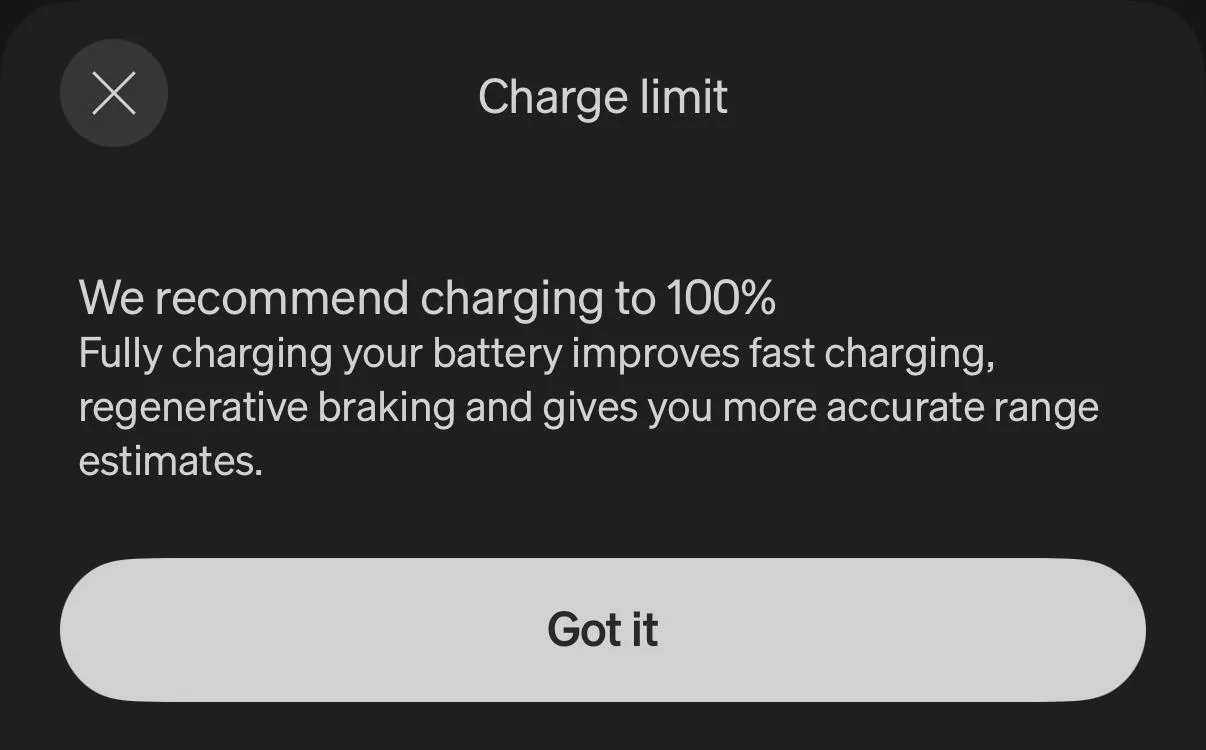
Can someone please explain to me how this is true? I would imagine the closer you are to 100% the harder it would be for the regen to charge up your battery.

This is from a Gen2 LFP
Rivian R1T R1S Charging to 100% improves regenerative braking?! IMG_7666
Sponsored


mikehmb

Well-Known Member
First Name
Mike
Joined
Jan 12, 2022
Threads
154
Messages
2,303
Reaction score
5,224
Location
SF Bay Area
Vehicles
My name is Mike, and I have a (car) problem
It's almost certainly because the 100% charge will calibrate the BMS. You won't be able to regen at 100% (by definition), but will once you set off and use some of the energy.
 
OP
OP
southerncadesi

southerncadesi

Well-Known Member
First Name
JD
Joined
Jun 25, 2024
Threads
2
Messages
60
Reaction score
44
Location
SoCal
Vehicles
2025 Rivian R1S (Rosalina), Nissan 350Z
Clubs
 
Gotcha, I understand why LFP’s need to be charged to 100%, but I didn’t know the BMS also aided the regen braking.
 

Time2Roll

Well-Known Member
Joined
Jul 10, 2025
Threads
2
Messages
776
Reaction score
666
Location
SoCal
Vehicles
2026 R1S Quad - 2001 F150
Yes LFP tolerates 100% charge better than other chemistries. Charging to 100% allows the BMS to balance the cells properly on a regular basis. All systems work better with the cells in balance.

Otherwise yes the regenerative braking usually drops off as an EV is at or near 100% charge.
 

ENVErider

Well-Known Member
First Name
Tyler
Joined
May 2, 2025
Threads
1
Messages
184
Reaction score
176
Location
Oakland, CA
Vehicles
2022 R1T Launch Edition
Occupation
Mechanical Engineer
I also think it's a LFP calibration thing, I don't think I have ever seen this message on my phone go my NMC gen1. I did read an interesting article a few weeks ago about how Rivian deals with braking when battery bank is already full, say after filling up in the mountains and then doing one pedal driving sustained downhills. It makes sense that you'd be able to get closer to the true 100% with a recent calibration.
 

Sponsored

UnsungZero_OldTimeAdMan

Well-Known Member
First Name
Barnum
Joined
Mar 20, 2023
Threads
68
Messages
8,667
Reaction score
11,901
Location
SoCal
Vehicles
'23 GW Quad-Large R1T "Ghost"
Occupation
Advertising Circus
Can someone please explain to me how this is true? I would imagine the closer you are to 100% the harder it would be for the regen to charge up your battery.

This is from a Gen2 LFP
IMG_7666.webp
No. It’s not about regen. It’s about maintaining software’s ability to gauge pack capacity (based on voltage) and provide accurate range estimation of cars with LFP packs. Watch Engineering Explained YouTube videos on LFP packs.

Regen is actually limited whenever pack is at or near 100%, to prevent cell damage. That’s why brake blending is needed to provide sufficient stopping ability. Charging to 100% occasionally recalibrates BMS, so it doesn’t think pack is near full when it actually isn’t (and falsely limit regen).
 
OP
OP
southerncadesi

southerncadesi

Well-Known Member
First Name
JD
Joined
Jun 25, 2024
Threads
2
Messages
60
Reaction score
44
Location
SoCal
Vehicles
2025 Rivian R1S (Rosalina), Nissan 350Z
Clubs
 
No. It’s not about regen. It’s about maintaining software’s ability to gauge pack capacity (based on voltage) and provide accurate range estimation of cars with LFP packs. Watch Engineering Explained YouTube videos on LFP packs.

Regen is actually limited whenever pack is at or near 100%, to prevent cell damage. That’s why brake blending is needed to provide sufficient stopping ability. Charging to 100% occasionally recalibrates BMS, so it doesn’t think pack is near full when it actually isn’t (and falsely limit regen).
This makes sense, appreciate the explanation!
Sponsored


Top