-
👉 R2 Orders ➡ Add Your R2 Orders / VIN / Delivery Info 📊
Sponsored
DucRider
Well-Known Member
They passed the minimum requirements and are able to sell.
NHTSA may or may not decide to test them, and it may not be anytime soon if they do.
NHTSA may or may not decide to test them, and it may not be anytime soon if they do.
electruck
Well-Known Member
- Joined
- Oct 6, 2019
- Threads
- 74
- Messages
- 4,196
- Reaction score
- 7,799
- Location
- Dallas, TX
- Vehicles
- 2023 Rivian R1S
Here's a good article from Consumer Reports, pretty sure I've posted it before but it's a good read.
Some Cars Will Never Be Crash-Tested... To be certified for sale, every new model sold in the U.S. must be crash-tested internally to ensure minimum federal safety standards are met. But a publicly available rating isn’t required.
Some Cars Will Never Be Crash-Tested... To be certified for sale, every new model sold in the U.S. must be crash-tested internally to ensure minimum federal safety standards are met. But a publicly available rating isn’t required.
The Jaguar F-Pace, Land Rover Discovery, and Porsche Macan are all comfortable SUVs with extra trimmings and technology. Consumers can easily compare their fuel economy, 0-to-60-mph acceleration time, and cargo capacity. But when it comes to safety, consumers are left in the dark as to how they would hold up in certain crash scenarios. That’s because these vehicles have no publicly available crash-test ratings.
Nearly a half-million passenger cars and SUVs sold each year have not been crash-test rated by the two main organizations that conduct independent assessments: the federal National Highway Traffic Safety Administration, which uses a star rating system, and the insurance industry-backed Insurance Institute for Highway Safety, which rates vehicles from Poor to Good.
Most of the vehicles without ratings are low-volume models, sports cars, luxury vehicles, or large vans. The expense is too great for NHTSA and the IIHS to test all vehicles, so choices are made based on car sales volume and testing budgets. Some untested models are new or redesigned and merely waiting in line to be evaluated. About 97 percent of all new vehicles sold are crash-test rated by one or both of the independent organizations.
...
To be certified for sale, every new model sold in the U.S. must be crash-tested internally to ensure minimum federal safety standards are met. But a publicly available rating isn’t required.
Currently, no Jaguar, Land Rover, or Porsche models are rated by NHTSA or the IIHS. Last year, those three automakers represented almost half of all vehicles sold without any public crash-test ratings—or more than 185,000 new vehicles on American roads.
Among vehicles without ratings, a few—such as the Cadillac CT6, Kia K900, and BMW 7 Series luxury sedans—have sales numbers below 10,000 cars a year. NHTSA has no crash-test ratings for any recent Maserati or Alfa Romeo vehicle, although the IIHS tested the Alfa Romeo Giulia and Maserati Ghibli sedans, both of which got Good ratings for crashworthiness. Similarly, NHTSA did not test the Fiat 500L hatchback, but the IIHS did—and it got a Poor rating on the driver-side front small-overlap test.
...
CommodoreAmiga
Well-Known Member
The S1 filing states Rivian‘s internal testing indicates they should achieve an overall-5-star rating once officially tested. Not the same as a certified result, of course, but maybe It puts you at ease?
This issue isn’t unique to Rivian. I’ve seen lots of window stickers for new models from BIG brands where the crash test results haven’t been officially released, yet they sell just fine.
This issue isn’t unique to Rivian. I’ve seen lots of window stickers for new models from BIG brands where the crash test results haven’t been officially released, yet they sell just fine.
timf
Well-Known Member
Independent crash testing requires vehicles to be randomly selected off the production line. This isn't possible before regular production begins. If Rivian chooses to participate, expect to wait a couple months before the results are publicized.
Sponsored

Longhorngirl
Well-Known Member
Just a FYI. Rivian is not on the list of vehicles being tested by the NHSTA for 2022.
https://www.nhtsa.gov/press-releases/2022-5-star-safety-ratings-tests
https://www.nhtsa.gov/press-releases/2022-5-star-safety-ratings-tests

RideAlong
Well-Known Member
- First Name
- Robert
- Joined
- Dec 16, 2021
- Threads
- 3
- Messages
- 217
- Reaction score
- 103
- Location
- montevelo california
- Vehicles
- 20 Porsche Panamera S + 19 Ford F-150
- Occupation
- Dentist
Not Currently rated. At this stage it is not necessary even for marketing and conquest sales etc. It's also moot , as if one survives the crash , the vehicle itself is irreplaceable for several years due to supply constraints. Wreck one in the first 3 years and it's just gone.
Sgt Beavis
Well-Known Member
I’m sure it’s a lot safer than my Jeep Wrangler.. ?
electruck
Well-Known Member
- Joined
- Oct 6, 2019
- Threads
- 74
- Messages
- 4,196
- Reaction score
- 7,799
- Location
- Dallas, TX
- Vehicles
- 2023 Rivian R1S
Not at all surprising given Rivian's low production volume for the foreseeable future.Just a FYI. Rivian is not on the list of vehicles being tested by the NHSTA for 2022.
https://www.nhtsa.gov/press-releases/2022-5-star-safety-ratings-tests
ads75
Well-Known Member
- Joined
- Nov 9, 2021
- Threads
- 9
- Messages
- 1,583
- Reaction score
- 2,993
- Location
- Reading, Pennsylvania
- Vehicles
- 2019 Jeep Wrangler Rubicon 2DR, 2024 GMC Sierra 1500 AT4X
- Occupation
- Utilities
I was thinking the exact same thing.I’m sure it’s a lot safer than my Jeep Wrangler.. ?
Sponsored
Attesan997
Well-Known Member
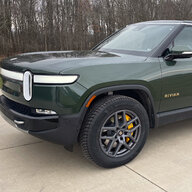
Very unlikely a new from ground up platform would achieve less than acceptable scores these days, ideally a perfect score for all the crash tests. If a 3rd Gen Tacoma that hasn't changed all that much from 2015 to 2021 can get mostly good scores I'd think it should be pretty easy for Rivian to ace every test.
SlaterGS
Well-Known Member
Agree, Rivians crash test ratings will probably be superb.Very unlikely a new from ground up platform would achieve less than acceptable scores these days, ideally a perfect score for all the crash tests. If a 3rd Gen Tacoma that hasn't changed all that much from 2015 to 2021 can get mostly good scores I'd think it should be pretty easy for Rivian to ace every test.
However the ability for other cars to hold up to this massive machine in an accident may be another story.
Zoidz
Well-Known Member
It's also possible that Rivian will use IIHS for independent crash testing. To my knowledge there's no requirement to use NHTSA.
electruck
Well-Known Member
- Joined
- Oct 6, 2019
- Threads
- 74
- Messages
- 4,196
- Reaction score
- 7,799
- Location
- Dallas, TX
- Vehicles
- 2023 Rivian R1S
There is no requirement for independent crash testing, period. See the CR article I linked above.It's also possible that Rivian will use IIHS for independent crash testing. To my knowledge there's no requirement to use NHTSA.
Zoidz
Well-Known Member
Yeah..... that's what I said. No requirement.There is no requirement for independent crash testing, period. See the CR article I linked above.
Sponsored
Similar threads
- Replies
- 17
- Views
- 2,394

- Replies
- 14
- Views
- 6,155


- Replies
- 17
- Views
- 5,922


