
Sponsored

Epicloop

Well-Known Member
First Name
Ray
Joined
Jun 3, 2023
Threads
11
Messages
541
Reaction score
378
Location
British Columbia
Vehicles
R1S
Occupation
Electrical Contractor
Look at the ratings of the large pack on the dual motor 21s R1S in the configurator - 352 mi / 127 kw = 2.771 kwh/mi. Now the max 400 / 2.771 = 144.3 which is essentially the usable capacity of the max pack as confirmed.
Assuming 95% of max for usable for both LP & MP on the R1T:
135kwh x 95% = 128.25kwh
149kwh x 95% = 141.55kwh
352 mi/128kwh =2.75mi/kwh
410 mi/2.75mi/kwh = 149kwh
149/141.55 = 1.05 ( 5% variance not 1%)
Something does not add up.
I really wanted them to keep their plan to put in a 180 kWh pack. So many levels of disappointment.
Or at least 165kwh & use the space available on the R1T & add the 1 or 2 modules for the added 10-16k
Bottom line, I expected better from Rivian,
Yes 149 is a long way from 180kwh
I don't need to drive 80 mph. I want to.
Maybe reeling it back to 5-10% in winter will do it till they have a real max pack.
Sponsored


mkhuffman

Well-Known Member
First Name
Mike
Joined
Nov 9, 2020
Threads
14
Messages
2,832
Reaction score
3,192
Location
Virginia
Vehicles
2025 R1T Tri-Max, Jeep GC-L, VW Jetta
Assuming 95% of max for usable for both LP & MP on the R1T:
135kwh x 95% = 128.25kwh
149kwh x 95% = 141.55kwh
352 mi/128kwh =2.75mi/kwh
410 mi/2.75mi/kwh = 149kwh
149/141.55 = 1.05 ( 5% variance not 1%)
Something does not add up.

Or at least 165kwh & use the space available on the R1T & add the 1 or 2 modules for the added 10-16k

Yes 149 is a long way from 180kwh

Maybe reeling it back to 5-10% in winter will do it till they have a real max pack.
I drive slower when my wife is in the car. I can handle it then because I know it makes her happy. But when I am alone, I want to go 120. Of course that would be irresponsible, right? And besides, I promised her I would keep it at 80 mph or slower. So I set the cruise for 80 and let it roll.
 

Jiji

Well-Known Member
First Name
Rick
Joined
Jun 21, 2023
Threads
17
Messages
296
Reaction score
430
Location
Finger Lakes, NY
Website
github.com
Vehicles
Rivian Blue R1S
It is true that driving the speed limit will measurably improve efficiency and range. I don't like driving the speed limit and getting passed by dump trucks. I want to drive 80 like I do now, and have enough range to avoid public charging.

The R1 (and just about any vehicle that costs more than $10k) is a want, not a need. I don't need a battery powered truck. I want one. I don't need to drive 80 mph. I want to.
Here are the test drive results on a 22.3 mile course driven in an R1S in All-Purpose mode and fitted with 21" tires (EPA range appears to 321 miles):

Test Speed
(mph)
Elapsed
Time
Range
Consumed
Est.Eff
(mi/kWh)
Avg Speed
(mph)
Max Speed
(mph)
ΔSoC
(%)
100% SoC Range
(mi)
60 mph25:3022.42.1752597.2309
65 mph24:3125.51.9155648.2272
70 mph22:3125.51.9359768.1275
75 mph21:1630.41.5963749.8227

It was nice to see that even on a 36ºF day with a battery temp in the mid-50s I could get close to the displayed range at 60 mph. Maybe the dual motor with a Max pack can hit your numbers but I think the quad motor with a Large pack would be a stretch.

Not sure what happened with the 70 mph test, in the first two I had no one in front of me as I was constantly being passed while in the 75 mph I either had clear road or was doing the passing. In the 70 mph test I was often tucked in behind someone going 70 mph so got to do some drafting. Or maybe the results are biased by rounding errors and the imperfect data available from the Rivian.
 

mkhuffman

Well-Known Member
First Name
Mike
Joined
Nov 9, 2020
Threads
14
Messages
2,832
Reaction score
3,192
Location
Virginia
Vehicles
2025 R1T Tri-Max, Jeep GC-L, VW Jetta
Here are the test drive results on a 22.3 mile course driven in an R1S in All-Purpose mode and fitted with 21" tires (EPA range appears to 321 miles):

Test Speed
(mph)
Elapsed
Time
Range
Consumed
Est.Eff
(mi/kWh)
Avg Speed
(mph)
Max Speed
(mph)
ΔSoC
(%)
100% SoC Range
(mi)
60 mph25:3022.42.1752597.2309
65 mph24:3125.51.9155648.2272
70 mph22:3125.51.9359768.1275
75 mph21:1630.41.5963749.8227

It was nice to see that even on a 36ºF day with a battery temp in the mid-50s I could get close to the displayed range at 60 mph. Maybe the dual motor with a Max pack can hit your numbers but I think the quad motor with a Large pack would be a stretch.

Not sure what happened with the 70 mph test, in the first two I had no one in front of me as I was constantly being passed while in the 75 mph I either had clear road or was doing the passing. In the 70 mph test I was often tucked in behind someone going 70 mph so got to do some drafting. Or maybe the results are biased by rounding errors and the imperfect data available from the Rivian.
Were you running the cabin heater?
 

Supratachophobia

Well-Known Member
Joined
Apr 8, 2023
Threads
9
Messages
1,780
Reaction score
2,122
Location
Ohio
Vehicles
S
Clubs
 
Here are the test drive results on a 22.3 mile course driven in an R1S in All-Purpose mode and fitted with 21" tires (EPA range appears to 321 miles):

Test Speed
(mph)
Elapsed
Time
Range
Consumed
Est.Eff
(mi/kWh)
Avg Speed
(mph)
Max Speed
(mph)
ΔSoC
(%)
100% SoC Range
(mi)
60 mph25:3022.42.1752597.2309
65 mph24:3125.51.9155648.2272
70 mph22:3125.51.9359768.1275
75 mph21:1630.41.5963749.8227

It was nice to see that even on a 36ºF day with a battery temp in the mid-50s I could get close to the displayed range at 60 mph. Maybe the dual motor with a Max pack can hit your numbers but I think the quad motor with a Large pack would be a stretch.

Not sure what happened with the 70 mph test, in the first two I had no one in front of me as I was constantly being passed while in the 75 mph I either had clear road or was doing the passing. In the 70 mph test I was often tucked in behind someone going 70 mph so got to do some drafting. Or maybe the results are biased by rounding errors and the imperfect data available from the Rivian.
I'm surprisingly ok with hitting EPA by going 60mph.... as long as that's the same measurement in both large and max. At least then you have a common basis for comparison that basically everyone can replicate.
 

Sponsored

Rivianmd

Well-Known Member
Joined
Oct 16, 2020
Threads
1
Messages
89
Reaction score
100
Location
Maryland
Vehicles
BMW 328d, Toyota 4Runner
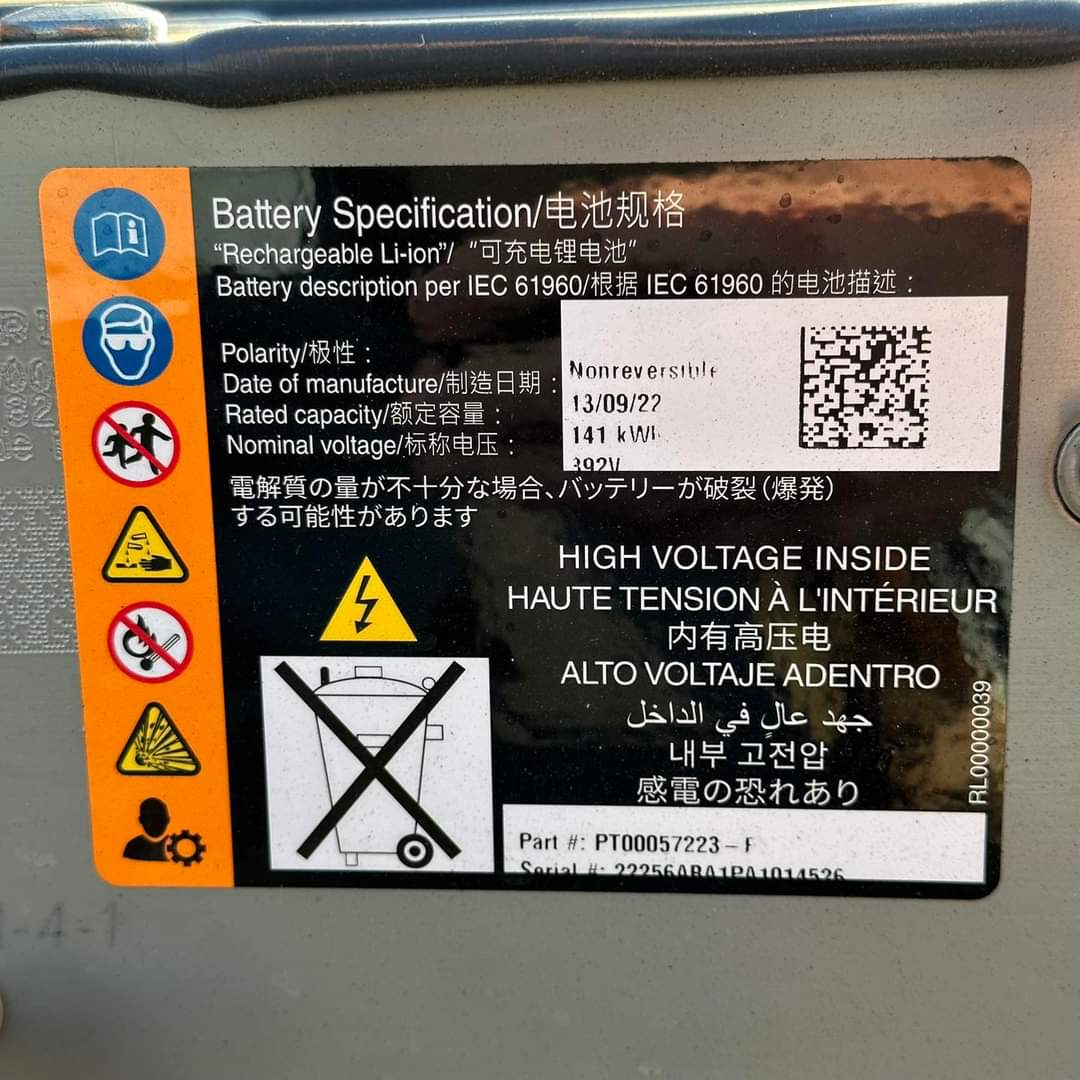
Hi all, just a heads up that the large pack capacity is actually 141kwh, not 135. They use INR21700-50G cells. 18.15wh new multiplied by 7776 cells. It was also confirmed by a blogger as stated on the actual pack. Fairly confident max pack is greater than 149 gross
 

Electrified Outdoors

Well-Known Member
First Name
Ken
Joined
Jan 30, 2023
Threads
63
Messages
3,683
Reaction score
3,980
Location
Mount Airy, Maryland
Website
EVoutdoors.org
Vehicles
2024 Rivian R1S Quad, 2024 Silverado EV RST First Edition
Occupation
Real Estate
Clubs
 
I posted this on another thread. From a salvage yard selling batteries off crash tested units. Several available.

LG was able to get 10% more capacity for the Bolt EV with a Chemistry change. Those packs went from 60 kwh to 66kwh in later production years. Now with that said, we have this 14 kwh number which just happens to be 10% of the gross capacity of the large pack.

After Rivian runs through the large packs with older chemistry why would they be producing two different packs with two different chemistry? Have one pack and do what Tesla did and nerf one though software?

Wild speculation on my part. If it's 149 gross that means it's an extra 8 kwh. Max pack could be a 155 kwh pack with 149 usable.

Rivian R1T R1S Max Pack Battery Capacity Confirmed - 149kWh 1000002188

Rivian R1T R1S Max Pack Battery Capacity Confirmed - 149kWh 1000002189
 
Last edited:

Supratachophobia

Well-Known Member
Joined
Apr 8, 2023
Threads
9
Messages
1,780
Reaction score
2,122
Location
Ohio
Vehicles
S
Clubs
 
I posted this on another thread. From a salvage yard selling batteries off crash tested units. Several available.

LG was able to get 10% more capacity for the Bolt EV with a Chemistry change. Those packs went from 60 kwh to 66kwh in later production years. Now with that said, we have this 14 kwh number which just happens to be 10% of the gross capacity of the large pack.

After Rivian runs through the large packs with older chemistry why would they be producing two different packs with two different chemistry? Have one pack and do what Tesla did and nerf one though software?

Wild speculation on my part. If it's 149 gross that means it's an extra 8 kwh. Max pack could be a 155 kwh pack with 149 usable.

1000002188.jpg

1000002189.jpg
Running these batteries at higher capacities has downsides. Like, steeper degradation and lower charge cycles. I'm not sure I would want a max pack if was just a short term chemistry change gain but a long term reliability issue
 

HyperionMark

Well-Known Member
First Name
Mark
Joined
Apr 22, 2022
Threads
14
Messages
416
Reaction score
358
Location
South Dakota
Vehicles
R1T and Model Y (previously a 3 and X)
Were you running the cabin heater?
Quick question that does seem at least tangentially related to this thread. You really live over 100 miles from your place of work? I'm sure you have a really good reason, but I'm kind curious what would make someone do that.
 

35803VeronicaSt

New Member
First Name
M
Joined
Feb 13, 2023
Threads
0
Messages
1
Reaction score
2
Location
SE Michigan
Vehicles
R1T
Hey all-- alot of math in this topic, but before you spend much more time on it I got some tips for you:

1) you can see the results of the testing done for EPA cert. It's in the EPA DIS database here: https://dis.epa.gov/otaqpub/publist1.jsp search for "applications" and "rivian" as the manufacturer and you'll see all the results to date. Look for "usable battery energy" and that's the measured energy taken from the battery during the test from 100% to 0%, it's great because that is what is available to you as the driver and doesn't consider any losses from chargers or charging or accessories-- unfortunately it's not always in the application. Often but not always, the manufacturer also includes the CA details, which show the breakdown of city/highway Wh/mile. This is also useful because it is "unadjusted", i.e. the raw data from the test.

2) The window sticker values are "adjusted" meaning that the raw measured range is reduced by a adjustment factor, that is usually 0.7. There are other possible ways to adjust, but most BEVs are just using the EPA guidance of 0.7. So if the window sticker says 400mile, it really drove 570 miles or so on the test.

3) the Wh/mile values are calculated using AC watt-hours, that is, using the energy measured at the wall (between the wall and the EVSE). Which ends up making it look like the vehicle has slightly higher energy consumption while driving because it includes charger efficiencies, battery losses, accessories running during charging, even the several hundred Wh of having the EVSE awake for the 12 hour minimum time.

4) No measurement can be 100% accurate. The test procedure has allowed tolerances that total up to around 3% or so-- best case. Some OEMs spend an awful lot of time trying to get it as accurate and repeatable and perfect as possible, but most are fine just being in the allowable tolerances. 3% is alot of Wh.

Hoping this information finds you all well and can help feed your interest in the subject and get you closer to trying to decode all the numbers and how they fit together. Here's some more details and links to deeper paths (the CFR, i.e. the federal law) https://www.epa.gov/greenvehicles/fuel-economy-and-ev-range-testing
 

Sponsored

Supratachophobia

Well-Known Member
Joined
Apr 8, 2023
Threads
9
Messages
1,780
Reaction score
2,122
Location
Ohio
Vehicles
S
Clubs
 
Lots of good info on there but I didn't find documents related to max pack yet. I did find that the max DC charging speed is 210kw so all these RANs at 300, yeah, we aren't ever getting that with these batteries. But the math pretty much already confirmed this.


Edit: This is strange. I can't find an application related to max pack. But oh, this is interesting. I see the applications from 2021/2022 that claim 146k AC watt hours, so battery capacity plus charging overhead. And then Rivian is testing the large pack again as recent as may 2023 with 151k AC watt hours. So am I reading this right that they unlocked the 5kw through software and then officially re-did the EPA tests to reflect the available energy?

Color me unimpressed until we get the max pack application. Unless they just argued using a different multiplier and claimed 400 miles on a large battery..... Oh that would be scandalous.
 
Last edited:

Ronaldinho

Well-Known Member
Joined
Aug 18, 2021
Threads
1
Messages
50
Reaction score
63
Location
MI
Vehicles
98 Trans Am, 76 CB750, PDM Max R1T
Clubs
 
Lots of good info on there but I didn't find documents related to max pack yet. I did find that the max DC charging speed is 210kw so all these RANs at 300, yeah, we aren't ever getting that with these batteries. But the math pretty much already confirmed this.


Edit: This is strange. I can't find an application related to max pack. But oh, this is interesting. I see the applications from 2021/2022 that claim 146k AC watt hours, so battery capacity plus charging overhead. And then Rivian is testing the large pack again as recent as may 2023 with 151k AC watt hours. So am I reading this right that they unlocked the 5kw through software and then officially re-did the EPA tests to reflect the available energy?

Color me unimpressed until we get the max pack application. Unless they just argued using a different multiplier and claimed 400 miles on a large battery..... Oh that would be scandalous.
The May 2023 data is part of test group PRIVT00.0192 which is the dual motor large pack test group.

The other dates are, I believe, variations of PRIVT00.0194 which is quad motor large pack.

What we (you, me, max packers everywhere) are waiting on is the detailed report of PRIVT00.0SEP which should be dual motor max pack test group.
 

Supratachophobia

Well-Known Member
Joined
Apr 8, 2023
Threads
9
Messages
1,780
Reaction score
2,122
Location
Ohio
Vehicles
S
Clubs
 
Another interesting thing is that if the test goes from 100% to dashboard zero, then Tesla is using specialized firmware, a la diesel gate, to change zero to include the lower end buffer. Normal firmware puts zero at the 4kwh buffer remaining.
Sponsored


Top