
Sponsored

Preparing for bi-directional charging

josh0

Well-Known Member
First Name
Josh
Joined
Jan 4, 2024
Threads
26
Messages
362
Reaction score
508
Location
Abiquiu, NM / Baltimore, MD
Vehicles
2023 (Nov) R1T, 2014 Jeep Cherokee
At the moment, I’m using a portable charger with a 30-amp outlet in the garage, however I’d like to install an outdoor pedestal charger by our carport (the previous owners had interesting ideas about geometry, resulting in the garage being inaccessible to anything larger than a side by side), doing so will require trenching power lines to the spot, which is fine. My concern is that if I do that work now, whether I install a new level 2 charger there or just a receptacle for the portable one, I’d have to dig it all up and completely re-do it for a bi-directional charger in the (hopefully near) future.

I would definitely like to have v2h bi-directional charging once that’s available with my R1T, as we’re way out in the middle of nowhere on 75 year old lines that are showing their age. The possibility of being able to use it to time-shift our consumption to take advantage of time of use billing would also be nice.

While we obviously don’t know the details of Rivian’s bi-directional charging, are there some reasonable assumptions we can make so that I can have the new charger site wired to take advantage of it on the first try?
Sponsored

 

Dark-Fx

Well-Known Member
First Name
Brian
Joined
Jul 15, 2020
Threads
147
Messages
13,521
Reaction score
27,288
Location
Michigan
Vehicles
R1T, R1S, Livewire One, Sierra EV, R1S
Occupation
Engineering
Clubs
 
I'm in the process of planning for this with my GM Powershift installation. I imagine Rivian might take a similar approach to what GM is doing here, but it's not impossible they decide to do things a little differently, considering the claim of 24kW of bi-directional DC power, so I'll make a few assumptions here about it.

Assumption 1: Rivian is planning on a minimum battery pack voltage of approximately 300V. This would mean they need to be able to supply up to 80A of DC over the DC lines back to the charger, which means a requirement of 2x 2AWG wires.

Assumption 2: Rivian will either ship the charger with 48A AC capability, or upgrade it to 80A. 48A means 2x 6AWG wire + EGC, 80A would mean another 2x2AWG wire + EGC.


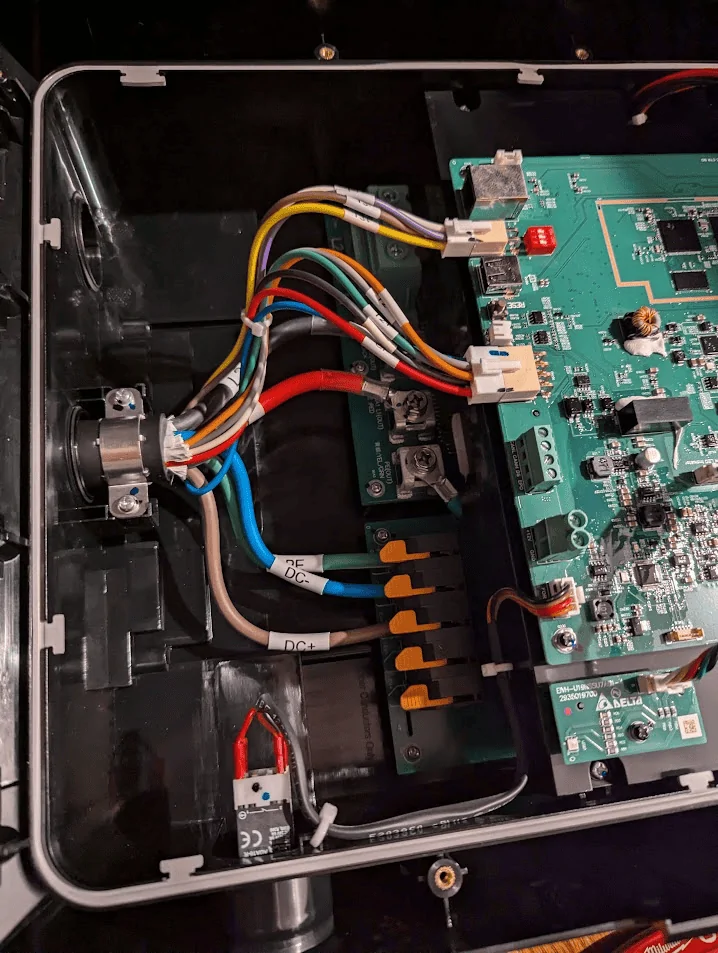
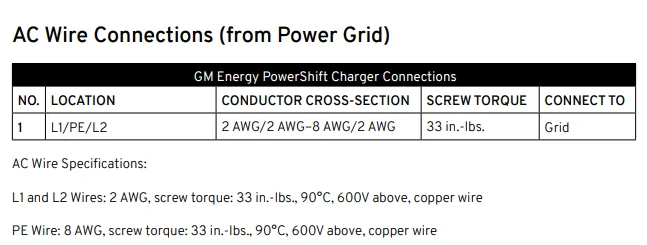
GM's setup is this: 80A over AC and ~37A over DC. The AC wires get wired to their "Hub" device. The DC wires get wired into their "Inverter". 2x2AWG for AC and 2x8AWG for DC. The EVSE can accept up to 1 1/4" conduit.

(Edit: I am only putting the AC wires in for now. Conduit is sized so the remaining DC wires can still be run in parallel, and I will be putting in a junction box before our 100A AC disconnect to separate out the DC wires to run to the inverter.)

Rivian R1T R1S Preparing for bi-directional charging 1724944764291-ts


Photo showing the wires coming from the EV connector in the GM charger, prior to my installation.
Rivian R1T R1S Preparing for bi-directional charging 1724945067553-xv
 
Last edited:

BrianB

Well-Known Member
First Name
Brian
Joined
Jun 9, 2024
Threads
14
Messages
189
Reaction score
294
Location
Conroe, TX
Vehicles
2025 R1S
Clubs
 
I’m not an electrician, but I’m learning. For my level 2 charger, I ran 100 amp wire to my main electric panel, to give me some future proofing. At 80% service factor, that should support 80 amp charging or V2h. It was <$100 extra for the wire and no extra work.
 

mikehmb

Well-Known Member
First Name
Mike
Joined
Jan 12, 2022
Threads
154
Messages
2,303
Reaction score
5,223
Location
SF Bay Area
Vehicles
My name is Mike, and I have a (car) problem
At the moment, I’m using a portable charger with a 30-amp outlet in the garage, however I’d like to install an outdoor pedestal charger by our carport (the previous owners had interesting ideas about geometry, resulting in the garage being inaccessible to anything larger than a side by side), doing so will require trenching power lines to the spot, which is fine. My concern is that if I do that work now, whether I install a new level 2 charger there or just a receptacle for the portable one, I’d have to dig it all up and completely re-do it for a bi-directional charger in the (hopefully near) future.

I would definitely like to have v2h bi-directional charging once that’s available with my R1T, as we’re way out in the middle of nowhere on 75 year old lines that are showing their age. The possibility of being able to use it to time-shift our consumption to take advantage of time of use billing would also be nice.

While we obviously don’t know the details of Rivian’s bi-directional charging, are there some reasonable assumptions we can make so that I can have the new charger site wired to take advantage of it on the first try?
I would be perfectly happy with a high capacity output on the 1772 port to a generator input to the panel via a manual transfer switch - 10kW would be way, way more than we need during blackouts (we could get away with 3kW and still only really give up the oven and dishwasher). With solar and no current battery backup, this would be the most economical for my use case.

But - because they're almost certainly coming out with a new bi-di EVSE I'm waiting to make any changes. Seems like you need to intercept the main into the panel so the new EVSE can auto switch and shut down the output to the grid.

@Dark-Fx is implementing the GM solution, which seems pretty robust. Will be interesting to see what Rivian comes up with.
 

PhatDaddy

Well-Known Member
First Name
Jim
Joined
Apr 11, 2023
Threads
8
Messages
408
Reaction score
400
Location
Coastal Central Florida
Vehicles
2025 G2 R1T El Cap PDM; (RIP: 2024 G1 R1T RC PDM)
Occupation
Retired IT
I also went with the “100 amp wire to my main electric panel” for L2 charger, to a pedestal outside, with the trenching, etc. Just so much still up in the air, I didn’t know what else to do from a future-proofing standpoint, since trenched conduit would have had to be pretty drastically oversized, depending. So my ‘future-proofing’ was pretty much limited and based on getting enough power to outside from the main panel to support an L2 charger and some extra amps for a future garage/storm shelter space to be built at the current location of my existing L2 pedestal outside. My thinking is to overbuild that future garage as our ‘storm backup’ living space, which here is regular hurricanes. It would be a much much smaller living space with limited power and AC loads (and using my R1T camp kitchen setup for cooking).. Then if bidirectional charging comes to fruition, I will run that space off of the R1T battery. It bidirectional continues to get pushed out indefinitely, I should be able to disconnect that storm shelter space and it’s 100 amp service from the main panel (transfer switch or whatever) and provide power to that smaller ‘backup’ living space via natural gas generator or external battery/solar setup specifically to support that garage space.
 

Sponsored

OP
OP
josh0

josh0

Well-Known Member
First Name
Josh
Joined
Jan 4, 2024
Threads
26
Messages
362
Reaction score
508
Location
Abiquiu, NM / Baltimore, MD
Vehicles
2023 (Nov) R1T, 2014 Jeep Cherokee
Running higher than necessary capacity wiring to allow for upgrading makes sense. I guess the question is where the hardware that allows for switching inputs to the house lives. If it’s built into the charger, it seems like you’d want the charger between the house and the main line, but I guess it makes more sense to have the hardware to switch over right at the main panel anyway, so it should probably be safe to put in the wiring now, and plan to add a new charger when a bi-directional one is available.
 

docwhiz

Well-Known Member
First Name
Mark
Joined
May 22, 2023
Threads
5
Messages
668
Reaction score
618
Location
Lake Tahoe, California
Vehicles
Tesla Model S LR (2022), Land Rover Discovery 2
Occupation
Retired
The NACS only uses two wires and switches them between AC and DC.
Don't know why they can't design V2H to just use those two wires.

Also, most houses can be run on 5 or 10 kW (Including AC, etc.) so don't know why people need more than that.

These two changes would dramatically reduce the cost.
 
OP
OP
josh0

josh0

Well-Known Member
First Name
Josh
Joined
Jan 4, 2024
Threads
26
Messages
362
Reaction score
508
Location
Abiquiu, NM / Baltimore, MD
Vehicles
2023 (Nov) R1T, 2014 Jeep Cherokee
The NACS only uses two wires and switches them between AC and DC.
Don't know why they can't design V2H to just use those two wires.

Also, most houses can be run on 5 or 10 kW (Including AC, etc.) so don't know why people need more than that.

These two changes would dramatically reduce the cost.
In the case of V2H I think you would just have two wires, at least for power transmission. It will be AC between the house and the charger and DC between the charger and the vehicle, so no need to do anything crazy in the wiring the charger to your house. The only potential complication would be if they want some sort of wired communications between the charger and whatever box at your breaker panel is responsible for switching between grid and battery power, though it certainly wouldn't be necessary to have that.
 

docwhiz

Well-Known Member
First Name
Mark
Joined
May 22, 2023
Threads
5
Messages
668
Reaction score
618
Location
Lake Tahoe, California
Vehicles
Tesla Model S LR (2022), Land Rover Discovery 2
Occupation
Retired
In the case of V2H I think you would just have two wires, at least for power transmission. It will be AC between the house and the charger and DC between the charger and the vehicle, so no need to do anything crazy in the wiring the charger to your house. The only potential complication would be if they want some sort of wired communications between the charger and whatever box at your breaker panel is responsible for switching between grid and battery power, though it certainly wouldn't be necessary to have that.
The NACS has signal wires and these would probably be necessary in V2H. Just an Ethernet type cable would be adequate.
 
OP
OP
josh0

josh0

Well-Known Member
First Name
Josh
Joined
Jan 4, 2024
Threads
26
Messages
362
Reaction score
508
Location
Abiquiu, NM / Baltimore, MD
Vehicles
2023 (Nov) R1T, 2014 Jeep Cherokee
The NACS has signal wires and these would probably be necessary in V2H. Just an Ethernet type cable would be adequate.
I'm actually planning on running ethernet to where I want the charger anyway; I wonder if I should just add a second run, just in case. Or maybe I should just wait until we know more and stick with the 30A receptacle in the garage for now…
 

Sponsored

docwhiz

Well-Known Member
First Name
Mark
Joined
May 22, 2023
Threads
5
Messages
668
Reaction score
618
Location
Lake Tahoe, California
Vehicles
Tesla Model S LR (2022), Land Rover Discovery 2
Occupation
Retired
I'm actually planning on running ethernet to where I want the charger anyway; I wonder if I should just add a second run, just in case. Or maybe I should just wait until we know more and stick with the 30A receptacle in the garage for now…
Hard to tell what they will do.
Probably something overcomplicated and hard to plan for.
 
OP
OP
josh0

josh0

Well-Known Member
First Name
Josh
Joined
Jan 4, 2024
Threads
26
Messages
362
Reaction score
508
Location
Abiquiu, NM / Baltimore, MD
Vehicles
2023 (Nov) R1T, 2014 Jeep Cherokee
Hard to tell what they will do.
Probably something overcomplicated and hard to plan for.
I wasn't even that interested in bi-directional charging until we just had some pretty big power outages, and I realized how much it could simplify my prep for that; now my plan is to get some grid-charged backup batteries, but they only need to last long enough to either ensure we have heat/cooling overnight if the power goes out while we sleep and then long enough after for me to take the R1T to the nearest functioning Level 3 charger and back (probably ends up being 1 day's worth, just to be safe).
 

Chrisy

Well-Known Member
Joined
Oct 26, 2023
Threads
4
Messages
196
Reaction score
245
Location
Detroit metro
Vehicles
R1T DM (sold)
So I was in similar situation and put some thoughts into this. Then some action early this month (trenching 18" deep for 2 conduits for ~40 feet, pulling a ton of beefy cables, etc) :D

My conclusion was that I pulled a 15A line from my garage to my basement (where my main panel lives). I put this to the garage end: https://a.co/d/a2cbJ2A and a normal 15A GFCI outlet in the basement (wit ha 15A breaker in between them). This is not hooked to the main panel directly, I had a separate small box for the 15A breaker between the GFCI outlet and the wires coming from the garage.

The idea is that this will connect to the Rivian outlet and will power a DC charger for a "solar generator" and I will use the solar generator inverter's 240V output to feed my main panel thru an interlock.

1) There are a few reasons why I did this way, most notable is that I do not depend on V2H equipment (charger should support it, vehicle should support it and more importantly there must be transfer switch associated to it, etc).

2) Second most important reason is that the average power usage of my house -with usual stuff on- is about 400W (of course cooking, laundry will increase it but those are not constant loads) so a solar generator about 3~4 kW should serve as a buffer between my DC charging from the R1T and my house usage.
In this scenario I use the R1T's battery to steadily charge the solar generator (with a 600W DC supply, easy for 15A 120V).
And this system (solar generator -> DC charger -> power extension cable -> R1T bed) is super portable and future proof in a sense I can change my charger infrastructure, I can change my EV, etc, still I have a system working (also see next point :devil: )

3) I also have an inverter generator running on my house NG line so I can always swap from the solar generator to a "real" generator if needed.

Note: I had no direct line from my main panel to my garage for the EVSE so I used 4AWG wires (in a sperate conduit from the 15A ones running in the same trench I made) to feed a new subpanel in my garage that is used for the EVSE. Plus I hooked all my electricity at my garage to this new subpanel (the original circuit from my main panel to the garage had a lot of stuff hooked to it at my house before going to the garage. So now I put the extra load off from the garage circuit).
So technically I can reverse the things and use this feeder line for V2H but then I loose my dedicated line from the main panel to this new subpanel. Never the less I left it as an option for the future.

Long story short: I did not want to run two 4AWG or conduits that long (due to cost) so I opted for one beefy run to use an EVSE from main panel and a much cheaper smaller run for the 15A 120V as an alternative "V2H" :sun:
 
OP
OP
josh0

josh0

Well-Known Member
First Name
Josh
Joined
Jan 4, 2024
Threads
26
Messages
362
Reaction score
508
Location
Abiquiu, NM / Baltimore, MD
Vehicles
2023 (Nov) R1T, 2014 Jeep Cherokee
So I was in similar situation and put some thoughts into this. Then some action early this month (trenching 18" deep for 2 conduits for ~40 feet, pulling a ton of beefy cables, etc) :D

My conclusion was that I pulled a 15A line from my garage to my basement (where my main panel lives). I put this to the garage end: https://a.co/d/a2cbJ2A and a normal 15A GFCI outlet in the basement (wit ha 15A breaker in between them). This is not hooked to the main panel directly, I had a separate small box for the 15A breaker between the GFCI outlet and the wires coming from the garage.

The idea is that this will connect to the Rivian outlet and will power a DC charger for a "solar generator" and I will use the solar generator inverter's 240V output to feed my main panel thru an interlock.

1) There are a few reasons why I did this way, most notable is that I do not depend on V2H equipment (charger should support it, vehicle should support it and more importantly there must be transfer switch associated to it, etc).

2) Second most important reason is that the average power usage of my house -with usual stuff on- is about 400W (of course cooking, laundry will increase it but those are not constant loads) so a solar generator about 3~4 kW should serve as a buffer between my DC charging from the R1T and my house usage.
In this scenario I use the R1T's battery to steadily charge the solar generator (with a 600W DC supply, easy for 15A 120V).
And this system (solar generator -> DC charger -> power extension cable -> R1T bed) is super portable and future proof in a sense I can change my charger infrastructure, I can change my EV, etc, still I have a system working (also see next point :devil: )

3) I also have an inverter generator running on my house NG line so I can always swap from the solar generator to a "real" generator if needed.

Note: I had no direct line from my main panel to my garage for the EVSE so I used 4AWG wires (in a sperate conduit from the 15A ones running in the same trench I made) to feed a new subpanel in my garage that is used for the EVSE. Plus I hooked all my electricity at my garage to this new subpanel (the original circuit from my main panel to the garage had a lot of stuff hooked to it at my house before going to the garage. So now I put the extra load off from the garage circuit).
So technically I can reverse the things and use this feeder line for V2H but then I loose my dedicated line from the main panel to this new subpanel. Never the less I left it as an option for the future.

Long story short: I did not want to run two 4AWG or conduits that long (due to cost) so I opted for one beefy run to use an EVSE from main panel and a much cheaper smaller run for the 15A 120V as an alternative "V2H" :sun:
Smart! I like it! I was also considering the fact that even without a V2H enabled charger, as long as there are batteries that the house can run off, the batteries could be charged via the Rivian's inverter. Ultimately that would be more efficient if it's done via DC power straight from the battery, but I don't know if anyone has something quite like that (pretty sure V2L solutions are still providing AC power).
 

Chrisy

Well-Known Member
Joined
Oct 26, 2023
Threads
4
Messages
196
Reaction score
245
Location
Detroit metro
Vehicles
R1T DM (sold)
Smart! I like it! I was also considering the fact that even without a V2H enabled charger, as long as there are batteries that the house can run off, the batteries could be charged via the Rivian's inverter. Ultimately that would be more efficient if it's done via DC power straight from the battery, but I don't know if anyone has something quite like that (pretty sure V2L solutions are still providing AC power).
Yes, I was thinking about efficiency but this should not matter that much (10% change?) as in the end of the day I am thinking about a solution for emergency cases only.

As for the solar generator I am planning to use it to "shape" my day of usage as well. And it is easier to keep that plugged in all the time. I use my Rivian time to time, that what it is for :D
Also when I am at the office the Rivian cannot act as a buffer to serve energy when the daily electricity rate is high.

Hence my hybrid approach. I think in price it might be cheaper or at least comparable (I think right now current V2H equipment is quite expensive).

My EVSE is $400(not V2H capable)
Solar generator $2700
DC charger about $100
DC charging cables: $30?
Solar transfer switch $1000 (only if I want to shape my time of use)

Total is about $4000 plus nick nacks.
So maybe $4500.

But because it is a modular system I do not have to buy all at once so I can spread the cost.
Right now I still need to buy the solar generator and panel. I will when I have the money and it is cheaper (Black Friday).
Sponsored

 
Last edited:


Top