Sponsored

R1T Limited Regen Warning: What's normal?

usulio

Well-Known Member
Joined
Jun 2, 2023
Threads
8
Messages
1,044
Reaction score
1,292
Location
CO
Vehicles
R1S
Clubs
 
An interesting downside to Rivian's strategy is unpredictable driving characteristics. The amount of braking force you get from letting off the pedal can change moment to moment and even on two different trips down the same hill, just based on the state of charge and what "level" of limited regen you're actually at.
Sponsored
 

mtberman

Well-Known Member
First Name
Terry
Joined
Sep 21, 2023
Threads
1
Messages
95
Reaction score
122
Location
Denver
Vehicles
2023 R1T DM large,2019 Chev Bolt, 2021 Audi e-tron
I got a dual motor R1T 2 weeks ago and first encountered this problem today at 550 miles, coming down Hwy 285 into Denver with bikes on board. I find it disappointing. I love the truck other than the sketchy thermal management.

I already ran into the rapidgate BS when I tried to DCFC it, so clearly this is the one weak spot with this car. TBH I thought maybe the oil cooling in the DM would save me, but no. It’s the same.

I have an Audi e-tron and it doesn’t blink at these same long climbs and descents. And it holds 150kW all the way to 80% SoC when DC fast charging. Of course that is because it has a complex thermal management system.

My hope is that they can update the software to start running the AC earlier and more aggressively to preemptively cool the battery on hills.
 

robd

Active Member
Joined
Dec 22, 2024
Threads
1
Messages
39
Reaction score
48
Location
Colorado
Vehicles
R1T; Tesla Model 3
Recently experienced disappointing limited regen behavior while towing a trailer downhill. Searched the site and this seems like the most relevant thread to discuss even though it is 2 years old.

2023 R1T Dual Motor Performance. Drive settings: All purpose, high regen.

On two similar trips in Colorado I had very different regen.
Trip 1 - Red Feather Lakes (elev 8245') to Livermore CO (elev 5900'); Early June
Trip 2 - Hermit Park (elev 8000' ) to Lyons (elev 5340'); Mid July

Trip 1 I had full regen all the way down. Didn't need to use the brakes.

Trip 2 I got limited regen after a mile or two into the trip. Had to use the brakes all the way down.

I'm about to repeat Trip 1 and am not sure what to expect. Perhaps I'll enable the service RIDE BMS and High Voltage dashboards to see if there are more detailed clues on what is limiting my regen. Wish I had the data logging like @jwardell.

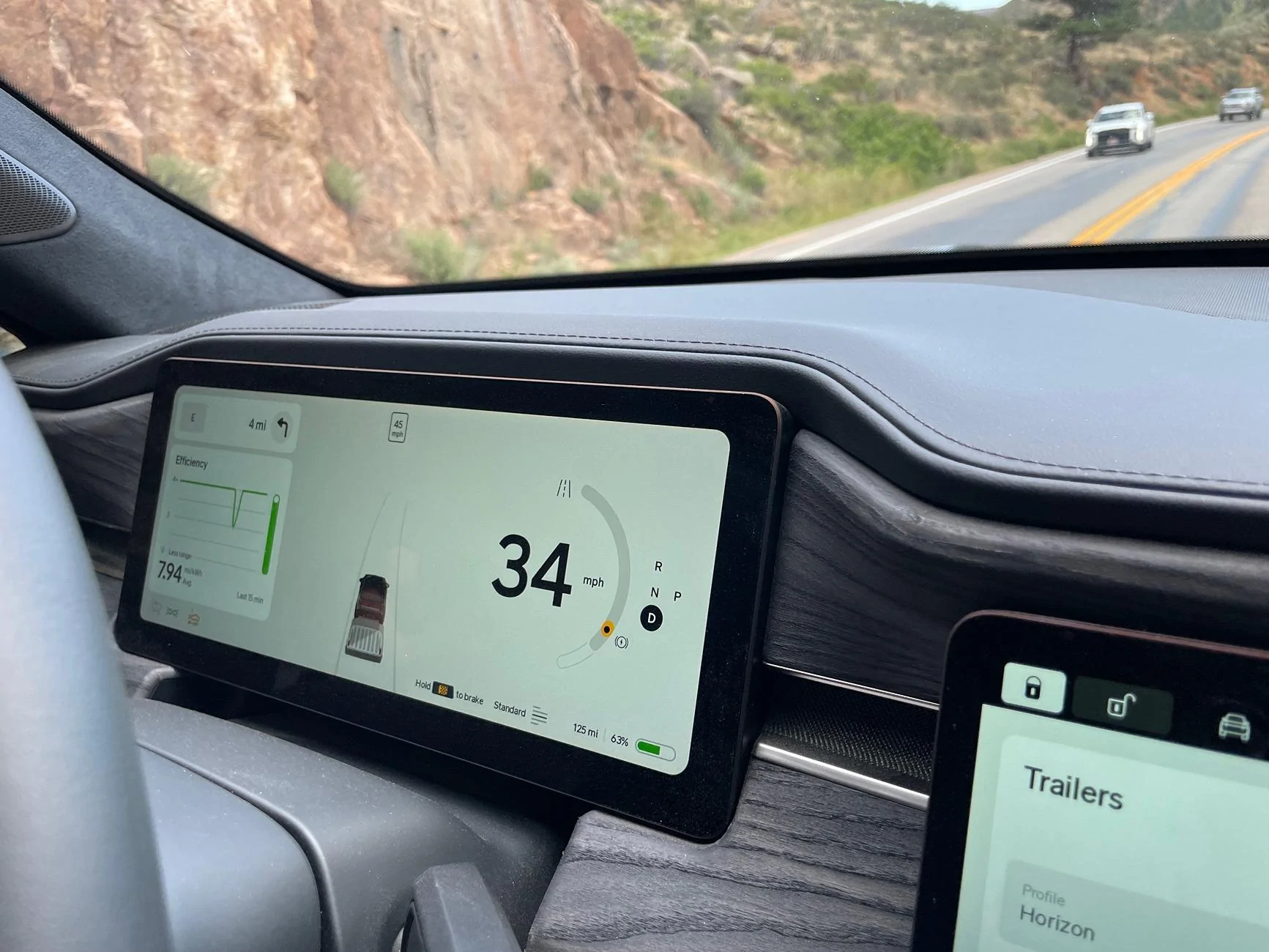
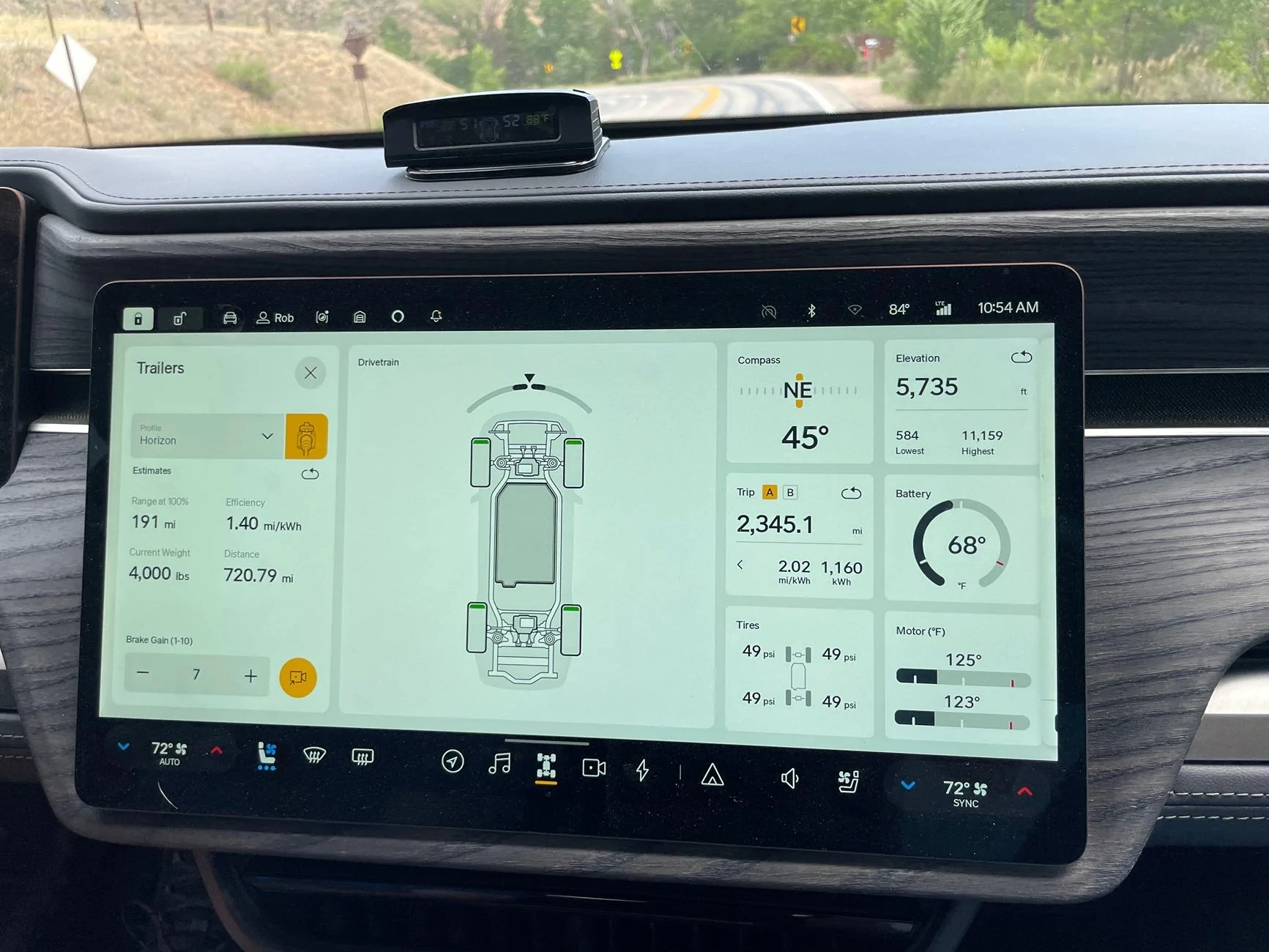
Here a couple of photos from Trip 2:
Rivian R1T R1S R1T Limited Regen Warning: What's normal? IMG_5489

Rivian R1T R1S R1T Limited Regen Warning: What's normal? IMG_5490
 

VSG

Well-Known Member
Joined
Oct 3, 2022
Threads
4
Messages
3,272
Reaction score
6,132
Location
WA
Vehicles
R1T LE/RB/OC/20
There has been a big change since this thread was last active - Rivian added a setting that lets you blend in mechanical brakes when regenerative braking is limited. That settings addresses the consistency problem called out above in this thread. Because you don't mention this setting, perhaps you're unaware of it?

There is also now a new energy screen where you can see how much energy you are getting from regenerative braking, and how much you are using for driving, climate, etc. This should give you a better understanding of what is going on.

Energy gained from regenerative braking is used to charge the battery. The powerful motors in a Rivian can generate a *lot* of energy going downhill - more than the battery can accept sometimes. When your Rivian generates more than your batteries can accept, regenerative braking is limited. It is or should be well known that all EV batteries can only accept a certain amount of energy, varying with the state of charge of your battery. This is the "charging curve" and you can google exactly what it looks like for Rivians and any other vehicle. Because you don't mention your SoC, which is probably the most important number when comparing these two trips, perhaps you're not aware that the amount of regenerative braking you can get varies drastically with SoC?

Compared to SoC, the other effects are minor. Sure, battery temperature affects regeneration, but if you precondition your battery for fast charging that not only improves fast changing speed but also improves regenerative braking, because both are limited by how much energy the battery can accept at a given SoC.
 

robd

Active Member
Joined
Dec 22, 2024
Threads
1
Messages
39
Reaction score
48
Location
Colorado
Vehicles
R1T; Tesla Model 3
Thanks for the reply @VSG. I am aware of the Regenerative Braking Assist setting. I have it on and am familiar with its behavior when I have a full or cold battery and it applies the brakes instead of, or in addition to, regenerative breaking. Interestingly, I don't think Braking Assist activated while towing downhill. I had to manually apply the brakes. Probably a good design so I had increased awareness of brake usage and could manage my brake temperature on the downhill.

What I'm trying to understand is why Trip 1 allowed full regen and Trip 2 only allowed partial regen. I don't have photos from Trip 1. No need since truck worked as I expected. Photos from Trip 2 show limited regen avail on the Power Gauge and what I believe are favorable battery level and motor + battery temps. Any opinions on if those are non-favorable for regen?

I'm also aware of the new energy screen. I can't recall if I looked at it for Trip 2 but I don't think it would have provided a clue as to why regen was limited.

I referenced @jwardell since his videos show the graph of BMS Charge Current Limit and other variables vs time on a drive. I assume a lower Charge Current Limit is what I experienced. Still trying to figure out the cause. Perhaps a higher ambient temp on Trip 2 (maybe 80F vs 70F)? New SW? Something else?
 

Sponsored

VSG

Well-Known Member
Joined
Oct 3, 2022
Threads
4
Messages
3,272
Reaction score
6,132
Location
WA
Vehicles
R1T LE/RB/OC/20
Be aware that even in ideal battery conditions, a Rivian can't charge faster than about 220kW.

My R1T Quad motor has 835hp which is the equivalent of about 614kW. I don't know how much of that power is available in "reverse" when generating electricity rather than consuming it, but even if it's only a fraction it seems clear that is incredibly easy to exceed even the maximum charge rate of the Rivian battery, let alone a lower rate like 75kW that might be the maximum you could put into the battery at say 75% SoC.

An EV with a better charging curve and far less horsepower would have less or no limit on regenerative braking - the reason you hit the limitation with a Rivian is mainly because it is heavy and has powerful motors so it can generate much more energy going down the same hill than (almost?) any other EV.
 

robd

Active Member
Joined
Dec 22, 2024
Threads
1
Messages
39
Reaction score
48
Location
Colorado
Vehicles
R1T; Tesla Model 3
@VSG While I agree with those facts, I don't draw that same conclusion because I had two similar drives but different regen experiences.

Without full data logging and knowing the internal Rivan mode logic I don't know if anyone can say for sure why regen was limited. I'll try to gather more data on my trip this week.
 
Last edited:

VSG

Well-Known Member
Joined
Oct 3, 2022
Threads
4
Messages
3,272
Reaction score
6,132
Location
WA
Vehicles
R1T LE/RB/OC/20
Yeah I guess what I'm trying to convey is that regen is limited for the same reason charging is limited, so:
  • SoC is the biggest factor limiting regen, and we don't know that for your two trips so can't really provide an explanation or expectation.
  • The new manual "precondition" button can be used both to maximize your fast charging performance and maximize your regen performance down a long grade.
Your second trip had an SoC of 63% in your photo, and already that means that your battery is only able to accept maybe half what it can at 30% SoC, so that may be the entire explanation. But we don't know what the Trip 1 SoC was. If your battery pack was cold-soaked on one trip but not the other, or if your battery pack was too hot on one trip but not the other, that could also be a factor.
 

robd

Active Member
Joined
Dec 22, 2024
Threads
1
Messages
39
Reaction score
48
Location
Colorado
Vehicles
R1T; Tesla Model 3
I confirmed Regenerative Brake Assist is disabled when towing.

From June 2025 Owner's Guide:
Rivian R1T R1S R1T Limited Regen Warning: What's normal? 1753561807976-1f
 

jwardell

Well-Known Member
First Name
Josh
Joined
Sep 14, 2021
Threads
1
Messages
221
Reaction score
337
Location
Boston
Website
www.jwardell.com
Vehicles
R1T
Occupation
Electrical Engineer
Clubs
 
Thanks for the reply @VSG. I am aware of the Regenerative Braking Assist setting. I have it on and am familiar with its behavior when I have a full or cold battery and it applies the brakes instead of, or in addition to, regenerative breaking. Interestingly, I don't think Braking Assist activated while towing downhill. I had to manually apply the brakes. Probably a good design so I had increased awareness of brake usage and could manage my brake temperature on the downhill.

What I'm trying to understand is why Trip 1 allowed full regen and Trip 2 only allowed partial regen. I don't have photos from Trip 1. No need since truck worked as I expected. Photos from Trip 2 show limited regen avail on the Power Gauge and what I believe are favorable battery level and motor + battery temps. Any opinions on if those are non-favorable for regen?

I'm also aware of the new energy screen. I can't recall if I looked at it for Trip 2 but I don't think it would have provided a clue as to why regen was limited.

I referenced @jwardell since his videos show the graph of BMS Charge Current Limit and other variables vs time on a drive. I assume a lower Charge Current Limit is what I experienced. Still trying to figure out the cause. Perhaps a higher ambient temp on Trip 2 (maybe 80F vs 70F)? New SW? Something else?
I do a regen braking test every single day as my commute is a continuous 5 miles downhill, repeatable in all conditions. I've continued to learn more details.

Remember regen is the same as high-powered DC charging, pushing 100-200kW into the pack. Similarly, the pack will refuse to accept it as the charge level rises and is also heavily temperature dependent.

There's also another layer of logic to this that I've been trying to figure out, essentially accepts high energy only for so long, but you can "get the lead out" and with a few seconds of powered acceleration you will get all your regen back. It can also happen with a break if you park.

Because of that,. so many people in the majority of situations where they don't actually regen continuously and have portions of road that still require some forward power for small flats or slight uphills may never experience the regen limit. But for me, it's every day of the year.

So first and foremost, state of charge will provide a hard limit to regen as well as the capacity/time before the regen limit kicks in. The difference between 60% and 70% SOC is noticeable to me, even better if lower.

Second is pack temperature (that's only related to weather if it's been sitting outside for many hours). I'll be lucky to get half a mile before I lose regen in the coldest winter days (even though it sleeps in an insulated garage around freezing), and I will get almost all the way down before regen starts limiting on the hottest summer days. The pack wants to be 80F and will derate as temperature falls from there.

But what I figured out in the past year, and what really will help in your towing situation, is there is a bit of a get-the-lead-out cheat: Find an opportunity/flat area to slow almost to a stop, then give it a good half throttle for as long as you can, and hopefully you will see the regen come back. Or, pull over and park it for a few minutes. You will have full regen again. I sucessfully used this trick several days this winter when I would get regen limit after a mile or two, and would use the last of it to come to a stop, then floor it at a flat part...I was able to get the rest of the way down without ever needing friction brakes, which is not possible without doing so
Sponsored


Top