
azbill
Well-Known Member
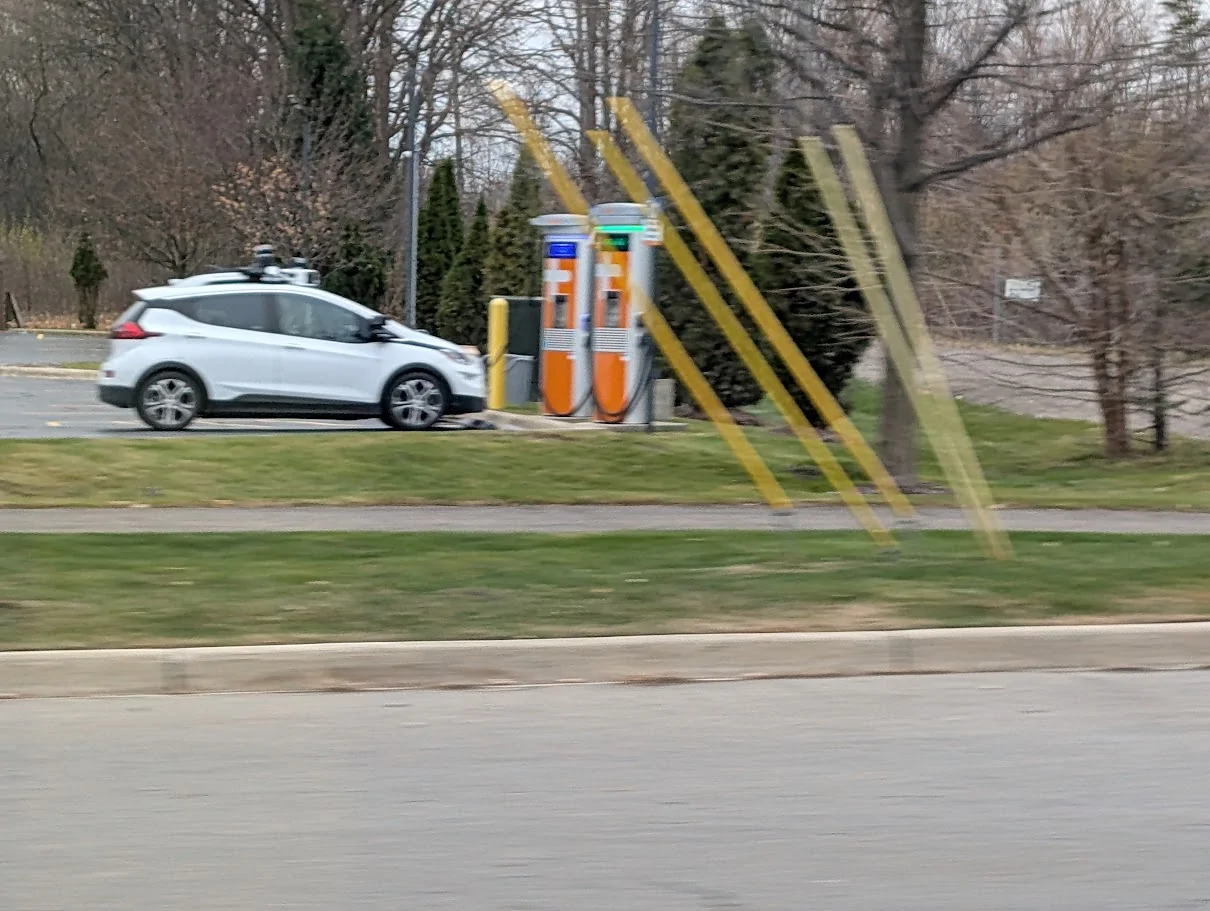
That looks just like the Cruise Bolts they test in Phoenix and SF. Interestingly, Tesla just got approved by ADOT in Arizona to use their Robotaxis here.I keep seeing this Bolt locally, this was last Thursday.

Sponsored
That looks just like the Cruise Bolts they test in Phoenix and SF. Interestingly, Tesla just got approved by ADOT in Arizona to use their Robotaxis here.I keep seeing this Bolt locally, this was last Thursday.

The highschool graduate, while more capable, can get you in a lot worse trouble. Like, life and death trouble, given how people use it. There is plenty of evidence and if that isn't enough, nothing will change some opinions.Before my R1S gen2 I drove a 2018 Model X with FSD. It worked fairly well point to point except you had to have a pretty good grip on the steering wheel or you got punished and locked out of FSD for a week. Any kind of inclement weather would also cause an alert to manually take over. I believe that Rivian's use of better cameras and radar will do a better job in that regard. Tesla has been receiving billions of bits of data for years and compared to Rivian I would liken it to a kindergartener vs. a high school graduate.

I’m sure the family of the deceased would concur and find solace in knowing their loved ones sacrificed their lives so that FSD is where it is today. You know, for the greater good.Edge cases don't negate the net positives to me.
Let's be honest with ourselves and look at statistics: " Globally, about 1.35 million people die each year in car accidents, according to the World Health Organization. The leading causes of these fatalities include speeding, distracted driving, impaired driving, and failure to use seatbelts "I’m sure the family of the deceased would concur and find solace in knowing their loved ones sacrificed their lives so that FSD is where it is today. You know, for the greater good.
I don’t have absolute faith in autonomy + however, I’ve yet to hear of a fatality involving it. I know its limitations and I’m aware 100% of the time it has control. I work and drive in all five boroughs of NYC every day. I’ve done so for 30-plus years. I wouldn’t have confidence in ANY self driving tech around here. WAY too many variables and unpredictable scenarios.
Minority ReportI am working on an SAE committee that is writing the standard for certification of AI in aviation. One of the key issues is that AI always has uncertainty, as you have pointed out.
One of the ways to get around uncertainty is to use dissimilar sensors and dissimilar AI algorithms. Sensor fusion is one of the newer terms for doing this. If you are using two sensors, such as radar and cameras, if they disagree you can hand control back to the driver or pilot, that provides a level of safety but not continued functionality. If you have three dissimilar sensors; lidar, radar and cameras, if one disagrees you can ignore it and continue. The case of three in disagreement at the same point in time becomes much lower in probability (but it does not become zero).

Totally agreed about Hyundai/Kia ADAS implementation being much better and practical for real world driving than Rivian. It does not simply quit whether mapped or not and that’s huge in relieving long drive tedium. Rivian needs to understand not just to ‘demonstrate’ but to solve real issues for real people.Based on where Rivian is at with their highway assist there is no way Rivian is even close to anything full FSD. Their highway assist is very poor and glitchy with lots of nuisances.
A few months back on vacation I rented a Hyundai Elantra and drove from the the tip of the Florida keys all the way up to Orlando. It had 2 independent buttons, 1 for adaptive cruise control and 1 for lane keep assist. Activating both of those together had me cruising for hours without ever touch the wheel and peddles. The performance on this crappy $25k car was way, way better than what I've ever achieved in my R1S.
Rivian has access to the NVIDIA Training system for vehicles. Tesla is behind not ahead as the multi-billion-dollar failed DOJO experiment (now shutdown) made obvious. There were a series of critical missteps that left them behind.Tesla has been receiving billions of bits of data for years and compared to Rivian I would liken it to a kindergartener vs. a high school graduate.
Whatever it takes for you to justify using it, that’s fine. You do you. I’m not convinced.Let's be honest with ourselves and look at statistics: " Globally, about 1.35 million people die each year in car accidents, according to the World Health Organization. The leading causes of these fatalities include speeding, distracted driving, impaired driving, and failure to use seatbelts "
We don't ban driving because of that and unfortunately not embracing ADAS systems isn't going to make things better.
The examples you provided namely the driving under the semi was using mobileye and that driver was absolutely not paying attention ( I believe he was watching harry potter ).
While anyone being taken down railroad tracks is no different to me than someone putting on cruise control and heading towards a cliff and just doing nothing. You tap the brake and the entire system turns off and you are still in control of the vehicle. You don't turn on FSD or Driver+ and lose control of the vehicle.
In my case my R1T veered into an exit lane at like 50+ mph and I had to regain control as these systems are not there yet for complete unsupervised use. I don't go around telling people my rivian almost killed me, but I also tell people to use any of these ADAS like a more advanced cruise control.
I think you and I might differ as I work in an area here Waymo has grown and now we will have teslas taxis doing the same things. Riding in a waymo is a surreal experience and I would bet all my money in 5-10 years will only get even better. After my 25 years of driving I will say my faith in human drivers dwindles by the day. Drivers seem more distracted than they ever were when I started driving.
No disrespect but I believe this is a gross oversimplification of things. It's like how people think strapping LIDAR on a car suddenly means you have solved level 4 autonomy. The real secret sauce is the actual software that knows what to do with that sensor data and the odd edge cases that are impossible to predict until they happen. Nvidia's system is not some panacea to self driving.Rivian has access to the NVIDIA Training system for vehicles. Tesla is behind not ahead as the multi-billion-dollar failed DOJO experiment (now shutdown) made obvious. There were a series of critical missteps that left them behind.
Lots of interesting stuff in the link below:
https://developer.nvidia.com/drive
I agree - the first update that switched the gen2 over to Rivians in house model was night and day for me. My daily commute was always the systems shutting off when there was a minor sun glare and since then it just stays locked in and hasn't had any sudden disengagements. Even the biggest scare with my R1T was when the mobileye system suddenly veered off an exit while I was going highway speeds. Lastly the previous system handled lane cut ins terribly. It would keep speeding up until a vehicle was 100% in the lane in front of me where the new system is predicting cut ins better.I agree with the current state of highway assist. The release of the Rivian system was worse than the Mobileye system that was there before it, but Rivian has since surpassed it by a significant degree. I drove for a few hours using it in heavy traffic and was impressed by how well it navigated the traffic and the decisions it made while switching lanes, adapting its behavior to the situation. Heavy freeway traffic jams are among the most challenging traffic situations to navigate, and Rivian performs remarkably well.
I think you did not look at the link. The NVIDIA system is not about LiDAR or even TOPS. The thing that is interesting is the end-to-end development system OEMs are buying into including the much more advanced simulation learning. NVIDIA’s Omniverse and Drive Sim platforms are its key advantage. They are selling OEMs access to a massive virtual fleet. And here is the thing - it is probably better than anything Tesla has from the real world and here is why:No disrespect but I believe this is a gross oversimplification of things. It's like how people think strapping LIDAR on a car suddenly means you have solved level 4 autonomy. The real secret sauce is the actual software that knows what to do with that sensor data and the odd edge cases that are impossible to predict until they happen. Nvidia's system is not some panacea to self driving.
I would argue Tesla's biggest advantage is the insane amount of real world training data they have and the edge cases that only real life can put forth. Even after Elon basically firebombing the brand with his antics, the model Y still sells a shit ton of vehicles even in the most recent quarter and that's just more drivers providing data.
I am rooting for Rivian but when it comes down to it a consumer can buy a tesla today that has quite an impressive ADAS suite that only is improving. Excited for Dec 11th and hoping its not just announcing we have to pay monthly without any tangible improvements.
I think you're simplifying a lot of things in the wrong way.I think you did not look at the link. The NVIDIA system is not about LiDAR or even TOPS. The thing that is interesting is the end-to-end development system OEMs are buying into including the much more advanced simulation learning. NVIDIA’s Omniverse and Drive Sim platforms are its key advantage. They are selling OEMs access to a massive virtual fleet. And here is the thing - it is probably better than anything Tesla has from the real world and here is why:
There is this misconception that the reason tesla does not have self driving is because they use camera only. Tesla is pursuing end-to-end self driving without HD maps, and these self driving solutions use vision as a backbone sensor. Waymo EMMA (end-to-end research model) is vision only. Wayve AI who is arguably #2 in this behind tesla and is backed by Nvidia is also vision-only. Many cars with lidar in their ADAS systems, the lidar is likely not even used. Lucid is not using their lidar and many Chinese and western systems it is turned off.If it is ultimately proven that robust self-driving requires additional sensors like high-definition radar or LiDAR for safety and reliability, then Tesla's current data set is vastly less useful because you can't train a LiDAR-based perception module (or mm radar) with camera-only data. If Tesla is wrong about the required sensors (it is) then its training advantage becomes a disadvantage. Tesla has less radar and lidar data than even a bit player and (this is the important part) no way to integrate the visual and other sensors data into a multi-sensor training set for a worldview.
Tesla spent about 1 billion on dojo. Most of that money went towards actual training compute. It wasn't a failure. Nvidia makes better gpus and Tesla purchase a lot of them. Training compute is important. Rivian lacks training compute. Storage is also important. Camera framerates are important. Rivian appears to be running their cameras at low framerate because of memory bandwidth limitations. They also appear to be collecting and training on low framerate video because they can't afford the proper amount of storage.That is why Tesla dumped so much money into DOJO and it is why it is such a big deal that it got shut down a few months ago.


