Sponsored

First Time EV Buyers: Battery Size and Charging Apprehensions

OP
OP

Riventures

Well-Known Member
First Name
Ft
Joined
Jul 15, 2021
Threads
6
Messages
133
Reaction score
214
Location
MD
Vehicles
eTron GT
Occupation
Management Consultant
I understand your point of view @ajdelange . Brakes, however, are not devices that only stop a vehicle, they have another equally important role in driving. BEV or not, a car is a car and still has to obey physics laws, and require proper techniques to make the most of it, besides going from A to B.
Sponsored

 

OEVA

Active Member
Joined
Aug 12, 2021
Threads
4
Messages
44
Reaction score
67
Location
Oregon
Website
www.oeva.org
Vehicles
many
Actually Tesla gets it right (though others may too). Tesla does not blend until the very last seconds (i.e. just before an actual stop) thus maximizing the kinetic energy recovered and minimizing that lost to friction braking (any use of friction brake represents energy loss).
I've seen this argument before, and don't understand why implementing regen thru the left pedal as opposed to the right one makes a difference in efficiency. As long as the same amount of regen is implemented before blending in the friction brakes, why would the efficiency be different?
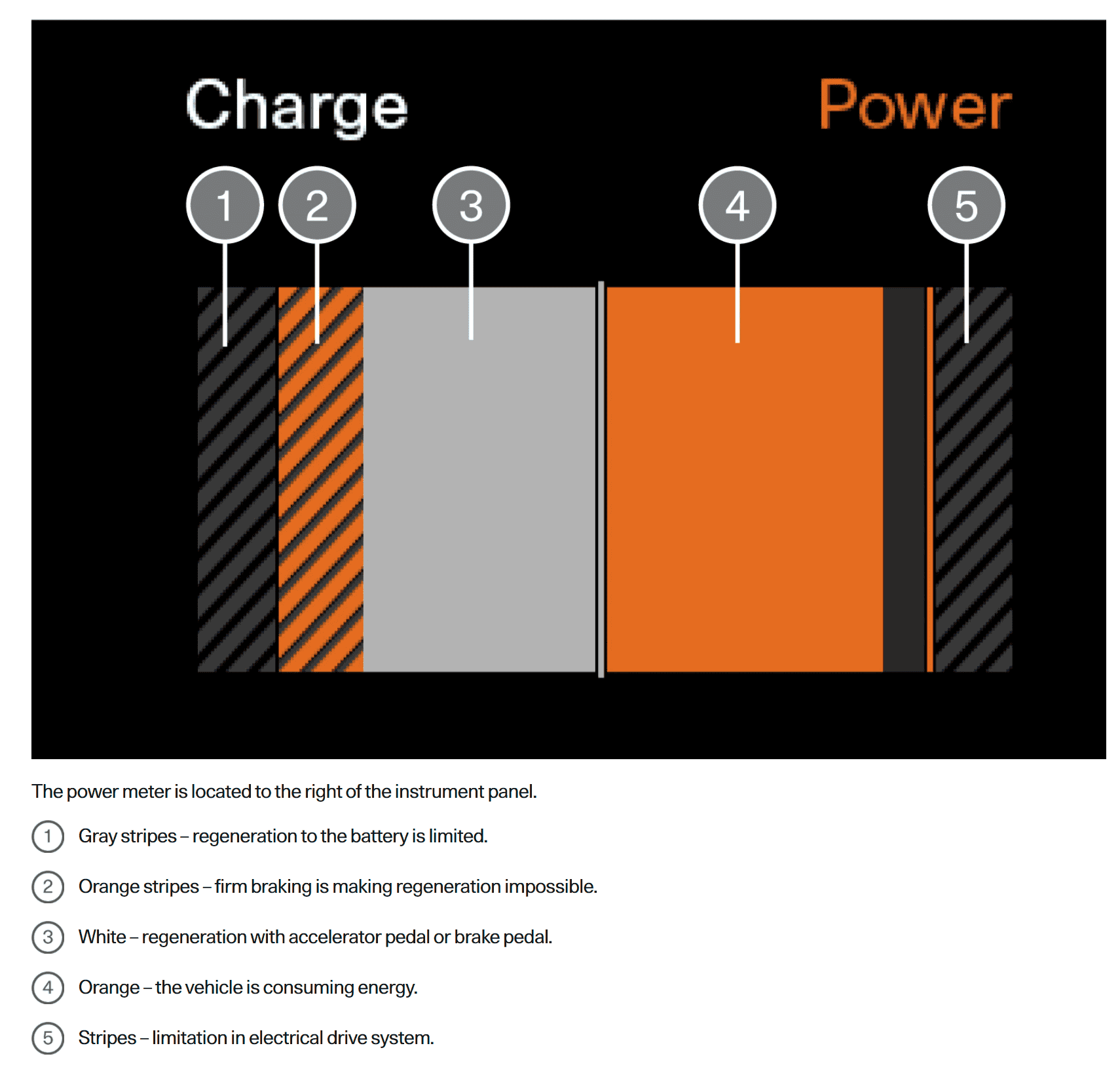
Polestar implements a "power meter" graphic as you brake that shows the amount of regen, how much (if any) friction brake is being used, and also how much potential regen is unavailable due to battery temp or SOC.
The same graphic also shows when temperature or other factors limit power to the accelerator power.
Rivian R1T R1S First Time EV Buyers: Battery Size and Charging Apprehensions 1639515396679


In the graphic above, you'll notice that area number 3 can be assigned to either the accelerator or brake pedal depending on personal preference. This can be done in several levels.
(Under normal driving, you'll only see the solid white and orange areas and they will vary as you accelerate/slow. When White, you are recapturing energy, when orange you are using it)
 

ajdelange

Well-Known Member
First Name
A. J.
Joined
Aug 1, 2019
Threads
9
Messages
2,883
Reaction score
2,319
Location
Virginia/Quebec
Vehicles
Tesla XLR+2019, Lexus, Landcruiser, R1T
Occupation
EE Retired
I understand your point of view @ajdelange . Brakes, however, are not devices that only stop a vehicle, they have another equally important role in driving.
What is that?

BEV or not, a car is a car and still has to obey physics laws, and require proper techniques to make the most of it, besides going from A to B.
One can, of course, argue about what is "proper technique" but it doesn't seem that there is anything that friction brakes can do that regen can't except decelerate faster than what one using what generally is thought of as "proper techniqe" should require and hold on a hill or serve as a "parking brake". And this is what the friction brakes do in Telsas and other BEV.[/quote]
 
Last edited:

ajdelange

Well-Known Member
First Name
A. J.
Joined
Aug 1, 2019
Threads
9
Messages
2,883
Reaction score
2,319
Location
Virginia/Quebec
Vehicles
Tesla XLR+2019, Lexus, Landcruiser, R1T
Occupation
EE Retired
Actually Tesla gets it right (though others may too). Tesla does not blend until the very last seconds (i.e. just before an actual stop) thus maximizing the kinetic energy recovered and minimizing that lost to friction braking (any use of friction brake represents energy loss). This implementation also makes one pedal driving reality. In other words you may well do an entire trip without ever touching the brake pedal.
I've seen this argument before, and don't understand why implementing regen thru the left pedal as opposed to the right one makes a difference in efficiency. As long as the same amount of regen is implemented before blending in the friction brakes, why would the efficiency be different?
It wouldn't nor does the post you quoted suggest that if would be. The quote from me claims that blending in friction brake, except at the last minute, is wasteful of energy. It does not say that implementing regen with paddles or levers or knobs or joysticks or roller wheels or trackballs is. In true one pedal driving one can invoke up to full regen without calling for any friction braking whatsoever as one can do with paddles, etc as long as the friction brake and regen are not coupled in the same control. The "problem" with systems that invoke regen with the wide pedal is that one can overshoot and wind up in the friction brake zone when he didn't intend to. I put "problem" in quotes because this isn't really a big problem if one is careful but it is interesting to think about this and true one pedal driving is certainly a pleasure once one gets used to it (which should take you about 10 minutes).
 

OEVA

Active Member
Joined
Aug 12, 2021
Threads
4
Messages
44
Reaction score
67
Location
Oregon
Website
www.oeva.org
Vehicles
many
It wouldn't nor does the post you quoted suggest that if would be. The quote from me claims that blending in friction brake, except at the last minute, is wasteful of energy. It does not say that implementing regen with paddles or levers or knobs or joysticks or roller wheels or trackballs is. In true one pedal driving one can invoke up to full regen without calling for any friction braking whatsoever as one can do with paddles, etc as long as the friction brake and regen are not coupled in the same control. The "problem" with systems that invoke regen with the wide pedal is that one can overshoot and wind up in the friction brake zone when he didn't intend to. I put "problem" in quotes because this isn't really a big problem if one is careful but it is interesting to think about this and true one pedal driving is certainly a pleasure once one gets used to it (which should take you about 10 minutes).
One pedal driving can, and often is, implemented on vehicles with blended braking.
Overshooting is not a problem or an issue. Stepping on the brake pedal will use regen exclusively up until the point you are requesting more stopping power than the motors and/or batteries can provide. If you press "too hard" (overshoot) on the brake, it is because you need to stop faster than regen allows. Onlly by deciding that you need to stop quicker than regen can provide will you engage the friction brakes. Not sure that accidentally stopping too fast is an issue related to which pedal controls regen - if the drivers perception is they need more braking than is being delivered, they will push on the "wide pedal" as you like to call it. You're grasping at straws if that is the best argument against blended braking you can come up with. Usually the next fallback in these discussions is something along the lines of "Tesla does it that way and they sell more EVs than anyone so therefore it is the best solution and every other EV maker should take note and follow what they do." Please don't go there as it will just make you look foolish.
 

Sponsored

OP
OP

Riventures

Well-Known Member
First Name
Ft
Joined
Jul 15, 2021
Threads
6
Messages
133
Reaction score
214
Location
MD
Vehicles
eTron GT
Occupation
Management Consultant
What is that?
As I mentioned previously, controlling the vehicle’s attitude, or weight at each corner.
One can, of course, argue about what is "proper technique" but it doesn't seem that there is anything that friction brakes can do that regen can't except decelerate faster than what one using what generally is thought of as "proper techniqe" should require and hold on a hill or serve as a "parking brake". And this is what the friction brakes do in Telsas and other BEV.[/quote]
I hope you would give me the benefit of the doubt, when I say there is far more to brakes than decelerating. Deceleration is almost a side benefit, depending on your driving.
When you are near Virginia someday, let’s have a drink, and I’ll explain and you’ll teach me about regen ;)
 
Last edited:

ajdelange

Well-Known Member
First Name
A. J.
Joined
Aug 1, 2019
Threads
9
Messages
2,883
Reaction score
2,319
Location
Virginia/Quebec
Vehicles
Tesla XLR+2019, Lexus, Landcruiser, R1T
Occupation
EE Retired
One pedal driving can, and often is, implemented on vehicles with blended braking.
No one has said otherwise.

Overshooting is not a problem or an issue.
That's your opinion which is not shared by all. The problem was first pointed out to me in a review of a vehicle (I can't remember which) that exhibits this problem. I don't have this problem as I drive a vehicle where regen is isolated. But in order to check the concept I figured that if my motor skills are good enough that I can go right to the border on a blended pedal I ought to be able to set the regen pedal to exactly 0 power on an isolated regen car. i can't but perhaps your motor skills are better than mine.

You're grasping at straws if that is the best argument against blended braking you can come up with.
No. Not even arguing. I like the isolated systems both as an engineer and a driver. You should buy what makes you happy,

Usually the next fallback in these discussions is something along the lines of "Tesla does it that way and they sell more EVs than anyone so therefore it is the best solution and every other EV maker should take note and follow what they do." Please don't go there as it will just make you look foolish.
A more intelligent continuation would point out that Tesla has sold lots of BEV and accumulated data on billions of miles of actual driving and, given that their engineers are demonstrably smart, only a fool would ignore what Tesla has learned (they offered various level of blending over time). indeed it appears that Rivian has been smart enough to do this as they have, AFAIK, turned off all the options that they evidently tried in test/demo vehicles. To be a bit more technical we would point out that if you ever use the friction brake when you don't have to you have wasted energy and cost yourself range. An isolated system does this and, of course, also simplifies the control system design. This makes it clear that Tesla's motivation is to get better EPA range numbers and indeed they do get quite a few extra from their regen approach.

For some reason some people seem to get very angry whenever it is suggested that Tesla did something smart. Get over it.
 

ajdelange

Well-Known Member
First Name
A. J.
Joined
Aug 1, 2019
Threads
9
Messages
2,883
Reaction score
2,319
Location
Virginia/Quebec
Vehicles
Tesla XLR+2019, Lexus, Landcruiser, R1T
Occupation
EE Retired
As I mentioned previously, controlling the vehicle’s attitude, or weight at each corner.
You didn't actually say that this was the "equally important role" though I suspected that this was what you had in mind.

I hope you would give me the benefit of the doubt, when I say there is far more to brakes than decelerating. Deceleration is almost a side benefit, depending on your driving.
I'm afraid I can't do that. Deceleration is the reason we have brakes (regen or friction) and "weight transfer" the penalty that we pay for having them because they decelerate the vehicle using thrust vectors that are not directed through the vehicle center of mass. The resulting torque (perpendicular to the longitudinal axis) tries to rotate the vehicle in the axial plane and must be offset by weight transfer associated torques. Let's start by observing that a BEV with its low COG is less subject to this phenomenon than an ICE vehicle but nonetheless it exists. Then lets point out that a deceleration vector of a given magnitude has exactly the same effect in this regard whether it is developed by a friction brake or a regenerative brake. Thus, again, we see that there is nothing the friction brake can do for us (or to us) that regen can't (or doesn't).

I'll drive from No Va to the Canadian border (600 mi) without, If things go well, using the friction brake at all. Thus if there be any benefit to the friction brake I've lost it. So I ask again "What benefit am I giving up?" I'll note that the car gives me a higher safety score on such a trip than it does if I have to use the friction brake because, in the opinion of the AI, if I use the friction brake I am in some sort of pickle which a safe driver would not have gotten himself into.
 
OP
OP

Riventures

Well-Known Member
First Name
Ft
Joined
Jul 15, 2021
Threads
6
Messages
133
Reaction score
214
Location
MD
Vehicles
eTron GT
Occupation
Management Consultant
Again, I think we are different types of drivers :)

if I am not mistaken, few decades ago Mario Andretti said:
It is amazing how many drivers, even at the Formula 1 level, think that brakes are for slowing the car down.
 

ajdelange

Well-Known Member
First Name
A. J.
Joined
Aug 1, 2019
Threads
9
Messages
2,883
Reaction score
2,319
Location
Virginia/Quebec
Vehicles
Tesla XLR+2019, Lexus, Landcruiser, R1T
Occupation
EE Retired
Doubtless! So I have, again, to ask, what do you (and, apparently, Mario Andretti) think brakes are for?

And I'll also ask again, as I didn't get an answer, if I don't use them (and I don't) what am I missing out on? If they are not for slowing the car what are they for? How would you explain my ability to get safely and economically from A to B without using them?
 
Last edited:

Sponsored

OP
OP

Riventures

Well-Known Member
First Name
Ft
Joined
Jul 15, 2021
Threads
6
Messages
133
Reaction score
214
Location
MD
Vehicles
eTron GT
Occupation
Management Consultant
Doubtless! So I have, again, to ask, what do you (and, apparently, Mario Andretti) think brakes are for?

And I'll also ask again, as I didn't get an answer, if I don't use them (and I don't) what am I missing out on? If they are not for slowing the car what are they for? How would you explain my ability to get safely and economically from A to B without using them?
I am not trying to dodge your questions, the answers will take more pages than available to explain. Many books have been written on performance driving techniques, and countless discussions continuously happen on many other forums. Frankly, as best as I understand your type of driving, it most likely does not matter.

I have raced for the better part of my life, thought performance driving for over 15 years, it is ingrained in me. It is never going from A to B to me. That does not mean I do street racing, never! It means I interact with the vehicle differently. Even off-road driving, IMHO, requires conscious decisions in managing the attitude (weight transfer, grip, reaction, etc.) at even 2 mph, and all the controls available in a vehicle (steering, brakes, throttle - and we used to have the gears too) need to be utilized to balance the vehicle in the best way to help overcome obstacles.

I do not have experience with the type of regen brakes you are referring to; but in situations where you need to delicately balance the vehicle, on or off-road, the level of retardation offered by those regen brakes (i.e. weight transfer) may be too much. If you are not in control of the level of retardation, then it is likely you are actually not in control of the vehicle.

Again, all this is very likely not relevant in your situations, and that is not a shortcoming of any kind, it is just a different type of driving. For off-road driving techniques, here is a good start IMO:


Also, I heard that Land Rover has several beginners to very advanced driving courses, which I intend to attend one of these days.
 
Last edited:

OEVA

Active Member
Joined
Aug 12, 2021
Threads
4
Messages
44
Reaction score
67
Location
Oregon
Website
www.oeva.org
Vehicles
many
No one has said otherwise.

That's your opinion which is not shared by all. The problem was first pointed out to me in a review of a vehicle (I can't remember which) that exhibits this problem. I don't have this problem as I drive a vehicle where regen is isolated. But in order to check the concept I figured that if my motor skills are good enough that I can go right to the border on a blended pedal I ought to be able to set the regen pedal to exactly 0 power on an isolated regen car. i can't but perhaps your motor skills are better than mine.

No. Not even arguing. I like the isolated systems both as an engineer and a driver. You should buy what makes you happy,

A more intelligent continuation would point out that Tesla has sold lots of BEV and accumulated data on billions of miles of actual driving and, given that their engineers are demonstrably smart, only a fool would ignore what Tesla has learned (they offered various level of blending over time). indeed it appears that Rivian has been smart enough to do this as they have, AFAIK, turned off all the options that they evidently tried in test/demo vehicles. To be a bit more technical we would point out that if you ever use the friction brake when you don't have to you have wasted energy and cost yourself range. An isolated system does this and, of course, also simplifies the control system design. This makes it clear that Tesla's motivation is to get better EPA range numbers and indeed they do get quite a few extra from their regen approach.

For some reason some people seem to get very angry whenever it is suggested that Tesla did something smart. Get over it.
I think I understand why you are confused.
Blended braking doesn't make a hard switch from regen to friction - it just adds in friction brakes on top of 100% regen when requested.
It's hard to do it in a manner that feels seamless to the driver, and very few manufacturers have been able to achieve a completely smooth feeling.
The easy way is indeed to separate the systems. Taking the easy way out is sometimes a better business decision, but doesn't make it the better method.
 

Dark-Fx

Well-Known Member
First Name
Brian
Joined
Jul 15, 2020
Threads
147
Messages
13,517
Reaction score
27,270
Location
Michigan
Vehicles
R1T, R1S, Livewire One, Sierra EV, R1S
Occupation
Engineering
Clubs
 
Actually Tesla gets it right (though others may too). Tesla does not blend until the very last seconds (i.e. just before an actual stop)
If you turn off one-pedal Regen braking because you want the car to function more like a normal vehicle, Tesla does not regen and starts using the mechanical brakes immediately upon the brake pedal being depressed. They don't have the hardware in the car to not do it this way. Personally I prefer "one-pedal until it isn't slowing enough" which works just fine in a Tesla, but if you want the traditional ICE "don't slow until I hit the brake pedal" it doesn't.
 

ajdelange

Well-Known Member
First Name
A. J.
Joined
Aug 1, 2019
Threads
9
Messages
2,883
Reaction score
2,319
Location
Virginia/Quebec
Vehicles
Tesla XLR+2019, Lexus, Landcruiser, R1T
Occupation
EE Retired
I am not trying to dodge your questions, the answers will take more pages than available to explain. Many books have been written on performance driving techniques, and countless discussions continuously happen on many other forums. Frankly, as best as I understand your type of driving, it most likely does not matter.
The kind of driving you are apparently thinking of is completly irrelevant to the way the driver of BEV experiences regen 99.999% which is on road. Going off road is an entirely different ball game as is the racetrack. The techniques one uses in those cases (yes, I had to take the Toyota course before the company would send me out to dodge kangaroos in one of their Landcruisers) are quite different. One does not, I hope, drive on the highway as he does on the track and if you are claiming to be a different sort of driver than I because you know some braking trick used by racing drivers I only hope you are not on the parts of the highway system I am on! On road the various techniques I think you are referring to are unnecessary because the vehicle manages those so much better than you can taking and processing measurements every few milliseconds.

It might help you to understand how independent regen works if you think of the skinny pedal as a thrust control. Push it towards the 'fire' wall and positive thrust increases. Back it away and positive thrust decreases down to 0 and into a negative thrust region. Thus you have to continuousl thrust control to some positive maximum and, as with the friction break, you have continuous thrust control to some negative minimum. If you bring the pedal back too far too fast such that it appears that you are getting out of the linear part of the thrust/slip curve then the computer will modulate for you.
 

ajdelange

Well-Known Member
First Name
A. J.
Joined
Aug 1, 2019
Threads
9
Messages
2,883
Reaction score
2,319
Location
Virginia/Quebec
Vehicles
Tesla XLR+2019, Lexus, Landcruiser, R1T
Occupation
EE Retired
I think I understand why you are confused.
Blended braking doesn't make a hard switch from regen to friction - it just adds in friction brakes on top of 100% regen when requested.
It's hard to do it in a manner that feels seamless to the driver, and very few manufacturers have been able to achieve a completely smooth feeling.
The easy way is indeed to separate the systems. Taking the easy way out is sometimes a better business decision, but doesn't make it the better method.
I think you are a little confused about how this works. Blended systems, as the name suggests, blend in friction braking during regen when the driver wants to slow down. It is in an independent system (like Tesla's) that the car adds in friction brakes on top of 100% regen. This is what happens if you take your foot off the skinny pedal (100% regen) and plant it on the wide one. Regen remains on.
Sponsored


Top