Sponsored

Wall charger vs. 14-50 plug in.

OP
OP

ftmeyer50

Member
First Name
frank
Joined
Oct 5, 2024
Threads
5
Messages
12
Reaction score
5
Location
Bozeman, MT
Vehicles
Rivian R1T 2025 Dual Motor
Thanks for the response in respect to the wiring and where we are at in the process. It seems like a no brainier now. Hardwire a wall charger. The charging times comparisons were very helpful.
Sponsored

 

HaveBlue

Well-Known Member
Joined
Nov 22, 2022
Threads
41
Messages
2,928
Reaction score
2,237
Location
91107
Vehicles
R1S DMP Max, Lifted GX470, APR Audi A7, BMW 325Ci
Clubs
 
First off -- it appears you are not aware a NEMA 14-50 outlet on only legal/approved for charging at 40 amps. The Electric codes say continuous current draws are limited to 80% of the nominal amount/fused current.

If you go with a NEMA 14-50 and you do not plan on leaving the cable essentially all the time plugged in, do not get your outlet from the likes of Home Depot. There are two grades of outlets. If you plan on taking the cable with your travels, be sure to get the commercial grade plug.

I am aware of several Tesla owners who have destroyed their mobile charging cables with non commercial grade plugs.
This is incorrect. NEC provides down to a 40A breaker on a 14-50 outlet per Table 210.21(B)(3) therefore some outlets will only charge at 32A which is why most mobile chargers only do 32A.
 

tps5352

Well-Known Member
Joined
Dec 26, 2020
Threads
22
Messages
235
Reaction score
285
Location
California Central Valley
Vehicles
2026 Tesla Model X All-Wheel Drive (5-seater)
Thanks for taking the time to go over issues i hadn’t even thought about! One more question. We are building a new house and the electrician already wired the spot where we would put the wall charger in the wall with a 60amp breaker. So at this point it’s either finish it with a hardwired wall charger or put in a 14-50 (would that even work?) i am going to go with the wall charger for the safety considerations.
Good responses/advice from other readers here. Based on them, I'll just add my additional two cents:

I'd be curious to ask the electrician, what gauge of wire he/she used. Was it 4-gauge? And did it have three wires, plus a ground wire (four wires total)?
  • If the wiring is 4-gauge and the breaker is 60-amps, then I believe that you can safely charge at 48-amps continuous using a good wall charger. Of course, you still have the (wise) option to charge at a less-powerful rate (using the car's software or the wall charger's built-in settings to lower the power rating). And if you don't need 48-amps, charging at a lower rate is generally a good idea. (Electric car charging is a relatively high energy demand endeavor. Puts a lot of temperature-related strain on a circuit over time. Best to minimize that strain when possible.)

  • If the house wire used was (for some reason) 6-gauge, I'd be more comfortable with no more than a 50-amp circuit (breaker) and a maximum of 40-amp continuous charging. (And depending on the area, perhaps that would be a maximum requirement per code?) And also, if only three wires were used, you may not be able to legitimately install a NEMA 14-50 receptacle (which normally requires four wires, per code).

  • To properly and safely use a NEMA 14-50 outlet/receptacle, you must have a (house) circuit connected to it that can and will not be able to exceed 50 amps of power. This is controlled/determined by the circuit breaker. So you do not want a NEMA 14-50 receptacle/outlet with a 60-amp breaker. However, it is OK (I believe) to have thicker wire than necessary; that should not be a problem. So if you want to install a NEMA 14-50 outlet, and the wire is 4-gauge (or 6-gauge?), and the breaker is for 60-amps, simply replace the breaker with a (proper GIS) 50-amp one, and install your (Hubbell 9450a or Bryant 9450fr) NEMA 14-50 outlet.

  • But to echo the thoughts of others, since your are starting with a new house and, I assume, a properly-wired (4-gauge) 60-amp dedicated circuit for electric car charging, if it were me I would definitely get a Rivian or other good wall charger (and simply "turn down" the power setting--using the car or wall charger settings--to 40- or even 32-amps for normal overnight charging).
Best of luck with all this.
 
Last edited:

MidnightRivian

Well-Known Member
Joined
Jun 21, 2021
Threads
98
Messages
2,296
Reaction score
3,671
Location
USA
Vehicles
Rivian R1S
Clubs
 
I would recommend a hardwired solution.

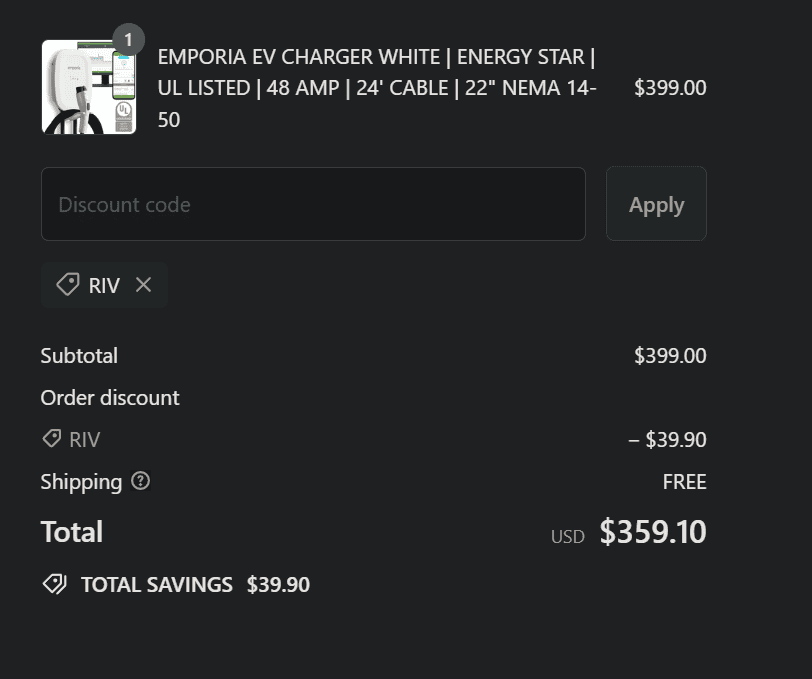
The Emporia EV Charging Station is a Level 2 electric vehicle charger that charges any EV up to 40 amps with 22” NEMA 14-50P or up to 48 amps with hardwired installation.

Emporia for $360 shipped OTD after forum discount is a great value.

Feel free to use the forum discount code “RIV” to save $$$ on A2Z EV website.

EMPORIA EV CHARGER WHITE | ENERGY STAR | UL LISTED | 48 AMP | 24' CABLE

Most Popular and Highly Recommended EV Charging Stations Which Qualify for Forum Discount code "RIV"

Rivian R1T R1S Wall charger vs. 14-50 plug in. IMG_8913
 

Rivian Owner

Well-Known Member
First Name
Mark
Joined
Sep 15, 2024
Threads
1
Messages
229
Reaction score
294
Location
Pacific North West
Vehicles
1971 GTO, 2019 F150,
Clubs
 
Just a thought....

A big reason I purchased a Rivian was the big battery they use. I got tired of losing power at home and I didn't want to spend a bunch of money on batteries that don't do anything but be batteries. Considering that this summer we've had power failures on successive days, having the ability to recharge quickly and maintain a 80% charge is important to my situation, therefore I invested in a charger that could deliver the full 48 amps.

If you are thinking about eventually implementing bidirectional charging, you might have the charging circuit's wires increased in size. I've seen estimates as high or higher than 100 amps for a fully functional bidirectional use of an EV. Even at 100 amps, you may still have to limit what appliances you run if the power goes out. I added a subpanel with 125 amp capacity near the location for the charger so that if and when bidirectional charging becomes a reality, only a short section of wire and a breaker change will give me the capacity I need. The subpanel also acts as an equipment disconnect for the charger.

FYI, for the most part, you can safely run 65 amps on a 6 ga wire. There are some limitations depending on the wire type, and some other nuances that can derate a circuit, but in most cases 65 amps is allowed. You can use larger wire sizes than what code allows, but keep in mind that a receptacle rated for 50 amps probably won't have connectors large enough to handle something like 2 ga wire, and larger gauge wire usually requires larger conduit.

As for getting a 240 volt shock if you touch one of the prongs on the plug, you'd have to touch both hot prongs on the plug to get a 240 volt shock; each prong carries 120 volts, yes a 120 volt shock is still going to make you scream, but you will only be getting electrocuted by 120 volts.
 

Sponsored

Nexus

Well-Known Member
Joined
May 19, 2022
Threads
1
Messages
64
Reaction score
36
Location
Baltimore
Vehicles
Toyota Tacoma, Tesla Model 3
Another thing to consider is future EVs. If ever you decide to get a second EV, some wall chargers can load share, ensuring that they never exceed the max load if they run off the same circuit. I am doing this with 2 tesla wall chargers (even though i have 2 separate circuits).
 

Kaiju

Well-Known Member
Joined
Aug 18, 2024
Threads
2
Messages
136
Reaction score
254
Location
Texas
Vehicles
R1T
One thing about GFCI breakers is that any charger that has one built-in will often have problems if there are two on the same circuit. Any NEC code newer than 2014 will require this in garage outlets, however if you have a typical class A 5mA GFCI it will often trip due to the ground-fault detection signal from the charger itself. There is such a thing as a class B 20mA GFCI but I have found them difficult to find for residential use.

You'll notice in some of the charger manuals it's mentioned you shouldn't put two GFCIs on the same circuit, but if you have to because of code you should attempt to get a Class B one.

And since wire size was mentioned, be careful of using only the wire size to judge its current rating. Temperature rating also matters and the usual residential 6 gauge NM-B (65C) from a big box store is only actually rated for 55A. You'd need 75C wire (THW, THWN, SE, USE, XHHW) for 65A.

Another thing worth mentioning though is that you can only oversize the wire in a charger circuit. Code won't let you, for example, put a 100A plug and a 50A charger on a 100A breaker because the charger would need to have a 50A breaker to keep it from being potentially overloaded. So you can put oversized wire in with an eye to a future upgrade, but ultimately both ends of the line are going to be limited by the charger amperage or whatever plugs are there. You also can't put a NEMA 14-50 plug on a circuit with a 60A breaker for a 60A charger for the same reason. The size of the fittings will determine the maximum wire size that you can use, so ultimately it all falls back on sizing the installation for the charger you choose.

I'd probably also have to recommend if you're going the road of a new built clean installation, get a 100-amp or greater sub-panel with at least 4 spaces in it put in your garage as mentioned above. That way at least the charger doesn't drive the size of the wiring going all the way back to the main panel. This would also include potentially upsizing your main panel for the extra headroom. You can get chargers up to 80A and while one vehicle doesn't need 60A or 80A, having the extra headroom for a tandem or second charger might be useful in the future and it is an enormous pain in the ass to deal with upgrading it after the fact. There's substantial cost savings in having your installation upsized a bit vs having to change something later.

For a retrofit I'd shoot for a 40A or 48A standalone charger because it becomes much more difficult and expensive to retrofit into an existing installation. If you already had a 14-50 plug, I'd tell you to just get the better Hubbell or Bryant plug and call it a day with a 40A charger that accomodates it because you're going to have to splice wire on or pull a new cable for a hardwired charger, and then eat any neccessary code updates.

I personally use a Hubbell NEMA 14-50 plug on a 50A circuit because I had to refrofit one in and naturally I was limited in what I could do. While I could use the portable charger, I still bought a dumb Grizzl-e mini with a long cord so I could charge at 40A, park any which way in the garage and also so the portable charger doesn't ever get left outside the vehicle. It still required me to upgrade my panel because the guys who originally wired my house cut corners on the electrical and didn't size everything to be able to handle the full 200A service coming in from the pole. Also if you ever upgrade something after the fact, you're required to bring it up to the most current code, which adds other expenses.

I happen to like the flexibility of the plug since it has other uses in the garage and if my charger ever dies, it's no big deal to change it out or to plug a different one in. However it will be forever limited to 40A charging.
 
Last edited:

Eeyore

Well-Known Member
First Name
Bruce
Joined
Nov 21, 2020
Threads
3
Messages
1,146
Reaction score
1,486
Location
Oregon
Vehicles
R1T LE, ID.4 AWD Pro S, Honda Fit
Occupation
Retired Union Electrician
Clubs
 
FYI, for the most part, you can safely run 65 amps on a 6 ga wire. There are some limitations depending on the wire type, and some other nuances that can derate a circuit, but in most cases 65 amps is allowed.
Only if ALL of the connections on the circuit are rated at 75C. Otherwise it is rated for 55 amps.
 

Dynabro86

Active Member
First Name
Brad
Joined
May 30, 2024
Threads
9
Messages
38
Reaction score
76
Location
illinois
Vehicles
2024 R1T
Clubs
 
Personally, I don't see a benefit for purchasing a wall charger.

I get ~14mi/hr on my 14-50 which is enough for (so far) 100% of my use cases in the last year and a half I've had my R1S.

I have solar and I live in Southern California where power is quite expensive, but charging after 9pm is good enough for me. Coincidentally the lowest I've ran the car was down to 9% and that was this past weekend. Charged back up to 80% by the time I needed to use the vehicle by the next morning. Even if not, it would have been enough to do the errand planned (not more than 10 miles total).

Again, just personally unless you just want a cool wall charger (and it is cool, and there's no problem with that), I can't see a use case where you need that much charging power on a daily basis. Are you burning through 200+ miles a day all the time? Even if you do it once a week, the following day you don't need that much.
Funny enough, I used the portable charger for a while and my issue came when I went on a road trip and forgot my portable at home. Totally my fault but I got a Wall charger literally so I would not forget my portable one when I needed it. That was my reason, which could be dumb for some people, but I do have a tendency to forget little things like that.
 

ElGuano

Well-Known Member
Joined
Oct 9, 2024
Threads
49
Messages
866
Reaction score
1,236
Location
Cali
Vehicles
R1T Trimax - Storm Blue, Driftwood, Sport Dark
I think safety is the big thing for me.

14-50 may require a GFCI breaker (I don't think it cares that your EVSE may have its own GFCI built in), and there's a lot of info out there on cheap receptacles that loosen/overheat/arc. A wall-mounted charger isn't going anywhere, so I don't see the ability to unplug it being any kind of real benefit.

If you already have a 14-50 and just want to use your mobile charger as your regular EVSE (this is what we do with our Tesla), I think it's fine as long as long as the charge rate is sufficient for you. But for a long-term permanent solution, wired in seems like the best path.
 

Sponsored

Crazychemist

Member
Joined
Jul 23, 2024
Threads
5
Messages
10
Reaction score
4
Location
Houston, TX
Vehicles
R1T Dual Large Gen 1
Clubs
 
I’ll add my experience, I drive about 70 miles a day and the portable wall charger with 14-50 plug is sufficient. I charge every other night and have not had to use a charge station since the at home install. The wall charger adds convenience but not $800 worth in my opinion.
 
OP
OP

ftmeyer50

Member
First Name
frank
Joined
Oct 5, 2024
Threads
5
Messages
12
Reaction score
5
Location
Bozeman, MT
Vehicles
Rivian R1T 2025 Dual Motor
Certainly a viable option. I’ve been charging with a 6-50 to 14-50 adaptor and it sure seems like a more affordable solution. About seven years ago my wife had a 50 amp 240v, 6-50 outlet installed in the garage to run an electric kiln. The kiln never happened but it sure was nice for my Rivian!
Sponsored


Top