Sponsored

Growing efficiency Gap: R2 w/ 21" vs. 20" tire sets

windshieldfarmer

Well-Known Member
First Name
KTMrider
Joined
Jul 22, 2026
Threads
0
Messages
78
Reaction score
86
Location
Wichita, KS
Vehicles
BMWIX50
Occupation
Retired
Good thing I am not in Rivian Roamer with my 20s because I have been flooring the car every time I drive. Its just too damn fun :)
Enjoy…once you start seeing the tires wear quickly I suspect you’ll dial back the fun a bit. Ask me how I know😜😜. Yes…fast EVs are a blast!
Sponsored


richpike

Well-Known Member
First Name
Rich
Joined
Jun 27, 2022
Threads
4
Messages
283
Reaction score
523
Location
6500ft ASL
Vehicles
Defender L663, Jeep JL, R1S
100%. I have posted the exact same thing before and it seems to go in one ear and out the other.

There are too many variables that impact efficiency to isolate the difference just to the tires. The same is true for the R1 data in RR, which has a lot more miles to compare. It isn't enough.

You need controlled testing to get a valid result. RR data is the opposite of controlled testing. Chad agrees, and it is his platform.
Just texted with Chad for a bit. He wants more data before spending any time or money doing significant analysis or drawing any conclusions. Totally understandable. Will be interesting to see his analysis as we get more data.

-Rich
 

mkhuffman

Well-Known Member
First Name
Mike
Joined
Nov 9, 2020
Threads
14
Messages
3,130
Reaction score
3,633
Location
Virginia
Vehicles
2025 R1T Tri-Max, Jeep GC-L, VW Jetta
Just texted with Chad for a bit. He wants more data before spending any time or money doing significant analysis or drawing any conclusions. Totally understandable. Will be interesting to see his analysis as we get more data.

-Rich
He also understands that there are many variables that impact efficiency besides tires. Such as driving style. Someone "flooring it" from every stoplight is not going to be as efficient as my wife who drives very gently.

You have to compare trucks that are being driven the same way in the same weather, in the same drive mode and with the same HVAC settings, the same tire wear, the same traffic, the same stoplights, etc.

We have no way of knowing most of the efficiency impacting variables in the data Rivian provides in the API RR uses. So while we might be able to get average speed one day, that information alone is not sufficient to stratify the data into sets that are comparable.

My average speed of 30 could be comprised of sprints to 80 mph, while someone else could be simply driving a consistent 30 mph. Guess which one is more efficient?

I can't believe this is so hard for people to grasp. You have to control as much as possible so that the ONLY thing that is different are the tires (or wheels). If multiple things are different, you cannot compare one of them and say that is the reason this person's R2 is more efficient than another.

It is very difficult to conduct controlled efficiency testing. Controlling the weather is not possible. Controlling the traffic is also not possible. There are ways to mitigate what you can't control, but it isn't easy. And the data will still be somewhat dirty.

The data in RR is dirty. It has no controls. None. You cannot draw conclusions from it.

You can draw conclusions from the EPA test results, and the range figures Rivian provides.

You can draw conclusions from your own RR data on your own truck, by tracking efficiency and noting when it is raining, when you are towing, when you have a bike rack on the back filled with bikes, or a RTT on the roof. @Budman does this. You should follow his efficiency threads.

This thread is totally unnecessary, and it is giving people bad information. I really hope people don't spend their hard-earned money based on the false claims in this thread.
 

Budman

Well-Known Member
First Name
Rick
Joined
Oct 22, 2021
Threads
60
Messages
885
Reaction score
3,092
Location
Minnesota
Vehicles
Honda CRV
Clubs
 
He also understands that there are many variables that impact efficiency besides tires. Such as driving style. Someone "flooring it" from every stoplight is not going to be as efficient as my wife who drives very gently.

You have to compare trucks that are being driven the same way in the same weather, in the same drive mode and with the same HVAC settings, the same tire wear, the same traffic, the same stoplights, etc.

We have no way of knowing most of the efficiency impacting variables in the data Rivian provides in the API RR uses. So while we might be able to get average speed one day, that information alone is not sufficient to stratify the data into sets that are comparable.

My average speed of 30 could be comprised of sprints to 80 mph, while someone else could be simply driving a consistent 30 mph. Guess which one is more efficient?

I can't believe this is so hard for people to grasp. You have to control as much as possible so that the ONLY thing that is different are the tires (or wheels). If multiple things are different, you cannot compare one of them and say that is the reason this person's R2 is more efficient than another.

It is very difficult to conduct controlled efficiency testing. Controlling the weather is not possible. Controlling the traffic is also not possible. There are ways to mitigate what you can't control, but it isn't easy. And the data will still be somewhat dirty.

The data in RR is dirty. It has no controls. None. You cannot draw conclusions from it.

You can draw conclusions from the EPA test results, and the range figures Rivian provides.

You can draw conclusions from your own RR data on your own truck, by tracking efficiency and noting when it is raining, when you are towing, when you have a bike rack on the back filled with bikes, or a RTT on the roof. @Budman does this. You should follow his efficiency threads.

This thread is totally unnecessary, and it is giving people bad information. I really hope people don't spend their hard-earned money based on the false claims in this thread.
What he said.
 

Thebandit

Well-Known Member
Joined
Jul 14, 2025
Threads
2
Messages
259
Reaction score
399
Location
NY
Vehicles
Subaru Crosstrek, Ascent
He also understands that there are many variables that impact efficiency besides tires. Such as driving style. Someone "flooring it" from every stoplight is not going to be as efficient as my wife who drives very gently.

You have to compare trucks that are being driven the same way in the same weather, in the same drive mode and with the same HVAC settings, the same tire wear, the same traffic, the same stoplights, etc.

We have no way of knowing most of the efficiency impacting variables in the data Rivian provides in the API RR uses. So while we might be able to get average speed one day, that information alone is not sufficient to stratify the data into sets that are comparable.

My average speed of 30 could be comprised of sprints to 80 mph, while someone else could be simply driving a consistent 30 mph. Guess which one is more efficient?

I can't believe this is so hard for people to grasp. You have to control as much as possible so that the ONLY thing that is different are the tires (or wheels). If multiple things are different, you cannot compare one of them and say that is the reason this person's R2 is more efficient than another.

It is very difficult to conduct controlled efficiency testing. Controlling the weather is not possible. Controlling the traffic is also not possible. There are ways to mitigate what you can't control, but it isn't easy. And the data will still be somewhat dirty.

The data in RR is dirty. It has no controls. None. You cannot draw conclusions from it.

You can draw conclusions from the EPA test results, and the range figures Rivian provides.

You can draw conclusions from your own RR data on your own truck, by tracking efficiency and noting when it is raining, when you are towing, when you have a bike rack on the back filled with bikes, or a RTT on the roof. @Budman does this. You should follow his efficiency threads.

This thread is totally unnecessary, and it is giving people bad information. I really hope people don't spend their hard-earned money based on the false claims in this thread.
/thread
 

Sponsored

OP
OP
ksurfier

ksurfier

Well-Known Member
First Name
Ken
Joined
Aug 23, 2022
Threads
58
Messages
1,302
Reaction score
1,244
Location
CA
Vehicles
R1S, Tesla
Occupation
Fake Science Lead
Clubs
 
What he said.
…common response: “too many variables” and the whole system is simply too complex to draw meaningful conclusions.

Hogwash!

Variability is real, but endlessly invoking it as a universal escape hatch does not answer the question. It avoids it.

At this point, the supposed real world efficiency advantage of the 21” configuration is looking increasingly like folklore. We can concoct excuses for every individual result: temperature, wind, elevation, driving style, traffic, tire pressure, sample size, planetary alignment, whatever. But when EPA estimates, Rivian’s claimed advantage, thousands of miles of owner data, and multiple independent real world tests stubbornly refuse to tell the same story, there is obviously a disconnect worth investigating.

If the 21” setup really has a meaningful, repeatable efficiency advantage, it should occasionally reveal itself in the wild. Yet somehow this supposedly superior setup keeps hiding whenever anyone actually measures it. That doesn’t prove the 20” is inherently more efficient under controlled conditions, but it certainly makes the notion of an obvious 21” real world advantage increasingly difficult to defend.

And the perpetual “too many variables!” refrain is becoming tiresome. Of course there are variables. Welcome to real world science. The whole point of collecting more data is to see whether a signal emerges despite the noise, identify patterns, formulate hypotheses, and then design better experiments to isolate the causes. Throwing up your hands because conditions aren’t laboratory perfect is not sophisticated skepticism. It’s analytical surrender dressed up as wisdom.

The armchair quarterbacks who stake their entire existence on explaining why this or that “can’t be done” contribute little to the conversation, why not:
  • Bring credible data.
  • Quantify the supposed confounder.
  • Identify an actual flaw.
  • Propose a better test.
  • Help answer the question.
Otherwise, repeating “too many variables” for the 47th time is just noise and, frankly, a bit of hogwash.
 

RivianTrackr

Well-Known Member
First Name
Jose
Joined
May 2, 2022
Threads
3
Messages
259
Reaction score
888
Location
Winter Garden, FL
Website
RivianTrackr.com
Vehicles
2025 Rivian R1T Tri Max, 2025 Rivian R1S Dual Large Performance
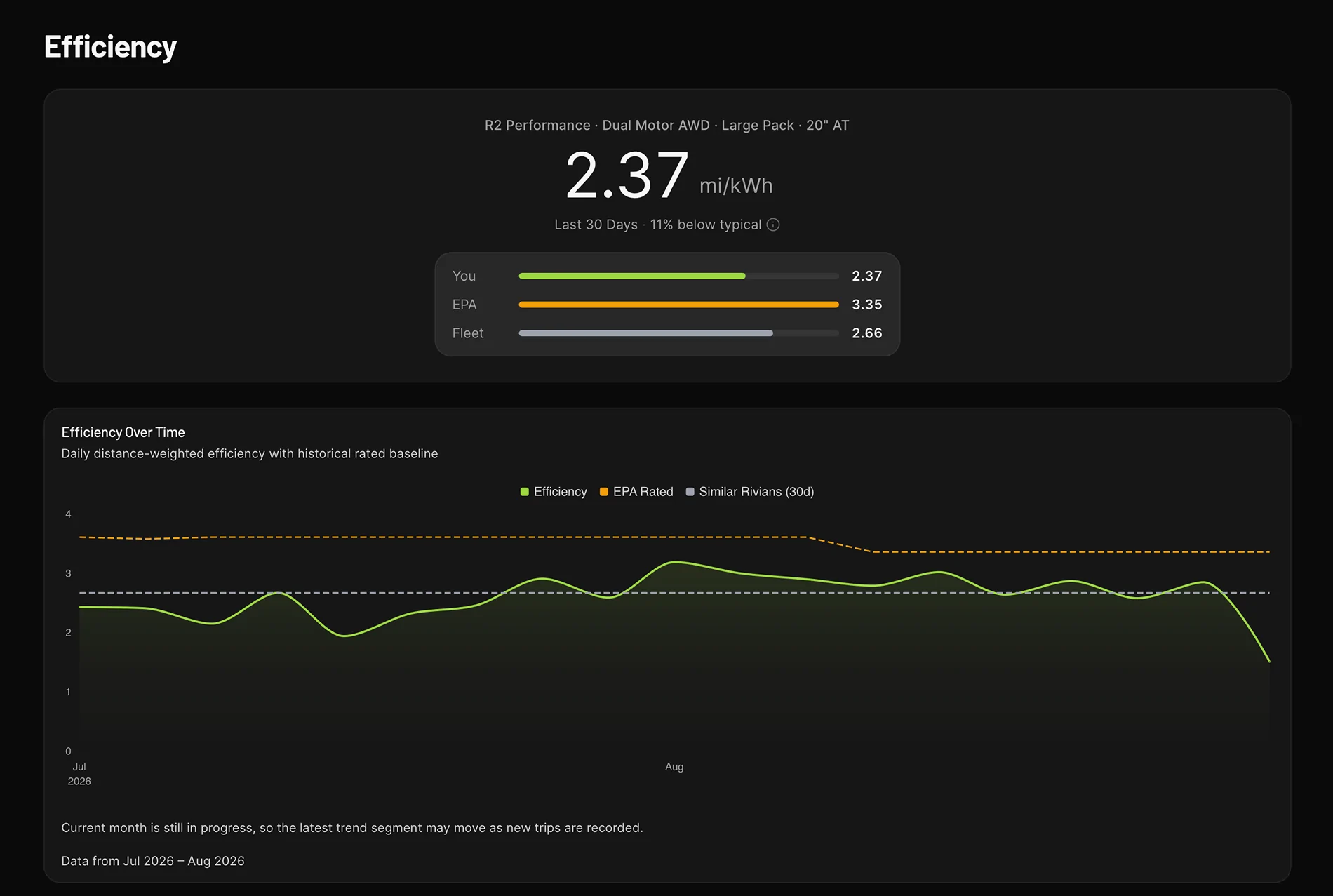
Efficiency took a hit today with over 105ºF weather and the HVAC running hard but this is me thus far.
Screenshot 2026-08-10 at 9.39.25 PM.webp
 

Dark-Fx

Well-Known Member
First Name
Brian
Joined
Jul 15, 2020
Threads
155
Messages
13,916
Reaction score
28,390
Location
Michigan
Vehicles
R1S, Livewire One, Sierra EV, R1S, R2
Occupation
Engineering, Dog Petting, Tesla Shill Spotter
Clubs
 
Efficiency took a hit today with over 105ºF weather and the HVAC running hard but this is me thus far.
Screenshot 2026-08-10 at 9.39.25 PM.webp
Oh, come on. You can do worse than that.
 

windshieldfarmer

Well-Known Member
First Name
KTMrider
Joined
Jul 22, 2026
Threads
0
Messages
78
Reaction score
86
Location
Wichita, KS
Vehicles
BMWIX50
Occupation
Retired
Efficiency took a hit today with over 105ºF weather and the HVAC running hard but this is me thus far.
Screenshot 2026-08-10 at 9.39.25 PM.webp
That’s pretty ugly. Tell me you are driving 80 mph…. I’m in Wichita and the temperature has been between 104 and 107 the last few afternoons. In my BMW IX50 for the last 50 miles of suburban driving I’m averaging 2.7 miles per KWh. Perhaps an apples to oranges comparison….
 

RivianTrackr

Well-Known Member
First Name
Jose
Joined
May 2, 2022
Threads
3
Messages
259
Reaction score
888
Location
Winter Garden, FL
Website
RivianTrackr.com
Vehicles
2025 Rivian R1T Tri Max, 2025 Rivian R1S Dual Large Performance
That’s pretty ugly. Tell me you are driving 80 mph…. I’m in Wichita and the temperature has been between 104 and 107 the last few afternoons. In my BMW IX50 for the last 50 miles of suburban driving I’m averaging 2.7 miles per KWh. Perhaps an apples to oranges comparison….
More recently, a lot of city driving so max of 55 mph with some highway around 70-75 mph. I am on 20s for what it's worth.
 

Sponsored

OP
OP
ksurfier

ksurfier

Well-Known Member
First Name
Ken
Joined
Aug 23, 2022
Threads
58
Messages
1,302
Reaction score
1,244
Location
CA
Vehicles
R1S, Tesla
Occupation
Fake Science Lead
Clubs
 
Your posts very much come off as AI generated, this line is very typical AI phrasing. Hard to take posts like this seriously, when all I can see is the AI voice.
Thanks ‘applemonsters’, I agree we should be careful which posts we take seriously…
 

Mos Eisley

Well-Known Member
First Name
Chris
Joined
Feb 24, 2026
Threads
42
Messages
870
Reaction score
1,621
Location
Minnesota
Vehicles
Mazda CX-5, CX-30 & R2 on the way!
Occupation
Marketing & Sales Consultant, Freelance Photographer
He also understands that there are many variables that impact efficiency besides tires. Such as driving style. Someone "flooring it" from every stoplight is not going to be as efficient as my wife who drives very gently.

You have to compare trucks that are being driven the same way in the same weather, in the same drive mode and with the same HVAC settings, the same tire wear, the same traffic, the same stoplights, etc.

We have no way of knowing most of the efficiency impacting variables in the data Rivian provides in the API RR uses. So while we might be able to get average speed one day, that information alone is not sufficient to stratify the data into sets that are comparable.

My average speed of 30 could be comprised of sprints to 80 mph, while someone else could be simply driving a consistent 30 mph. Guess which one is more efficient?

I can't believe this is so hard for people to grasp. You have to control as much as possible so that the ONLY thing that is different are the tires (or wheels). If multiple things are different, you cannot compare one of them and say that is the reason this person's R2 is more efficient than another.

It is very difficult to conduct controlled efficiency testing. Controlling the weather is not possible. Controlling the traffic is also not possible. There are ways to mitigate what you can't control, but it isn't easy. And the data will still be somewhat dirty.

The data in RR is dirty. It has no controls. None. You cannot draw conclusions from it.

You can draw conclusions from the EPA test results, and the range figures Rivian provides.

You can draw conclusions from your own RR data on your own truck, by tracking efficiency and noting when it is raining, when you are towing, when you have a bike rack on the back filled with bikes, or a RTT on the roof. @Budman does this. You should follow his efficiency threads.

This thread is totally unnecessary, and it is giving people bad information. I really hope people don't spend their hard-earned money based on the false claims in this thread.
 
OP
OP
ksurfier

ksurfier

Well-Known Member
First Name
Ken
Joined
Aug 23, 2022
Threads
58
Messages
1,302
Reaction score
1,244
Location
CA
Vehicles
R1S, Tesla
Occupation
Fake Science Lead
Clubs
 
@Budman, while I’ve come to expect this kind of reaction from a small but vocal group here, I genuinely didn’t think you were part of that crowd. Do you really believe that openly questioning the data, comparing real-world results, and having an honest discussion somehow amounts to making “false claims” or causing people to lose their “hard-earned money”?

That strikes me as a pretty extraordinary leap. Healthy skepticism and challenging assumptions are how we get closer to the truth, not something that should be silenced because the conclusions might be inconvenient.

I’ve always respected and appreciated the content you post, which is exactly why I’m surprised to see you framing an open discussion this way.
Sponsored


Top