Sponsored

Do you charge the R1T every night?

Mark_AZR1T

Well-Known Member
Site Sponsor
First Name
Mark
Joined
May 28, 2021
Threads
42
Messages
2,222
Reaction score
3,867
Location
Gilbert, AZ
Website
jackpucks.com
Vehicles
R1T Launch, R1S Canyon Red
Clubs
 

IGranite

Member
Joined
Jul 9, 2022
Threads
1
Messages
7
Reaction score
2
Location
USA
Vehicles
Rivian R1T
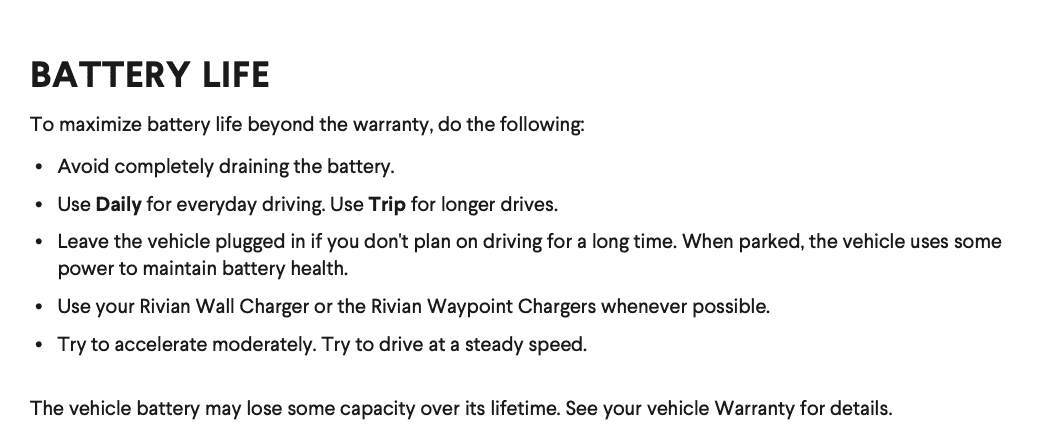
My interpretation of this was that to maximize life, you generally leave it in the mode where it charges to 70% max unless you are on a trip.

My understanding has always been, with lithium ion batteries, that the fewer cycles you have the better off you are from a capacity and longevity standpoint. Personally I only charge when it gets down to the 20-30% range, unless I expect not to be able to need more charge in a short period of time.
 

Cavalryscout18

Well-Known Member
Joined
Nov 24, 2021
Threads
11
Messages
325
Reaction score
456
Location
Los Angeles
Vehicles
Tesla
I have owned my Model 3 for 4 years. The battery is still at 95% capacity and I drive an average of a 80 miles per day. I plug in daily, even if I only drive it 5 miles. The rule that I kept hearing from Elon and other battery engineers before I bought the car was that you want to limit the amount of strain on your battery. Charging level 2 is better for battery than level 3 because level 3 puts an insane amount of energy into your battery in short time (lots of heat). Level 2 is also better than level 1 because with level 1, it trickle charges and it takes many hours/days to fully charge so the battery is always on. Charging from 0% to 100% is also very stressful on the battery since it’s in the extremes (lowest 20% and highest 20%) and the battery strains more in extremes (that’s why it takes so long to charge from 80% to 100%). Finally, to the original question, to charge daily or to charge only once battery is low. Going back to the original idea of “strain” on a battery, it is believed that charging from 20% to 80% in one go is slightly more stressful on the battery than six separate charge cycles of 10% each (60% charge). Most of these are just rules of thumb and would probably have minimal impact on battery life over many years, though. If I had to follow a few key rules, I would try and keep my SOC above 10% and below 90%. When needed you can go down to 5% and up to 100% but not regularly. Use level 2 most of the time but level 3 once or twice a week is fine. And finally, unless an emergency, I would never use level 1 on the Rivian. Will probably add like 1.5 miles per hour to the battery and would take days to fully charge it. I’m not an engineer but I did a lot of research since the battery is the most expensive part of an EV.
 

kizamybute'

Well-Known Member
Joined
Oct 17, 2021
Threads
84
Messages
1,195
Reaction score
2,034
Location
Los Angeles
Vehicles
This one, that one and the other one.
Clubs
 
I go to 85%. Used to charge the Tesla to 90%, which was within their recommended daily range. Don't see why the Rivian would be any different. My dad charged his Tesla to 100% every single time for 3 years and his car had less degradation than mine. Who knows in 8 years. Certainly don't think there's a measurable impact doing 70 or 85%. But, that's just my opinion after 9 years in Tesla's. 85% is more convenient in having to charge less as I don't charge every day. 85% probably gets me another day or two each week that I don't have to charge. Plus, the Rivian seems to be more greedy with power when plugged in, like it gets a green light to use more energy for itself. Tesla was the same way but not nearly as bad. I seems to conserve power better when not plugged in. Again, just based on personal use and opinion. Naturally, I'm not Rivian. I'm sure they have their reasoning for their recommendations. But often, manufacturers take the conservative approach. My opinion is, do what works best for you and don't worry about it. 100% probably isn't the best. I do wish they allowed you to pick the percentage rather than limiting you to 15% increments. I'd probably do 80 if it was available. Or maybe go back 90% for convenience.
 

kizamybute'

Well-Known Member
Joined
Oct 17, 2021
Threads
84
Messages
1,195
Reaction score
2,034
Location
Los Angeles
Vehicles
This one, that one and the other one.
Clubs
 
My interpretation of this was that to maximize life, you generally leave it in the mode where it charges to 70% max unless you are on a trip.

My understanding has always been, with lithium ion batteries, that the fewer cycles you have the better off you are from a capacity and longevity standpoint. Personally I only charge when it gets down to the 20-30% range, unless I expect not to be able to need more charge in a short period of time.
This is where the confusion comes in. Are you better off charging more times to 70% or fewer times to 85%? Considering most batteries are rated based on the number of charges cycles, I would tend to believe that fewer 85% charges are better for the long term life than more 70% charges. Back to my prior post, could very well be the reason why my Dad's Tesla had less degradation after three years than I did only charging to 90%. Or was just luck of the draw. He didn't charge every day, just when it got to a certain point. So he certainly had fewer charging cycles than I did.

I hadn't really thought much about it for a while. I just simply selected "the one in the middle". But, this thread has me thinking about it again. Maybe I should just go to 100% and not charge as many times. I keep vehicles about three years, thus likely won't notice much difference either way. No way to really know the long term affects for certain until we get the the long term. Ask the question again in 5 years and see where everyone is at!
 

Sponsored

CommodoreAmiga

Well-Known Member
Joined
Dec 30, 2020
Threads
39
Messages
4,104
Reaction score
7,729
Location
INACTIVE
Vehicles
INACTIVE
This is where the confusion comes in. Are you better off charging more times to 70% or fewer times to 85%? Considering most batteries are rated based on the number of charges cycles, I would tend to believe that fewer 85% charges are better for the long term life than more 70% charges. Back to my prior post, could very well be the reason why my Dad's Tesla had less degradation after three years than I did only charging to 90%. Or was just luck of the draw. He didn't charge every day, just when it got to a certain point. So he certainly had fewer charging cycles than I did.

I hadn't really thought much about it for a while. I just simply selected "the one in the middle". But, this thread has me thinking about it again. Maybe I should just go to 100% and not charge as many times. I keep vehicles about three years, thus likely won't notice much difference either way. No way to really know the long term affects for certain until we get the the long term. Ask the question again in 5 years and see where everyone is at!
My understanding of a “charge cycle“ for a battery is an abstract ‘100% capacity’ which may be split over multiple actual (un)plug cycles.

for example, going from 70-50% and charging back to 70% five times would be ‘1 charge cycle” the same as going from 70-20% and charging back to 70% twice.
 

ajdelange

Well-Known Member
First Name
A. J.
Joined
Aug 1, 2019
Threads
9
Messages
2,883
Reaction score
2,319
Location
Virginia/Quebec
Vehicles
Tesla XLR+2019, Lexus, Landcruiser, R1T
Occupation
EE Retired
Elon Musk has always advocated having the car plugged in at all times when it is not in use. Rivian's batteries are probably similar but not exactly the same. So ???

I discovered that if I just plugged the R1T in when I got home it would charge to 70%, discharge to 69.5%, recharge to 70%, discharge to 69.5%... IOW it would go through 20 charge cycles over night. To solve this I set up scheduled charging. When I come home and plug it it announces that charging is scheduled but it does not occur until the scheduled time. As I have solar I set this for when the sun is up in order to minimize round trip current through the batteries and pick up some efficiency (off grid system). If I use the net metererd system I still set to charge when the sun is shining in order to minimize the chance of getting caught up in "demand charges" (and the right to claim the cars are charged exclusively with sun light).

Rivian needs to increase the dead band in their charging scheme so that once charged to 70% charging will not start anew until 67% or some such number is reached. Rivian also has to change their scheme to allow us to pick any charging level between 50 and 100%.
 

IGranite

Member
Joined
Jul 9, 2022
Threads
1
Messages
7
Reaction score
2
Location
USA
Vehicles
Rivian R1T
My understanding of a “charge cycle“ for a battery is an abstract ‘100% capacity’ which may be split over multiple actual (un)plug cycles.

for example, going from 70-50% and charging back to 70% five times would be ‘1 charge cycle” the same as going from 70-20% and charging back to 70% twice.
Pure speculation on my part, but it may also depend on how they are managing cells and charging within the battery. When you are only charging at a low rate to get to 70, maybe the software is limiting the number of cells and bringing them from a much lower state of charge to 70%. That could also be a factor for preconditioning prior to DC fast charge (and charge rate during)… normalizing charge across cells so all cells can be charged at once across the battery.
 

timesinks

Well-Known Member
Joined
Sep 20, 2020
Threads
6
Messages
570
Reaction score
1,851
Location
Seattle
Vehicles
R1T, ID.4, Sprinter
We have always plugged all our EVs in every night and not thought about it.

Charge cycles are usually measured as a full 100-0-100. A full cycle is much harder on modern EV chemistries than a 30-70-30 kind of pattern. These battery chemistries can generally withstand an order or two of magnitude more of these partial cycles than full cycles.

Every time you accelerate, you discharge. Every time you decelerate, you charge. Would you consider every change in go-pedal position a charge cycle? I think the clear answer is no...

Rivian recommends charging to 70% and not leaving the vehicle off the charger for extended periods of non-use. They have not expressly said one way or the other if you should or should not charge daily, but they have also made it clear they don't expect it to be a problem if you do.
 

ajdelange

Well-Known Member
First Name
A. J.
Joined
Aug 1, 2019
Threads
9
Messages
2,883
Reaction score
2,319
Location
Virginia/Quebec
Vehicles
Tesla XLR+2019, Lexus, Landcruiser, R1T
Occupation
EE Retired
I think it is clear that the thing that degrades the battery is that not all the lithium ions headed for the anode (charge) or cathode (discharge) make it to the intended destination. In this regard any current in either direction shortens battery life. But it also seems intuitive that an ion is less likely to properly intercallate when the "stadium" is nearly full as is the case with the anode at high SoC or the cathode at low SoC.
 

Sponsored

nc10

Well-Known Member
Joined
Sep 24, 2021
Threads
35
Messages
532
Reaction score
575
Location
South Carolina
Vehicles
R1T LE, EV6 GT Line
Occupation
Engineer
One thing that no one has mentioned yet is that you can set up a charging schedule. So, for example, you can plug the truck in when you pull into your garage but tell it not to start charging till after 10pm, when your power might be cheaper.
I do this, set to charge between 10 pm and 6 am.. Plug my truck in whenever I've driven more than 40-50 miles Try to keep it in the 50-70% range.
 

timf

Well-Known Member
First Name
Tim
Joined
May 3, 2019
Threads
7
Messages
709
Reaction score
1,122
Location
Novi, MI
Vehicles
Rivian R1S
Clubs
 
My typical charging routine with my Model X is charge to 90% (the top end of Tesla's "Daily" range indicator), and recharge when I'm below 50%. Originally that would top out at about 230 miles of range, but with 6 years of degradation I only get 210 now. With the Rivian's larger battery, I expect to follow the 70% recommendation and still have about the same range as I currently have.
 

nc10

Well-Known Member
Joined
Sep 24, 2021
Threads
35
Messages
532
Reaction score
575
Location
South Carolina
Vehicles
R1T LE, EV6 GT Line
Occupation
Engineer
Considering most batteries are rated based on the number of charges cycles, I would tend to believe that fewer 85% charges are better for the long term life than more 70% charges.
Three charge/discharge events from 33.3% to 66.7% count the same as two charge discharge events from 25 to 75%, or one 0% to 100% event, all are 1 "charge cycle". A single 0 to 100% charge/discharge event will degrade a battery more than than three 33.3% to 66.7% events.

My understanding, is discharging to very low state of charge or charging to very high state of charge should be avoided. Rivian has provided some recommendations for the high end, but haven't seen info on the low end. Going to 70% is better for battery life even if you charge more times than you would going to 85%.

This could be documented more clearly and consistently, and I think some discussions refer to any size charge/discharge event to be a charge cycle. Pasted a few links w/definitions below.

https://en.wikipedia.org/wiki/Charge_cycle
"Apple Inc. clarifies that a charge cycle means using all the battery's capacity, but not necessarily by discharging it from 100% to 0%: "You complete one charge cycle when you’ve used (discharged) an amount that equals 100% of your battery’s capacity — but not necessarily all from one charge. For instance, you might use 75% of your battery’s capacity one day, then recharge it fully overnight. If you use 25% the next day, you will have discharged a total of 100%, and the two days will add up to one charge cycle."

https://www.techtarget.com/whatis/definition/charge-cycle#:~:text=A charge cycle is a,charged before use or purchase.
" A charge cycle can be a complete full charge to discharge or a series of partial drains adding up to the battery’s capacity. "

https://www.tesla.com/es_ES/blog/bit-about-batteries
" Cycle Life For Li-ion cells, manufacturers define cycle life as the number of full discharge-charge cycles that it takes to reduce a cell's capacity to some fraction of its original state. "
 
Last edited:

EVTrucking

Well-Known Member
Joined
Jun 3, 2021
Threads
15
Messages
626
Reaction score
789
Location
Unknown
Vehicles
Unknown
Clubs
 
Three charge/discharge events from 33.3% to 66.7% count the same as two charge discharge events from 25 to 75%, or one 0% to 100% event, all are 1 "charge cycle". A single 0 to 100% charge/discharge event will degrade a battery more than than three 33.3% to 66.7% events.

My understanding, is discharging to very low state of charge or charging to very high state of charge should be avoided. Rivian has provided some recommendations for the high end, but haven't seen info on the low end. Going to 70% is better for battery life even if you charge more times than you would going to 85%.

This could be documented more clearly and consistently, and I think some discussions refer to any size charge/discharge event to be a charge cycle. Pasted a few links w/definitions below.

https://en.wikipedia.org/wiki/Charge_cycle
"Apple Inc. clarifies that a charge cycle means using all the battery's capacity, but not necessarily by discharging it from 100% to 0%: "You complete one charge cycle when you’ve used (discharged) an amount that equals 100% of your battery’s capacity — but not necessarily all from one charge. For instance, you might use 75% of your battery’s capacity one day, then recharge it fully overnight. If you use 25% the next day, you will have discharged a total of 100%, and the two days will add up to one charge cycle."

https://www.techtarget.com/whatis/definition/charge-cycle#:~:text=A charge cycle is a,charged before use or purchase.
" A charge cycle can be a complete full charge to discharge or a series of partial drains adding up to the battery’s capacity. "

https://www.tesla.com/es_ES/blog/bit-about-batteries
" Cycle Life For Li-ion cells, manufacturers define cycle life as the number of full discharge-charge cycles that it takes to reduce a cell's capacity to some fraction of its original state. "
Excellent information!

Thank you.
 
First Name
Andrew
Joined
Apr 23, 2021
Threads
1
Messages
24
Reaction score
25
Location
Eastern NC
Vehicles
R1T Adventure, Mercedes 350GL, HD CVO Breakout
Occupation
Dentist
I interpreted that second to last bullet point to mean that you should leave your truck plugged in to the Rivian charger whenever possible. As a result, I have my trucked plugged in at all times when I’m home and have charging capped at 70%.
No, no, no. That means "When you need to charge, use a Rivian charger whenever possible", as opposed to "Use your Rivian charger every chance you get". You should absolutely not charge every night (unless you're driving so much that you need to). This is the worst thing you can do for your battery life. Try to operate within 20-80% charge for daily driving. That is how you maximize your long-term battery life. Set your charge limit on 80%, and charge when you need to, not every chance you get. If you're going to road-trip for a long distance, set to 100% the night before, and charge fully. That "ABC" stuff is a great way to shorten the life of your battery, and is completely misinformed.
Sponsored

 
Last edited:


Top