
Sponsored
Cabin Heater Impacted Significantly by Outside Temp
- Thread starter Gchamilton
- Start date
- Watchers 3
mini2nut
Well-Known Member
I don’t think I would have purchased a Rivian or a competing BEV if I lived in a climate where it gets to sub freezing temperatures during the winter. Range loss and cabin heating are too much of a compromise compared to an ICE vehicle.
Battery technology should improve drastically in the next 5-10 years. Once it does the tipping point will occur where it just doesn’t make sense to purchase an ICE powered vehicle anymore.
Battery technology should improve drastically in the next 5-10 years. Once it does the tipping point will occur where it just doesn’t make sense to purchase an ICE powered vehicle anymore.
R1Tom
Well-Known Member
I disagree. It is -8f today and I had no issues with it being plenty warm (better than preheating an ICE by running engine for 20 minutes to get heat) and unless one is traveling to extents of range, range degradation is pretty meaningless for daily uses. It would have to get to as bad as .5m/kwh to be even to a TRX or Raptor for cost per mile of fuel. And I have not seen worse than 1.25 m/kwh. So still alot less money and as much fun.I don’t think I would have purchased a Rivian or a competing BEV if I lived in a climate where it gets to sub freezing temperatures during the winter. Range loss and cabin heating are too much of a compromise compared to an ICE vehicle.
Battery technology should improve drastically in the next 5-10 years. Once it does the tipping point will occur where it just doesn’t make sense to purchase an ICE powered vehicle anymore.

crashmtb
Well-Known Member
- Joined
- Jul 11, 2021
- Threads
- 1
- Messages
- 4,725
- Reaction score
- 7,238
- Location
- Man oh Manitoba
- Vehicles
- 2002 aluminium garden shed TD5
“range loss” happens just the same at cold temperatures in ICE vehicles.I don’t think I would have purchased a Rivian or a competing BEV if I lived in a climate where it gets to sub freezing temperatures during the winter. Range loss and cabin heating are too much of a compromise compared to an ICE vehicle.
Battery technology should improve drastically in the next 5-10 years. Once it does the tipping point will occur where it just doesn’t make sense to purchase an ICE powered vehicle anymore.
difference is it is much more convenient to refuel.
I’ve done long EV trips in winter (-20 and colder) and the level of planning is no different than with a gas car in those conditions. Wind up stopping to “recharge” at the same intervals.
Dark-Fx
Well-Known Member
Nice part about an EV is you don't have to shut it off to refuel too.“range loss” happens just the same at cold temperatures in ICE vehicles.
difference is it is much more convenient to refuel.
I’ve done long EV trips in winter (-20 and colder) and the level of planning is no different than with a gas car in those conditions. Wind up stopping to “recharge” at the same intervals.
Sponsored
tgo10000
Well-Known Member
- First Name
- J
- Joined
- Jul 4, 2022
- Threads
- 0
- Messages
- 282
- Reaction score
- 227
- Location
- springfield
- Vehicles
- mach e, r1t, r1s
Yeah drove around yesterday various outsides temp 0 to -6 degrees trips were 45 mins up to 1 hour. And I was definitely too hot and had to turn it down. I guess the cool kids extrapolate anecdotal experiences and made definitive statements about Rivian. So I’ll say yeah Rivian did a great job with their heater it’s amazing.
on a serious note op I had a stellar experience and you may want to check with Rivian about your specific issue. I have noticed though people not you necessarily miss that defog mode and defrost mode same button vastly different.
on a serious note op I had a stellar experience and you may want to check with Rivian about your specific issue. I have noticed though people not you necessarily miss that defog mode and defrost mode same button vastly different.
Last edited:
rivian1800
Well-Known Member
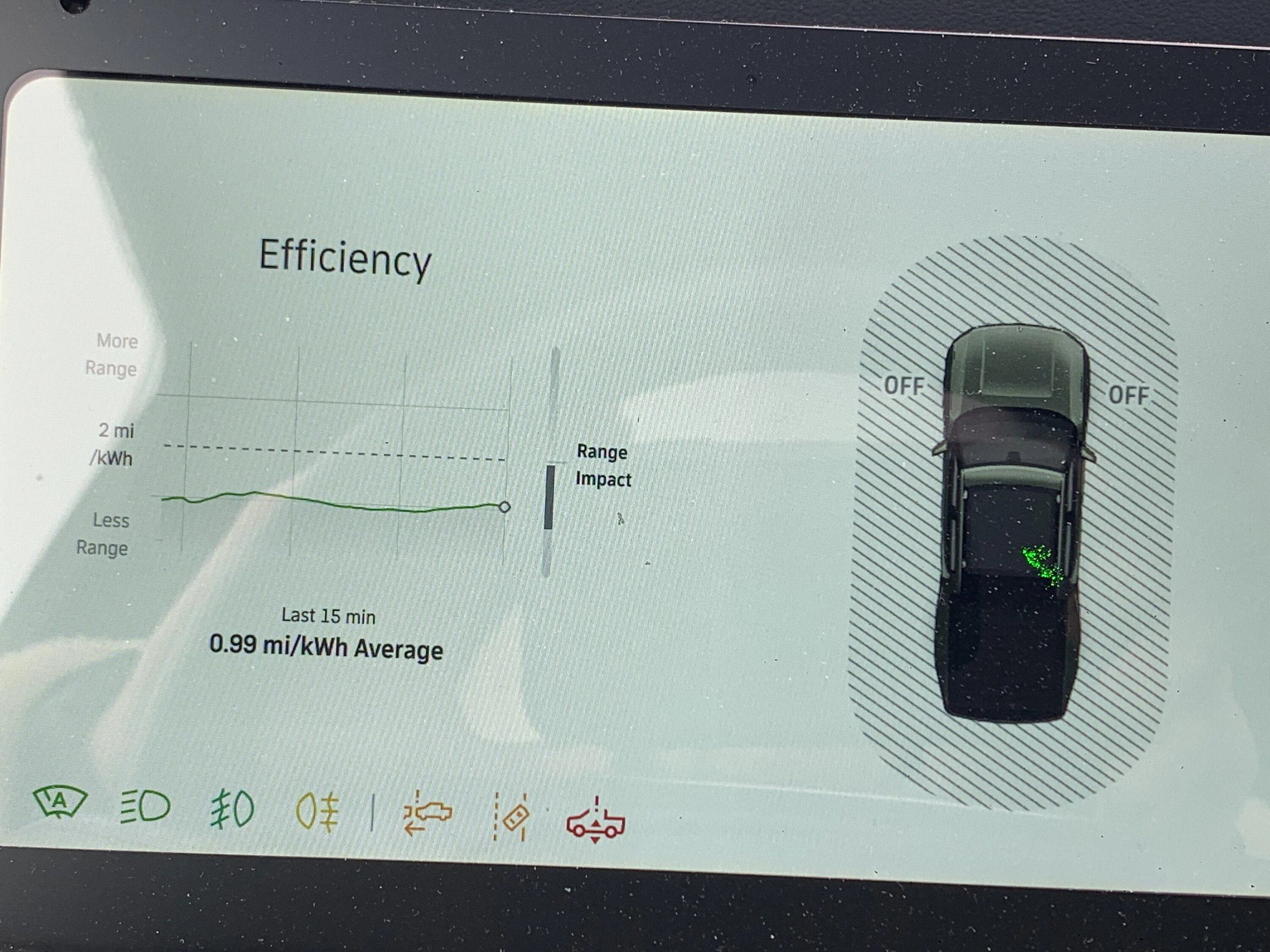
My worst efficiency numbers so far…I disagree. It is -8f today and I had no issues with it being plenty warm (better than preheating an ICE by running engine for 20 minutes to get heat) and unless one is traveling to extents of range, range degradation is pretty meaningless for daily uses. It would have to get to as bad as .5m/kwh to be even to a TRX or Raptor for cost per mile of fuel. And I have not seen worse than 1.25 m/kwh. So still alot less money and as much fun.

Marchin_MTB
Well-Known Member
In the recent -10F temps we’ve had, I noticed that I can preheat the cabin or get it up to temp just fine, in fact it’s pretty great! However once the cabin temp stabilizes, the heat control logic gets weird and I have to manually cycle the temp setting to get it to behave. I really do think it’s a control issue.
on another note, snow mode has been great on all this packed snow.
on another note, snow mode has been great on all this packed snow.
JamesPolk24
Well-Known Member
In cabin temperatures seem to be accurate. It's the control logic like you mentioned that needs fixing. Rivian app shows interior temp even when driving. With mild temps (35-40°) cabin still showing 58° when set to 68° even after a decent drive.From what other people are reporting it sounds like Rivian's climate control system logic needs some work. Or maybe some trucks have bad in-cabin temperature sensors? It's frustrating because cars have had automatic climate control for over 50 years now so it seems like the kind of thing which shouldn't be that difficult to get right.
I'm hoping it's the logic and it can be corrected OTA. I'm sure the people getting A/C blown at them (snowflake showing on the vents) when the cabin is much colder than their set temp would appreciate that! If there is a sensor problem then that sounds like a hardware fix and a visit to a service center.
Between the heat issues on the Rivians and the EA chargers not working in bitter cold it sounds like our tech companies need to do more extreme weather testing. Products not working in cold temps isn't cool!
JamesPolk24
Well-Known Member
Resistant heat is superior to waste engine heat. It's only 100% efficient but instant. Rivian needs to work on the logic and damper control. It forces full outside air with dumb logic so it's going to be cold.I don’t think I would have purchased a Rivian or a competing BEV if I lived in a climate where it gets to sub freezing temperatures during the winter. Range loss and cabin heating are too much of a compromise compared to an ICE vehicle.
Battery technology should improve drastically in the next 5-10 years. Once it does the tipping point will occur where it just doesn’t make sense to purchase an ICE powered vehicle anymore.
Sponsored
yizzung
Well-Known Member
- Joined
- Jul 30, 2020
- Threads
- 54
- Messages
- 831
- Reaction score
- 1,510
- Location
- California / Colorado
- Vehicles
- R1T | Audi allroad
- Occupation
- Tech
What I noticed when I drove from SF to Tahoe, where it was in the low teens earlier this week, is that the cabin temp reading seemed to be roughly correct. I had it set on auto at around 68 degrees. If I surfed up to 70, heat symbol popped up, if I surfed down to 67, I got the snowflake.From what other people are reporting it sounds like Rivian's climate control system logic needs some work. Or maybe some trucks have bad in-cabin temperature sensors?
This seemed to me to be operating more or less as expected. What was more unexpected to me was the lack of any, uh, subtlety? I don't know how to describe it.
On my relatively new Audi allroad, the car seems to know "hey I'm hovering right around the temp range of what this guy wants, so I'm going to lower the fan speed a bit, maybe cycle the output, and see how things go..."
On the Rivian, If I moved up a couple degrees, heat comes out hot and heavy. A couple ticks down on the thermostat and suddenly arctic air is blowing out the vents as if it's a warm summer day...
It seemed a little odd to me that the car's behavior was so binary and that it didn't seem like it know how to regulate its output. Wasn't that big of a deal -- cabin was comfy -- but struck me as different for sure.
SoCal Rob
Well-Known Member
That sure sounds like something which can be tweaked via OTA update.What I noticed when I drove from SF to Tahoe, where it was in the low teens earlier this week, is that the cabin temp reading seemed to be roughly correct. I had it set on auto at around 68 degrees. If I surfed up to 70, heat symbol popped up, if I surfed down to 67, I got the snowflake.
This seemed to me to be operating more or less as expected. What was more unexpected to me was the lack of any, uh, subtlety? I don't know how to describe it.
On my relatively new Audi allroad, the car seems to know "hey I'm hovering right around the temp range of what this guy wants, so I'm going to lower the fan speed a bit, maybe cycle the output, and see how things go..."
On the Rivian, If I moved up a couple degrees, heat comes out hot and heavy. A couple ticks down on the thermostat and suddenly arctic air is blowing out the vents as if it's a warm summer day...
It seemed a little odd to me that the car's behavior was so binary and that it didn't seem like it know how to regulate its output. Wasn't that big of a deal -- cabin was comfy -- but struck me as different for sure.
I'm used to what you describe: the closer the cabin temperature is to the set temperature the less extreme the temperature and fan speed. One thing that would be nice which my mom's car does: set a preference for auto fan of low, medium, or high. While you can still override the fan speed manually, this setting means that when set climate control to full auto the fan speed can be kept lower or higher than the factory default.
tgo10000
Well-Known Member
- First Name
- J
- Joined
- Jul 4, 2022
- Threads
- 0
- Messages
- 282
- Reaction score
- 227
- Location
- springfield
- Vehicles
- mach e, r1t, r1s
luckily Rivian has shown a strong willingness to improve functionality through ota updates so submitting feedback to them seems to be the way in terms of the smoothness of temp regulation
R1Tom
Well-Known Member
[/QUOTE]
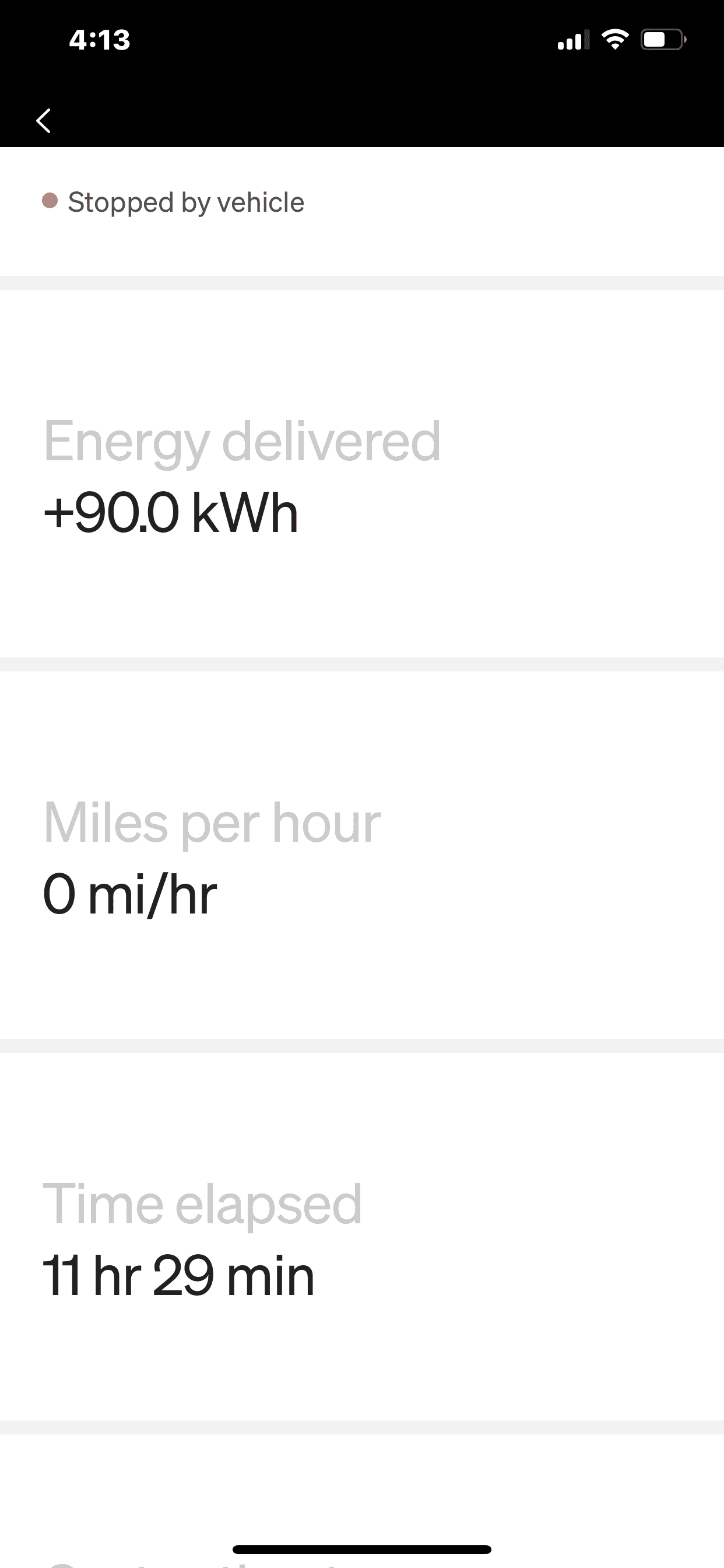
I am guessing you did not precondition the battery and cabin (while being plugged in) prior to departure?My worst efficiency numbers so far…

rivian1800
Well-Known Member
I am guessing you did not precondition the battery and cabin (while being plugged in) prior to departure?
[/QUOTE]
For this short trip, ur right. No precondition but for first trip (at 4 am) I have plugged all night long just to play safe considering the weather (-11 F)
Sponsored


