
-
👉 R2 Orders ➡ Add Your R2 Orders / VIN / Delivery Info 📊
Sponsored
DB-EV
Well-Known Member
131 usable, with a total pack of 135. So the consensus is 131. Your battery seems happy with those numbers. Like 1% loss.My batteryCapacity value seen through electrafi is: 130.145004
Is the consensus that the original denominator is 131 or 135?

mroe
Well-Known Member
Cool. For context, I'm at 20K miles and pretty hard on the battery: lots of DCFC and high state of charge cycles.131 usable, with a total pack of 135. So the consensus is 131. Your battery seems happy with those numbers. Like 1% loss.
DB-EV
Well-Known Member
Dude, I am at 24,000 miles in 18 months and I am at 130.8 (outside temp of 69.8 degrees and battery temp of 69.1). I DCFC on road trips (most common in winter, and less commmon maybe once per month in winter). Have definitely charged to 100. Only a handful of times have I let the car go below 10%. Before I read about how to care for the battery for fun I drove down to like 6 miles of range. But I think I have never DCFC below 10%.Look here: https://www.rivianforums.com/forum/threads/how-to-link-your-rivians-live-data-to-abrp-5-0.29384/
As for percentage-wise - it is difficult to say w/o knowing how Rivian manages buffers. For day-to-day degradation - yes, it will show you how much % or Kwh you have for usable battery capacity. Remember that this number is not static and changes based on outside temperature and SoH. So unless Rivian creates a "Battery Test" in the menu (similar to Tesla) - you can only get an estimation.
Now for the good part - you really should not care... The reason is - you will not have this car long enough to see the problem. I bet most of us will replace it within 3-5 years and not because of the battery. IMHO

KootenayEV
Well-Known Member
- First Name
- Andrew
- Joined
- Sep 22, 2021
- Threads
- 29
- Messages
- 617
- Reaction score
- 590
- Location
- Nelson, BC
- Vehicles
- R1T, Tesla Model 3
- Occupation
- Environmental Engineer
IIRC the various pack tear-downs on the original (ie Gen 1) Large packs showed the gross capacity was 141 or 142 kWh, with usable originally at 128kWh, later expanded by Rivian to 131kWh (I can't recall which update it was, late 2022 or spring 2023 I think? Was before I picked mine up in Sep '23)131 usable, with a total pack of 135. So the consensus is 131. Your battery seems happy with those numbers. Like 1% loss.
Sponsored
shap
Well-Known Member
Same here. Few things may be the case - either Rivian is not reporting this value correctly, or they relocate the buffer or we just have great batteries. Who knows ...Dude, I am at 24,000 miles in 18 months and I am at 130.8 (outside temp of 69.8 degrees and battery temp of 69.1). I DCFC on road trips (most common in winter, and less commmon maybe once per month in winter). Have definitely charged to 100. Only a handful of times have I let the car go below 10%. Before I read about how to care for the battery for fun I drove down to like 6 miles of range. But I think I have never DCFC below 10%.

Hawkjody
Well-Known Member
- First Name
- Jody
- Joined
- Aug 30, 2022
- Threads
- 1
- Messages
- 67
- Reaction score
- 62
- Location
- Fresno California
- Vehicles
- Keep Grand Cherokee
- Occupation
- Physician
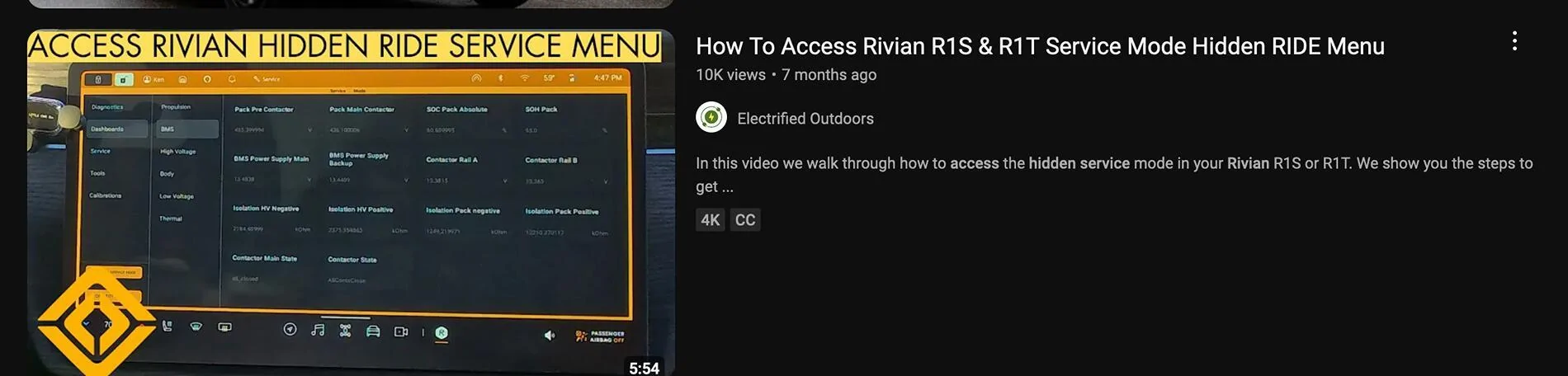
There are youtube videos explaining how to acces the Rivian Serivce menue which has some information on the 12v battery - you may find the information you are looking for hereHas anyone else experienced this? Attaching image of conversation in service app. I just hit 50k miles over a year+ of ownership and would like to know my battery state of health (%) so I can make more informed decisions around my charging habits.

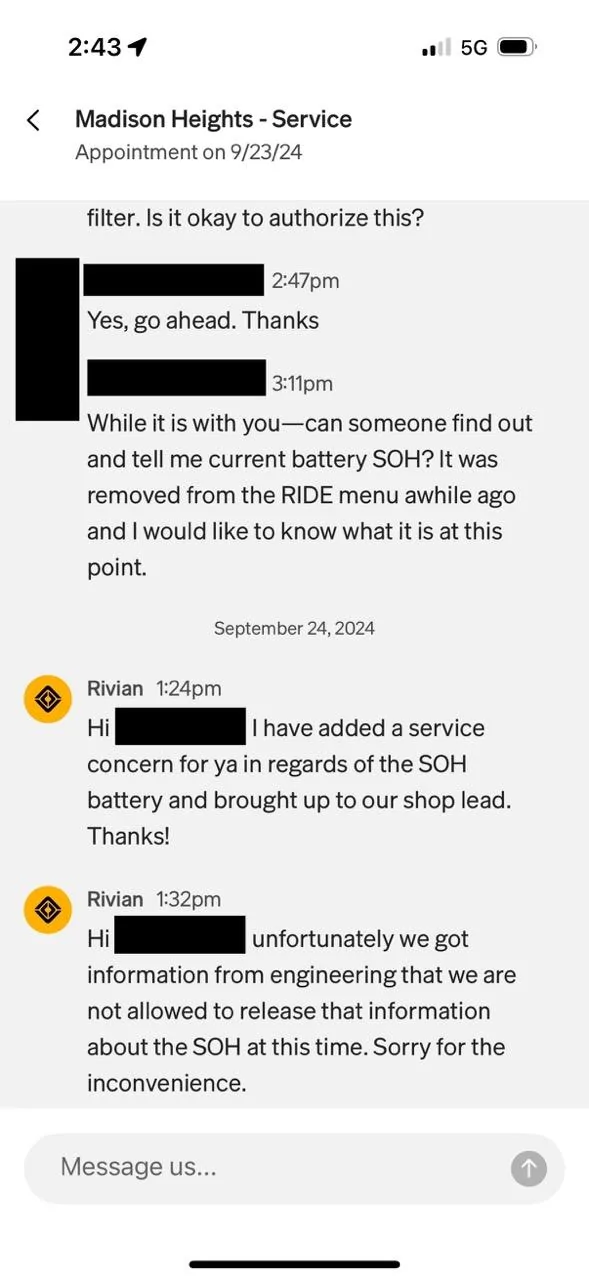
good luck /jbh
godfodder0901
Well-Known Member
- First Name
- Jared
- Joined
- Mar 12, 2019
- Threads
- 27
- Messages
- 5,811
- Reaction score
- 10,224
- Location
- Washington
- Vehicles
- 2022 Rivian R1T LE
He's asking about the HV battery. That info was removed from the RIDE menu.There are youtube videos explaining how to acces the Rivian Serivce menue which has some information on the 12v battery - you may find the information you are looking for here
good luck /jbh

DB-EV
Well-Known Member
So this is funny. I was at 130.8. I dropped my son off at practice about 1.5 miles each way up and down a hill. Now it says 130.1 (I think this may be what one of the posters was saying it gives you a good idea but it is not exact). Bat temp went up a bit. Man this data is addictive.
Brian A
Well-Known Member
- First Name
- Brian
- Joined
- May 20, 2024
- Threads
- 0
- Messages
- 89
- Reaction score
- 41
- Location
- Pueblo West, CO
- Vehicles
- 2024 R1T, 2022 Tucson PHEV, 2017 Sonata Hybrid, 2007 SLK350, 1979 Camaro
- Occupation
- Electrical Engineer
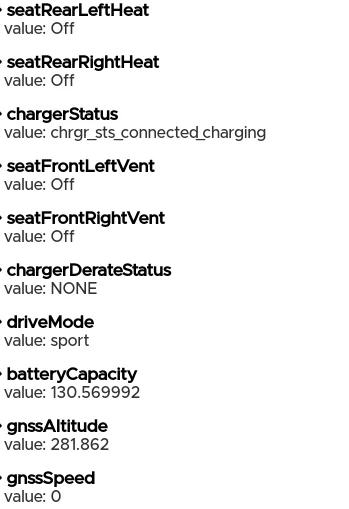
I know some are wondering so I will ask. How did you get your app API data?I see 3 paths forward that result in the information you want.
Option 1.
Step 1: watch odometer and drive until you have used 5% of the battery. Multiply the answer by 20 and divide by the EPA rated range. Declare that value your state of health. Do this on a cold day to ensure that the number is really low.Step 2: Respond to Rivian that you believe your battery is down to 50% (whatever you calculated) and demand a battery replacement under the warranty.Step 3: Rivian will deny your claim.Step 4: File a lawsuit/arbitration claiming breach of contract/warranty.Step 5: Rivian will then be required to either replace the battery or provide real evidence that your battery is fine. If they replace your battery you now know that your state of health is 100%. If they chose to provide evidence, that evidence will include an answer to the question they are currently refusing to answer.Even though your calculation was terrible, a terrible calculation is still better than no calculation. So the only way for Rivian to prevail is to provide their own data. And you will have a right to see that data.
Option 2.
Step 1: same as above.Step 2: Tell Rivian your plan to follow through on 2-5 and suggest it will be much cheaper for Rivian to just provide the evidence now before the lawyers get involved.
Option 3:
Look at the Rivian app API data. Specifically the batteryCapacity field. Divide the answer by theoretical capacity.The API is reporting my battery is 130.569992 kWH. 130.569992/135 = 96.7%I don't know for a fact that this is accurate, but the value does shift around from day to day so it isn't a hard coded number. And back when the SOH was listed in the RIDE menu, it showed up as 97% so it lines up with that.
Sponsored
sub
Well-Known Member
I wrote an Amazon lambda function that pretends to be the official Android app and polls Rivian's servers once a minute. A lot of the info about how to pretend to be the Android app was gathered by people de-compiling the Rivian Android App. Other fields (such as BatteryCapacity) are not used by the app and were found by randomly guessing field names and seeing what happens. https://www.rivianforums.com/forum/threads/rivian-api.676/I know some are wondering so I will ask. How did you get your app API data?
But for the not-so-tech savvy you can create an account at https://electrafi.com and they will do all of the heavy lifting for you. You just give them your Rivian username/password and they will get the data and display lots of pretty charts and graphs for you.
The screenshot I shared was actually from electrafi. Even though I collect the data myself, I also have an electrafi account too because all those pretty graphs would be really time-consuming to recreate.

norivian
Well-Known Member
I am the same way with my Tesla. I have 100K+ miles on it in 2 yrs. I don’t micro-manage it but I can’t say much has changed as far as my range. Having said that, I am sure the science behind battery care and maintenance is true.SoH used to be in the RiDE menu and they removed the entire BMS tab for this very reason. It is my belief that any and all battery degradation is taken from the unusable buffer maintained in the battery. They do this for one simple reason - to keep your effective range similar throughout standard ownership and warranty periods. I treat my battery very terribly. I charge to 100% a lot (more often than not), DC fast charge a lot, park with over 95% for long periods, etc My range has remained unchanged over the past 2-1/2 years 46k miles (except the small adjustments they've made in software a couple times) 284mi in AP 20" wheels large battery.

LivingInKaos
Well-Known Member
I don't disbelieve. I was merely pointing out that the removal of the SoH reading was more about triage for the service department and that they likely took steps to maintain the same great driving experience throughout standard ownership/warranty periods.I am the same way with my Tesla. I have 100K+ miles on it in 2 yrs. I don’t micro-manage it but I can’t say much has changed as far as my range. Having said that, I am sure the science behind battery care and maintenance is true.
Had they answered the op's question, it would open them up to having everyone on the forum calling asking what their SoH is. My suggestion in that regard is next time you're in for service, ask the tech at the service center when you're there. Depending on the service center, they may not tell you either, but at least you are already using billable time.
Dark-Fx
Well-Known Member
Should be able to glean this somewhat by looking at battery voltages at specific SoCs, but the battery temperatures need to be identical as well, and that's going to be very difficult to control for.Same here. Few things may be the case - either Rivian is not reporting this value correctly, or they relocate the buffer or we just have great batteries. Who knows ...
shap
Well-Known Member
Yep. I would not overthink it for now, unless you see the degradation with day-to-day usage.Should be able to glean this somewhat by looking at battery voltages at specific SoCs, but the battery temperatures need to be identical as well, and that's going to be very difficult to control for.
Sponsored
Similar threads
- Replies
- 2,296
- Views
- 641,763


