
Sponsored
Charge to 70% or 80% ?
- Thread starter greg martin
- Start date
- Watchers 7
Schroederhc
Well-Known Member
- First Name
- Bub
- Joined
- May 5, 2024
- Threads
- 7
- Messages
- 374
- Reaction score
- 373
- Location
- Washington
- Vehicles
- R1T
Scientific 75%

misterturbo
Well-Known Member
- Joined
- May 11, 2024
- Threads
- 5
- Messages
- 117
- Reaction score
- 176
- Location
- The Northern Neck, Virginia
- Vehicles
- R1T
On a lease, 100% concur. It’s the bank’s car. When it goes to wholesale, it’s someone else’s problem. That’s the agreement.I know this is controversial for some people here, but I’m not using my vehicle for the next owner, I’m using it for me. If the next owner isn’t smart enough to inspect the vehicle before they buy it, or get a warranty, that’s on them.
Same reason I have always put regular unleaded in my leased Audis. Car drives & performs fine. I’m not paying an extra $0.50-0.75 per gallon for some other driver’s future use. Not my issue.
I’m not vacuuming out and double clicking the pump on a Hertz rental.
NY_Rob
Well-Known Member
- First Name
- Rob
- Joined
- Feb 9, 2022
- Threads
- 23
- Messages
- 5,396
- Reaction score
- 7,970
- Location
- long island
- Vehicles
- Model 3 LR AWD, BMW i3 REX, 2024 Rubicon 4xe
- Occupation
- IT
Just FYI... there is a page in the RIDE menu that shows battery pack State of Health.
I never charged my 2023 R1T to 100% nor did I discharge it to even 20%, and it was never ever DC Fast Charged even once. With only 3,500mi on the odometer in 1.5yrs of ownership, I checked the pack State of health a few months back and it was reporting 95% pretty much like all the other OG large packs that were posting in the thread where the SOH came up. In the end, the Rivian battery packs are so large and so well made, there's probably not much a owner could do to damage one.
I never charged my 2023 R1T to 100% nor did I discharge it to even 20%, and it was never ever DC Fast Charged even once. With only 3,500mi on the odometer in 1.5yrs of ownership, I checked the pack State of health a few months back and it was reporting 95% pretty much like all the other OG large packs that were posting in the thread where the SOH came up. In the end, the Rivian battery packs are so large and so well made, there's probably not much a owner could do to damage one.
gultin
Well-Known Member
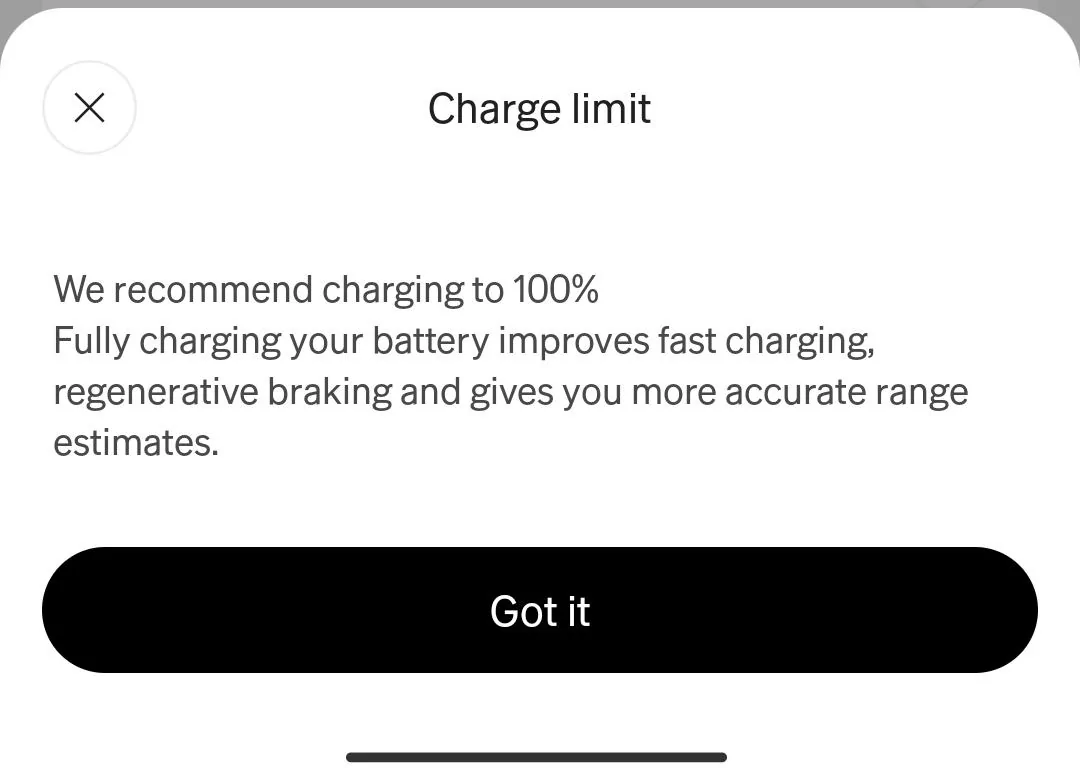
Not directly related to OP's question, but Rivian actually recommends 100% for LFP/Standard. I don't quite understand how that's beneficial for regenerative braking, since from Large pack my experience is that high SOC limits the amount of regeneration. Does anyone know why Rivian recommends this? Also does anyone know whether long term battery life/longevity/health for LFP actually benefits from 100% charging? If not, I'd rather prefer to limit it to something like 70% for daily use.

Last edited:
Sponsored

UnsungZero_OldTimeAdMan
Well-Known Member
LFP needs to be charged to 100% occasionally to calibrate software parameters—for accuracy of range estimation. There’s been much oversimplification when reality is more nuanced than good/bad. It’s good/bad pending other factors. And some have already been mentioned. Regen is a form of charging. When the pack is near full, it’s more resistant to accept charge. That is why regen is limited. Also why Rivian added brake blending to assist with slowing/stopping whenever conditions call for limited regen.Not directly related to OP's question, but Rivian actually recommends 100% for LFP/Standard. I don't quite understand how that's beneficial for regenerative braking, since from Large pack my experience is that high SOC limits the amount of regeneration. Does anyone know why Rivian recommends this? Also does anyone know whether long term battery life/longevity/health for LFP actually benefits from 100% charging? If not, I'd rather prefer to limit it to something like 70% for daily use.
Last edited:
dradam
Well-Known Member
average 10 to 20 % or less.How much percentage donusbuse daily?
gultin
Well-Known Member
If Rivian used the word "occasionally" I'd have been perfectly fine with it. However they don't, and recommend charging to 100% period, and claim that this benefits regenerative braking, which seems odd.LFP needs to be charged to 100% occasionally to calibrate software parameters—for accuracy of range estimation. There’s been much oversimplification when reality is more nuanced than good/bad. It’s good/bad pending other factors. And some have already been mentioned. Regen is a form of charging. When the pack is near full, it’s more resistant to accept charge. That is why regen is limited. Also why Rivian added brake blending to assist with slowing/stopping whenever conditions call for limited regen.
LL75
Well-Known Member
I thought they removed it.Just FYI... there is a page in the RIDE menu that shows battery pack State of Health.
I never charged my 2023 R1T to 100% nor did I discharge it to even 20%, and it was never ever DC Fast Charged even once. With only 3,500mi on the odometer in 1.5yrs of ownership, I checked the pack State of health a few months back and it was reporting 95% pretty much like all the other OG large packs that were posting in the thread where the SOH came up. In the end, the Rivian battery packs are so large and so well made, there's probably not much a owner could do to damage one.
DRJ564
Well-Known Member
Occasionally charging to 100% on LFP batteries balances the cells better. The voltage curve is flatter on LFP so the BMS has a harder time with cell balancing. If the cells aren’t balanced well, the voltage the BMS sees isn’t the true voltage of each cell which can effect regen and of course the other items listed.Not directly related to OP's question, but Rivian actually recommends 100% for LFP/Standard. I don't quite understand how that's beneficial for regenerative braking, since from Large pack my experience is that high SOC limits the amount of regeneration. Does anyone know why Rivian recommends this? Also does anyone know whether long term battery life/longevity/health for LFP actually benefits from 100% charging? If not, I'd rather prefer to limit it to something like 70% for daily use.
Sponsored
beaker
Well-Known Member
Mine is set to 69% for daily.
garb
New Member
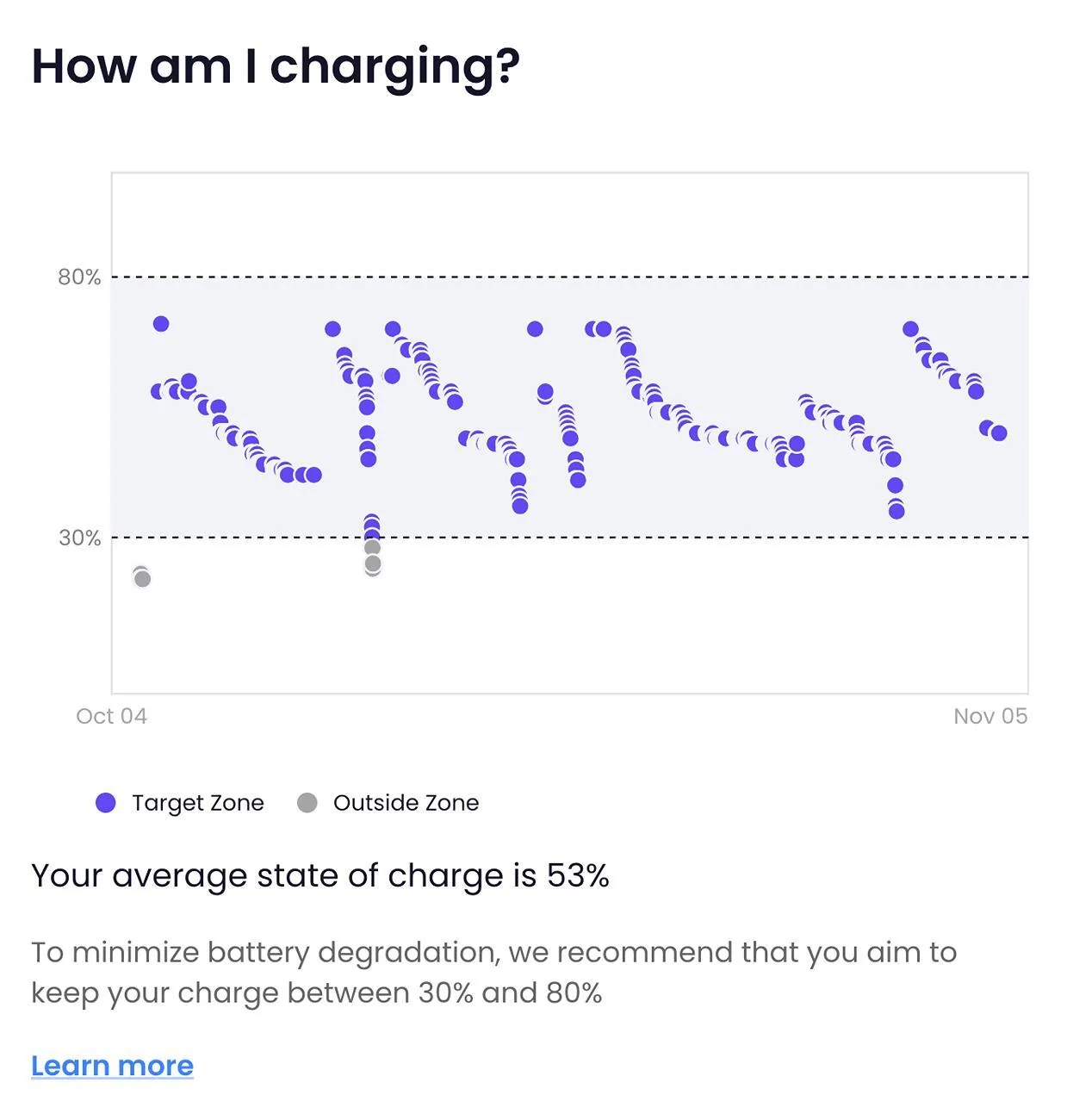
Just keep in mind that 50% is the most "balanced" for a lithium ion battery and the extremes (0% or 100%) are the least balanced, which over time will cause more wear and tear.
For daily driving: charge to 70% then drive down to 30% then recharge again. For the large pack, that's pretty easy to do because it's basically charging to 200 miles range then driving to 100 miles range.
I also use Recurrent, which is free. Here's my charging history.
Last piece of advice: Don't worry about charging to 100 when you need it. When I bought my first EV, I was too worried about keeping balanced charge levels that I made life more complicated than it needed to be. If you need the range, charge up. Your truck has a sophisticated battery management system so you'll be fine!

For daily driving: charge to 70% then drive down to 30% then recharge again. For the large pack, that's pretty easy to do because it's basically charging to 200 miles range then driving to 100 miles range.
I also use Recurrent, which is free. Here's my charging history.
Last piece of advice: Don't worry about charging to 100 when you need it. When I bought my first EV, I was too worried about keeping balanced charge levels that I made life more complicated than it needed to be. If you need the range, charge up. Your truck has a sophisticated battery management system so you'll be fine!
SoCal72
Well-Known Member
Hi,
I keep my max SOC at 70% and probably use 10-15% a day. Should I wait till it hits 50% to recahrge, too low, too high? Or set it max SOC to say60%, then the same questions, at what level should I recharge as I'll still have more than enough at even 40%SOC? I'm confused as some say to charge frequently, some seem to let it discharge quite a bit. Thanks for the advice.
I keep my max SOC at 70% and probably use 10-15% a day. Should I wait till it hits 50% to recahrge, too low, too high? Or set it max SOC to say60%, then the same questions, at what level should I recharge as I'll still have more than enough at even 40%SOC? I'm confused as some say to charge frequently, some seem to let it discharge quite a bit. Thanks for the advice.
ukyank
Well-Known Member
- Joined
- Mar 28, 2024
- Threads
- 0
- Messages
- 231
- Reaction score
- 444
- Location
- Pittsburgh
- Vehicles
- wienermobile
Who do you think the next owner is after a lease ends?Sure! Just F over the next owner. Nobel Prize candidate! Haha
stormbreaker
Well-Known Member
- First Name
- Ettore
- Joined
- Sep 13, 2024
- Threads
- 31
- Messages
- 181
- Reaction score
- 206
- Location
- Connecticut
- Vehicles
- 23 R1T Dual/Large, 94 Z28
- Occupation
- SE
Hi all - this is all really good discussion. I had a question and not sure if anyone has seen something similar. Like many folks, I will charge the truck once a week to 70%. I have solar and rivian charger at home, but since we don't make as much power during the less daylight season I will charge at work using a L2 charger from Blink. At 20 cents per kw its not bad!!
My question is, I have the truck set to 70% but more often than not it will stop charging at 69%. Unclear when I lost that extra 1%. I recall months ago it would go to 70%.
Any ideas why?
My question is, I have the truck set to 70% but more often than not it will stop charging at 69%. Unclear when I lost that extra 1%. I recall months ago it would go to 70%.
Any ideas why?
Sponsored
Similar threads

- Replies
- 5
- Views
- 574
- Replies
- 11
- Views
- 770
- Replies
- 51
- Views
- 4,503


