
Sponsored
Out of Spec 10% Challenge of Gen2 R1T dual Max: Massively Negative!

- Banned
- #77
so if you had a choice between an EV that takes 40 minutes or 15 minutes to charge you wouldn’t care?The 400V vs 800V charging architecture is not a consideration for me at all. I rarely hit DCFC stations and do almost all my charging at home. I think there are a lot of people with a similar use case. When I do use a DCFC I only charge as much as I need to get to the next stop, which is usually less than 85% SOC. I don't have enough patience for Kyle to watch the entire video and what I've read here and on reddit, I wouldn't agree with most of his complaints anyway.

NY_Rob
Well-Known Member
- First Name
- Rob
- Joined
- Feb 9, 2022
- Threads
- 23
- Messages
- 5,391
- Reaction score
- 7,960
- Location
- long island
- Vehicles
- Model 3 LR AWD, BMW i3 REX, 2024 Rubicon 4xe
- Occupation
- IT
800v vs 400v charging makes no difference because it's not the cells themselves causing the issue, it's Rivian's "end plate" cooling design that's causing the problem.
The individual cells charge at 4.2 volts, 4amps max rate which causes them to heat up quickly. Just the fact that the cells are already heating up charging from 400 volt EVSE proves they are maxing out on heat due to charging. 800 volt charging has no effect on the cells charging at 4.2 volts because no matter 400v or 800v EVSE, the cells still charge at 4.2 volts/4amps max which 16.8ah. You can't charge them at 8 volts 2 amps to keep heat down because you are over-volting the cells. Increasing volts and lowering amps works for keeping wires cooler, but doesn't work on charging batteries that have a fixed upper charging limit which in this case is 4.2 volts which they are already charging at.
The only thing you can do is change the cell cooling layout from just cooling the top or bottom of the cells to possibly using the the Tesla lasagna noodle style cooling which cools the full sides of the cells from the top to the bottom, not just the top or bottom cell plates. Once you start cooling the whole cell like Tesla does, you can maintain much higher current because you're keeping the whole cell cool not just the top and bottom of the cell.
If Rivian want's to charge at higher rates for longer periods, they need a full battery pack redesign. Tesla did a lot of research to come up with the most efficient cell cooling strategy, Rivian took the easy, quick way out which is now limiting charging rates.
I made a newer post here with clear illustrations of Rivian vs Tesla cell cooling...
https://www.rivianforums.com/forum/...dual-max-massively-negative.36591/post-669045
The individual cells charge at 4.2 volts, 4amps max rate which causes them to heat up quickly. Just the fact that the cells are already heating up charging from 400 volt EVSE proves they are maxing out on heat due to charging. 800 volt charging has no effect on the cells charging at 4.2 volts because no matter 400v or 800v EVSE, the cells still charge at 4.2 volts/4amps max which 16.8ah. You can't charge them at 8 volts 2 amps to keep heat down because you are over-volting the cells. Increasing volts and lowering amps works for keeping wires cooler, but doesn't work on charging batteries that have a fixed upper charging limit which in this case is 4.2 volts which they are already charging at.
The only thing you can do is change the cell cooling layout from just cooling the top or bottom of the cells to possibly using the the Tesla lasagna noodle style cooling which cools the full sides of the cells from the top to the bottom, not just the top or bottom cell plates. Once you start cooling the whole cell like Tesla does, you can maintain much higher current because you're keeping the whole cell cool not just the top and bottom of the cell.
If Rivian want's to charge at higher rates for longer periods, they need a full battery pack redesign. Tesla did a lot of research to come up with the most efficient cell cooling strategy, Rivian took the easy, quick way out which is now limiting charging rates.
I made a newer post here with clear illustrations of Rivian vs Tesla cell cooling...
https://www.rivianforums.com/forum/...dual-max-massively-negative.36591/post-669045
Last edited:

MountainBikeDude
Well-Known Member
While watching the video I played a drinking game. And you can, too!
Just grab your favorite holiday spirit and take a shot each time Kyle says: “I’m going to sit down and talk with the Rivian Engineers about this…”

zefram47
Well-Known Member
- First Name
- Aaron
- Joined
- Feb 6, 2022
- Threads
- 18
- Messages
- 2,749
- Reaction score
- 4,511
- Location
- Denver, CO
- Vehicles
- Rivian R1T, Alfa Romeo 4C
- Occupation
- Software Engineer
I'm sure almost no one will, but watch even some of the last episode of their I-90 Surge series. Charging speed trumps inefficiency all day, every day on a road trip. Kyle claims that Porsche engineers told him that they pushed charging speed significantly on the gen 2 Taycan because they weren't seeing any significant battery degradation over their gen 1 effort. That vehicle has a much smaller battery than Rivian, yet is able to hold over 300 kW to 60% SoC and stays over 200 kW through 75% SoC. That is the benchmark. At that point you barely have time to hit the restroom before the car has taken on enough to get to the next stop. To be blunt, the Taycan finished a nearly 3000 mile road trip about 2 hours behind an ICE they brought along which took 44 hours. Two hours over that period is basically nothing. A Rivian on the same route would take *significantly* longer.Battery degradation has not been discussed enough in this thread. Kyle is focused on Speed Speed Speed. Battery health does not factor into his assessment.
There are design trade offs we just don’t have visibility to.
This image spells it out. The Rivian Quad+Large is the bottom curve and the new Taycan is on the top. Even R1S to the previous gen Taycan is literally double the range gained in 15 minutes...2nd gen is 77 miles vs 256 miles.
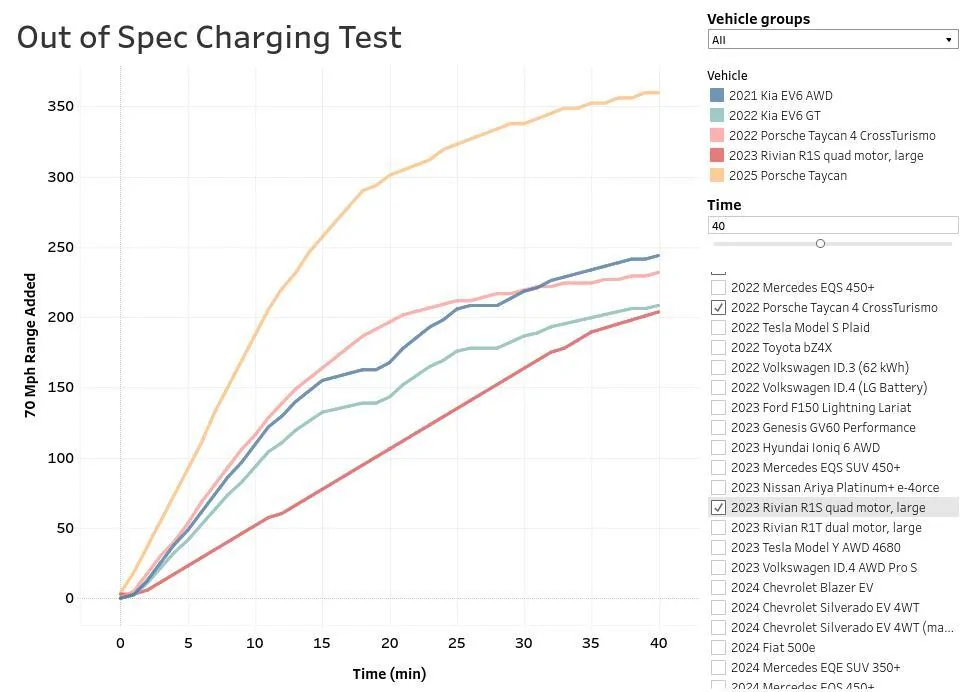
There's a massive difference between those two and shorter is almost always better.
Last edited:
Sponsored
ukyank
Well-Known Member
- Joined
- Mar 28, 2024
- Threads
- 0
- Messages
- 231
- Reaction score
- 444
- Location
- Pittsburgh
- Vehicles
- wienermobile
I doubt most people would share this thought process
BCondrey
Well-Known Member
- First Name
- Barry
- Joined
- Dec 12, 2021
- Threads
- 0
- Messages
- 692
- Reaction score
- 692
- Location
- Richmond, VA
- Vehicles
- R1T
- Occupation
- IT
It has been my experience that 15 min vs 40 min has more to do with the charging station than the vehicle. Stations that are de-rated, having to switch to a different cabinet, charging sessions that start strong and then quickly derate before 70% SOC can all easily take 40 minutes. I'd never make a vehicle purchase decision over charge times when there are so many factors that can negatively impact it. Oh, and 90%+ of the charging for most of us is done at home anyway.I doubt most people would share this thought process
DayTripping
Well-Known Member
The closer we can get to parity for gas cars with recharging, the quicker EVs will be mainstream. I have a young child and adding an extra 30 minute per charging stop, just drains the patients of my child. So combine slow charging, with an inefficient vehicle, and you have about the worst combo you can have without adding in a small battery pack. I wouldn't have minded if they also upped the home charging speed too like Chevy did. Give me a 80 amp charging option for home please.
- Banned
- #84
Probably why it just came down that Rivian was stealing battery secrets from Tesla in that lawsuit LOL800v vs 400v charging makes no difference because it's not the cells themselves causing the issue, it's Rivian's "end plate" cooling design that's the problem. The cells charge at 4.2 volts, 4amps max rate which causes them to heat up. Just the fact that the cells are already heating up charging from 400 volt EVSE proves they are maxing out on heat due to charging. 800 volt charging has no effect on the cells charging a 4.2 volts because no matter 400v or 800v EVSE, the cells still charge at 4.2 volts/4amps max which 16.8ah. You can't charge them at 8 volts 2 amps to keep heat down because you are over volting the cells. Higher volts and lower amps works for keeping wires cooler, but doesn't work on charging batteries that have a fixed upper charging limit which in this case is 4.2 volts.
The only thing you can do is change the cell cooling layout from only cooling the top and bottom of the cells to possibly using the the Tesla lasagna noodle style cooling which cools the sides of the cells fully from the top to the bottom, not just the top and bottom cell plates. Once you start cooling the whole cell like Tesla does, you can maintain much higher current because you're keeping the whole cell cool. if Rivian want's to charge at higher rates for longer periods, they need a full battery pack redesign. Tesla did a lot of research to come up with the most efficient cell cooling strategy, Rivian took the easy way out which is now limiting charging rates.

UnsungZero_OldTimeAdMan
Well-Known Member
The folly of social media, giving any joe schmoe a platform.. and rewarding them with an audience/revenue. A few minutes difference isn't going to hurt anyone. Already spending 20~40 minutes charging... what's a few more (unless you suffer from chronic acute bowel movements). /sAt the end of the day, we’re talking a difference of a few minutes between Gen 1 and Gen 2 charging times. It hasn’t been any deal at all to us
Early reports from Gen2 of latest OTA indicate Rivian has already taken steps to address audio quality. Does it get any attention? No. The peanut gallery reads the thread headlines, see long-winded influencer videos, conclude and repeat falsely that the audio system is permanently bad. Social media discourage individual critical thinking and make the masses dumber.
Last edited:
Sponsored
cwang089
Active Member
correct me if I am wrogn, but isn't the Rivian Gen 1 and Gen 2 the worst charging vehicle you can buy that costs more than $50k?
That is pretty bad.
For most people its not a big deal as most of the charging is done at home. I only do 2 roadtrips a year where it matters. But I have a 5 hour trip coming up next month and I am debating whether to take the Tesla Y or the Rivian. My passengers will appreciate the comfort of the Rivian..but I much prefer ADAS in the Tesla as well as the ease of charging.
That is pretty bad.
For most people its not a big deal as most of the charging is done at home. I only do 2 roadtrips a year where it matters. But I have a 5 hour trip coming up next month and I am debating whether to take the Tesla Y or the Rivian. My passengers will appreciate the comfort of the Rivian..but I much prefer ADAS in the Tesla as well as the ease of charging.

Budman
Well-Known Member
No. My $55,000 Volvo XC40 is SIGNIFICANTLY slower.correct me if I am wrogn, but isn't the Rivian Gen 1 and Gen 2 the worst charging vehicle you can buy that costs more than $50k?
That is pretty bad.
For most people its not a big deal as most of the charging is done at home. I only do 2 roadtrips a year where it matters. But I have a 5 hour trip coming up next month and I am debating whether to take the Tesla Y or the Rivian. My passengers will appreciate the comfort of the Rivian..but I much prefer ADAS in the Tesla as well as the ease of charging.
elatrickWheels
Well-Known Member
- First Name
- Trey
- Joined
- Dec 27, 2023
- Threads
- 8
- Messages
- 139
- Reaction score
- 253
- Location
- San Francisco, CA
- Vehicles
- Rivian R1S
- Occupation
- Ski bum, mountain bike bore
He could have said the same thing in five or ten minutes and if he had, I might have watched it all. I can’t help looking back on the whiplash that accompanied the Gen 2 launch, when the Gen 1 cars that we’d all been gushing about in here seemed instantly to have become garbage, with “unacceptable” rides (especially everyone’s R1S except mine), ”total lack of quality control,” “worst-in-class audio,” “preposterous phantom drain,” etc. Now the boot’s on the other foot; the OG is the best and with Gen 2 you pay far more and get far less.
Hear me now: There’s going to be a Gen 3. It will come with its own set of compromises, but will probably be generally better. Even so, when that happens, I still plan to be driving my Gen 1 R1S, and still expect to love it.
Hear me now: There’s going to be a Gen 3. It will come with its own set of compromises, but will probably be generally better. Even so, when that happens, I still plan to be driving my Gen 1 R1S, and still expect to love it.
Last edited:
greyboundary
Well-Known Member
Having a Gen2 dual max, I genuinely don't share any of the complaints. Audio is fine (and I've owned a ton of high end non-auto equipment), heat pump isn't noisy in mine, and the real world range is so beastly that I have yet to even take mine to a public fast charger.
The once a year that I do my >500 mile trip that required multiple stops in my last EV will now be one stop. Even if it takes 40 or even 50min vs a theoretical 35, 30 - I just don't think it's the end of the world.
TBH these hours and hours of research and hour long videos is over-thinking it. I think even the max vs large battery "disappointments" found by comparing kwh are blown out of proportion. There's other factors such as the motor efficiency. The EPA mixed use results say it all, and to me, more battery is more battery.
It was money well spent and it's a banger vehicle. I strongly recommend the gen 2 dual max.
The once a year that I do my >500 mile trip that required multiple stops in my last EV will now be one stop. Even if it takes 40 or even 50min vs a theoretical 35, 30 - I just don't think it's the end of the world.
TBH these hours and hours of research and hour long videos is over-thinking it. I think even the max vs large battery "disappointments" found by comparing kwh are blown out of proportion. There's other factors such as the motor efficiency. The EPA mixed use results say it all, and to me, more battery is more battery.
It was money well spent and it's a banger vehicle. I strongly recommend the gen 2 dual max.

SeaGeo
Well-Known Member
You need a service ticket bud.5) AC noisy, car steams up not sure why
Sponsored
Similar threads


- Replies
- 65
- Views
- 17,584

