Sponsored

opnwide

Well-Known Member
First Name
Brian
Joined
Nov 18, 2020
Threads
35
Messages
1,227
Reaction score
5,407
Location
Denver, CO
Vehicles
R1S delivered 2/2023
I’ve got a res for the all-electric Traveler, and after owning the S, and I’m completely fine with that. Something about a 100 mile battery pack and a gas generator in back “slowly”charging the battery pack just isn’t connecting all synapses in my cerebellum. But that wouldn’t be the first time. Not to mention I have to fill the tank and do oil and filter changes. 🤔
Sponsored


Mark_AZR1T

Well-Known Member
Site Sponsor
First Name
Mark
Joined
May 28, 2021
Threads
42
Messages
2,222
Reaction score
3,867
Location
Gilbert, AZ
Website
jackpucks.com
Vehicles
R1T Launch, R1S Canyon Red
Clubs
 
I am pretty sure the gas engine will not generate enough energy to move the truck by itself. Or if it does, it won't move the truck when towing. I think the gas engine turns on when the battery gets down to some percentage, maybe 50%, and then keeps adding to the battery as long as gas is available. But if you are towing, the battery will most likely be depleted faster than the engine can charge it.

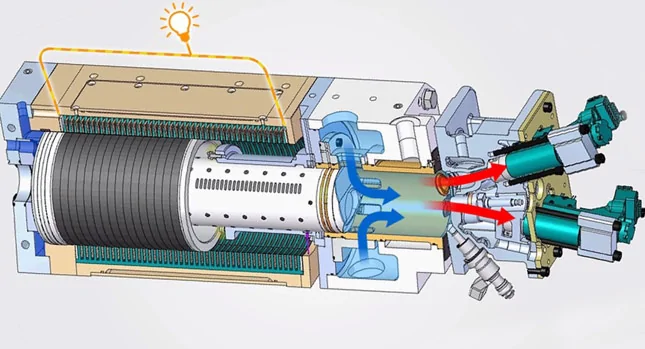
I am super interested to learn about the gas engine and how much power it produces, as that will have a huge impact on range and towing capacity. We do know it is small, because they fit it next to the rear axle. It isn't a large V6 or anything like that. What is it that can fit there?

Something like this thing Toyota developed?
1763777676195-6i.webp
It’s pretty clear why Scout won’t share details on the range extender yet: the system isn’t performing. If the onboard gas engine can’t keep up with battery demand at freeway speeds, especially while towing, you eventually run the pack dry faster than the engine can recharge it. And since the engine doesn’t drive the wheels, once the battery’s empty you’re out of both gas and electrons.

The most likely scenario is that the engine-generator setup is producing far less usable output on the test stand than they projected, which explains the silence around what should be their flagship feature.

It also explains why they still haven’t committed to which model launches first, the BEV or the gas-assist version, even though the range-extender model reportedly has the most preorders. If they could hype it, they would.

This isn’t a minor delay. It’s a big problem.
 

TexasBob

Well-Known Member
First Name
Bob
Joined
Jan 15, 2022
Threads
49
Messages
1,194
Reaction score
2,641
Location
Houston
Vehicles
2024 R1T DM LRG, 2025 R1S Dune
It’s pretty clear why Scout won’t share details on the range extender yet: the system isn’t performing. If the onboard gas engine can’t keep up with battery demand at freeway speeds, especially while towing, you eventually run the pack dry faster than the engine can recharge it. And since the engine doesn’t drive the wheels, once the battery’s empty you’re out of both gas and electrons.

The most likely scenario is that the engine-generator setup is producing far less usable output on the test stand than they projected, which explains the silence around what should be their flagship feature.

It also explains why they still haven’t committed to which model launches first, the BEV or the gas-assist version, even though the range-extender model reportedly has the most preorders. If they could hype it, they would.

This isn’t a minor delay. It’s a big problem.
That is a whole lot of speculation. It needs a 60kw generator to sustain towing a full 5k load at highway speed (< 1 mile per kWh). The VW 1.6L engine (EA211) Scout is using can produce 81 kw peak and 60.7 kw continuous. The towing capacity on the Harvester is 5k vs 7k /10k on the bev. I suspect the reason is that the engine cannot keep up with towing a heavier load than that at high speeds. But within the confines of the 5k limitation, the VW engine should be fine.

The BEV will be the higher performance vehicle on every dimension except range.
 
Last edited:

VandalSibs

Well-Known Member
First Name
Andrew
Joined
Dec 27, 2023
Threads
15
Messages
1,386
Reaction score
2,405
Location
Eastern Washington State
Website
www.sibulskymusic.com
Vehicles
R1T Dual Motor Large Pack
Occupation
Composer, IT Service Desk Analyst
Clubs
 
That is a whole lot of speculation. It needs a 60kw generator to sustain towing a full 5k load at highway speed (< 1 mile per kWh). The VW 1.6L engine (EA211) Scout is using can produce 81 kw peak and 60.7 kw continuous. The towing capacity on the Harvester is 5k vs 7k /10k on the bev. I suspect the reason is that the engine cannot keep up with towing a heavier load than that at high speeds. But within the confines of the 5k limitation, the VW engine should be fine.

The BEV will be the higher performance vehicle on every dimension except range.
I wonder (being a person that pretends to know more about automotive design and engineering that I actually do) if the position of the generator is also a factor in the lower towing capacity - in the TFL video, the exec being interviewed says it's in front of the rear electric motor and axle, along the same plane.
 

Sponsored

mroe

Well-Known Member
Joined
Nov 19, 2021
Threads
13
Messages
167
Reaction score
247
Location
Oakland
Vehicles
R1T
Clubs
 
I was so bought in on Scout when they were originally announced and have lost all interest after they've leaned into prioritizing the Harvester models.
 

mkhuffman

Well-Known Member
First Name
Mike
Joined
Nov 9, 2020
Threads
14
Messages
2,864
Reaction score
3,214
Location
Virginia
Vehicles
2025 R1T Tri-Max, Jeep GC-L, VW Jetta
I’ve got a res for the all-electric Traveler, and after owning the S, and I’m completely fine with that. Something about a 100 mile battery pack and a gas generator in back “slowly”charging the battery pack just isn’t connecting all synapses in my cerebellum. But that wouldn’t be the first time. Not to mention I have to fill the tank and do oil and filter changes. 🤔
The one thing I don't think I have seen anyone mention is the refueling process on a trip.

They are targeting 500 miles of range with the gas extender. When you are at 480 miles, and stop to refuel, do you need to DCFC and also fill up the gas tank? As we all know, the 80 to 100% charging time is too long to wait, so I assume you do a fairly quick (25 minute?) charge to 80%, and then pull up to the gas pump and fill her up? And since the battery is only charged to 80%, now you are at 480 miles of range? Maybe?

I don't know the answers to all the questions raised above, but I expect if all you do is refuel the gas tank, you won't get another 500 miles of range. You will get maybe 400. Which isn't that bad, but still. Something to think about.

To answer your questions, exhibit A is my wife. She absolutely refuses to get a BEV. I keep trying, but she won't budge. She is willing to get a BEV that has a gas range extending engine, however. I think there are many, many people like her, as evidenced by the reservations people have made.

My wife has been educated by our experience traveling in a BEV. And she is not impressed. She wants a gas-powered car. Period.

Oil changes in a REEV will be much less frequent than in a typical gas-powered vehicle. If most of your driving is on battery power, the engine gets very little use. A realistic oil change frequency is probably yearly, or maybe every two years. That isn't bad at all. Spark plugs are probably 5-10 years, or maybe they will last the life of the vehicle. So engine maintenance will be very minimal, I think.
 

richguess

Well-Known Member
First Name
Richard
Joined
Oct 22, 2022
Threads
3
Messages
191
Reaction score
141
Location
Newport Beach
Vehicles
Hyundai Ionic5. R1S on order
Occupation
Retired ER doc
The SUV is pushing 210”, too big for my tastes. As ranges approach 400 miles, for me an ICE backup is unnecessary. R2, Q6, ix3, and Volvo ex 60 (stated 400 miles) are perfect. We have a RAV4 prime when needed.
 

Mark_AZR1T

Well-Known Member
Site Sponsor
First Name
Mark
Joined
May 28, 2021
Threads
42
Messages
2,222
Reaction score
3,867
Location
Gilbert, AZ
Website
jackpucks.com
Vehicles
R1T Launch, R1S Canyon Red
Clubs
 
By March 2028, I’ll be at six years with a Rivian. I’m on both deposit lists, but the idea of moving back to a petrol-burning truck, one with an unproven generator setup that may still require both gas (some estimates are 10+ gallons) and charging stops for 400 miles, feels like a step backward. Not to mention, oil changes, a radiator, timing belt/chain, serpentine belts, alternator, etc.

No, thank you.
 
Last edited:

Sponsored

ksumnole

Well-Known Member
Joined
Dec 12, 2024
Threads
18
Messages
164
Reaction score
237
Location
USA
Vehicles
2025 R1T TriMax
Occupation
Engineer
Clubs
 
By March 2028, I’ll be at six years with a Rivian. I’m on both deposit lists, but the idea of moving back to a petrol-burning truck, one with an unproven generator setup that may still require both gas (some estimates are 10+ gallons) and charging stops for 400 miles, feels like a step backward. Not to mention, oil changes, a radiator, timing belt/chain, serpentine belts, etc.
I strongly believe the future is purely electric. Whether we are storing that energy in a lithium battery or some other form such as hydrogen. The competition around the world, whether it's in Asia or Europe, is not going to wait and look at what we are doing in the USA. They are going to keep iterating and improving over electric technology. And at some point, which is now pretty clear, they will become leaders in many of its aspects. I frequently chat with engineers that are constantly traveling to China to work on various systems outside of the automotive industry and they are shocked by how far ahead China is.

I'm not making this a political discussion or debate, but it is clear that the Trump administration has put its foot on the back of American EV manufacturers and is actively destroying it whether it's through sheer stupidity or narrow thinking.

As much as I like the look of the Scout vehicle, heck I love it, I believe it is a dead technology that by the time it arrives will already be absolute.

The future is electric whether people like it or not. The world is moving away from fossil fuels. And AI is only going to accelerate this transition.

Just my two cents.
 

Zorg

Well-Known Member
Joined
Nov 1, 2022
Threads
9
Messages
1,002
Reaction score
1,226
Location
SF bay area
Vehicles
Model X
If solid state batteries are a few years out, EREV will be short lived. As someone else said, EREV are the gateway drug to EV.
 

TexasBob

Well-Known Member
First Name
Bob
Joined
Jan 15, 2022
Threads
49
Messages
1,194
Reaction score
2,641
Location
Houston
Vehicles
2024 R1T DM LRG, 2025 R1S Dune
The SUV is pushing 210”, too big for my tastes. As ranges approach 400 miles, for me an ICE backup is unnecessary. R2, Q6, ix3, and Volvo ex 60 (stated 400 miles) are perfect. We have a RAV4 prime when needed.
The Traveler is 190". The rest is the rear spare tire if you choose one.

While I have a reservation and like the way these look, and the pure EV 350 miles might be a contender for me, I am kind of with RJ at this point: at least one of the vehicles in our house must have true eyes off autonomy at least on the freeway. Everything else is out of date. And Scout is proudly anti-autonomy.
 

strykerwsu

Well-Known Member
Joined
Dec 21, 2022
Threads
6
Messages
969
Reaction score
1,191
Location
Kansas
Vehicles
Chevy SS, Ford Bronco, Ram Rebel, Ford Flex, G8
By March 2028, I’ll be at six years with a Rivian. I’m on both deposit lists, but the idea of moving back to a petrol-burning truck, one with an unproven generator setup that may still require both gas (some estimates are 10+ gallons) and charging stops for 400 miles, feels like a step backward. Not to mention, oil changes, a radiator, timing belt/chain, serpentine belts, etc.
The only reason for the hybrid is if they can truly allow towing a decent weight a good distance. Otherwise it’s night and day on charging available vs 3 years ago and I dont see the need if you own a home.
Sponsored


Top