Sponsored

Am I the only one who thinks anything less than 400mi of range is legacy at this point?

BTOR

Well-Known Member
First Name
Brad
Joined
Dec 2, 2024
Threads
14
Messages
215
Reaction score
134
Location
Oregon
Vehicles
2023 Bolt, 2025 R1S
I remember buying my 2018 Model 3, which had 310 mile epa range and 400V charging speed. I think it cost somewhere in the low $50Ks.

8 years later, today, I’d argue it’d be hard to find a new EV with 300+ miles range and 400V charging that costs in the low $50Ks.

8 years later, why aren’t EVs cheaper for the core EV specs?
Keep in mind, all vehicles have increased in price by 30% since 2019. So to expect EV prices to remain the same or decrease isn’t logical. Most of these increases are due to the “technology” new vehicles offer and the expense of the components that enable that technology.
Sponsored


carsly

Well-Known Member
Joined
Apr 19, 2023
Threads
46
Messages
740
Reaction score
1,023
Location
Princeton, NJ
Vehicles
LR Defender, Tesla Model S
Keep in mind, all vehicles have increased in price by 30% since 2019. So to expect EV prices to remain the same or decrease isn’t logical. Most of these increases are due to the “technology” new vehicles offer and the expense of the components that enable that technology.
That's all inflation. 29.8% inflation between 2019 and early in 2026 as we discuss here.

Rivian R1T R1S Am I the only one who thinks anything less than 400mi of range is legacy at this point? 1773762745284-m8
 

VandalSibs

Well-Known Member
First Name
Andrew
Joined
Dec 27, 2023
Threads
15
Messages
1,381
Reaction score
2,399
Location
Eastern Washington State
Website
www.sibulskymusic.com
Vehicles
R1T Dual Motor Large Pack
Occupation
Composer, IT Service Desk Analyst
Clubs
 
I've never quite understood those (even in ICEV) that don't use as much of the tank/battery when road tripping... it's just a waste of the capacity of the vehicle. Yeah, don't stretch yourself - but if there is charging/gas available in an area when you are approaching empty, make it work. I've gone down to as little as 4% when towing with my R1T. Made it to the charger just fine.

Guess what I'm saying is that those who say the 20%-80% capacity of their EV's battery is the "real" range are incorrect and are just limiting themselves for no good reason.
 
Last edited:

getut

Active Member
Joined
Mar 14, 2026
Threads
2
Messages
40
Reaction score
39
Location
NC, USA, Earth
Vehicles
equinox ev and hyundai santa cruz, shopping rivian
I don't think EVs are going to increase range much from the 300ish they have now because even if the batteries improve on energy density, manufacturers are going to just use smaller batteries to lower costs. I think what's more likely to solve this issue is better fast charging. The BYD blade II battery can recharge from 10%-100% in something like 15 minutes using their fast chargers. I think the answer isn't more battery, but faster charging. Additionally, I've heard that solid state batteries don't lose nearly as much in cold weather.
I think 300'ish miles is good for a car, but not for a pickup truck. Heck I just bought an equinox EV that is rated for 318 miles and it gets very close to that without even having to work at it. I'm also shopping between Rivian and the Silverado EV. But for trucks that are used as trucks for real work, I think a solid 400 mile rating with a full battery is the absolute bare minimum. Not because I use 400 miles in optimal conditions, but because I need the range boost in NON-optimal conditions. 400 miles with just me my family and luggage is more than I can sit in the truck. BUT when you consider possibly worst case conditions with 10 years of age on the battery (I keep vehicles forever), super cold weather while possibly also towing, then vehicles that are in the 300 mile or less range would almost have to be recharged just getting out of my driveway. So stated another way, I consider 175 miles the absolute least mileage I will live with under ANY conditions or usage scenario.

I don't want the size of the silverado, but I'm just not getting a warm squishy that Rivian's can reach the rated 420 miles unless you are working your arse off hypermiling while also getting "lucky" and getting stuck in slow traffic. GM seems to a MUCH better job with their EPA ratings and reaching EPA while at constant 70MPH highway speeds is easy and takes no effort beyond "just drive". I just posted a welcome in main thread yesterday voicing some of those questions. I was really hoping people would chime in, especially on the mileage aspect and tell me they were getting vastly different results than what I have read.. but that didn't happen. People are confirming 420 is very difficult to reach in the rivians that are rated for it.
 

godfodder0901

Well-Known Member
First Name
Jared
Joined
Mar 12, 2019
Threads
27
Messages
5,749
Reaction score
10,139
Location
Washington
Vehicles
2022 Rivian R1T LE
Guess what I'm saying is that those who say the 20%-80% capacity of their EV's battery is the "real" range are incorrect and are just limiting themselves for no good reason.
Well, there are good reasons for some. Those reasons are charging speed and battery longevity. Stopping more frequently, but shorter stops, usually results in a shorter trip than fewer, but longer, stops.
 

Sponsored

DuoRivians

Well-Known Member
Joined
Dec 30, 2022
Threads
257
Messages
3,809
Reaction score
9,076
Location
California
Vehicles
R1T, R1S
I’ll take 400 miles of range. Even if I don’t commute that, it just means more time between charging sessions. I’ll accept 300 miles of range, if the batteries are considerably fewer and car much cheaper though.
 

djinndjinn

Member
First Name
Eric
Joined
Nov 8, 2025
Threads
1
Messages
12
Reaction score
12
Location
Pennsylvania
Vehicles
cybertruck, 2026 R1S Dual Max
Daily commuters don’t need range. I get it. But if you take frequent long trips (us) the math gets interesting. As an example, we frequently drive from PA to SC (640 miles). Our first EV (Tesla S - 2012) took us 12 1/2 hours. Our latest Tesla (CT) we can do it in about 11 hours - quite difference. Just got a max pack R1S (405 miles) so should be interesting to see if that’s any better - likely not.

but to the op’s post, 400 miles isn’t really 400 miles. Hypothetical - let’s say you’re over 65 and like to stop every 2 1/2 - 3 hours, and let’s call that about 180 miles highway. Here are the ‘hits’ that lower that 400 mile battery.

charge to 80% (above 80% and you’re likely just wasting time) - 20% hit
drive above highway speeds - 10% hit (conservative)
wintertime - 30% hit (that’s what we have seen if it’s 20 degrees or lower)

depending on how you do the math the 400 miles becomes somewhere between 160-200 miles If it’s cold out.

absolutely understand that this is an approximation, not as much an issue if warmer, and not every parameter above may matter to you. But for us, it’s why having battery rated at 350+ miles is our sweet spot. YMMV, figuratively and literally. :)
 

VandalSibs

Well-Known Member
First Name
Andrew
Joined
Dec 27, 2023
Threads
15
Messages
1,381
Reaction score
2,399
Location
Eastern Washington State
Website
www.sibulskymusic.com
Vehicles
R1T Dual Motor Large Pack
Occupation
Composer, IT Service Desk Analyst
Clubs
 
Well, there are good reasons for some. Those reasons are charging speed and battery longevity. Stopping more frequently, but shorter stops, usually results in a shorter trip than fewer, but longer, stops.
I agree that there are some concerns, but I think that unless you are draining the batter 100% to 0% every single day, those concerns are not warrantied, considering the data we've seen over the last few years regarding DCFC's impacts on battery life.


An unexpected detour could have left you stranded. I'd like a bit more cushion myself.
I was right on the route to the next charger, just a mile or two away (I was actually amazed at how accurate the remaining SoC guess from the truck was, considering the wind conditions I had been in!)
 

ribuck97

Well-Known Member
Joined
Mar 16, 2026
Threads
1
Messages
48
Reaction score
40
Location
SoCal
Vehicles
Tesla Model 3 LR AWD
I think 300'ish miles is good for a car, but not for a pickup truck. Heck I just bought an equinox EV that is rated for 318 miles and it gets very close to that without even having to work at it. I'm also shopping between Rivian and the Silverado EV. But for trucks that are used as trucks for real work, I think a solid 400 mile rating with a full battery is the absolute bare minimum. Not because I use 400 miles in optimal conditions, but because I need the range boost in NON-optimal conditions. 400 miles with just me my family and luggage is more than I can sit in the truck. BUT when you consider possibly worst case conditions with 10 years of age on the battery (I keep vehicles forever), super cold weather while possibly also towing, then vehicles that are in the 300 mile or less range would almost have to be recharged just getting out of my driveway. So stated another way, I consider 175 miles the absolute least mileage I will live with under ANY conditions or usage scenario.

I don't want the size of the silverado, but I'm just not getting a warm squishy that Rivian's can reach the rated 420 miles unless you are working your arse off hypermiling while also getting "lucky" and getting stuck in slow traffic. GM seems to a MUCH better job with their EPA ratings and reaching EPA while at constant 70MPH highway speeds is easy and takes no effort beyond "just drive". I just posted a welcome in main thread yesterday voicing some of those questions. I was really hoping people would chime in, especially on the mileage aspect and tell me they were getting vastly different results than what I have read.. but that didn't happen. People are confirming 420 is very difficult to reach in the rivians that are rated for it.
FYI I just was able to rent a Silverado EV from Avis in DFW last week. It was a 400 mile range pack. I'm not sure what overall trim it was but... it had manual seats which I was shocked by. In the last month I've driven my TM3, overnighted a R1S, and then the Silverado.

There were a few things I despised about the Chevy:

It had a permanent in lane assist (which was probably a button I couldn't find) which sort of took over the steering wheel. It just felt odd.

The "warning" on proximity sensing was like a 6" sub vibrating significantly in the seat bottom (prolly another setting to disable)... audible would be much better

It felt like they took the suspension from the normal Silverado and put it in the EV with a massive battery. Hitting road expansion joints or bumps made the truck significantly bounce in a wave pattern. Was awful.

Not of concern, but the interior felt cheap and would need some of the options.
 

Sponsored

River Ghost

Active Member
Joined
May 11, 2024
Threads
1
Messages
28
Reaction score
27
Location
Santa Fe, New Mexico
Vehicles
Rivian R1S, Tesla Model 3
RJ Scaringe (in a video talking to Kyle Conner of Out of Spec) stated that their data shows that on average Rivian's are fast charged 10 times a year. So they design their batteries to optimize energy density rather than power (and charging time). Given that data I think that is the correct decision.

My own thought is the sweet spot for most people is a range between 300 and 400 miles. Rivian stated that the R2 would be 300+ which shows that they agree. If you get over 400 miles then for most people they are only driving ~30 miles a day and the mi/kWh goes down hauling a 400 mile battery that rarely gets used. There also is the cost of a larger battery but the sweet spot is based on a trade off of range versus efficiency given how most people drive.

I am in the mountain west which is sparsely populated and has long distances between gas stations not to mention fast chargers. A lot of DC fast chargers have been added in the last couple of years and Rivian now has access to the Tesla network version 3 and above. We still have a lot of version 2 fast chargers in rural areas.

If you are in a cold climate then the most important thing is not range but having a heat pump. If you do not have a heat pump your range drops a lot. By the way, I grew up in Minnesota in a rural area and ICE cars also suffer from reduced range in cold weather.

I rarely get the full charging performance of a 400 volt system. Many chargers are 50 kW or 150 kW and a lot of "faster" chargers do not charge at their advertised rate. Tesla version 3 fast charging is 250 kW and is the most widely installed charger. 800 volt cars do not charge at their theoretical speed at Tesla version 3 chargers so their really is no benefit over a 400 volt system at these chargers. Electrify America DC fast charging does have 350 kW charging but those often do not work or charge slowly. Their 150 kW chargers are more reliable so often that is better than the 350 kW charger next to it. So in theory 800 volt charging should be faster but in practice I see very little benefit. Now that is changing but if the average Rivian owner is DC fast charging 10 times a year and most of those places do not in practice charge faster with 800 volt systems it does not seem like it would help much to switch from a 400 volt system to an 800 volt system.

There are use cases where having 400 mile range or higher would be helpful. If you tow a lot then that drops your range so to get the 300+ mile range while towing you need a bigger battery. I happen to be someone that needs 350 - 400 mile range or better because I travel in remote areas for days at a time and I do not want to have to drive back to town or worse just to charge. Even with ICE vehicles it has been good practice to fill up your tank completely before leaving town and with an EV that means long charging times getting close to 100%. A river ranger told me there is a guy that shows up to the launch in his EV and when he launches he leaves a generator running to charge his EV until it runs out of gas so he will have enough range to get back to a fast charger.

Although I would like more range I am not entitled enough to think that Rivian should build a car just for my needs. They need to design for the broad majority of users. If they offered a "max pack" for the R2 that would make me happy but they learned from the R1T and R1S that having a lot of options caused problems with production. And seeing how critical the roll out of the R2 is for Rivian it makes sense to streamline everything so that they get the R2 out to as many people as possible as fast as possible rather than trying to satisfy everyone.
 

richguess

Well-Known Member
First Name
Richard
Joined
Oct 22, 2022
Threads
3
Messages
191
Reaction score
141
Location
Newport Beach
Vehicles
Hyundai Ionic5. R1S on order
Occupation
Retired ER doc
Even in Cali, I lean toward the 400mi mark. 90%+ for me is home charging with solar. But, for a road trip to NoCal, which we do at least 5x/yr, having to stop only once for charging is a real bonus. And, having the port at the driver‘s rear makes Tesla Supercharger access easy as well. Both the R2 and the ex60 have that location, the BMW does not. The BMW probably is the best driving/handling of the lot, and I suspect the most expensive as well. I’ll decide when all are out and I have a chance to drive them.
 

RivAW

Well-Known Member
First Name
Alex
Joined
Mar 9, 2023
Threads
1
Messages
864
Reaction score
841
Location
MA
Vehicles
R1T, Glacier White, Black Mountain, Black AT 20s,
Clubs
 
Living in the northeast, cold climate, I won't buy an EV with less than 400 miles of range at this point. I just think it's too problematic especially in cold and especially as the car (batteries) age. Long drives in winter you get 30-50% range degradation, it's 2026, how is it that all batt packs aren't at least 400miles+?

What EV's (excepting paying "ridiculous upgrade $$" have greater than 400 miles of range?? Also, I call BS on loosing 30-50%in the cold unless you live somewhere that has single digit temperature for an extended period of time. I have been driving exclusively EV in the Northeast (MA) and while there is admittedly some range reduction during winter (we've had our fair share of single digit temps and teens), it's nowhere near that.
 

rhumbliner

Well-Known Member
First Name
thomas
Joined
Nov 8, 2020
Threads
12
Messages
335
Reaction score
527
Location
Bend
Vehicles
R1T & Model X
Occupation
Retired
I think 300'ish miles is good for a car, but not for a pickup truck.
I beg to differ. I use my 2023 R1T to drag my 28’ AS up and down the west coast with a range somewhere between 120-160 miles depending on the terrain. During these extended road trips the most important factor, for me, is the number of trailer-friendly SuperCharger’s. My wife & I like to stop every 2 hours to stretch our legs, use the bathroom, and grab a snack and that’s about how long it takes to charge back up.

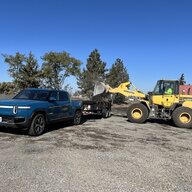
At home I tow a heavy hydraulic trailer (see photo) to haul material around town. At low city speeds (45 mph) and virtually no wind resistance my range is roughly 280 miles and I’ve rarely had a day where I need to stop to charge, and when I do it’s time for lunch.
 

blipit

Well-Known Member
Joined
Feb 7, 2026
Threads
0
Messages
170
Reaction score
219
Location
Dallas
Vehicles
R1T
Getting worried with the amount of people in this thread with bladder issues. You definitely should not have to use the restroom every 3 hours. Some of you need to get your PSA levels checked. Does everyone on Rivian forum live in senior living?
Sponsored


Top