
Sponsored

josephponline

Well-Known Member
Joined
Jan 23, 2023
Threads
7
Messages
102
Reaction score
131
Location
Colorado
Vehicles
Rivian R1T
I recently saw this post:

https://www.rivianforums.com/forum/...ailer-my-first-journey-towing-with-r1t.53356/

It reminded me that I never shared my own tow-test data here, which may be useful to folks evaluating electric trailers with the Rivian R1T.

We spent time looking seriously at both the Lightship AE.1 and the Pebble Flow (this was before Evotrex). After seeing both at Overland Expo events, we ultimately decided to go with the Lightship. That said, I’m not trying to make a case here for one trailer over another, I’m just sharing the towing efficiency behavior of electric trailers behind the R1T, since real-world numbers are still pretty sparse across all three platforms.

Before purchasing, the Lightship team let me do a real-world tow test with my truck, and the results ended up looking broadly similar to what @JamuJoe is reporting with the Pebble.

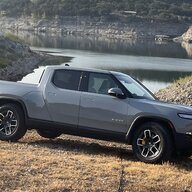
Here were the observed numbers from that evaluation drive using my Gen 1 Quad R1T on 22" Michelin Defender LTX tires:

Baseline efficiency (no trailer): 2.1 mi/kWh
Towing AE.1 without TrekDrive assist: 0.9 mi/kWh
Towing AE.1 with TrekDrive assist: 1.9 mi/kWh

For anyone unfamiliar with the term, TrekDrive is Lightship’s electric propulsion system in the trailer axle that actively contributes torque (and regenerative braking) so the trailer helps move itself instead of acting as passive load.

In practical terms, the AE.1 canopy aero profile (which retracts behind the tow vehicle) combined with TrekDrive propulsion assist brought towing efficiency very close to my normal solo-driving baseline. That was not what I expected going into the test.

A couple caveats to the data:
  1. TrekDrive was configured to activate at ~15 mph and disengage at ~65 mph. I understand production trailers will extend that upper limit to ~75 mph.
  2. The test loops included multiple stops and speed transitions rather than sustained freeway driving, so I would expect better results in the wild.
Subjectively, towing with assist engaged was surprisingly noticeable. The R1T obviously doesn’t lack torque, but you can clearly feel when the trailer starts contributing propulsion, the truck settles in, and efficiency immediately improves.

According to the Lightship team (approximate explanation, not a spec), their control system targets roughly 5–10% tension on the hitch ball to determine whether to provide propulsion assist or regenerative braking support depending on vehicle state.

Overall, that short evaluation drive was enough to convince us to move forward with the AE.1. I’m continuing to gather additional tow data as we spend more time with it and can share more structured highway and elevation-change results if that would be useful to others here considering electric trailers in general.

Happy to share the experience or any more data I have if there's interest.
Sponsored
 
OP
OP
josephponline

josephponline

Well-Known Member
Joined
Jan 23, 2023
Threads
7
Messages
102
Reaction score
131
Location
Colorado
Vehicles
Rivian R1T
Thanks for sharing. With a Quad large R1T, do you think you could realistically get 200 miles between charges?
The short answer is yes. Here's my rationale.

1. Most of my current travel is on interstates in Colorado. Traffic on the I-25 or I-70 generally clips along at 65 to 85 mph. So my baseline efficiency is nowhere near as good as it could be.

2. When I've really had to push for range, I'll get a good 220 or up to 240 miles, simply by slowing down and knowing with certainty that I'll get a charge at charge at home or destination.

Not that it matters for this discussion, but I'm happy with 220 to 240 miles. My bladder can't last longer than that anyway, and I'm at that stage where I don't mind stopping for 20 to 30 minutes to charge and walk around a small town.

So, my thinking is that I should be able to get 220 given (a) I'll be towing at probably a max of 65mph, and (b) the TrekDrive plus Aero on the Lightship eliminates my range loss. I look at the numbers I got from my test, and I think they're conservative, i.e., not at aero-flow optimal speeds (too much stopping and starting), and on a highway at or just under the limit, so TrekDrive I'm sure will give me back all my range.

In summary - yes, I'm confident. With an obvious caveat that climbing the I-70 into the Colorado mountains is going to kill my range irrespective of TrekDrive. In those instances I'll be lucky to get 185 miles. But that's 185 miles whether I'm towing or not with the Lightship.

I was really pleasantly surprised when I got saw the data. As I said to the Lightship team, it's one of the few instances where the reality probably beats the marketing.

Are you thinking about it?
 
Last edited:

Time2Roll

Well-Known Member
Joined
Jul 10, 2025
Threads
2
Messages
771
Reaction score
662
Location
SoCal
Vehicles
2026 R1S Quad - 2001 F150
How many miles will the trailer continue to assist?
Does the trailer accept L3 charging?
 
OP
OP
josephponline

josephponline

Well-Known Member
Joined
Jan 23, 2023
Threads
7
Messages
102
Reaction score
131
Location
Colorado
Vehicles
Rivian R1T
How many miles will the trailer continue to assist?
Does the trailer accept L3 charging?
The trailer has a 77 kWh battery, but I didn’t run a full depletion test. Based on observed efficiency, I expect the trailer to reach low SOC at roughly the same time as my Rivian R1T since both are working against the same grades and conditions. In practice, that likely means arriving at a charger with the trailer around 5–10% SOC, similar to the truck.

Lightship’s target is roughly 300 miles of trailer-assisted range at 100% SOC under typical conditions, which happens to align closely with the R1T’s nominal range. That may not be coincidence. When the AE.1 was being designed, the R1T was effectively the only serious EV tow vehicle in market.

Operationally, it’s mostly a non-issue. When I stop to charge the truck, I’ll charge the trailer at the same time (unless I’m finishing the day at a full-service campground and can afford to tow without the TrekDrive - which is still aero-efficient compared to a regular trailer). The trailer battery appears sized to match the R1T’s charging cadence rather than requiring additional stops.

... and yes. It accepts L3 charging, and has 1.7kWh solar on the roof. Slow, but helpful.
 

Sponsored

jpv

Member
First Name
Jose Pepe
Joined
May 5, 2023
Threads
5
Messages
23
Reaction score
37
Location
Petaluma ca
Vehicles
Rivian, rav4. Bmw R65,bmwR90, bmwR100R,bmwR1250GS
Occupation
Retired
Now granted I don’t have a quad. We do have one at the house but my particular vehicle is the R1 S and the first R1 S I had was the max pack and I found that when I hooked up to our tab 400 ,18 foot trailer with my max pack at 100% charge. I get 248 miles to the charge while towing the trailer I thought that with this trek drive, I would gain some of that extra mileage. Your test run doesn’t show that unless you did a comparative side-by-side run with and without the trailer, but what do I know I’m just a consumer.
And your rig looks beautiful. Why didn’t you get the truck painted the same color now that’s just me being envious. I’m trying to get a response to go down to go see that pebble plant and check out the pebble. My eye is leaning that way right now because of the generator on board the self maneuvering for parking in just a cool looking EV trailer as much as I want The or Two and I have the reservation for it. I’m still stuck on this R1 S it’s just a damn sweet comfortable beautiful ride and thank you for sharing your info.
 
OP
OP
josephponline

josephponline

Well-Known Member
Joined
Jan 23, 2023
Threads
7
Messages
102
Reaction score
131
Location
Colorado
Vehicles
Rivian R1T
Hey @jpv, so I don't know where the forum picked up the image from, it must be AI. I'm waiting for delivery of my AE.1. I'm in the factory every Wednesday watching the build process. So it'll be a black R1T with a white AE.1. Very excited.

Thanks for the thoughtful reply. I think there may be a small misunderstanding about what my test was showing. If I'm still misunderstanding let me know.

I did run a direct comparison, which simplified was:

– No trailer: 2.1 mi/kWh
– Trailer, TrekDrive OFF: 0.9 mi/kWh
– Trailer, TrekDrive ON: 1.9 mi/kWh

So the side-by-side result was essentially baseline vs towing normally vs towing with Trekdrive. I was obsessed with getting these comparatives and that's why I insisted on the tow-test before I finalized my purchase agreement. All the testing I'd seen prior to my test was normal trailer towing efficiency vs. AE1 towing efficiency, and candidly, that didn't mean much to me. The team were great in allowing me to test one of their demo units and I literally signed the contact as soon as we got back to the factory.

Re-iterating, without assist, my drive efficiency dropped by more than half (which matches typical Rivian towing behavior). With assist engaged, efficiency came back to nearly my normal solo-driving baseline.

It doesn’t increase range beyond the truck’s normal efficiency. What it does is recover most of the range you normally lose when towing. Some of the marketing implies a X.X% gain ... but again, that's to a box trailer baseline, not to standard efficiency.

Also worth noting: this was a mixed-speed loop with stops and transitions, not steady freeway driving, so I expect the numbers to improve slightly in real highway use. As I was getting up to higher speeds, Gary (on the efficiency page) started to smile.

Your TAB 400 experience lines up with what I’d expect from a passive trailer. TrekDrive changes the equation because the trailer is no longer just drag ... it’s contributing torque to eliminate it's drag, it doesn't contribute to vehicle propulsion.

And agreed on the Pebble. The self-maneuvering feature is extremely compelling. I spent time with both platforms before working out which platform delivered the best answers for my use case.

If I misread your observation, let me know.
 

mkhuffman

Well-Known Member
First Name
Mike
Joined
Nov 9, 2020
Threads
14
Messages
2,849
Reaction score
3,206
Location
Virginia
Vehicles
2025 R1T Tri-Max, Jeep GC-L, VW Jetta
I am curious how the DCFC process is going to work. You will need two chargers unless you want the charging time doubled. So do you back the trailer into one space, plug it in, disconnect, drive to another space, plug in and charge the truck? I wonder how much time the disconnecting and reconnecting adds to the charging time? What if the charging station is congested?
 

Tucker74

Well-Known Member
First Name
Tucker
Joined
Sep 20, 2022
Threads
17
Messages
409
Reaction score
509
Location
Austin, TX
Vehicles
2023 R1T
Occupation
Engineer
I’m curious how much weight these systems add to the RV, which also plays into the non-assist range hit. Clearly from your numbers it’s a great feature while towing. Having just done a 500mi trip last week with my Airstream 27FB, I worry about the charging as well. I primarily did Buc-ee’s Tesla Superchargers which are handy since they usually have 20-30 and you can find a non-blocking corner or end so you don’t have to unhook. This would definitely necessitate unhooking, and likely push your charging stops to 45-60min minimum with both charging and the maneuvering. Basically the range advantage would only help if you could eliminate 1/3 of your overall charging stops, due to the un-hitching hit by my rough math. Lastly, does the trailer use the HV battery when using or is there a separate 12v house system it recharges? You would likely want your last leg unassisted if the former. Interested to hear some real world feedback after use, happy camping!
 
Last edited:

racekarl

Well-Known Member
Joined
Jan 5, 2023
Threads
9
Messages
555
Reaction score
826
Location
MA
Vehicles
2023 R1T
The short answer is yes. Here's my rationale.

1. Most of my current travel is on interstates in Colorado.
Another consideration is that your Colorado air is thinner than most places, which will increase your range (especially when towing) relative to what others closer to sea level might be able to achieve.
 

Sponsored

Captblue

Well-Known Member
First Name
Carlos
Joined
Nov 2, 2021
Threads
10
Messages
240
Reaction score
180
Location
Florida
Vehicles
R1T
the information of “ Trailer, TrekDrive ON: 1.9 mi/kWh” is misleading. In order to get the actual mi/kWh. You need to add the total battery capacity of the trailer and the Rivian. Then divided by the total distance travel.
 
OP
OP
josephponline

josephponline

Well-Known Member
Joined
Jan 23, 2023
Threads
7
Messages
102
Reaction score
131
Location
Colorado
Vehicles
Rivian R1T
I am curious how the DCFC process is going to work. You will need two chargers unless you want the charging time doubled. So do you back the trailer into one space, plug it in, disconnect, drive to another space, plug in and charge the truck? I wonder how much time the disconnecting and reconnecting adds to the charging time? What if the charging station is congested?
Honestly, this is my biggest concern.

Reality is just going determine the process. I see three scenarios.

1. DCFC is busy. Decouple Is my only choice. Try and charge both, at two separate stalls or just the Truck. PITA. Note, I’d probably try this instead of decouple and know that I’ll be charging again in 150 miles.

2. DCFC is empty and I take a few spots to charge Truck and Trailer without decoupling. Nice situation if I can get it. Of course I’d have to move if needed.

3. Use PlugShare and find new buildouts of pull through charging. E.g., Costco and some Ionna stations now have the pull through‘s like a gas station so effectively I’d charge both at the same time without a decouple.

I’ve been electric for about 10 years now and I remember the days of having to pre-plan routes because DCFC charging was sketchy. I don’t even think about it anymore. So it will absolutely be back to some planning.
 
OP
OP
josephponline

josephponline

Well-Known Member
Joined
Jan 23, 2023
Threads
7
Messages
102
Reaction score
131
Location
Colorado
Vehicles
Rivian R1T
I’m curious how much weight these systems add to the RV, which also plays into the non-assist range hit. Clearly from your numbers it’s a great feature while towing. Having just done a 500mi trip last week with my Airstream 27FB, I worry about the charging as well. I primarily did Buc-ee’s Tesla Superchargers which are handy since they usually have 20-30 and you can find a non-blocking corner or end so you don’t have to unhook. This would definitely necessitate unhooking, and likely push your charging stops to 45-60min minimum with both charging and the maneuvering. Basically the range advantage would only help if you could eliminate 1/3 of your overall charging stops, due to the un-hitching hit by my rough math. Lastly, does the trailer use the HV battery when using or is there a separate 12v house system it recharges? You would likely want your last leg unassisted if the former. Interested to hear some real world feedback after use, happy camping!
The TrekDrive only assists between 15 mph and 65 mph or 75 mph. So you are always at some point in any tow, pulling the whole +8000 lbs weight. When TrekDrive is on the engineers told me that they’re aiming for 5% to 10% nominal tension on the tow ball to ensure the system isn’t pushing the tow vehicle. I read that very simply as during TrekDrive application, the Rivian will only feel nominal weight on the tow ball. It’ll be interesting to see the weight calculation screen on the Towing page try and work that out.

I’m 100% with you on Buc-ees and these large interestate systems. I tend to avoid both coasts and I travel off-peak. My plan (which hasn’t met reality) will be to do exactly as you’ve described. If I have to unhitch every time it’ll be a PITA. If I can only charge the Rivian that means another stop 150 miles away.

The trailer has both a LV and HV system. My understanding is the 12V like most EV’s is used to boot up the system and open the contacts for the HV. When tow-assisting and camping, the HV system is used, it powers all internal systems. The solar recharges both.

To your last comment … that’s my plan. The last leg of any day, particularly if I’m pulling into a serviced campground would be to pull in close to empty on both and let the systems charge one at a time, and let the solar do it’s work over 4 to 5 days. I’ve already established a calculator (CER - camp establishment reserve) which works out how much charge I’ll need depending on the campground, speed of charging, and net HV usage (battery + solar - utilities) to work out what I need to arrive with to establish camp.
 
OP
OP
josephponline

josephponline

Well-Known Member
Joined
Jan 23, 2023
Threads
7
Messages
102
Reaction score
131
Location
Colorado
Vehicles
Rivian R1T
the information of “ Trailer, TrekDrive ON: 1.9 mi/kWh” is misleading. In order to get the actual mi/kWh. You need to add the total battery capacity of the trailer and the Rivian. Then divided by the total distance travel.
That’s a fair point depending on what metric you’re trying to measure.

My goal in that test wasn’t to calculate total system energy consumption (truck + trailer). It was to understand tow-vehicle efficiency impact, which is the primary concern for most EV owners trying to estimate real towing range between charging stops.

What TrekDrive demonstrated in this test was recovery of most of the efficiency normally lost while towing. That aligns with other early real-world assisted-trailer testing (for example TFL’s work with a conventional tow vehicle).

If the objective is total energy consumption across both vehicles, then yes, the trailer battery absolutely needs to be included in the calculation. That’s something I plan to measure once I have production access to the AE.1 telemetry. The Atlas tablet reports trailer energy usage in real time, so it should be straightforward to quantify.
Sponsored


Top