
Sponsored

bowhunter

Well-Known Member
Joined
Apr 3, 2019
Threads
15
Messages
287
Reaction score
1,049
Location
Oregon
Vehicles
R1T LE
Clubs
 
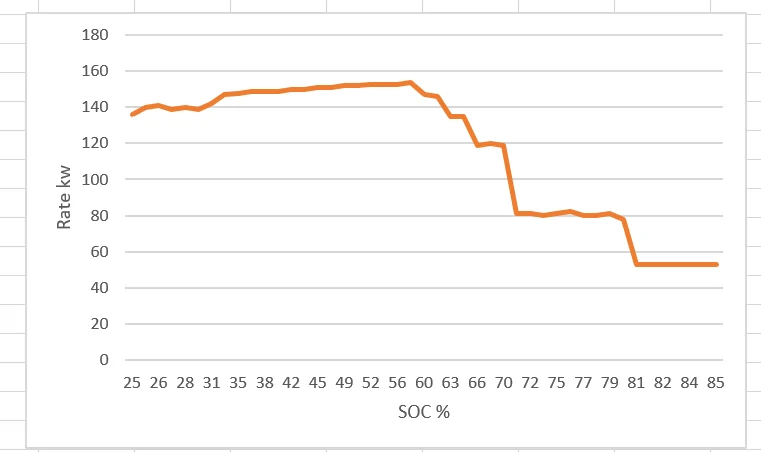
I had time to drop by a CCS charging station today so I documented the data from it (data points were captured at each minute). This was an EA 350 kw charger.

I charged from 25% SOC to 85%. This took 44 minutes to complete. Peak rate was 154 kw.

At 25% SOC, the mile remaining estimate was 68 miles and at 85 it was 233 (all purpose driving mode).

Rate across SOC:
Rivian R1T R1S My R1T Charging Session Data - From 25% SOC to 85% Charging session rate vs. SOC


Software version: 2022.7.0
Sponsored
 

SeaGeo

Well-Known Member
First Name
Brice
Joined
Jan 12, 2021
Threads
50
Messages
5,673
Reaction score
10,212
Location
Seattle
Vehicles
Xc60 T8
Occupation
Engineer
Nice! Thanks! It looks like the truck was probably maxing out the charger current up till ~60%, with the linear increase in pack voltage.

That is an absurdly aggressive drop in rate starting at ~60%. What happens after the 70% or 80%+ range is where I've been a little confused by the employee owner reports, because I've seen reports of maintaining ~180kw at 50%, and then pulling 120kw up to around 70 or 80%. Which would imply 27 minutes from say 10 to 70% or something (or their 140 miles in 20 minutes... aka ~10 to 55% in 20 minutes). But then I've also seen what seems like really long charging times to get to 85 or 100%.
 

SeaGeo

Well-Known Member
First Name
Brice
Joined
Jan 12, 2021
Threads
50
Messages
5,673
Reaction score
10,212
Location
Seattle
Vehicles
Xc60 T8
Occupation
Engineer

SANZC02

Well-Known Member
First Name
Bob
Joined
Feb 11, 2021
Threads
50
Messages
7,409
Reaction score
12,702
Location
California
Vehicles
Tesla Model S, LE - R1S
Occupation
Retired
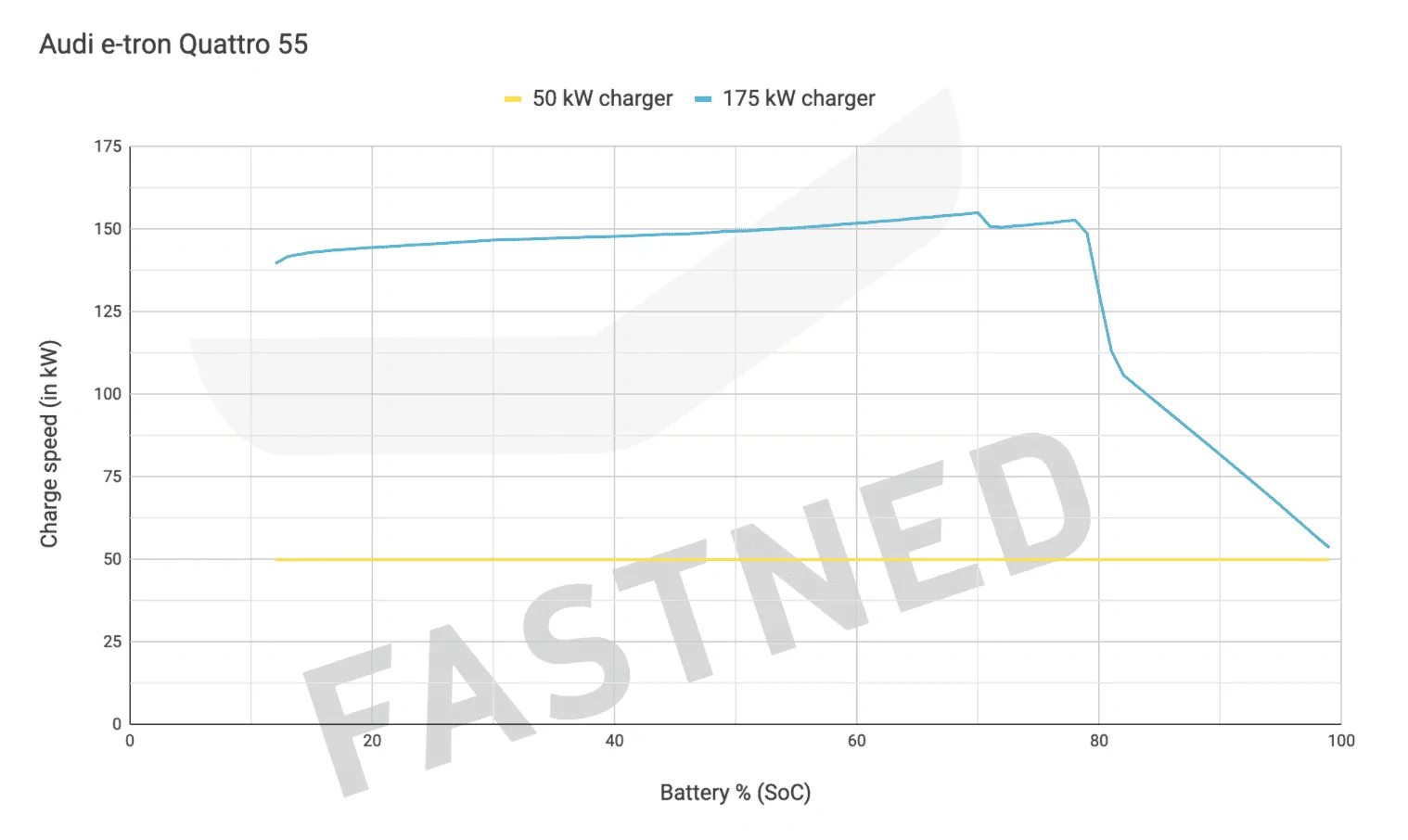
This is what I want to see. Nice stable charging around 150kW to 80%.

Audi E-tron.

Audietron55.png
I’m just curious what that does to the battery long term. Looks very aggressive, has anyone seen any long term data on the Audi battery degradation?
 

Sponsored

SeaGeo

Well-Known Member
First Name
Brice
Joined
Jan 12, 2021
Threads
50
Messages
5,673
Reaction score
10,212
Location
Seattle
Vehicles
Xc60 T8
Occupation
Engineer
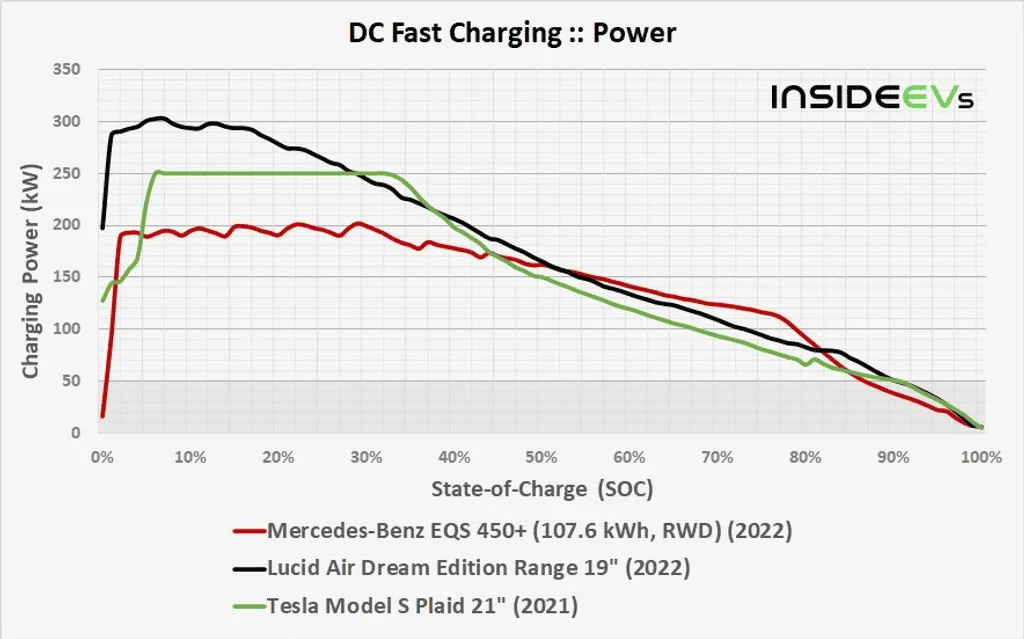
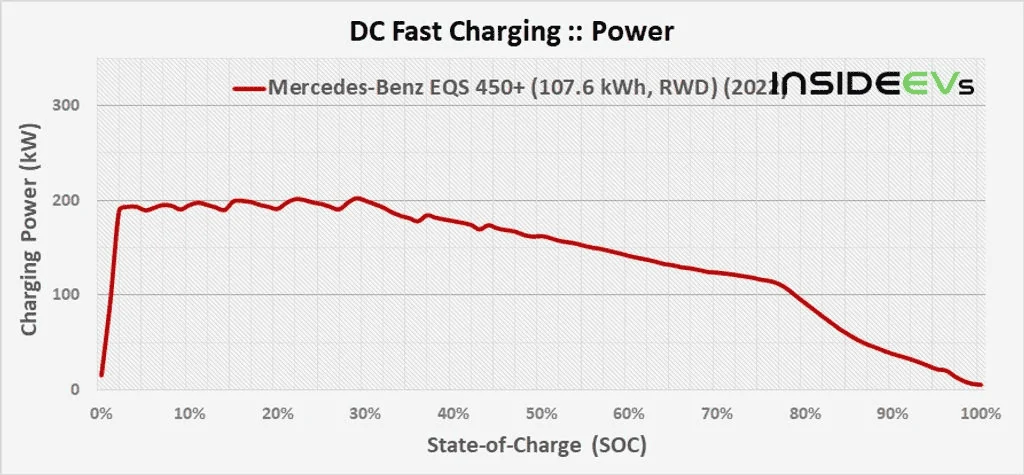
I'm not far off from you @manitou202. If the R1 is truly limited to 400v (~210kw), then the curve needs to be very flat. The e-tron is a bit of an anomaly, but assuming the R1T can keep the pack temperature handled as well as it, then maintaining more than 175kw to 80% would be a less aggressive curve than the e-tron. But even scaling up the EQS curve for pack size would be a significant improvement. That'd be pulling 150kw @ 70% and 123 kw @ 80% rather than... 80 kw.

Hopefully this gets improved very quickly given how long they've been developing the pack.
 

SeaGeo

Well-Known Member
First Name
Brice
Joined
Jan 12, 2021
Threads
50
Messages
5,673
Reaction score
10,212
Location
Seattle
Vehicles
Xc60 T8
Occupation
Engineer
I’m just curious what that does to the battery long term. Looks very aggressive, has anyone seen any long term data on the Audi battery degradation?
It's not crazy aggressive really. It just looks that way because it was conservative on the low end, and the e-tron has a 12kwh buffer to help manage the potential degradation. (83 kwh usable vs 95 nominal)

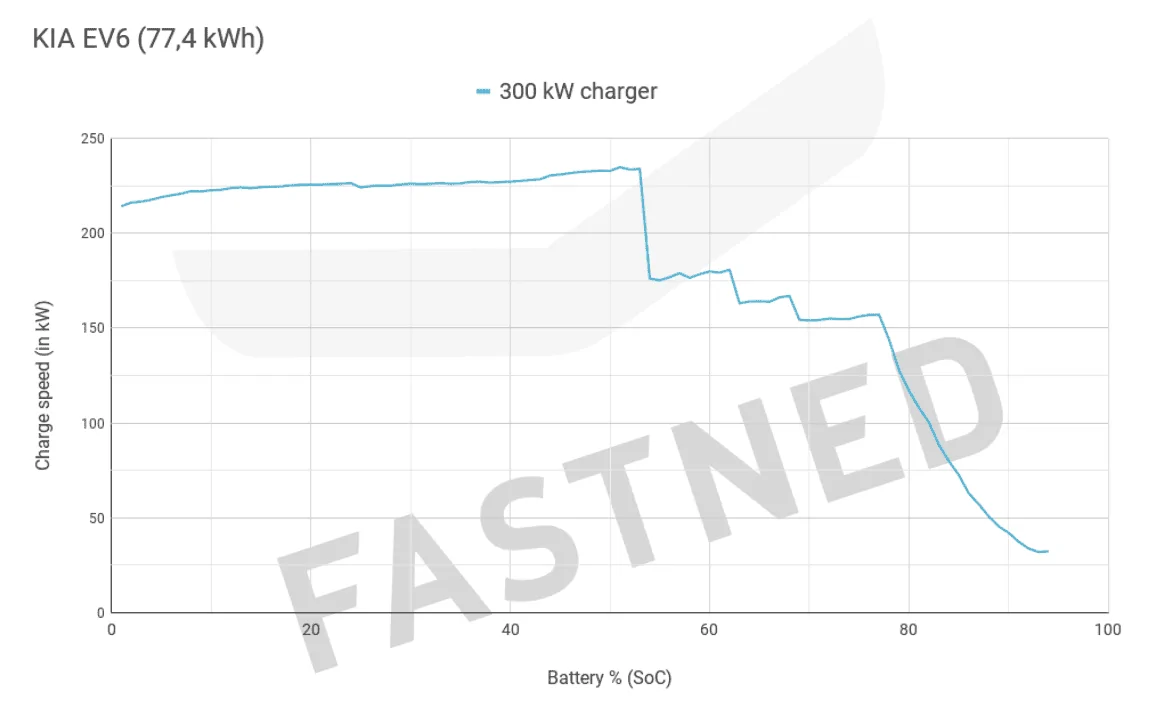
Compare that to the EV6 with a 77kwh battery, which pulls ~150kw to 80% as well. TBH, the egmp cars are a big part of the disappointment with the R1S. Their pack is only about 60% as large, but it seems like they charger faster at nearly every SOC up to 80%.
https://support.fastned.nl/hc/en-gb/articles/4408899202193-Charging-with-a-Kia-EV6
Rivian R1T R1S My R1T Charging Session Data - From 25% SOC to 85% 1647380042632
 

zefram47

Well-Known Member
First Name
Aaron
Joined
Feb 6, 2022
Threads
18
Messages
2,750
Reaction score
4,513
Location
Denver, CO
Vehicles
Rivian R1T, Alfa Romeo 4C
Occupation
Software Engineer
I’m just curious what that does to the battery long term. Looks very aggressive, has anyone seen any long term data on the Audi battery degradation?
The R1 battery is massive in comparison to most at 135 kWh. Charging at 150 kW sustained is only 1.1C and should be totally reasonable. I'm starting to get a bit concerned they have a thermal problem.
 

SeaGeo

Well-Known Member
First Name
Brice
Joined
Jan 12, 2021
Threads
50
Messages
5,673
Reaction score
10,212
Location
Seattle
Vehicles
Xc60 T8
Occupation
Engineer
The R1 battery is massive in comparison to most at 135 kWh. Charging at 150 kW sustained is only 1.1C and should be totally reasonable. I'm starting to get a bit concerned they have a thermal problem.
Man, they seemingly put so much effort into avoiding having one that I'd be super surprised if that were the case. I'm still hopeful that they are starting with a conservative curve out of the gate, but they've been working on it for so long (remember, these were supposed to be shipping last June...) that my spidey senses are definitely tingling a bit.
 

hroussel

Well-Known Member
First Name
Harold
Joined
Aug 19, 2021
Threads
26
Messages
182
Reaction score
114
Location
Montreal, Canada
Vehicles
Tesla model 3 perf, R1T DM El Cap with OC
It's not crazy aggressive really. It just looks that way because it was conservative on the low end, and the e-tron has a 12kwh buffer to help manage the potential degradation. (83 kwh usable vs 95 nominal)

Compare that to the EV6 with a 77kwh battery, which pulls ~150kw to 80% as well. TBH, the egmp cars are a big part of the disappointment with the R1S. Their pack is only about 60% as large, but it seems like they charger faster at nearly every SOC up to 80%.
https://support.fastned.nl/hc/en-gb/articles/4408899202193-Charging-with-a-Kia-EV6
A 800V architecture makes a huge difference. There is an excellent youtube video by Peter Rawlinson (of Lucid) on their battery pack with lots of technical info. Half the current means a quarter of the dissipated energy.

It's tempting to wait for the Rivians with the 800V battery and new motors. But then we lose our reservation price...
 

Sponsored

SeaGeo

Well-Known Member
First Name
Brice
Joined
Jan 12, 2021
Threads
50
Messages
5,673
Reaction score
10,212
Location
Seattle
Vehicles
Xc60 T8
Occupation
Engineer
A 800V architecture makes a huge difference. There is an excellent youtube video by Peter Rawlinson (of Lucid) on their battery pack with lots of technical info. Half the current means a quarter of the dissipated energy.

It's tempting to wait for the Rivians with the 800V battery and new motors. But then we lose our reservation price...
Yep. I totally agree. That's why I pulled in some 400v systems for reference curves (other than the EV6).
 

SANZC02

Well-Known Member
First Name
Bob
Joined
Feb 11, 2021
Threads
50
Messages
7,409
Reaction score
12,702
Location
California
Vehicles
Tesla Model S, LE - R1S
Occupation
Retired
Yep. I totally agree. That's why I pulled in some 400v systems for reference curves (other than the EV6).
I found it interesting in the drive of the New EQS SUV video the engineer said it was a conscious decision for them to go with 400 volt because most of the world is not ready for the 800 volt. That requires hardware to adjust for that which causes inefficiencies charging at 400 volts on an 800 volt system. He said they are watching the status of that and will adjust when the time is right.
 

AllInev

Well-Known Member
Joined
Nov 22, 2021
Threads
37
Messages
1,265
Reaction score
2,111
Location
Oakland, CA
Vehicles
Prius V, 2022 R1T
Clubs
 
The R1 battery is massive in comparison to most at 135 kWh. Charging at 150 kW sustained is only 1.1C and should be totally reasonable. I'm starting to get a bit concerned they have a thermal problem.
Or they're holding back an OTA that would allow sustained faster charging until they're more comfortable with the numbers they're seeing.

In other words, Rivian is just being very conservative during product launch to minimize the chance of a battery PR debacle. If so, I'm hoping they'll communicate that soon as we start to see more press get their hands on R1 vehicles for charging tests.
 

SeaGeo

Well-Known Member
First Name
Brice
Joined
Jan 12, 2021
Threads
50
Messages
5,673
Reaction score
10,212
Location
Seattle
Vehicles
Xc60 T8
Occupation
Engineer
I found it interesting in the drive of the New EQS SUV video the engineer said it was a conscious decision for them to go with 400 volt because most of the world is not ready for the 800 volt. That requires hardware to adjust for that which causes inefficiencies charging at 400 volts on an 800 volt system. He said they are watching the status of that and will adjust when the time is right.
I need to watch that, but that seems.... inconsistent with our charging infrastructure at least (at least the stuff we use the most). I could be wrong, but it seems like most of the DCFC chargers you encounter are rated for 800v systems. And the ones that aren't, there are some ways to adjust the voltage from the charger to the car. Porsche and Hyundai each have done it differently. Bjorn has a good discussion on it.


They definitely don't have as many suppliers available to them for an 800v system, which would probably make it more expensive...
 

AllInev

Well-Known Member
Joined
Nov 22, 2021
Threads
37
Messages
1,265
Reaction score
2,111
Location
Oakland, CA
Vehicles
Prius V, 2022 R1T
Clubs
 
It's tempting to wait for the Rivians with the 800V battery and new motors. But then we lose our reservation price...
If my delivery window gets pushed too far into 2023, I'm going to be VERY tempted to reconfig my preorder to the newer 800V architecture and drivetrain units --assuming Rivian confirms some of the necessary details. Also interested in some of the benefits of the LFP batteries --charging to 100%, less degradation, less environmental impact, etc. ?
Sponsored


Top