Sponsored

charging session summary (2022.23.5 FW)

OP
OP

hayduke

Well-Known Member
First Name
John
Joined
Jun 28, 2022
Threads
11
Messages
98
Reaction score
72
Location
Mammoth Lakes, CA
Vehicles
R1T
Occupation
Engineer
Clubs
 
One more screen shot on a ~6kW overnight charge. Implied 551W. Parked outside overnight, about 50-60F ambient temp.

I went out and listened to the truck (without my phone, gear guard is not on) and just listened to it. Clearly some fans and pumps are running while charging. I could not feel any airflow in our out of the grill/ air dam.

I'd be really surprised if any of the HVAC is low-voltage, and HVAC/fan really aren't
"accessories" so the session summary seems really misleading. Seems if nothing else *how* this energy use is being reported sure seems like a bug - at least in my mind the most probable culprit is battery heating/cooling. Next best guess is the A/C charger is that lossy, but it is also not low voltage and weird that its loss wouldn't be roughly proportional to charge rate.

Finally, I don't think anyone (myself is included) is seeing this sort of parasitic loss when _not_ charging. 500W would imply about ~12kWh/day... car would be dead as a door nail in about 10 days of sitting. So, you'd really have to convince me this loss is not charging-related.

So I'd be very skeptical this is gear guard or really anything I would define as a "low voltage accessory".

My best guess is either via technical limitation or motivated by safety, the coolant system is being circulated at all times during charging. I'd hope in the future with maybe more data and confidence, Rivian could program the HVAC to operate at a lower rate (lower duty cycle or speed) if the charge rate is lower. It just doesn't make sense to me that you'd have to invest 500W of cooling/heating into a pack being charged at ~1/40C assuming ambient temps are ~room temperature.

Rivian R1T R1S charging session summary (2022.23.5 FW) Screen Shot 2022-07-11 at 11.44.04 AM
Sponsored


DJG

Well-Known Member
Joined
Apr 13, 2022
Threads
12
Messages
1,006
Reaction score
1,108
Location
TX
Vehicles
Various
One more screen shot on a ~6kW overnight charge. Implied 551W. Parked outside overnight, about 50-60F ambient temp.

I went out and listened to the truck (without my phone, gear guard is not on) and just listened to it. Clearly some fans and pumps are running while charging. I could not feel any airflow in our out of the grill/ air dam.

I'd be really surprised if any of the HVAC is low-voltage, and HVAC/fan really aren't
"accessories" so the session summary seems really misleading. Seems if nothing else *how* this energy use is being reported sure seems like a bug - at least in my mind the most probable culprit is battery heating/cooling. Next best guess is the A/C charger is that lossy, but it is also not low voltage and weird that its loss wouldn't be roughly proportional to charge rate.

Finally, I don't think anyone (myself is included) is seeing this sort of parasitic loss when _not_ charging. 500W would imply about ~12kWh/day... car would be dead as a door nail in about 10 days of sitting. So, you'd really have to convince me this loss is not charging-related.

So I'd be very skeptical this is gear guard or really anything I would define as a "low voltage accessory".

My best guess is either via technical limitation or motivated by safety, the coolant system is being circulated at all times during charging. I'd hope in the future with maybe more data and confidence, Rivian could program the HVAC to operate at a lower rate (lower duty cycle or speed) if the charge rate is lower. It just doesn't make sense to me that you'd have to invest 500W of cooling/heating into a pack being charged at ~1/40C assuming ambient temps are ~room temperature.
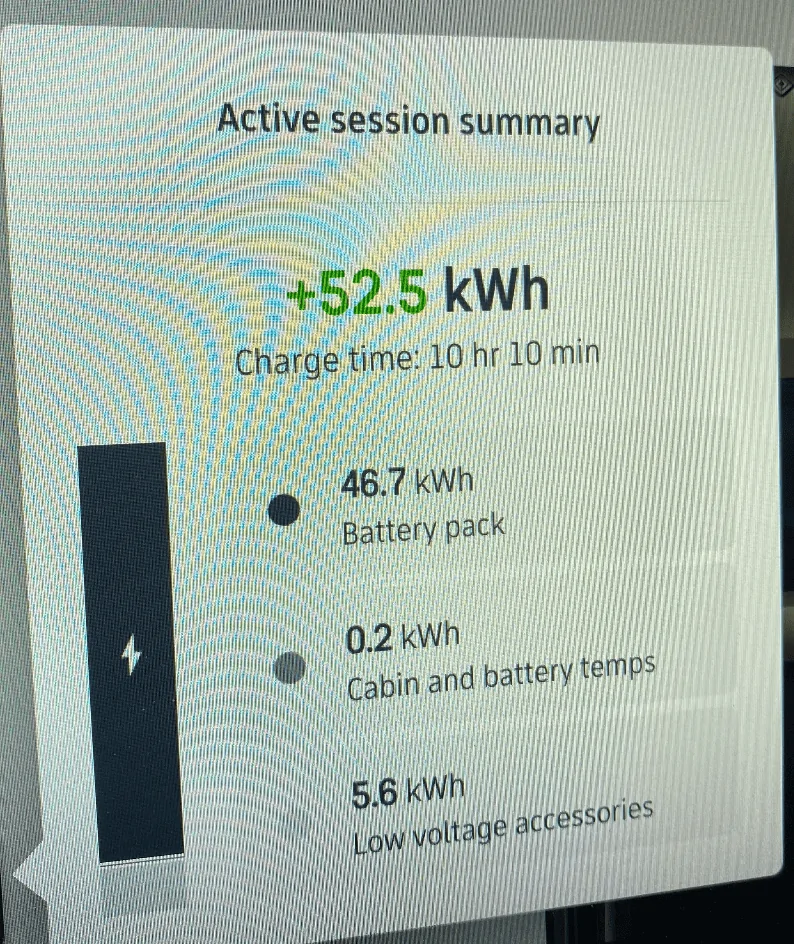
Screen Shot 2022-07-11 at 11.44.04 AM.png
So it would be useful to compare the total reported here to the total reported by your EVSE. I THINK this total is already net of charging losses. The amount into the battery definitely is, so the question is whether charging losses are taken out before the 52.5kwh, or if they are considered part of the 5.6kwh low voltage accessories. It would typically be around 10%, so if it's not already taken out it could be the majority of that line item.
 

astonius

Well-Known Member
Joined
Oct 5, 2021
Threads
53
Messages
1,434
Reaction score
3,070
Location
US
Vehicles
Cars
Just to chime in, my Wallbox is showing a fair amount more kWh usage than I would expect given my driving habits. If I can remember I'll try to keep tabs on the charging session details for a few days to see what's going on, but I suspect my low-voltage usage is high as well despite having Gear Guard off at home and proximity unlock completely turned off.
 

Dark-Fx

Well-Known Member
First Name
Brian
Joined
Jul 15, 2020
Threads
148
Messages
13,589
Reaction score
27,446
Location
Michigan
Vehicles
R1T, R1S, Livewire One, Sierra EV, R1S
Occupation
Engineering
Clubs
 
Finally, I don't think anyone (myself is included) is seeing this sort of parasitic loss when _not_ charging. 500W would imply about ~12kWh/day... car would be dead as a door nail in about 10 days of sitting. So, you'd really have to convince me this loss is not charging-related.
I was a couple patches ago. Lots of the same noises you'd hear while charging but unplugged.
 

ajdelange

Well-Known Member
First Name
A. J.
Joined
Aug 1, 2019
Threads
9
Messages
2,883
Reaction score
2,319
Location
Virginia/Quebec
Vehicles
Tesla XLR+2019, Lexus, Landcruiser, R1T
Occupation
EE Retired
My solar puts out about 3.5kW peak (thus the desire to charge at ~3kW) and it seems because of the inefficient charger that the savings from self-consuming solar are going to be offset by having to run the charger many more hours.
The only advantage I see to charging during times of high solar output is that the energy doesn't have to go through the battery thus saving round trip current or cycling or however yoy kije to think of it. I simply set the current to a relatively low level and kick off charging at 10:30 local as by that time the sun, if it is coming out that day, is out.
 

Sponsored

OP
OP

hayduke

Well-Known Member
First Name
John
Joined
Jun 28, 2022
Threads
11
Messages
98
Reaction score
72
Location
Mammoth Lakes, CA
Vehicles
R1T
Occupation
Engineer
Clubs
 
The only advantage I see to charging during times of high solar output is that the energy doesn't have to go through the battery thus saving round trip current or cycling
Are you talking about a home stationary battery? I don't have that, just net metering. Where I live, I pay a small amount in taxes for kWh pulled from the grid (and don't get credited for kWh supplied to the grid) so there is a small financial incentive to charge directly off the solar on my roof. (I'm a dork and spreadsheeted out the tradeoffs between charging at different speeds with different levels of solar and in every single case, the Rivian charger is so darn costly/inefficient that it always makes sense to charge at the maximum rate my charger will allow).

The second reason/incentive is purely environmental. I think a lot of thinking in the industry is that maximizing self-consumption of solar is key to way to reduce strain on the electrical grid, avoid otherwise necessary infrastructure investment, including need for storage (battery or otherwise) somewhere else on the grid. Electrons delivered in the middle of the night are certainly not coming directly from solar and I would guess less likely to be coming from renewables overall.

Seems a shame I more than produce enough solar to power my car, but due to lack of software control (from Rivian, maybe I could buy a charger and write a script) as well as a really inefficient charging mechanism at low speed I'm unable to charge my car efficiently from the sun.
 

RWerksman

Well-Known Member
Site Sponsor
First Name
Rob @ OSEV
Joined
Nov 13, 2020
Threads
81
Messages
1,773
Reaction score
3,737
Location
Pittsburgh
Website
opensourceev.com
Vehicles
Jeep & R1T & Silverado EV
Clubs
 
This large low voltage drain basically explains why L1 charging on these trucks is basically worthless. Almost all of it is eaten by whatever is running when charging.
 

ajdelange

Well-Known Member
First Name
A. J.
Joined
Aug 1, 2019
Threads
9
Messages
2,883
Reaction score
2,319
Location
Virginia/Quebec
Vehicles
Tesla XLR+2019, Lexus, Landcruiser, R1T
Occupation
EE Retired
My solar puts out about 3.5kW peak (thus the desire to charge at ~3kW)
Are you talking about a home stationary battery? I
Yes.

I don't have that, just net metering. Where I live, I pay a small amount in taxes for kWh pulled from the grid (and don't get credited for kWh supplied to the grid) so there is a small financial incentive to charge directly off the solar on my roof.
I clearly don't have all the details but I interpret your statement to mean that the utility accepts your solar but does not compensate you in any way for it so that if your house is, for example, drawing 1 kW and the sun comes out such that your PV produces the full 3.5 kW 1 KW goes to the house and 2.5 to the utility so that you get billed nothing but if this persists for an hour you do NOT get a credit for the 2.5 kWh you sent them. If the house load goes up to 5 kW (because you are charging the car, for example, while the sun is shining you take 3.5 kW from the PV and 1.5 from the utility and pay the utility from the 1.5. If I've got that right then the bill minimizing strategy is to make sure that you harvest every watt hour the PV produces by being sure they go to your loads and not the utility, You can't control the sun so that means you must control your loads to the point that the net power flowing into your house is 0. About the only load that one can control easily is his car's charger and "easily" means manually. You can sit in your R1T and ask for more or less current in 2 ampere increments or, in a Tesla, 1 amp increments and with Tesla you can do it remotely from the app while you monitor a whole house consumption meter. I call this "following the sun" but my motivation is not cost reduction but minimization of round trip current to/from the house batteries,


(I'm a dork and spreadsheeted out the tradeoffs between charging at different speeds with different levels of solar and in every single case, the Rivian charger is so darn costly/inefficient that it always makes sense to charge at the maximum rate my charger will allow).
That could be as much as 11 kW meaning you'd be taking 7.5 from the utility and you want to take it from the sun, not the utility. The goal is to match the loading to the solar so that net is 0. But your loads are what they are. Do you need to run your house (typically 30 kWh/da) and cover phantom 9typically 2 -3 kWh/da) or run your house and replace 100 miles (50 kWh). It makes a big difference in how you manage your charge.

The second reason/incentive is purely environmental. I think a lot of thinking in the industry is that maximizing self-consumption of solar is key to way to reduce strain on the electrical grid, avoid otherwise necessary infrastructure investment, including need for storage (battery or otherwise) somewhere else on the grid. Electrons delivered in the middle of the night are certainly not coming directly from solar and I would guess less likely to be coming from renewables overall.
This is a minor point but I mention it from time to time. No electrons are delivered from the grid. Energy is. More to your question: certainly if the power flows directly from your PV array to your truck efficiency is greater than if it flows out to the mains and into your neighbors' houses and you truck is then charged hours later from power generated miles away but in general if you connect 3500W to the grid the grid produces 3500 (approximately) fewer watts and burns 3500 watts worth less fuel when that array is generating. My system uses Enphase inverters monitored by Enphase and Enphase files for RECs based on my production - not how much I am using directly or sending to the utility. Someone buys those RECs (thank you) so however my solar is managed I am doing something for the environment. Comfort yourself with that.

However if you want to be able to say "My BEV is powered completely by the sun" then you have to, in a net metered system, follow the sun by adjusting the charging load such that your net demand of the utility is 0 or negative at all times. This insures that none of the power charging the vehicle is coming from anywhere but your PV array.

Seems a shame I more than produce enough solar to power my car, but due to lack of software control (from Rivian, maybe I could buy a charger and write a script) as well as a really inefficient charging mechanism at low speed I'm unable to charge my car efficiently from the sun.
Your 3.5 kW array may give you 7*3.5 = 24.5 kWh/da. That's not a whole lot for a BEV that takes around 400 Wh/mi. After deducting 3 kWh phantom drain that leaves 21.5 kWh good for about 54 miles added range. That's certainly enough for my daily use but is it good enough for yours? Don't forget the rest of your house loads. Also don't forget that you may get 7 hours FSE (full sun equivalent) at this time of year but how many will you get in December and January?
 
OP
OP

hayduke

Well-Known Member
First Name
John
Joined
Jun 28, 2022
Threads
11
Messages
98
Reaction score
72
Location
Mammoth Lakes, CA
Vehicles
R1T
Occupation
Engineer
Clubs
 
Thanks for all the detail @ajdelange . I *do* get credited (NEM (Net Energy Metering)) but it's just a bit of a misnomer as it's not 1:1. In the "winter" (8 months of the year by SCE's calendar) the problem is a bit worse the price in the nighttime is more than the daytime (8am-4pm) when I'm producing excess solar. tl;dr it's financially advantageous to self-consume solar, but I do get some credit so it's not as bad as maybe you thought. My rate details are here - it's complicated, you have to deduct $0.09 from all the prices so the resultant % differences are bigger than they would appear). I think I've calculated that I can only buy back about 2/3rds of a kWh at night with my daytime credit of 1 kWh (winter rates).

https://www.sce.com/residential/rates/Time-Of-Use-Residential-Rate-Plans

The Rivian is a bit more power-hungry than I would have guessed before purchase, but even still my solar is roughly covering my power needs. My day to day driving is somewhat minimal, long trips I tend to use other chargers, and I don't have AC. A lot of days my whole home only consumes 5-10kWh of energy so I typically have a 15-20kWh surplus. I don't have enough data to know how I'll do across a whole year but I suspect you're right that I will have a deficit of energy and a (small) bill from the utility. Charging directly from solar would in theory (with an efficient charger) minimize this bill.

Also, related:

https://www.thedrive.com/tech/mpge-...is-calculated-and-why-it-doesnt-always-add-up

There is some interesting info on the window sticker.

My window sticker claims the electricity consumption is 48kWh / 100 miles (small number next to city / highway combined MPGe). It also claims the charge time is 13 hours (240V, no specified amperage, but based on simple math sounds like 11.5kW/48A). The charge must slow down near 100% so it gets really complicated to know what the efficiency is of the charger (you can do some other interpolated math if you believe you know the kWh capacity of the battery the 314 mile range is based on.

My math comes up with it "costing" about ~150kWh to fill the battery completely which implies 20kWh are lost in charging. That seems really high. Our ~500W charging loss for a 13 hour charge should only be 6.5kWh.


And thanks, I use "electrons" as a phrase of speech.. I'm aware that I'm not consuming any. :)
 

CommodoreAmiga

Well-Known Member
Joined
Dec 30, 2020
Threads
39
Messages
4,104
Reaction score
7,729
Location
INACTIVE
Vehicles
INACTIVE
Yes, I'd really love to see that down to 200-300 like Leaf, etc. It makes a huge difference with 120v charging. Not the 500-600s seen here.
Doesn't the Leaf only have passive/air cooling for the battery pack? Rivian uses coolant with pumps + fans.
 

Sponsored

pc500

Well-Known Member
Joined
Jun 22, 2021
Threads
20
Messages
1,045
Reaction score
563
Location
US
Vehicles
dodge ram
Doesn't the Leaf only have passive/air cooling for the battery pack? Rivian uses coolant with pumps + fans.
This is true, but charging at 1-3kw on a 135kw pack -- none of this should be necessary. Turn the pumps off.
 

pc500

Well-Known Member
Joined
Jun 22, 2021
Threads
20
Messages
1,045
Reaction score
563
Location
US
Vehicles
dodge ram
Thanks for all the detail @ajdelange . I *do* get credited (NEM (Net Energy Metering)) but it's just a bit of a misnomer as it's not 1:1. In the "winter" (8 months of the year by SCE's calendar) the problem is a bit worse the price in the nighttime is more than the daytime (8am-4pm) when I'm producing excess solar. tl;dr it's financially advantageous to self-consume solar, but I do get some credit so it's not as bad as maybe you thought. My rate details are here - it's complicated, you have to deduct $0.09 from all the prices so the resultant % differences are bigger than they would appear). I think I've calculated that I can only buy back about 2/3rds of a kWh at night with my daytime credit of 1 kWh (winter rates).

https://www.sce.com/residential/rates/Time-Of-Use-Residential-Rate-Plans

The Rivian is a bit more power-hungry than I would have guessed before purchase, but even still my solar is roughly covering my power needs. My day to day driving is somewhat minimal, long trips I tend to use other chargers, and I don't have AC. A lot of days my whole home only consumes 5-10kWh of energy so I typically have a 15-20kWh surplus. I don't have enough data to know how I'll do across a whole year but I suspect you're right that I will have a deficit of energy and a (small) bill from the utility. Charging directly from solar would in theory (with an efficient charger) minimize this bill.

Also, related:

https://www.thedrive.com/tech/mpge-...is-calculated-and-why-it-doesnt-always-add-up

There is some interesting info on the window sticker.

My window sticker claims the electricity consumption is 48kWh / 100 miles (small number next to city / highway combined MPGe). It also claims the charge time is 13 hours (240V, no specified amperage, but based on simple math sounds like 11.5kW/48A). The charge must slow down near 100% so it gets really complicated to know what the efficiency is of the charger (you can do some other interpolated math if you believe you know the kWh capacity of the battery the 314 mile range is based on.

My math comes up with it "costing" about ~150kWh to fill the battery completely which implies 20kWh are lost in charging. That seems really high. Our ~500W charging loss for a 13 hour charge should only be 6.5kWh.


And thanks, I use "electrons" as a phrase of speech.. I'm aware that I'm not consuming any. :)
I do favor the EPA including charging efficiency at the home charger rate in EPA MPGe ratings to fix some of these issues.
 
OP
OP

hayduke

Well-Known Member
First Name
John
Joined
Jun 28, 2022
Threads
11
Messages
98
Reaction score
72
Location
Mammoth Lakes, CA
Vehicles
R1T
Occupation
Engineer
Clubs
 
I do favor the EPA including charging efficiency at the home charger rate in EPA MPGe ratings to fix some of these issues.
Sure, but this assumes people have a 60A circuit and a 48A charger. Or are you saying they should indicate different MPGe for different home charing setups?

I would guess that only a fraction of Rivian owners (just anecdotally on this forum) are able to charge at this rate. And I would guess many more incorrectly assume that slower charging will be more efficient (and maybe better for the life of the battery). The MPGe of the Rivian would be significantly worse if the EPA rated it based on a slower/smaller home charger.

I did not realize this issue was almost as bad for the Tesla crowd.

https://teslamotorsclub.com/tmc/threads/model-3-home-charging-efficiency.202780/

Honestly this slow-charging-is-actually ridiculously-inefficient thing has been the most surprising thing that I have learned since owning my first EV.
 

ajdelange

Well-Known Member
First Name
A. J.
Joined
Aug 1, 2019
Threads
9
Messages
2,883
Reaction score
2,319
Location
Virginia/Quebec
Vehicles
Tesla XLR+2019, Lexus, Landcruiser, R1T
Occupation
EE Retired
I *do* get credited (NEM (Net Energy Metering)) but it's just a bit of a misnomer as it's not 1:1. In the "winter" (8 months of the year by SCE's calendar) the problem is a bit worse the price in the nighttime is more than the daytime (8am-4pm) when I'm producing excess solar. tl;dr it's financially advantageous to self-consume solar, but I do get some credit so it's not as bad as maybe you thought.
The answer depends on the exact details of your tariff, how much sun you get and how much you drive. My tariff is very simple. For each kWh I send them I get a credit for 1 kWh. I may not use kWh I bank in August until November. Given this no strategy is necessary on my part. I just pray to Ra. Over the past year the arrays produced 81% of the electricity I used and while the utility adds fees for readiness and transmission and who knows what else and adjusts my bill every month what they ask for generally gets more than covered by REC sales and green credits to my real estate tax bill so my solar system actually makes me a little (very little) money. The other thing to take note of is that the cars use very little of my total electrical consumption (4%) because I heat and cool with heat pumps and don't drive that much (retired). Your numbers may be quite different as your situation evidently is.

A lot of days my whole home only consumes 5-10kWh of energy so I typically have a 15-20kWh surplus.
For comparison my average daily consumption over the last 365 days was 96.7 kWh most of which went to heat pumps (it's moderately cold here in winter and nasty hot/humid in summer). Never the less I too have surplus in the spring, summer and fall which get banked for the winter.
 
Last edited:

ajdelange

Well-Known Member
First Name
A. J.
Joined
Aug 1, 2019
Threads
9
Messages
2,883
Reaction score
2,319
Location
Virginia/Quebec
Vehicles
Tesla XLR+2019, Lexus, Landcruiser, R1T
Occupation
EE Retired
Continued...

My window sticker claims the electricity consumption is 48kWh / 100 miles (small number next to city / highway combined MPGe).
That's the consumptiom (480 Wh/mi) "at the wall" meant to help you figure out how much it is going to cost you to drive a certain number of miles. The charger is about 90% efficient at healthy charge rates and diminished to perhaps 75 - 80% if charging from 120V. Thus of 480 Wh you take in perhaps 50 are lost to heat and 430 go to the battery. This assumes that there are no phantom loads on during charging and I think it is those you are focused on. If you charge in the sun with the A/C going full bore then obviously all the 430 Wh aren't going to the battery - some are going to the A/C (and whatever else is on). The Rivians seem to have pretty substantial phantom drain unless they are asleep.


It also claims the charge time is 13 hours (240V, no specified amperage, but based on simple math sounds like 11.5kW/48A). The charge must slow down near 100% so it gets really complicated to know what the efficiency is of the charger (you can do some other interpolated math if you believe you know the kWh capacity of the battery the 314 mile range is based on.
Charging at 11.5 kW implies a rate of about 11.5/135 = 0.09C (11.8 hrs for a full charge). I don't think they slow at that level.


My math comes up with it "costing" about ~150kWh to fill the battery completely which implies 20kWh are lost in charging. That seems really high. Our ~500W charging loss for a 13 hour charge should only be 6.5kWh.
That's about 85% efficient which is a little low but not surprisingly given that the rectifier itself is about 90% efficient.
Sponsored

 
Last edited:


Top