Sponsored

Home charging units

Mike B

New Member
Joined
Jun 29, 2025
Threads
1
Messages
2
Reaction score
1
Location
Morgan Hill
Vehicles
Rivian R1T
Hey all, new to this forum but just became a new used 2023 Rivian R1T Adventure, Quad, Limestone, owner and wanted to know what would be a recommnded home charging station. I already have a 240v 50amp breaker with the 4 prong wall plug. I'm currently using the portable cable that Rivian supplied but since PG&E is offering to reimburse full cost to install new one I wanted to see what everone would recommend? Any thoughts would be appreciated.
Thanks.
Sponsored


ElGuano

Well-Known Member
Joined
Oct 9, 2024
Threads
48
Messages
862
Reaction score
1,220
Location
Cali
Vehicles
R1T Trimax - Storm Blue, Driftwood, Sport Dark
Most chargers (EVSEs) are pretty basic electronics, their function is to be a glorified extension cord that reaches your car. So for the basic models, there isn't usually too much difference, and you could just buy one, plug it in, and be done with it. But it may be worth your time to consider some of the basic safety questions around EVSE installation:

1. Confirm you have a NEMA 14-50 receptacle (presumably you do if you're plugging your mobile charger into it).

2. Note that code now requires that receptacle to be GFCI-protected (typically with a special breaker).

3. What brand is the receptacle? There are an alarming number of reports of meltdowns on ones that were not intended to be used for continuous loads like EV charging.

4. What's the electrical service to your house? 100A? 150-200A? You could plug in an ESVE and just charge, but if your house has a small service like 100A and you have a lot of electrical loads (AC, electric dryer or heater, water heaters, spa, electric cooktop or oven, etc.), you may not actually have enough spare capacity to run a 40A EVSE and pass code. Of course, maybe your electrician already did the load calc and permitting when installing that 50A breaker, try to find the documentation and permit for it.

Again, the easiest thing for you is to choose an EVSE - check out the State of Charge Youtube channel, that guy has reviewed just about every one of them out there. I'd recommend just confirming that the plug and circuit you have is in fact on the up and up.

I have a 100A service and there's no way I'd get an EVSE approved. I ordered and just received an Emporia Pro, which has dynamic power management; it's pretty much the only way I'll be able to install anything in my house without a $15-20k service upgrade.
 

Gurule92

Well-Known Member
Joined
Jun 4, 2024
Threads
43
Messages
422
Reaction score
482
Location
Colorado
Vehicles
19 Tesla Model X Raven & 22 R1T, Adventure, QM, Glacier White.
Occupation
Cyber Stuff
I have the Tesla wall connector with an adapter. Wish I had the universal Tesla connector though. Covers all the bases and then when we go nacs you'll be ready
 

mab

Member
First Name
Mike
Joined
Jul 16, 2025
Threads
2
Messages
14
Reaction score
12
Location
Bay Area: South Bay
Vehicles
2023 Rivian R1T, Quad, Limestone, 2022 Kia Telluride Nightfall Editn., Graywolf.
Most chargers (EVSEs) are pretty basic electronics, their function is to be a glorified extension cord that reaches your car. So for the basic models, there isn't usually too much difference, and you could just buy one, plug it in, and be done with it. But it may be worth your time to consider some of the basic safety questions around EVSE installation:

1. Confirm you have a NEMA 14-50 receptacle (presumably you do if you're plugging your mobile charger into it).

2. Note that code now requires that receptacle to be GFCI-protected (typically with a special breaker).

3. What brand is the receptacle? There are an alarming number of reports of meltdowns on ones that were not intended to be used for continuous loads like EV charging.

4. What's the electrical service to your house? 100A? 150-200A? You could plug in an ESVE and just charge, but if your house has a small service like 100A and you have a lot of electrical loads (AC, electric dryer or heater, water heaters, spa, electric cooktop or oven, etc.), you may not actually have enough spare capacity to run a 40A EVSE and pass code. Of course, maybe your electrician already did the load calc and permitting when installing that 50A breaker, try to find the documentation and permit for it.

Again, the easiest thing for you is to choose an EVSE - check out the State of Charge Youtube channel, that guy has reviewed just about every one of them out there. I'd recommend just confirming that the plug and circuit you have is in fact on the up and up.

I have a 100A service and there's no way I'd get an EVSE approved. I ordered and just received an Emporia Pro, which has dynamic power management; it's pretty much the only way I'll be able to install anything in my house without a $15-20k service upgrade.
Confirmed I do have the 14-50 NEMA receptacle and the electrical service to the house is 125 amp.
Had the electrician add the 14-50 receptacle when I had my solar put in and specifically told them it would be used for an EV (Tesla). They checked the load calc and said it was fine but no more room for anything else. It was inspected and passed. It was charging my Tesla fine at 32amp and getting 26 miles per hr.
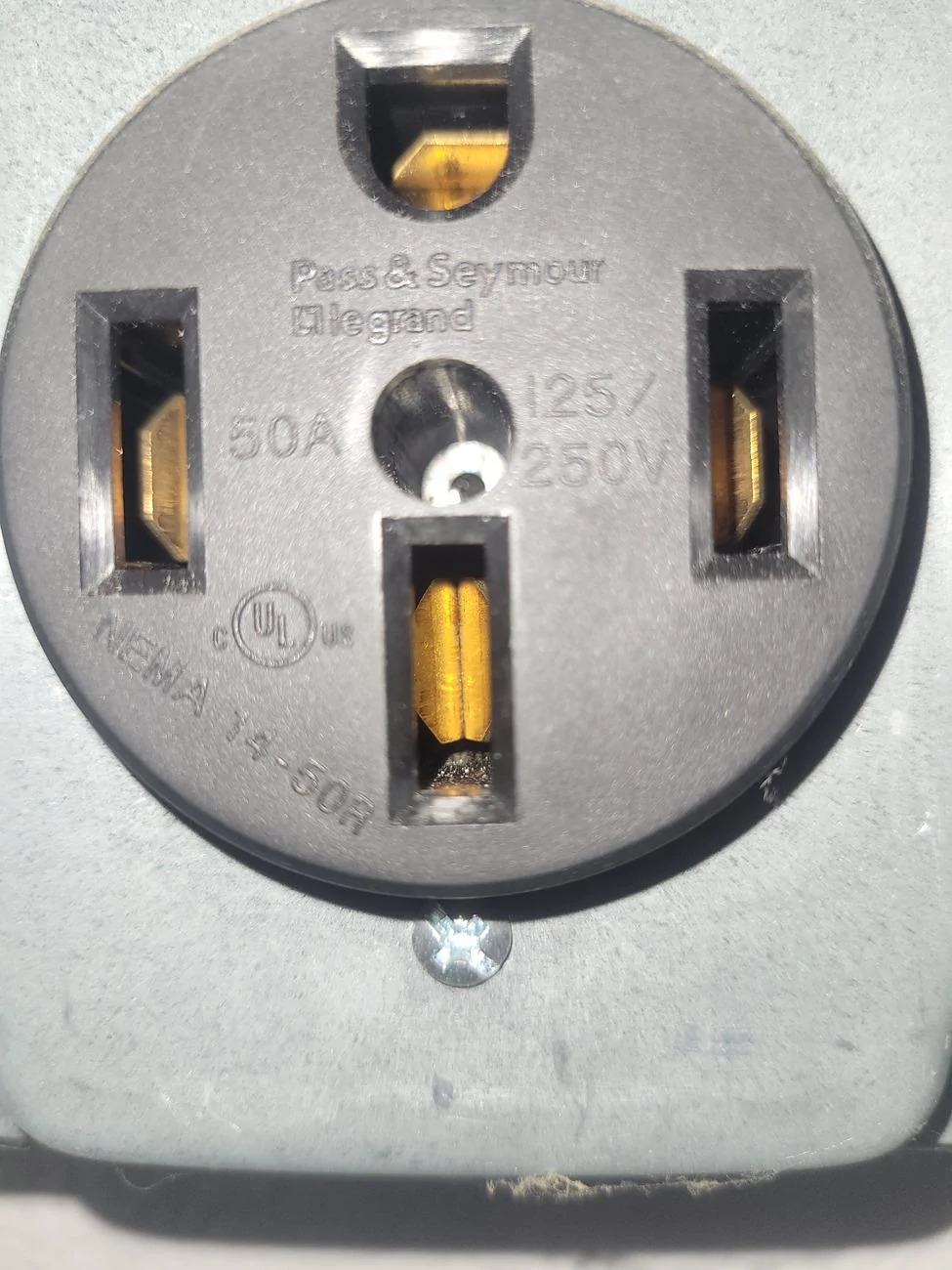
Adding that 50-amp breaker was the last I could add, without upgrading the panel for quite a cost, so no room for anything else but it's working fine now. Attached picture of my outlet. No spa's and only a dryer and oven, that are electrical, as my water heater, furnace and stove run on gas.

Rivian R1T R1S Home charging units 20250717_203145
 

ElGuano

Well-Known Member
Joined
Oct 9, 2024
Threads
48
Messages
862
Reaction score
1,220
Location
Cali
Vehicles
R1T Trimax - Storm Blue, Driftwood, Sport Dark
NEMA 14-50: Check
125 amp service, load calc performed: Check
Electrician-installed, passed city inspection: Check

I think you're good to go. Some might say the Legrand is a bit of a weak point and could be replaced by a Hubbel 14-50, just throwing it out there.

I think PG&E has a very small number of qualifying EVSEs that they're reimbursing for. Ford, Wallbox, EvoCharge, FLO, REV, is that right? Remember that with a 14-50, you're capped to 40A so you don't need to go hog wild on some 80A monster. I'd say just go to State of Charge and watch the reviews on each, and see if you like one over the others.
 

Sponsored

Rivian Owner

Well-Known Member
First Name
Mark
Joined
Sep 15, 2024
Threads
1
Messages
229
Reaction score
293
Location
Pacific North West
Vehicles
1971 GTO, 2019 F150,
Clubs
 
Since your panel is maxed out you might want to look at the Emporia device. It can monitor the load in your panel and reduce the charge current going to your EV when you have other loads maxing out your panel. Their charger can be hard wired or plug-in so you have options. I like their ap. I have 16 circuit monitors in my panel so I can monitor the house as well as my solar panel array's output. I've been very happy with their products!
 
Last edited:

MidnightRivian

Well-Known Member
Joined
Jun 21, 2021
Threads
98
Messages
2,296
Reaction score
3,671
Location
USA
Vehicles
Rivian R1S
Clubs
 
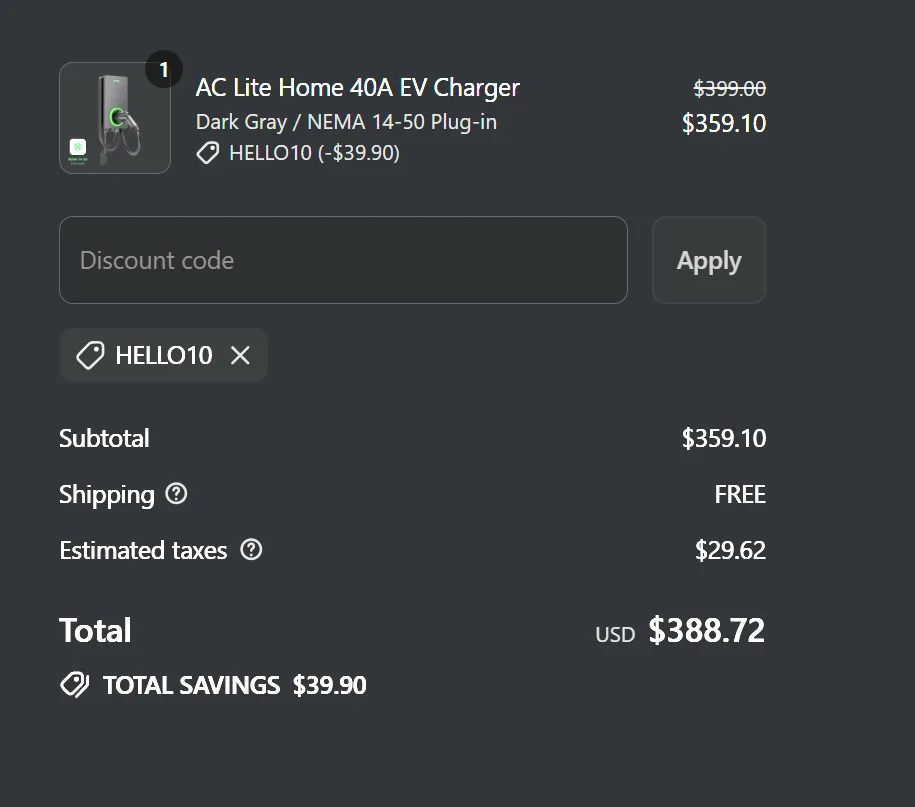
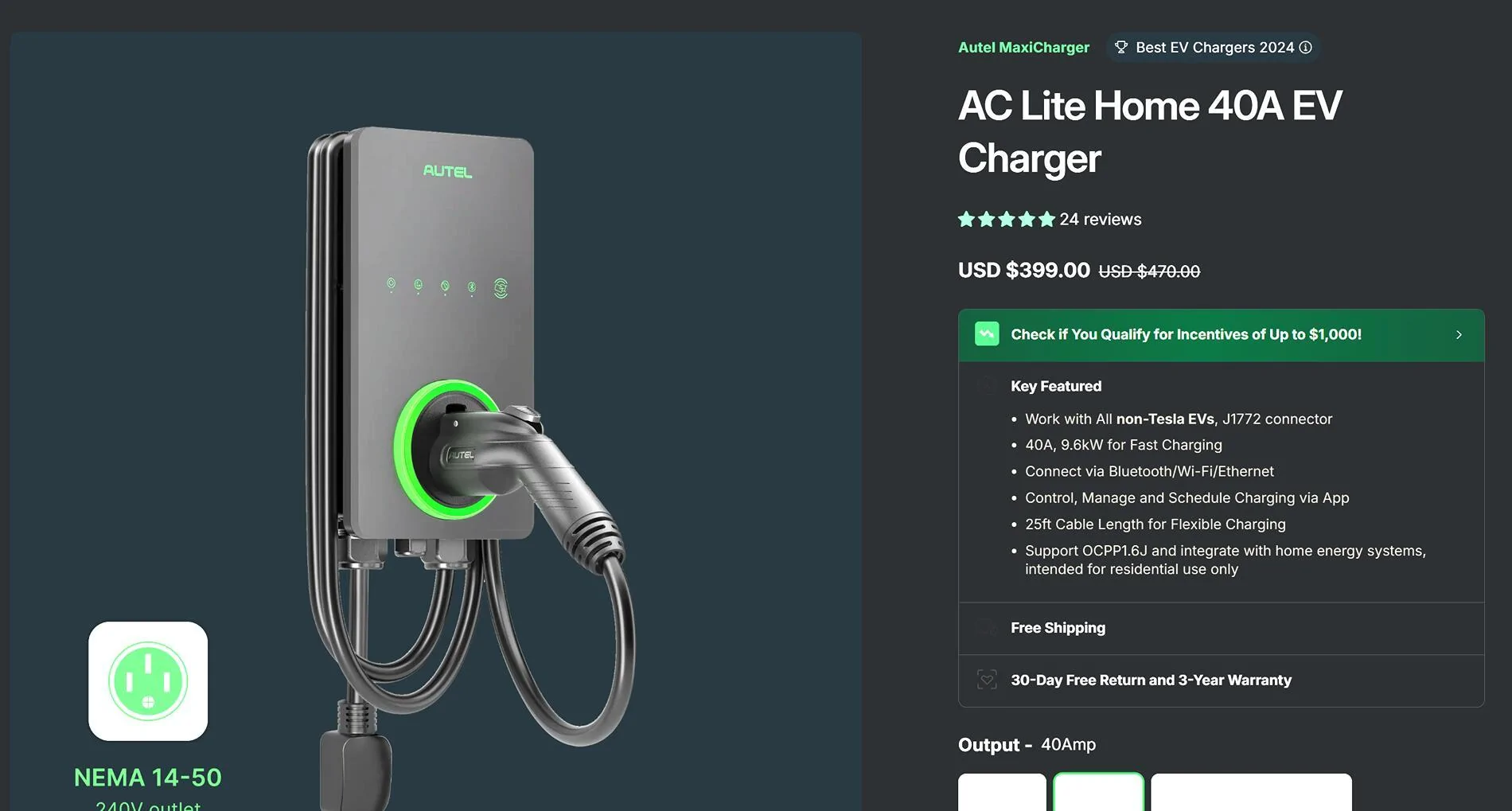
You can save some good money by purchasing the Autel AC Lite Home 40A Nema 14-50 plug-in EV Charger in dark gray instead of silver or black.

You can also stack the 10% off "HELLO10 " code on top.

Click the below link, navigate to shop ev chargers > AC Lite > AC Lite Home 40A EV Charger. Add to cart the Dark Gray option / charger and stack the "HELLO10" code.

This way you can charge using your native J-1772 port and don't have to worry about adapters.

Autel EV Home Smart Charger- Save 10% (HELLO10)

Rivian R1T R1S Home charging units 1752840690639-in


Rivian R1T R1S Home charging units 1752840720637-h3
 

shamoo

Well-Known Member
Joined
Jan 3, 2022
Threads
6
Messages
682
Reaction score
953
Location
SoCal
Vehicles
Rivian R1S, Porsche 911 GT3
Occupation
Cybersecurity
When this topic comes up, I always toss in my 2 cents. Perhaps an unpopular opinion.

Why spend the money on an expensive fancy charging "box" when the included/free mobile connector is available? If you have a 240/14-50 receptable, you can get ~15 miles per hour charging rate at home.

I can't see how that's not sufficient for nearly everyone.
- The average driver in the US drives 30-40 miles a day. That's 2-3 hours of charging and you can do it overnight.
- Even if you do a road trip, you can park your car at home and charge for 8 hours (or more) and get another 120 miles which is likely plenty for whatever you have planned the next day. Every hour of charging after that is another 15 miles more.

There are three scenarios which may make sense for something fancier:
1. You want it because its cool. That's a 100% good reason.
2. You need to charge faster because you do long trips often, and sometimes need to charge in the middle of the day quickly. Not a great reason since you only get a little more miles per hour charge.
3. Your home's power usage times work in a way where you need to charge during specific times and you need to be done by that time. Again, not a great reason because most low cost times span from 9pm to 4pm the next day. If you don't have time of day charging schedules, charging fast vs. slow makes no difference. The total power delivered is the same.

Again, just my two cents. Been using included mobile chargers since I got into EVs in 2020.
 

ElGuano

Well-Known Member
Joined
Oct 9, 2024
Threads
48
Messages
862
Reaction score
1,220
Location
Cali
Vehicles
R1T Trimax - Storm Blue, Driftwood, Sport Dark
Again, just my two cents. Been using included mobile chargers since I got into EVs in 2020.
We've been on L1 EV charging for nearly 10 years. 90% of the time, 120v is enough for day to day charging. The Rivian is straining that for us since it's only 2mi/hour :)

One other reason I would recommend a dedicated EVSE over the mobile charger is if you ever need your mobile charger somewhere else. No 14-50 receptacle is really made for frequent connect/disconnects, and that's probably one of the most dangerous activities in terms of increasing fire risk. So if you are unplugging that mobile charger more than a couple of times a year, get a dedicated EVSE you can leave in place and plugged in. I'm sure it's fine if that is another mobile charger, though I suspect the cost difference isn't all that much. The difference between 32A and 40A isn't going to be make or break for most cases.
 
  • Like
Reactions: VSG

jeeden

Well-Known Member
First Name
Jeremy
Joined
Oct 27, 2020
Threads
57
Messages
1,083
Reaction score
1,632
Location
Northern VA
Vehicles
Rivian R1S, 2016 Ford Escape, 2015 Ford Mustang GT
Occupation
Project Manager
Clubs
 
You can save some good money by purchasing the Autel AC Lite Home 40A Nema 14-50 plug-in EV Charger in dark gray instead of silver or black.

You can also stack the 10% off "HELLO10 " code on top.

Click the below link, navigate to shop ev chargers > AC Lite > AC Lite Home 40A EV Charger. Add to cart the Dark Gray option / charger and stack the "HELLO10" code.

This way you can charge using your native J-1772 port and don't have to worry about adapters.

Autel EV Home Smart Charger- Save 10% (HELLO10)

1752840690639-in.png


1752840720637-h3.jpg
Yup, I LOVE my Autel charger. I have the 48A with the remote holster and installed it 6 months before I got my rivian (direct wire) and it has been FLAWLESS. The app is really well done. The unit has lots of features I don't use (at least yet) like the weatherproofing, electronic locking and sharing of the ability to charge, scheduling, and load balancing. When my R2 comes I may get another one and put it outside my garage as the one I have for the R1 is inside. Can't recommend it enough and it often goes on sale on Amazon.
 

Sponsored

shamoo

Well-Known Member
Joined
Jan 3, 2022
Threads
6
Messages
682
Reaction score
953
Location
SoCal
Vehicles
Rivian R1S, Porsche 911 GT3
Occupation
Cybersecurity
We've been on L1 EV charging for nearly 10 years. 90% of the time, 120v is enough for day to day charging. The Rivian is straining that for us since it's only 2mi/hour :)

One other reason I would recommend a dedicated EVSE over the mobile charger is if you ever need your mobile charger somewhere else. No 14-50 receptacle is really made for frequent connect/disconnects, and that's probably one of the most dangerous activities in terms of increasing fire risk. So if you are unplugging that mobile charger more than a couple of times a year, get a dedicated EVSE you can leave in place and plugged in. I'm sure it's fine if that is another mobile charger, though I suspect the cost difference isn't all that much. The difference between 32A and 40A isn't going to be make or break for most cases.
L1 charging, yeah that's not usable really except in emergencies :).

I meant L2 on a 50amp (of course running lower) will get you ~15 miles an hour.

Yes, you're right about the plug. Not something you want to unplug/plug all the time. In the 2 years I've had my Rivian, I only unplugged once so I forgot about that. And buying another mobile connector isn't that cheap. At that point, spending a little more for a "fancy" box might make sense. Good point.
 

Judd

Active Member
First Name
Judd
Joined
Mar 2, 2025
Threads
0
Messages
43
Reaction score
43
Location
DFW, TX
Vehicles
2023 R1T
This is one of those paralysis via analysis situations I got in. There are so many pro/cons to each of them if you dig enough you’ll find someone pissed about something.

So, I ended up going the complete other direction…looked for a local used one that I could save some money buying. I ended up with an EVIQO because I got it from a guy who was going back to gas after a failed R1S purchase. Consequently, it was one of the more positively reviewed on Amazon and I’ve been very pleased with it.

Good luck!
 
OP
OP

Mike B

New Member
Joined
Jun 29, 2025
Threads
1
Messages
2
Reaction score
1
Location
Morgan Hill
Vehicles
Rivian R1T
When this topic comes up, I always toss in my 2 cents. Perhaps an unpopular opinion.

Why spend the money on an expensive fancy charging "box" when the included/free mobile connector is available? If you have a 240/14-50 receptable, you can get ~15 miles per hour charging rate at home.

I can't see how that's not sufficient for nearly everyone.
Get average driver in the US drives 30-40 miles a day. That's 2-3 hours of charging and you can do it overnight.
- Even if you do a road trip, you can park your car at home and charge for 8 hours (or more) and get another 120 miles which is likely plenty for whatever you have planned the next day. Every hour of charging after that is another 15 miles more.

There are three scenarios which may make sense for something fancier:
1. You want it because its cool. That's a 100% good reason.
2. You need to charge faster because you do long trips often, and sometimes need to charge in the middle of the day quickly. Not a great reason since you only get a little more miles per hour charge.
3. Your home's power usage times work in a way where you need to charge during specific times and you need to be done by that time. Again, not a great reason because most low cost times span from 9pm to 4pm the next day. If you don't have time of day charging schedules, charging fast vs. slow makes no difference. The total power delivered is the same.

Again, just my two cents. Been using included mobile chargers since I got into EVs in 2020.
Good point. I was just concerned if using the included free mobile charger would get worn out but sounds like thats not a problem.
Thanks.
 

wrightwood

Well-Known Member
Joined
Oct 13, 2023
Threads
6
Messages
54
Reaction score
66
Location
Los Angeles
Vehicles
Polestar, R1T
When this topic comes up, I always toss in my 2 cents. Perhaps an unpopular opinion.

Why spend the money on an expensive fancy charging "box" when the included/free mobile connector is available? If you have a 240/14-50 receptable, you can get ~15 miles per hour charging rate at home.

I can't see how that's not sufficient for nearly everyone.
- The average driver in the US drives 30-40 miles a day. That's 2-3 hours of charging and you can do it overnight.
- Even if you do a road trip, you can park your car at home and charge for 8 hours (or more) and get another 120 miles which is likely plenty for whatever you have planned the next day. Every hour of charging after that is another 15 miles more.

There are three scenarios which may make sense for something fancier:
1. You want it because its cool. That's a 100% good reason.
2. You need to charge faster because you do long trips often, and sometimes need to charge in the middle of the day quickly. Not a great reason since you only get a little more miles per hour charge.
3. Your home's power usage times work in a way where you need to charge during specific times and you need to be done by that time. Again, not a great reason because most low cost times span from 9pm to 4pm the next day. If you don't have time of day charging schedules, charging fast vs. slow makes no difference. The total power delivered is the same.

Again, just my two cents. Been using included mobile chargers since I got into EVs in 2020.
I was of the same mind for the first 10 years of EV ownership, but that ended when someone stole our charging cable from the front of our house. After that I put in a hard wired Grizzl-E and have been generally happy since.
Sponsored


Top