
Sponsored

Owner experience with Fast Charging stations?

B_Wagon136

Well-Known Member
Joined
Oct 28, 2024
Threads
14
Messages
58
Reaction score
67
Location
SoCal
Vehicles
PDM R1S, Black Diamond Bronco
TLDR:
I understand Rivian's Charging Network plus the Tesla partnership provides a lot of coverage along popular routes for long roadtrips, but what kind of kW capacity do I need to be on the lookout for when I'm looking for charge from 10-20% up to 70-80% in 20-30 minutes time?

The rest:
My wife and I are inching closer towards an R1S purchase and this forum has been a great resource for us. Recently we rented a 2023 R1S Launch when we had family visiting in town and the kids and parents both loved it too. Ample cargo space and no complaints about third row legroom!

This rental experience was our first exposure to what owning an EV could be like and our biggest question is centered around "fast charging" while out on the road.

When it came time to return our rental, we had to charge back up to the 90% level we picked it up at and I feel foolish for not fully understanding the difference in all the EV stations out there.

A couple hours before the vehicle was due back our battery was around 50% and I pulled up to a Chargepoint station in my office complex (while the car was in conserve mode). I assumed this would be plenty of time to get the battery charged back up to where it needed to be -- for some reason the Hyundai Ionic 5 commercial touting 178 miles of charging in just 15 minutes was stuck in my head.

It was a 6.6 kW charger, and seeing the charging rate of "4 mi of range per hour" show up on the screen was a sobering dose of reality. I sat there for a few minutes thinking "surely the charging speed will pick up soon" but I was left sinking to a slow death in EV quicksand.

From there I unplugged, turned the car back on, got out of conserve mode, and pulled up to the charger on the next spot over. Same 6.6 kW charger shown on the Chargepoint interface, but this time the charging rate showed as "12 mi of range per hour." Better but still not anywhere close to what I needed and we ended up returning the car shamefully with quite a bit less range than what we picked it up as.

I've familiarized myself with plugshare and to my dismay there are not any "fast chargers" (say, 100+ kW) within 20 miles of me (we live between LA and SD).

We didnt do anything but city driving on this trip but if we were to eventually own an R1S it would be for the size and capability to take 7-pax roadtrips upwards of 500-1000 miles.

I understand Rivian's Charging Network plus the Tesla partnership provides a lot of coverage along popular routes for these kinds of trips, but I'm curious what kind of kW capacity I'd need to be on the lookout for when I'm looking for charge from 10-20% up to 70-80% in 20-30 minutes time? And from what I''ve gathered, some of the fast-charging stations can be limited to only a handful of actual chargers (sometimes just 6 or 8)... are these charges not always jammed full of other EV's already filling up? A 20 minute fast charge obviously isn't as great if we have to wait an hour just for a charger to open up...

What have your experiences been with these types of things out in the real world? Are crowded supercharge stations an overblown concern? And is Rivian's battery charging speed above or below standard for other EVs?
Sponsored


 

Effopec

Well-Known Member
Joined
Jul 18, 2022
Threads
14
Messages
106
Reaction score
86
Location
Dallas
Vehicles
'23 R1T Gen 1 DM Large, Tesla 3
Occupation
Engineer
Clubs
 
You were at an AC charger. What you need is a DC fast charger. The Rivian can charge up to about 220 kW, so the station you were at is nowhere near that, more like a home garage setup meant to charge overnight - not in a half hour. There are many different networks for DC chargers, so many that it seems really complicated. The most common are Tesla, Electrify America, EVGO, Rivian and dozens more. To complicate matters more most of these networks also have slower AC chargers in other locations. Try using the app A Better Route Planner and fill in the data showing that you have a Rivian and it will show you what chargers to use on your selected route (the truck will also do this if you have a destination selected). Another great app is PlugShare where you can filter chargers for speed and connector type.

Good Luck,
 

MountainBikeDude

Well-Known Member
First Name
Adam
Joined
Jun 20, 2019
Threads
54
Messages
3,334
Reaction score
7,088
Location
Vancouver
Vehicles
2023 El Cap Quad Motor R1T (Selling the Xterra)
Clubs
 
Where are you located just out of curiosity?

150kW DCFC chargers are ideal for a Rivian in most situations, if you really want to push in the power, a 350kW charger will allow you to hit the upper peak charging on a Rivian of around 215-220kW and that will allow you to charge a fairly large percentage of your pack in around 30 minutes 20-70% give or take.

Level 2 chargers 6kW-11.5kW are AC and have a thinner cable, plug, and post. typically around the size of a tool box. These are typically meant for hotel overnight charging, or at home when you have 8 or more hours where you aren't driving.

DCFC chargers are in most cases, the size of a refrigerator and vary in capabilities. Typically they range from 50kW speeds and usually are branded 50kW, 100kW, 150kW, 180kW, 200kW, 350kW.
350Kw chargers sound like they're the fastest, and typically they are, but Rivian's can't fully utilize the chargers speed, so don't sit and wait for a 350 to become available if you can use a 150.

Also, think of charging a vehicles battery like finding parking at Costco, it's easy to find a spot when it first opens, and the lot is empty, but as it fills up, it takes longer to find a spot to park. Same goes for a battery and energy being dumped into it. low states of charge (below 70%) you'll charge the quickest. 70-80% is slower, 80-90% is slower again, and 90-100% can take nearly as long as it did for you to go from 20-70%
 

mpshizzle

Well-Known Member
Joined
Jun 16, 2024
Threads
76
Messages
1,307
Reaction score
2,180
Location
Utah
Vehicles
2025 R1S Dual Max (Baymax)
One thing I will say, is home charging is essential for owning an EV. You should just start the day all charged up and you never have to think about it, you never have to take time out of your day

DC fast chargers should really only be used occasionally for long trips. They just take too much time out of your day to be viable for normal use.

If you try to use your EV like you would a gas car and just rely on public fast charging, that's the fastest way to grow to hate your new EV. Getting a proper AC charger installed at home is by far the most frictionless way to go. So much so that I'd say you shouldn't but a Rivian (or any EV) if home charging isn't an option


As far as road tripping goes, you should be just fine. I have a dual max performance and recently did a road trip to Canada (from Utah). Very doable using Tesla Superchargers primary with a couple of electrify Americas along the way
 

COdogman

Well-Known Member
First Name
Brian
Joined
Jan 21, 2022
Threads
33
Messages
11,641
Reaction score
34,494
Location
CO
Vehicles
2023 R1T
Occupation
Cyber defender
Clubs
 
Some of it is personal preference. I agree a 6kW is not helpful unless you are leaving it parked overnight or longer, but the upper range of the L2 chargers (10-20kW) is often fine unless you are on a trip and want to charge as fast as possible.

I find myself picking chargers near a restaurant or coffee shop or some other place I can walk and stretch my legs and use a restroom more than I look for the fastest possible charge...although that is helpful too.
 

Sponsored

Polar

Well-Known Member
First Name
Scott
Joined
Feb 16, 2022
Threads
33
Messages
1,098
Reaction score
2,039
Location
WA
Vehicles
C40, LE CY R1S
Occupation
IT
Clubs
 
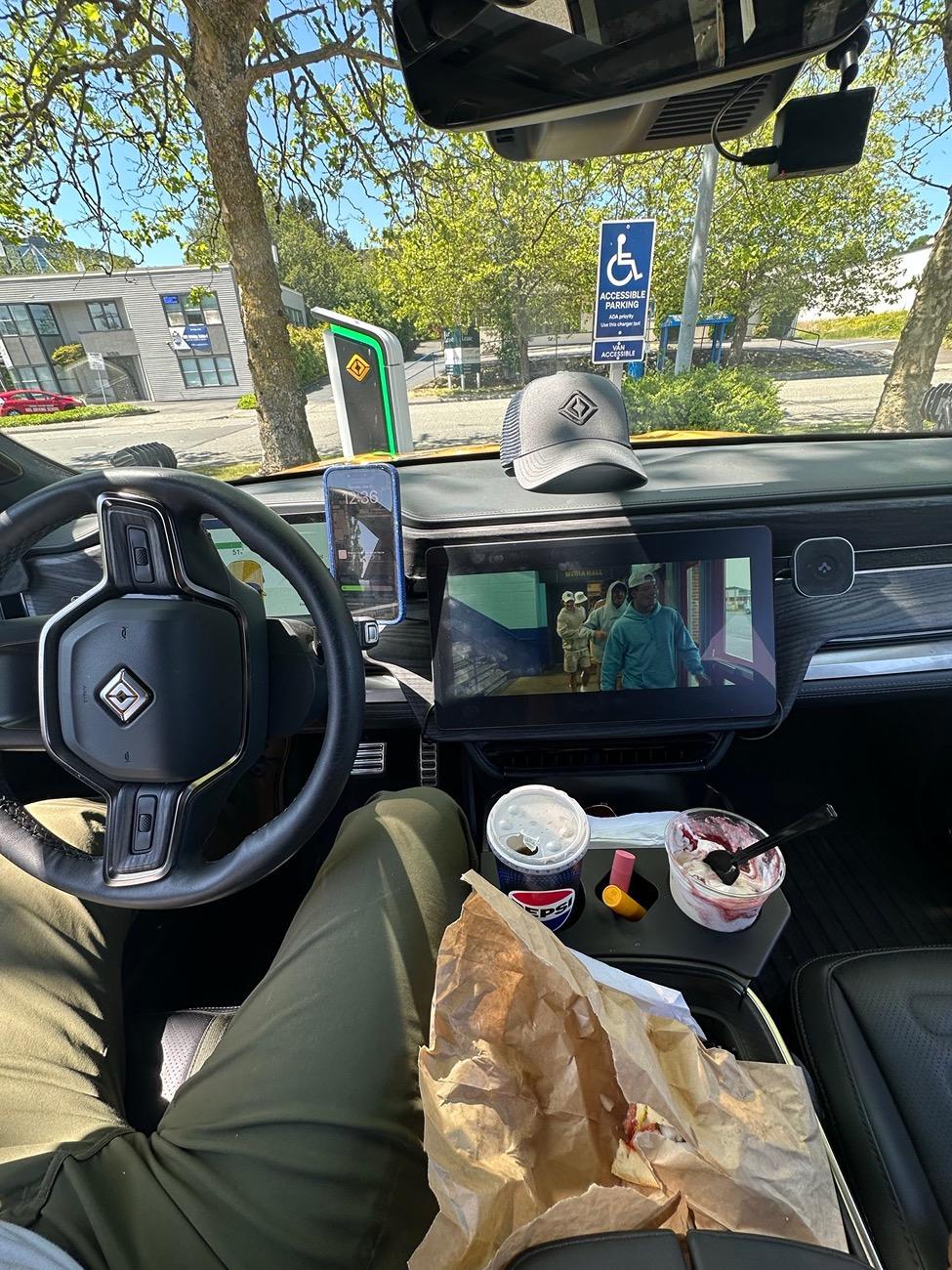
My usual owner experience at a fast charge station…. Not shown my handicap placard*

Rivian R1T R1S Owner experience with Fast Charging stations? IMG_6047
 

MountainBikeDude

Well-Known Member
First Name
Adam
Joined
Jun 20, 2019
Threads
54
Messages
3,334
Reaction score
7,088
Location
Vancouver
Vehicles
2023 El Cap Quad Motor R1T (Selling the Xterra)
Clubs
 
One thing I will say, is home charging is essential for owning an EV. You should just start the day all charged up and you never have to think about it.

DC fast chargers should really only be used occasionally for long trips.

If you try to use your EV like you would a gas car and just rely on public fast charging, that's the fastest way to grow to hate your new EV. Getting a proper AC charger installed at home is by far the most frictionless way to go. So much so that I'd say you shouldn't but a Rivian (or any EV) if home charging isn't an option
Charging at home is the ideal choice, but if you can't, charging publicly isn't that bad, and in my situation, have worked it into my life. Typically I leave early for work, usually I take a more scenic drive, but the one day a week I need to charge, I skip the scenery and charge up.

I am fortunate, that my commute is short distance, and that once a week, barring any weekend excursions, is good and typically keep my SOC within a 25-30% window of 50-70%
 

mpshizzle

Well-Known Member
Joined
Jun 16, 2024
Threads
76
Messages
1,307
Reaction score
2,180
Location
Utah
Vehicles
2025 R1S Dual Max (Baymax)
Charging at home is the ideal choice, but if you can't, charging publicly isn't that bad, and in my situation, have worked it into my life. Typically I leave early for work, usually I take a more scenic drive, but the one day a week I need to charge, I skip the scenery and charge up.

I am fortunate, that my commute is short distance, and that once a week, barring any weekend excursions, is good and typically keep my SOC within a 25-30% window of 50-70%
That's impressive!! I would have a hard time haha. I use about 12% battery with my daily commute. And I often have extra excursions after work .


...

Maybe that's how I've hit 18,000mi in just 9 months... 🤔
 

Eeyore

Well-Known Member
First Name
Bruce
Joined
Nov 21, 2020
Threads
3
Messages
1,146
Reaction score
1,486
Location
Oregon
Vehicles
R1T LE, ID.4 AWD Pro S, Honda Fit
Occupation
Retired Union Electrician
Clubs
 
I agree. Charging at home is the key. I almost never have to fast charge. With 328 miles of range when at 100% SOC, I can easily drive to my son's house north of Seattle, which is roughly 230 miles. I installed a 50 amp outlet in his garage, so I can charge there to drive home.

If, for some reason I have to get some charge either going or returning, there are plenty of of DC fast chargers on the I-5 corridor between Seattle and Portland.

I use the plug share app. I like it's filtering ability.
 

bigsky

Banned
Well-Known Member
Joined
Jan 8, 2024
Threads
12
Messages
1,098
Reaction score
740
Location
MUM
Vehicles
MUM
Where are you located just out of curiosity?

150kW DCFC chargers are ideal for a Rivian in most situations, if you really want to push in the power, a 350kW charger will allow you to hit the upper peak charging on a Rivian of around 215-220kW and that will allow you to charge a fairly large percentage of your pack in around 30 minutes 20-70% give or take.

Level 2 chargers 6kW-11.5kW are AC and have a thinner cable, plug, and post. typically around the size of a tool box. These are typically meant for hotel overnight charging, or at home when you have 8 or more hours where you aren't driving.

DCFC chargers are in most cases, the size of a refrigerator and vary in capabilities. Typically they range from 50kW speeds and usually are branded 50kW, 100kW, 150kW, 180kW, 200kW, 350kW.
350Kw chargers sound like they're the fastest, and typically they are, but Rivian's can't fully utilize the chargers speed, so don't sit and wait for a 350 to become available if you can use a 150.

Also, think of charging a vehicles battery like finding parking at Costco, it's easy to find a spot when it first opens, and the lot is empty, but as it fills up, it takes longer to find a spot to park. Same goes for a battery and energy being dumped into it. low states of charge (below 70%) you'll charge the quickest. 70-80% is slower, 80-90% is slower again, and 90-100% can take nearly as long as it did for you to go from 20-70%
Speaking metaphorically, so you have a vehicle that can and indeed legally drives at 100 mph (220 kW), but you consider that driving that vehicle in the slow lane at 50 mph ( 150 kW) is "ideal." Interesting.

The Tesla supercharging network vehemently disagrees with the notion that charging a Rivian at a max, derated charging rate of 150 kW is ideal. Indeed, as far as I know, 150 kW Tesla DCFCs will not even work with Rivians.
 

Sponsored

MountainBikeDude

Well-Known Member
First Name
Adam
Joined
Jun 20, 2019
Threads
54
Messages
3,334
Reaction score
7,088
Location
Vancouver
Vehicles
2023 El Cap Quad Motor R1T (Selling the Xterra)
Clubs
 
Speaking metaphorically, so you have a vehicle that can and indeed legally drives at 100 mph (220 kW), but you consider that driving that vehicle in the slow lane at 50 mph ( 150 kW) is "ideal." Interesting.

The Tesla supercharging network vehemently disagrees with the notion that charging a Rivian at a max, derated charging rate of 150 kW is ideal. Indeed, as far as I know, 150 kW Tesla DCFCs will not even work with Rivians.
From a thermal standpoint, Rivians tend to get bogged down when going flat out charging while people are inside trying to stay cool. 150kW is kind of a happy middle ground for a Rivian in some cases.

Tying up a 350kw charger with a 220kw peak rate Rivian is kinda lame, considering there are vehicles out there that can better utilize the full power of those chargers. It's like rocking up to a set of DCFC's and a Chevy Bolt and BZ4X are taking up the 350kW chargers, and all that's left is a 50 or 100. Both of those vehicles maybe, on a good day can charge around 100kW, but often owners don't know any better, they think rocking up to a 350, is somehow going to make their vehicle charge quicker than its capable of.
 

bigsky

Banned
Well-Known Member
Joined
Jan 8, 2024
Threads
12
Messages
1,098
Reaction score
740
Location
MUM
Vehicles
MUM
From a thermal standpoint, Rivians tend to get bogged down when going flat out charging while people are inside trying to stay cool. 150kW is kind of a happy middle ground for a Rivian in some cases.

Tying up a 350kw charger with a 220kw peak rate Rivian is kinda lame, considering there are vehicles out there that can better utilize the full power of those chargers. It's like rocking up to a set of DCFC's and a Chevy Bolt and BZ4X are taking up the 350kW chargers, and all that's left is a 50 or 100. Both of those vehicles maybe, on a good day can charge around 100kW, but often owners don't know any better, they think rocking up to a 350, is somehow going to make their vehicle charge quicker than its capable of.
I think that you are getting lost in the weeds. One can make a similar argument therefore that because all EVs charging rate dramatically drops to trickle as 100% gets near, no EV should ever tie up or use any DCFC, then.
Thermal issues aside, or anything else for that matter, amy and all EV when fast charging always should use the DCFC that will afford the capacity for that EV to charge at the maximum advetised peak rate. Nothing DCFC higher, nothing DCFC lower; ergo, my point of saying that a 150 kW DCFC for a Rivian is not ideal. To me, that makes as much sense as saying that a 300 kW DCFC is ideal for a Bolt.
 

bigsky

Banned
Well-Known Member
Joined
Jan 8, 2024
Threads
12
Messages
1,098
Reaction score
740
Location
MUM
Vehicles
MUM
From a thermal standpoint, Rivians tend to get bogged down when going flat out charging while people are inside trying to stay cool. 150kW is kind of a happy middle ground for a Rivian in some cases.

Tying up a 350kw charger with a 220kw peak rate Rivian is kinda lame, considering there are vehicles out there that can better utilize the full power of those chargers. It's like rocking up to a set of DCFC's and a Chevy Bolt and BZ4X are taking up the 350kW chargers, and all that's left is a 50 or 100. Both of those vehicles maybe, on a good day can charge around 100kW, but often owners don't know any better, they think rocking up to a 350, is somehow going to make their vehicle charge quicker than its capable of.
You actually make an, albeit totally unrelated, excellent good point.
Sadly, it looks as if the EV community as a whole does need a big dose of EV charging education and etiquette. Just because a DCFC spews out 1,000 kW does not mean your EV can use it. Learn about your EV capabilities, please do not tie up chargers your EV cannot take full advantage of, use one suited for your EV whenever possible, etc.
 

BigSkies

Well-Known Member
First Name
Brian
Joined
Sep 4, 2021
Threads
17
Messages
1,235
Reaction score
2,651
Location
Denver
Vehicles
R1T, Model Y
Clubs
 
The Chargepoint ~6kW chargers are amazingly useful in some situations, but clearly not what you want for the situation you were in. They are slow, but they are also significantly cheaper than the DCFC (aka fast charger) options.

For example, I'll pretty much only book hotels that have a L2 charger, of which those ~6kW chargers are a common option. They'll only fill the Rivian battery ~50% overnight, but they're typically cheap or free. I'll also look for them in places like parks, zoos, or parking garages while in different cities. They're not going to fill the battery, but they are a cheap top-up.

On road trips, you really want to find things that are 150kW+. While the Rivian can accept up to 220kW, the practical differences in charge time between 150kW and 220kW aren't huge. These chargers are expensive, and the only reason to use them is on road trips >~150miles. I'd still take a faster charger than 150kW when available, but the difference won't be more than a couple minutes.

Most new DCFC's going in are 150kW+, although there are regional variances. Some small Colorado and Utah mountain towns have deployed relatively cheap 60-120kW fast chargers near their downtowns. These aren't as fast, but they're frequently much cheaper than the faster options. This just becomes a choice of time vs. money.
 

VSG

Well-Known Member
Joined
Oct 3, 2022
Threads
4
Messages
3,228
Reaction score
6,026
Location
WA
Vehicles
R1T LE/RB/OC/20
150kW DCFC chargers are ideal for a Rivian in most situations, if you really want to push in the power, a 350kW charger will allow you to hit the upper peak charging on a Rivian of around 215-220kW
my point of saying that a 150 kW DCFC for a Rivian is not ideal
@bigsky: You're missing the context.

Which is, that the 150kW EA chargers will provide >190kW to a Rivian, so that you spend almost the same amount of time charging at a 150kW EA charger as at a 350kW EA charger. This has been discussed quite frequently in this forum, with videos and graphs and all sorts of accounts from actual users.

Because EVs can only maintain their peak charging rate for a portion of their charging curve, once the charging curve falls below ~190kW there is no difference in the amount of power you will get from a 150kW EA charger (giving ~190kW peak) and a 350kW EA charger (giving ~220kW peak). This crossover point is at 40%-45% SoC on a Rivian.

Plus, the 350kW EA chargers tend to have more problems, while the 150kW EA chargers are pretty reliable.

Additionally, people think big numbers are better, so the 350kW chargers seem to be the first choice for everyone driving up to a station, meaning they are usually the first stall occupied.

So, many Rivian drivers find that deliberately choosing the 150kW chargers means you're less likely to find them occupied, they're more likely to work, and they're less likely to derate as the 350kW chargers are prone to do. And if it takes 2-3 minutes longer to charge, who cares - you will waste five to ten times that if you pull up to a 350kW charger and it won't start or if it derates after you've started your charge and walked into the Walmart to use the bathroom ...

The advice from @MountainBikeDude is very practical. Of course you're welcome to follow whatever strategy you desire, but that doesn't make his advice wrong.
Sponsored


Top