Sponsored

Quad motor vs locking diff

kurtlikevonnegut

Well-Known Member
Joined
Sep 1, 2021
Threads
27
Messages
2,715
Reaction score
7,525
Location
SC/TX
Vehicles
2023 R1S DM, Honda Odyssey
Clubs
 
I weirdly got grief for inviting people out to play with us, instead of manipulating a keyboard into wild, unsubstantiated claims. Come on, come show me what I am doing wrong. I am literally going out today, because getting into situations like this is what I do for fun; and I am retired having fun.
Inviting people on the internet to drive their truck to one of the most remote parts of the country to demonstrate how you are wrong is not earnest. Whether or not it is intended, it sounds incredibly snarky to suggest because it is completely detached from the reality in which we live.
Sponsored


SingleMalt

Member
First Name
Jon
Joined
May 15, 2022
Threads
2
Messages
15
Reaction score
36
Location
Indiana
Vehicles
Rivian R1T
Occupation
Soon to be retired
I'm not qualified to speak on the questions raised in this thread, but a few month ago I came across this:


Engineering Explained on YouTube does a great job in breaking down (in simple terms to morons like me) the engineering and science related to a whole bunch of automotive technology.

The above video suggests that the Rivian's quad-motor setup is the "Holy Grail" of AWD systems.

Just another perspective with some science (instead of anecdotes) to back up his claims.
 

SoCal Rob

Well-Known Member
First Name
Rob
Joined
Apr 19, 2021
Threads
39
Messages
2,808
Reaction score
5,963
Location
Laguna Niguel / Palm Springs / Pioneertown
Vehicles
2025 Rivian R1S & 2021 VW ID.4 (2023 R1S sold)
Occupation
Information Technology
Clubs
 
Good thought process, and I believe that the process is valid. Again, it is the "long way" around a problem that has a much simpler solution, so I may not give it the credence some would like me to.

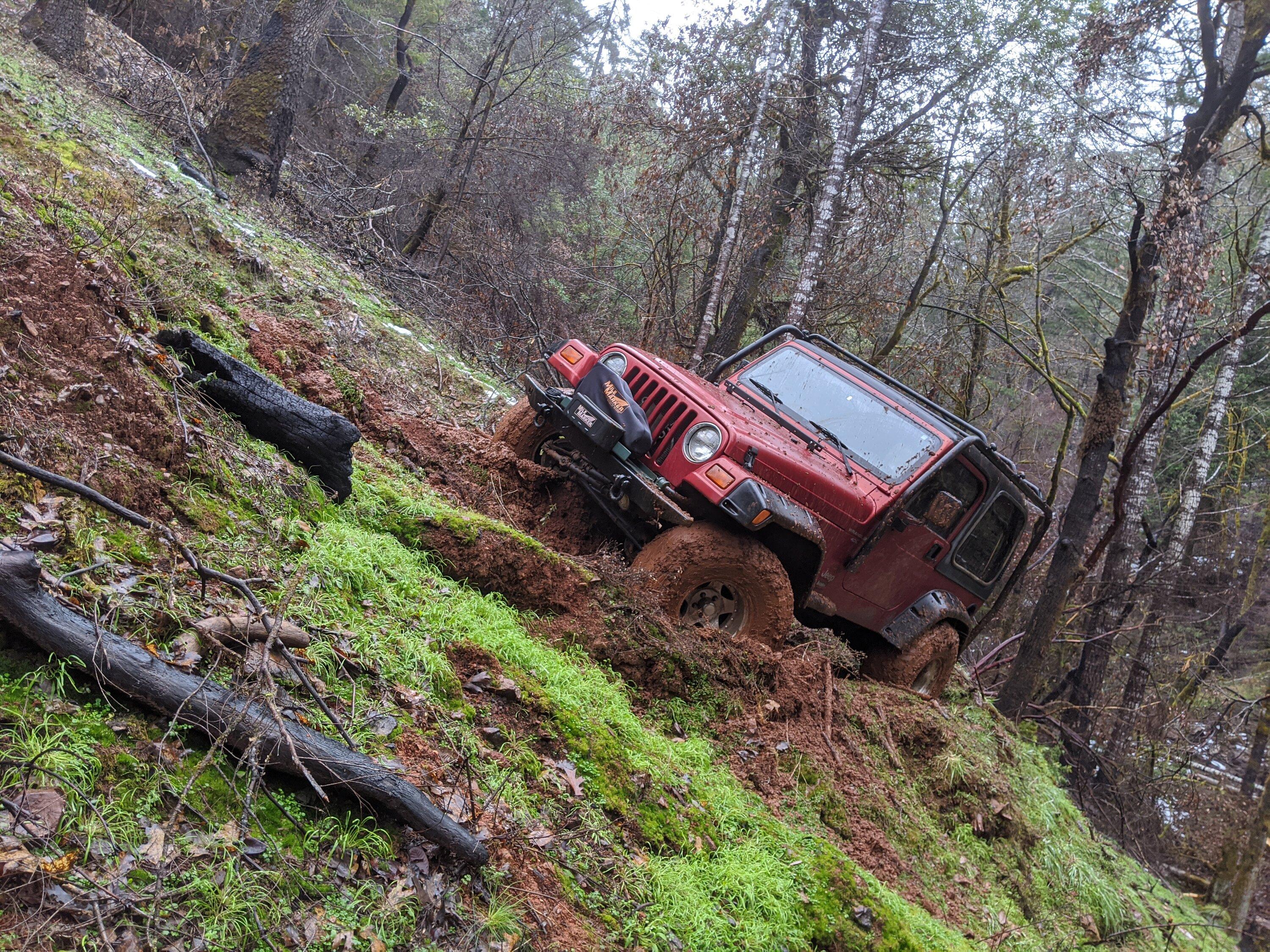
All that said, it is the vehicles' inability to mimic an _open_ differential that I find is it's biggest handicap. Refer to example test #2 way up the thread. One poster's solution was "well that is ridiculous, I just don't go on off camber surfaces. Um, OK, but that is not practical where I live:
IMG_20200122_101008.jpg

Some would say "wow, I am glad that is not my $100k Rivian over that bank". In fact, I have way over $100k in that Jeep, so it is not the money thing I am grateful for. No, I am grateful that was my 2000lb Jeep there, not my 7000lb R1T with traction control issues.

I weirdly got grief for inviting people out to play with us, instead of manipulating a keyboard into wild, unsubstantiated claims. Come on, come show me what I am doing wrong. I am literally going out today, because getting into situations like this is what I do for fun; and I am retired having fun.

With that, I really am headed out now... we will see how much hate is waiting for me when I get back lol.
I wish I lived close enough to play offroad with you in our ancient LR3 now and in our future R1S. I think that everyone getting the most joy (or at least utility) out of their vehicle is the theme that brings us all together. Have a blast off-road and please post some pics. I may have questions and propose solutions, but I promise you that I have no hate.

Getting back to Rivians, I think with off-camber loose and muddy surfaces the biggest issue is the ~7,000 lb. weight of Rivians. I say that coming from a ~6,000 Land Rover where the weight was enough to cause a rubble shelf road with a downslope outside curve to start collapsing as we drove on it.
 

Dark-Fx

Well-Known Member
First Name
Brian
Joined
Jul 15, 2020
Threads
147
Messages
13,517
Reaction score
27,280
Location
Michigan
Vehicles
R1T, R1S, Livewire One, Sierra EV, R1S
Occupation
Engineering
Clubs
 
Soooo, there seem to be a few references in this debate to a classic locking diff setup “knowing” which wheel has traction vs which does not.

How does it know?

I’d really like to know.
In a fully locked 4 wheel situation, power goes to all wheels. Wheels that slip don't consume energy and the energy that would have been consumed is split between the remaining wheels that have traction. The ones that "slip" don't rotate more than the ones that are still being driven. Works up to the point where all of your wheels are spinning.
 
Last edited:

Almex1

New Member
Joined
Jan 23, 2023
Threads
0
Messages
3
Reaction score
7
Location
Ak
Vehicles
M/T taco
Occupation
Black thumb
Inviting people on the internet to drive their truck to one of the most remote parts of the country to demonstrate how you are wrong is not earnest. Whether or not it is intended, it sounds incredibly snarky to suggest because it is completely detached from the reality in which we live.
Pretty sure he reached the point of inviting people well after exhaustively explaining the nature of the mechanical issue. People still didn't get it, so instead of saying f off, he said fine come drive with me and I'll show you. Not much more he can do to explain how a diff works in real life.
 

Sponsored

moosehead

Well-Known Member
Joined
Sep 16, 2021
Threads
64
Messages
2,092
Reaction score
4,594
Location
Denver, CO
Vehicles
‘22 Ioniq 5, ‘78 Jeep Wagoneer
In a fully locked 4 wheel situation, power goes to all wheels. Wheels that slip don't consume energy and the energy that would have been consumed is split between the remaining wheels that have traction. The ones that "slip" don't rotate more than the ones that are still being driven. Works up to the point where all of your wheels are spinning.
I think I get that.

Namely that quads might lose the entirety of any of the motor’s power availability when spinning vs in say a locked scenario.

But is that it, simply a power dilution in an especially heavy quad rig, or are there other traction forces being referenced?
 

Zoidz

Well-Known Member
First Name
Gil
Joined
Feb 28, 2021
Threads
226
Messages
5,185
Reaction score
11,685
Location
PA
Vehicles
23 R1S Adv, Avalanche, BMWs-X3,330cic,K1200RS bike
Occupation
Engineer
Ignoring the 'which is better' and focusing on the 'how could an R1 emulate physical lockers performance' my thought is this:

I think it's reasonable to assume that the system is both aware of and able to limit the RPM of the electric motors at each wheel. I believe it's also reasonable for the system to know how those RPMs translate to RPM of the tires, and thus 'speed'. I believe Rivian has the power to limit RPMs at the motor, as not being able to do so would be terrible for safety and longevity of the motors. I'm not sure if the speed limiter accomplishes this by capping motor rpm, but I do believe the speed limiter is proof that Rivian can modulate the RPM of the motors.

If all of that is true, is it then not reasonable to assume Rivian could release an ultra-rock-crawl mode that allows you to specifically set the max rotation of the motors, no matter how hard you mash the pedal, and assure that the same amount of RPM is going to each wheel, with full torque. Would this not, for all intents and purposes, simulate what physical lockers are doing without any need for feedback on traction from the underlying surface?

Edit: This is a legit question. That all makes sense to me, but I'm not a physicist or a mechanical/electrical engineer.
Yes, with the exception of starting from a full stop. Some amount of rotation must occur for the hardware/software system to get the necessary feedback to determine what's happening with each motor/wheel/tire and adjust the power to the motor.

No matter what equal power level you start at for all 4 wheels, the possibility exists that it's too much power for one wheel since that wheel has low/no traction, while the others have full traction and don't turn because power is too low. Once you have a little bit of motion (feedback) the software can compensate.
 

Inkedsphynx

Well-Known Member
Joined
May 27, 2021
Threads
4
Messages
1,021
Reaction score
2,035
Location
Washington
Vehicles
'22 LE R1T, '21 CB500FA, '21 CMX1100A
Yes, with the exception of starting from a full stop. Some amount of rotation must occur for the hardware/software system to get the necessary feedback to determine what's happening with each motor/wheel/tire and adjust the power to the motor.

No matter what equal power level you start at for all 4 wheels, the possibility exists that it's too much power for one wheel since that wheel has low/no traction, while the others have full traction and don't turn because power is too low. Once you have a little bit of motion (feedback) the software can compensate.
Right, but if you're limiting the speed of the tire via software to a max of 1mph, does the slip really matter or lack of slip matter? You just slowly dial up how much rotation the wheels are allowed if you need. Elsewise, locking diffs don't prevent a wheel slipping either, they just prevent it overrotating in the event it does slip, which, I believe, my proposal does as well.

EDIT: The point I'm getting at here is that you can remove the need for any feedback and simulate full lockers in this manner. This obviously doesn't help with the simulation of an open diff.
 

Dark-Fx

Well-Known Member
First Name
Brian
Joined
Jul 15, 2020
Threads
147
Messages
13,517
Reaction score
27,280
Location
Michigan
Vehicles
R1T, R1S, Livewire One, Sierra EV, R1S
Occupation
Engineering
Clubs
 
But is that it, simply a power dilution in an especially heavy quad rig, or are there other traction forces being referenced?
A little bit of that, but there's differences between static friction and dynamic friction at play. Once you have a wheel that's spinning on loose substrate, you have less overall friction until the tire speed matches the speed of the rest of the vehicle. It's super surface dependent though, sometimes its better to let the vehicle kick loose rocks and dirt off of a harder surface.
 

zefram47

Well-Known Member
First Name
Aaron
Joined
Feb 6, 2022
Threads
18
Messages
2,749
Reaction score
4,511
Location
Denver, CO
Vehicles
Rivian R1T, Alfa Romeo 4C
Occupation
Software Engineer
I'm not qualified to speak on the questions raised in this thread, but a few month ago I came across this:


Engineering Explained on YouTube does a great job in breaking down (in simple terms to morons like me) the engineering and science related to a whole bunch of automotive technology.

The above video suggests that the Rivian's quad-motor setup is the "Holy Grail" of AWD systems.

Just another perspective with some science (instead of anecdotes) to back up his claims.
While I argue some of the points made by the OP and I regularly watch EE and saw this video previously, at the end of the day it's where the rubber meets the "road". It's undeniable that there are still issues with the quad-motor calibration in some very specific situations. I'd like to think that Rivian will be able to improve some of its off-road manners, but that's yet to be seen. It's also undeniable that on-road the quad-motor setup is capable of things that ICEs can't even dream of.
 

Sponsored

ironpig

Well-Known Member
Joined
Nov 19, 2021
Threads
7
Messages
2,105
Reaction score
3,557
Location
Los Angeles, CA
Vehicles
2022 R1T LE, 2015 4Runner, 1975 FJ55 Land Cruiser
So, I have to admit, I thought so too. But, like you, I did not think it through enough. Now what I have on-the-ground experience with it, I will walk you through some of the scenarios that are happening.

Located at 7777 Galice Road in Merlin, Oregon is a 4x4 park where all the "forum wisdom" is washed away and real 4x4s gather to negotiate real obstacles on the ground. These obstacles are a mix of real-world overlanding experiences, and some man-made obstacles that test a vehicle's ability in a variety of situations. We have had a number of R1Ts out there now, including mine, and they do not fare well. Some of that is weight; soft surfaces are not their friend. But it came as a genuine surprise to me at how often it is the quad motor design that stops them.

For purposes of this discussion, lets call your standard Jeep/Bronco/Yoda old-school 4x4s the "classics". The classics typically have 3 differentials that are controllable (lockable) and a power source. It can be gas, diesel or electric, this is not a EV vs. the rest thing. What turns out to be the overreaching advantage of the classics can be summed up with three areas of control;
  1. Torque to the wheels
  2. Rotational speed control of the wheels
  3. Torque vectoring control
What I did not understand before, is that you lose #2 in the quad motor design, and you lose a critical element of #3.

TEST #1: The bolder-filled creek

Place classic 4x4 on 4 large boulders, one under each wheel. Once the vehicle is atop the boulders, remove support from one of the boulders, meaning it will roll freely if the wheel attempts to put torque on it.
-Instructions to driver: 4-wheel locked mode, apply enough power to the wheels to get off the rocks.
-Result: Torque is routed to all wheels equally through the transfer case and drivelines. With the diffs locked, the wheel on the loose bolder will rotate at the exact speed of the other three that are propelling the vehicle forward. The net result is zero torque to the wheel on the loose boulder, and it does not slip or "spin" that bolder out of position.

How does the vehicle know to put zero torque on that wheel? It does not, it is the simple physics of having all wheels driven at the same rotational speed. In the creek crossing scenario that we just demonstrated, as each wheel in ln turn encounters these loose/slippery rocks, no spinning occurs, the wheels with traction continue to drive the vehicle forward, even if the wheels with traction swap places 10 times during the crossing.

Place quad-motor vehicle on the same obstacle.
-Instructions to driver: Apply enough power to crawl off the obstacle.
-Result: Since no physical connection exists between the wheels, the vehicle can only control torque; trying to adjust as quickly as possible once they start to spin. As was demonstrated perfectly in Kyle's video, the wheel on the rolling bolder will spin, kicking that bolder up under the well and causing a potential hang affect while immediately falling into the hole the bolder was just pulled out of. This will be repeated with every loose/slick bolder the truck encounters in the crossing. The result is a MESS, and with no way to lock rotational speeds, is not curable with any amount of software.

TEST #2: The side hill

This trail is an off-camber approach to the creek. It is very steep, and although kind of a gut-check, I have seen even cars like Subarus and Ford Explores make it just fine. It is kryptonite for my R1T Here is why:

-Instruction to driver: Select 4-wheel-drive, first gear, traction control off, DIFFERENTIALS UNLOCKED! it is very steep, but whatever you do, do NOT touch the brakes! Aim for the opening in the trees at the bottom, and trust the vehicle.
-Result. Providing the driver does not touch the brakes, the left side tires tend to dig into the downhill side of the camber and just roll, as all torque from the driveline is transferred automatically to the wheels with less traction (in this case the uphill side). These free-wheeling wheels provide the lateral and directional control needed to make it to the bottom without sliding off the trail. If the driver freaks out and touches the brakes, those left side tires stop rotating and the hapless vehicle immediately slides off the trail and into the brush.

Climbing back out is pretty much just the reverse. People attempting the obstacle with a locked diff just slid off the trail. Your torque-vectoring open differential is your friend on these off-camber trails.

At least, this is how the scenario plays out when driving a classic. A quad-motor machine has no way to "loose" its downhill traction wheels. There is no way of applying the slowing forces to just the uphill wheels, and it IMMEDIATELY slides off the trail. Same problem trying to climb back out. There is not way to keep torque from going to the wheels needed for lateral control, and away she goes sideways down the hill.

No, software can't fix this. There is no way for the vehicle to react to the surface the way a differential does. It is impossible for the truck to know which wheels happen to be on the more slippery surface the way a differential-equipped vehicle can.
I understand why you started this thread and the points above. I may never experience any of them in my R1T because I didn't buy if for rock crawling etc but I do like seeing the new tech in action.

Because you have access to a park and wheel all week - it would be great for you to make videos of the scenarios and post them here. I think that would help people understand more than the influencer videos that are currently being produced. Just simple A and B between a traditional locked rig and your Rivian.
 

clcbjc123

Well-Known Member
Joined
Oct 28, 2022
Threads
2
Messages
57
Reaction score
66
Location
Arkansas
Vehicles
RS1, Escalade, Z07, GT3RS
How will the quad motor act on the gravel road my wife has to take when she picks up art from the framer? Should we wait for dual motors and locking differential? I'm so confused, the rest of the time it will be on asphalt.
 

Inkedsphynx

Well-Known Member
Joined
May 27, 2021
Threads
4
Messages
1,021
Reaction score
2,035
Location
Washington
Vehicles
'22 LE R1T, '21 CB500FA, '21 CMX1100A
How will the quad motor act on the gravel road my wife has to take when she picks up art from the framer? Should we wait for dual motors and locking differential? I'm so confused, the rest of the time it will be on asphalt.
Unless your gravel road is tilted to the side at an extreme angle, you're going to be absolutely fine. I drive on gravel/dirt/etc roads all the time and there are absolutely no issues.

This thread is discussing some pretty extreme situations, the kind you don't end up in unless you intend to end up in them.
 

racekarl

Well-Known Member
Joined
Jan 5, 2023
Threads
9
Messages
554
Reaction score
825
Location
MA
Vehicles
2023 R1T
Soooo, there seem to be a few references in this debate to a classic locking diff setup “knowing” which wheel has traction vs which does not.

How does it know?

I’d really like to know.
1. A locked diff is one in which both wheels always get the same power and must always rotate at the same speed - there is no possibility for one wheel to spin faster or slower than the other (for simplicity we'll assume we're talking about a single axle with 1 wheel at either end)

2. An open diff is one in which both wheels are able to spin completely independently of each other. In this type of diff the wheel that has less friction will get most (or possibly all) of the power applied.

3. A limited slip differential is sort of in-between the above two. It allows both wheels to spin independently but does not allow 100% of the power to go to the wheel with the least friction.

A "locking" differential of the kind R.I.P was referring to in his vehicles allows the user to select from any of the above settings, and in fact to adjust the behavior along a continuous range from fully open to fully locked.

Hopefully that makes it clear that a locked differential does NOT "know" anything - both wheels always get the same power and rotate at the same speed as if they were linked by a solid rod.

You are thinking of an open differential, which will send power to the wheel which is easiest to turn. It doesn't do this by "knowing" anything, it's a purely mechanical process. Think about it like electricity following the path of least resistance. Or maybe think about how if you collapse a telescoping pole it collapses one section at a time - it didn't know to do it any order, it just collapsed in ascending order of static friction between the sections.

Incidentally I think this is the crux of the "dispute" between R.I.P and White Shadow. White Shadow seemed fixated on how a 4 motor set up could replicate a fully locked diff while R.I.P was more concerned with issues the R1T has relative to BOTH locked and open diffs, but open diffs in particular.
 

the long way downunder

Well-Known Member
First Name
Adam
Joined
Jan 15, 2021
Threads
3
Messages
944
Reaction score
998
Location
charging
Vehicles
Tesla
Occupation
WFH
Ignoring the 'which is better' and focusing on the 'how could an R1 emulate physical lockers performance' my thought is this:

I think it's reasonable to assume that the system is both aware of and able to limit the RPM of the electric motors at each wheel. I believe it's also reasonable for the system to know how those RPMs translate to RPM of the tires, and thus 'speed'. I believe Rivian has the power to limit RPMs at the motor, as not being able to do so would be terrible for safety and longevity of the motors. I'm not sure if the speed limiter accomplishes this by capping motor rpm, but I do believe the speed limiter is proof that Rivian can modulate the RPM of the motors.

If all of that is true, is it then not reasonable to assume Rivian could release an ultra-rock-crawl mode that allows you to specifically set the max rotation of the motors, no matter how hard you mash the pedal, and assure that the same amount of RPM is going to each wheel, with full torque. Would this not, for all intents and purposes, simulate what physical lockers are doing without any need for feedback on traction from the underlying surface?

Edit: This is a legit question. That all makes sense to me, but I'm not a physicist or a mechanical/electrical engineer.
In the recent interview of Max Hoff he started to explain how this would work but didn't get to give a complete explanation.
The design of the R1 allows for the anti-roll ("sway") bars to increase or reduce down force at each corner.
It's not clear if the air suspension can dynamically modulate downforce in motion. We know the air suspension can "level" the chassis (slowly, when stationary) but I'm guessing since it has individual control of each corner through the air struts, the chassis dynamics computers could use "Rock Crawl" mode to actively control each corner or even give the driver manual control or semi-automatic control.
Imagine climbing straight uphill over rocks and say the left rear falls in a ditch … you could ask the vehicle to compensate ("reaching" down into the hole under the left rear, lowering the whole chassis to increase reach, lowering the front of the vehicle to reduce the uphill pitch, deliberately tilting the chassis by raising the right rear so the vehicle has more load on that left rear, then dynamically leveling and avoiding a tip-over as it climbs out of the hole.
The vehicle could also use these control inputs to decide "now is a good time to send maximum cooling to the rear motors and the power systems" in anticipation of the demand on systems.

The "next level" would be the option for the driver to say "unweight left rear" (rebalance the vehicle to take all down force off that corner. The driver could then position rocks under the unweighted corner or even use a high-lift jack (if only Rivian had thought to incorporate jacking points) or maybe use a tire sling to lift the unweight corner … then shove some rocks and dirt under that corner, get a gotread or maxtrax under then and self-recover.

There's more than a few "next level" maneuvers possible with quad motor and four wheel independent suspension and air struts with hydraulic anti-roll … as someone with a background in racing, not that I'm a chassis engineer, the suspension of the R1 is truly impressive and wildly too expensive for anyone to build independently … I can only hope that Rivian sponsors racers (they've done a couple) and encourages an enthusiast community of aftermarket upgrades for these vehicles to become legendary performers, not just goofy grocery getters for the lucky few.
Sponsored


Top