
-
👉 R2 Orders ➡ Add Your R2 Orders / VIN / Delivery Info 📊
Sponsored
Who has experience in REAL cold... subzero temps for several days in a row?

Donald Stanfield
Well-Known Member
My experience is that it really sucks and you should move. I don't have any EV experience when it is that cold though but I did wind up moving and I like winter a lot better now.
Dark-Fx
Well-Known Member
No issues with the Rivian other than efficiency just being terrible. Cabin heater is completely adequate in sub zero temps.
SSteveEV
Well-Known Member
Not much sub 0 in winter last year but had some single digit cold days/weeks and other than efficiency tanking it performed well in storms, didn't freeze up, and could stay warm (if 72*+ on the HVAC controls because they are basically nonfunctional below that)
Thedude
Well-Known Member
Efficiency sucks until the battery warms up but the cabin heat and heated seats were more than adequate. A couple times the truck was in turtle mode because the battery was so cold from sitting outside all night. That wouldn’t be a problem if you have a heated garage or plug the truck in and let it charge for a bit to warm up the battery before driving.
Sponsored
EVTrukHog
Well-Known Member
Last winter during single digit temps, my suspension compressor struggled to keep up until it warmed up. This meant ride height changes were occasionally unavailable for the first 15 to 30 minutes of a drive.

Budman
Well-Known Member
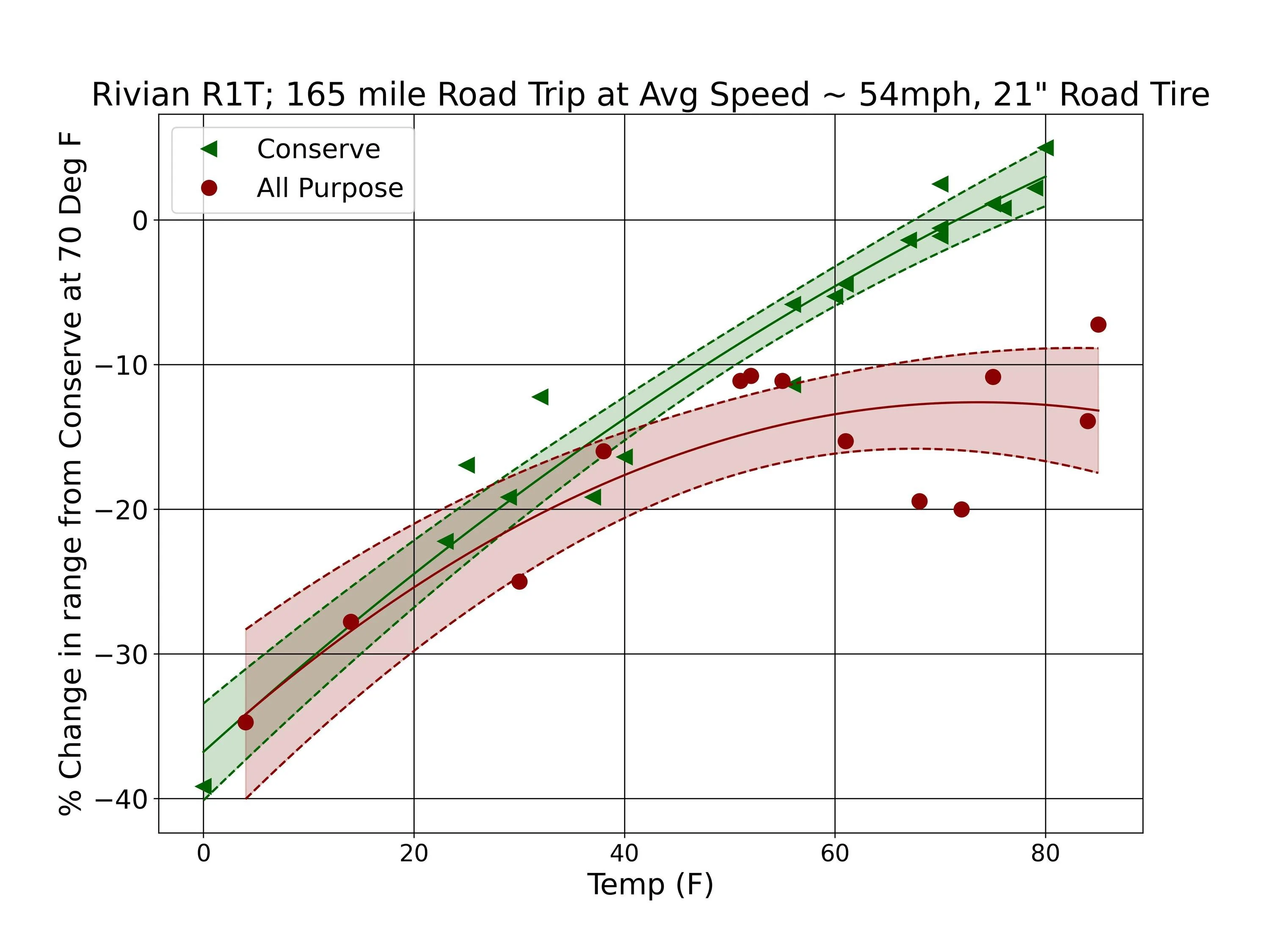
Live in Minneapolis with a cabin in Northern WI we frequent in the winter. No issues at all. Efficiency drops about 35% on long drives at around 0 deg F. Cabin heater is plenty strong. 21" road tires are adequate (would do winters if there were available...). It's a great vehicle, just drive it and don't worry.


Electrified Outdoors
Well-Known Member
- First Name
- Ken
- Joined
- Jan 30, 2023
- Threads
- 64
- Messages
- 3,683
- Reaction score
- 3,982
- Location
- Mount Airy, Maryland
- Vehicles
- 2026 S Tri Max, 2024 Silverado EV RST First Edition
- Occupation
- Real Estate
Its a great question. While I have no experience with the Rivian in these temps I do have experience with other EVs. They all get awful efficiency in these temps. Below 20F even the cars with heat pumps don't have any significant efficiency advantage. My Tesla's really suffered when it was below 20F and they both had heat pumps.
An EV is still workable though range will obviously be reduced. How much daily driving do you do?
These temps are manageable though. If you have a heated garage that's obviously the most desirable storage location. Unheated still better than outside. If not and you have to leave it outdoors, leave it plugged in and schedule charging to occur as close to the time your leaving as possible. A good long charging session will help warm up the battery.
An EV is still workable though range will obviously be reduced. How much daily driving do you do?
These temps are manageable though. If you have a heated garage that's obviously the most desirable storage location. Unheated still better than outside. If not and you have to leave it outdoors, leave it plugged in and schedule charging to occur as close to the time your leaving as possible. A good long charging session will help warm up the battery.

Riviot
Well-Known Member
- Joined
- Mar 29, 2021
- Threads
- 122
- Messages
- 6,463
- Reaction score
- 10,916
- Location
- Kitsap, WA
- Vehicles
- R1T
Imperial or metric?
Christopher
Well-Known Member
- First Name
- Christopher
- Joined
- May 31, 2022
- Threads
- 34
- Messages
- 583
- Reaction score
- 573
- Location
- South Florida
- Vehicles
- R1T
- Occupation
- Tech
Wouldn't a heat pump be less effective the colder it is? And since the Rivian doesn't have one, the PTC heating element it does have would be better in sub-zero temperatures?Its a great question. While I have no experience with the Rivian in these temps I do have experience with other EVs. They all get awful efficiency in these temps. Below 20F even the cars with heat pumps don't have any significant efficiency advantage. My Tesla's really suffered when it was below 20F and they both had heat pumps.
An EV is still workable though range will obviously be reduced. How much daily driving do you do?
These temps are manageable though. If you have a heated garage that's obviously the most desirable storage location. Unheated still better than outside. If not and you have to leave it outdoors, leave it plugged in and schedule charging to occur as close to the time your leaving as possible. A good long charging session will help warm up the battery.
Sponsored
Electrified Outdoors
Well-Known Member
- First Name
- Ken
- Joined
- Jan 30, 2023
- Threads
- 64
- Messages
- 3,683
- Reaction score
- 3,982
- Location
- Mount Airy, Maryland
- Vehicles
- 2026 S Tri Max, 2024 Silverado EV RST First Edition
- Occupation
- Real Estate
Yes heat pumps less effective at temps below freezing. Less heat to extract from the air and a higher heating demand.Wouldn't a heat pump be less effective the colder it is? And since the Rivian doesn't have one, the PTC heating element it does have would be better in sub-zero temperatures?
SparkyR1t
Well-Known Member
I can share me experience with Tesla. in addition to my Rivian I have been driving Teslas since 2015. Some with resistance heat some with heat pumps experience is at -10 F
Comparison
EV always starts up where as the ICE vehicle may not
EV instant heat no waiting for long engine warm up
Tesla can precondition the cab using wall power saving the battery, Rivian uses the battery always. With an ICE vehicle not issue
ICE vehicle can usually keep the cabin very warm, EV keeps you warm not hot may also need to use seat heaters
EV in extreme cold you will want to fully charge battery and leave plugged in when not in use, not an issue with ICE
Range- figure you will lose up to 50% in extreme cold. So if you have a normal warm weather range of 300 miles figure 150 miles in extreme cold. ICE not an issue
Conclusion; I prefer not driving either vehicle in extreme cold. But other than reduced range and need to charge often I still vote for an EV. It’s just different and requires a bit more planning
Comparison
EV always starts up where as the ICE vehicle may not
EV instant heat no waiting for long engine warm up
Tesla can precondition the cab using wall power saving the battery, Rivian uses the battery always. With an ICE vehicle not issue
ICE vehicle can usually keep the cabin very warm, EV keeps you warm not hot may also need to use seat heaters
EV in extreme cold you will want to fully charge battery and leave plugged in when not in use, not an issue with ICE
Range- figure you will lose up to 50% in extreme cold. So if you have a normal warm weather range of 300 miles figure 150 miles in extreme cold. ICE not an issue
Conclusion; I prefer not driving either vehicle in extreme cold. But other than reduced range and need to charge often I still vote for an EV. It’s just different and requires a bit more planning
Hopper
Well-Known Member
- First Name
- Richard
- Joined
- Feb 20, 2021
- Threads
- 27
- Messages
- 398
- Reaction score
- 351
- Location
- Upstate New York
- Vehicles
- Launch Green R1T, 2022 Polaris Ranger NorthStar
- Occupation
- Retired Executive and technical writer. Board of Directors Fly Fishers International.
Agreed. My experience is the same. Pre-conditioning the cabin while on the charger helps.No issues with the Rivian other than efficiency just being terrible. Cabin heater is completely adequate in sub zero temps.
Hopper
Well-Known Member
- First Name
- Richard
- Joined
- Feb 20, 2021
- Threads
- 27
- Messages
- 398
- Reaction score
- 351
- Location
- Upstate New York
- Vehicles
- Launch Green R1T, 2022 Polaris Ranger NorthStar
- Occupation
- Retired Executive and technical writer. Board of Directors Fly Fishers International.
If the Rivian is on the wall charger and charging @11 kwh, is there a net loss to SOC from preconditioning the cabin?I can share me experience with Tesla. in addition to my Rivian I have been driving Teslas since 2015. Some with resistance heat some with heat pumps experience is at -10 F
Comparison
EV always starts up where as the ICE vehicle may not
EV instant heat no waiting for long engine warm up
Tesla can precondition the cab using wall power saving the battery, Rivian uses the battery always. With an ICE vehicle not issue
ICE vehicle can usually keep the cabin very warm, EV keeps you warm not hot may also need to use seat heaters
EV in extreme cold you will want to fully charge battery and leave plugged in when not in use, not an issue with ICE
Range- figure you will lose up to 50% in extreme cold. So if you have a normal warm weather range of 300 miles figure 150 miles in extreme cold. ICE not an issue
Conclusion; I prefer not driving either vehicle in extreme cold. But other than reduced range and need to charge often I still vote for an EV. It’s just different and requires a bit more planning

Blueassassin
Well-Known Member
I'm lucky enough I have a heated garage to park in at home and there is a charger at work to plug in and slow charge to keep the battery warm. But chicago winters and the cold sucks.
Sponsored
Similar threads

- Replies
- 1
- Views
- 1,364


- Replies
- 1
- Views
- 365

- Replies
- 17
- Views
- 2,326


- Replies
- 229
- Views
- 47,844