
Sponsored

Wire Guage clarification help.

SANZC02

Well-Known Member
First Name
Bob
Joined
Feb 11, 2021
Threads
50
Messages
7,407
Reaction score
12,698
Location
California
Vehicles
Tesla Model S, LE - R1S
Occupation
Retired
Here I go again,

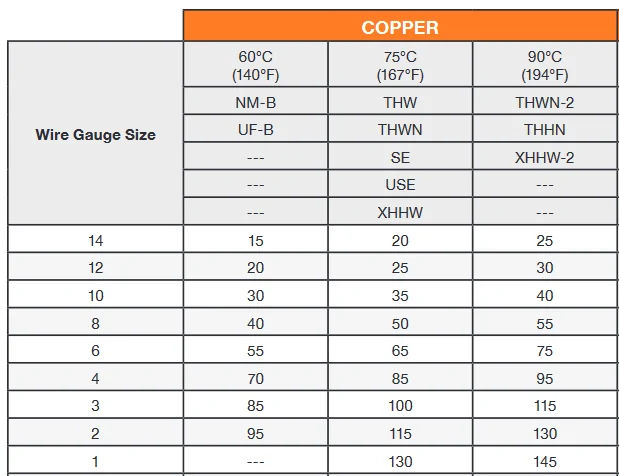
Electrician asked me to speak to his supplier to clarify wire size. Supplier says 6AWG THHN is rated to 55 ampacity and for 48 A charging I need to go to 4AWG.

Here on the forum people have said that while the charger block may accept 4AWG The connection block is spec'd for 6AWG so don't do it.

Here People have said that 6 AWG THHN in conduit IS ok .

What am I missing? (and please don't say an electrician)

My current presumptive plan is 6AWG THHN in a flexible PVC Conduit. I an seeing that 6AWG ampacity is 65A and with a 20 percent derating for safety sould be fine carrying 52 A .

Thanks again in advance.
You need a new electrician. 6awg 90c thhn copper is rated to 75 amps.

Maybe he is looking at 60c or maybe aluminum wire but seriously, I would not let that electrician anywhere near my house.
Sponsored
 

Dark-Fx

Well-Known Member
First Name
Brian
Joined
Jul 15, 2020
Threads
147
Messages
13,525
Reaction score
27,291
Location
Michigan
Vehicles
R1T, R1S, Livewire One, Sierra EV, R1S
Occupation
Engineering
Clubs
 
You need a new electrician. 6awg 90c thhn copper is rated to 75 amps.

Maybe he is looking at 60c or maybe aluminum wire but seriously, I would not let that electrician anywhere near my house.
It could be that the OP's breakers are old and are only rated for 60C wire but the electrician should clearly state that.
 

SANZC02

Well-Known Member
First Name
Bob
Joined
Feb 11, 2021
Threads
50
Messages
7,407
Reaction score
12,698
Location
California
Vehicles
Tesla Model S, LE - R1S
Occupation
Retired
It could be that the OP's breakers are old and are only rated for 60C wire but the electrician should clearly state that.
There is no difference between the wire on 60c and 90c only the cover.
 

Dark-Fx

Well-Known Member
First Name
Brian
Joined
Jul 15, 2020
Threads
147
Messages
13,525
Reaction score
27,291
Location
Michigan
Vehicles
R1T, R1S, Livewire One, Sierra EV, R1S
Occupation
Engineering
Clubs
 
There is no difference between the wire on 60c and 90c only the cover.
Ignore the word "wire" in my statement. Breakers and devices have their own ratings independant of what the wires have.
 
OP
OP
dradam

dradam

Well-Known Member
Joined
Sep 18, 2022
Threads
23
Messages
425
Reaction score
518
Location
Maryland
Vehicles
2023 R1S OC LA Silver 21 as of 23xxx Nov 3, 2023 !!
It could be that the OP's breakers are old and are only rated for 60C wire but the electrician should clearly state that.
Thank you for keeping an eye on this thread. There is a ton of confusion over this not just from owners, but some electricians as well. Seems many are charging with NM/romex and may not know it is limited to 55A.

My 60 A breaker will be new and should exceed the 90 c rating. My run is 33 feet or less all hiden in a large chase and terminated in an unfinished area.

From everything I see 6 AWG THHN sould be adequate in conduit and is what is specfied to fit in the Rivian charger connector.

I would like to use a flexible 1 inch conduit -- although at least one person on reddit suggested that that may require using the 60c derating I have not seen that. Any thoughts appreciated .

Thanks again.
 
Last edited:

Sponsored

OP
OP
dradam

dradam

Well-Known Member
Joined
Sep 18, 2022
Threads
23
Messages
425
Reaction score
518
Location
Maryland
Vehicles
2023 R1S OC LA Silver 21 as of 23xxx Nov 3, 2023 !!
You need a new electrician. 6awg 90c thhn copper is rated to 75 amps.

Maybe he is looking at 60c or maybe aluminum wire but seriously, I would not let that electrician anywhere near my house.
I appreciate your concern. Just trying to find the safest path that fits in the charger. Will likely be 6AWG THHN in 1 inch flex conduit. New CH Breaker. Thx
 

SparkyR1t

Well-Known Member
Joined
Apr 5, 2023
Threads
2
Messages
380
Reaction score
388
Location
Chicago
Vehicles
R1t/Model Y
Occupation
Retired Commercial Electrician and mechanic
if it helps a circuits thermal performance rating which is the value you must use for designIng your circuit maximum ampacity is based on the weakest component in your electrical System. You are the safest using 60C for wire ampacity if unsure. Actually I grabbed an Eaton series CH 60 amp breaker from my truck and it’s embossed 40 C. So remember the NEC is a minimum standard you want to work to. So when I design a circuit I almost always use the 60 degree ampacity column. Never will I use the 90 degree column.

Yes THHN insulation will withstand a much higher current at the 90 degree rating then at the 60 degree rating but you must evaluate and prove with 100 % certainity that the terminals on the wall connector and the terminals on the circuit breaker and any possibly splice connections are rated for the wire load value you are choosing to use. Seldom do I find all components rated for 90 degree service. Running a component at 194 degrees F Is asking for trouble

And one more consideration a breaker running extremely hot then heats your power panel bus bar which in turn will heat nearby breakers. That’s how electrical fires begin when you use the incorrect values for wire and components. Hence why we have electricians.
 
OP
OP
dradam

dradam

Well-Known Member
Joined
Sep 18, 2022
Threads
23
Messages
425
Reaction score
518
Location
Maryland
Vehicles
2023 R1S OC LA Silver 21 as of 23xxx Nov 3, 2023 !!
if it helps a circuits thermal performance rating which is the value you must use for designIng your circuit maximum ampacity is based on the weakest component in your electrical System. You are the safest using 60C for wire ampacity if unsure. Actually I grabbed an Eaton series CH 60 amp breaker from my truck and it’s embossed 40 C. So remember the NEC is a minimum standard you want to work to. So when I design a circuit I almost always use the 60 degree ampacity column. Never will I use the 90 degree column.

Yes THHN insulation will withstand a much higher current at the 90 degree rating then at the 60 degree rating but you must evaluate and prove with 100 % certainity that the terminals on the wall connector and the terminals on the circuit breaker and any possibly splice connections are rated for the wire load value you are choosing to use. Seldom do I find all components rated for 90 degree service. Running a component at 194 degrees F Is asking for trouble

And one more consideration a breaker running extremely hot then heats your power panel bus bar which in turn will heat nearby breakers. That’s how electrical fires begin when you use the incorrect values for wire and components. Hence why we have electricians.

Omg that was an amazing response !! What will it take to bring you out of retirement? So how would you set this up ? What awg ? based on the Rivian charger if it were you're home. Without doubt I would be checking the ampacity and temp of all components.

Thank you for your help.
 

SparkyR1t

Well-Known Member
Joined
Apr 5, 2023
Threads
2
Messages
380
Reaction score
388
Location
Chicago
Vehicles
R1t/Model Y
Occupation
Retired Commercial Electrician and mechanic
Thanks

so a quick clarification after some online research my Eaton breaker is rated for 60 or 70 C wire to the terminals . But definitely no 90 C use.

I grabbed the ambient temp rating previously -my bad

if I were doing the work and how I have installed my two wall connectors in my home I drop to the next larger wiring size and use 4awg wire. That way I am designing beyond the minimum standards when referencing the NEC.
I believe it was mentioned a particular wall connector will not accept 4awg wire??

Are we sure
 

SparkyR1t

Well-Known Member
Joined
Apr 5, 2023
Threads
2
Messages
380
Reaction score
388
Location
Chicago
Vehicles
R1t/Model Y
Occupation
Retired Commercial Electrician and mechanic
And re-reading the threads the Rivian wall connector states in their install manual 6 awg max wire so 6 it must be. When sizing a circuit for extended use that is over 3 hours continuous heavy loading as our vehicles occasionally require you must not exceed 80% of the circuit capacity. That equates to a circuit capable to handling minimum of 60 amps for a wall connector set to deliver 48 amps to the vehicle . As long as all components of your electrical system are rate for at least 75C you are good using THHN wire.
 

Sponsored

NY_Rob

Well-Known Member
First Name
Rob
Joined
Feb 9, 2022
Threads
23
Messages
5,397
Reaction score
7,972
Location
long island
Vehicles
Model 3 LR AWD, BMW i3 REX, 2024 Rubicon 4xe
Occupation
IT
Here I go again,
Electrician asked me to speak to his supplier to clarify wire size. Supplier says 6AWG THHN is rated to 55 ampacity and for 48 A charging I need to go to 4AWG.
These are "professionals"?
If I can find an ampacity chart in under 30 seconds how do they keep getting the numbers wrong?

6AWG THHN is rated for 75 amps, not 55.

Rivian R1T R1S Wire Guage clarification help. 1693601302121
 
OP
OP
dradam

dradam

Well-Known Member
Joined
Sep 18, 2022
Threads
23
Messages
425
Reaction score
518
Location
Maryland
Vehicles
2023 R1S OC LA Silver 21 as of 23xxx Nov 3, 2023 !!
Thanks

so a quick clarification after some online research my Eaton breaker is rated for 60 or 70 C wire to the terminals . But definitely no 90 C use.

I grabbed the ambient temp rating previously -my bad

if I were doing the work and how I have installed my two wall connectors in my home I drop to the next larger wiring size and use 4awg wire. That way I am designing beyond the minimum standards when referencing the NEC.
I believe it was mentioned a particular wall connector will not accept 4awg wire??

Are we sure
Rivian wall mounted hard wire charger specifies 6AWG. Some have said that 4 AWG will fit in the connector, but others have said that 4 AWG in a 6 AWG specified block is not correct. 4AWG would end this discussion for me from a rating and ampacity standpoint but is not consistent with Rivian specifications.
 

SparkyR1t

Well-Known Member
Joined
Apr 5, 2023
Threads
2
Messages
380
Reaction score
388
Location
Chicago
Vehicles
R1t/Model Y
Occupation
Retired Commercial Electrician and mechanic
Rated at 75 amps and can be used for a 75 load if all components are rated at 90C. Not likely to find a residential breaker with a 90c rating. But I agree the wire can handle 75 amps and the insulation will not melt but you
can seriously overheat and cause other components in the circuit to fail.
 
OP
OP
dradam

dradam

Well-Known Member
Joined
Sep 18, 2022
Threads
23
Messages
425
Reaction score
518
Location
Maryland
Vehicles
2023 R1S OC LA Silver 21 as of 23xxx Nov 3, 2023 !!
And re-reading the threads the Rivian wall connector states in their install manual 6 awg max wire so 6 it must be. When sizing a circuit for extended use that is over 3 hours continuous heavy loading as our vehicles occasionally require you must not exceed 80% of the circuit capacity. That equates to a circuit capable to handling minimum of 60 amps for a wall connector set to deliver 48 amps to the vehicle . As long as all components of your electrical system are rate for at least 75C you are good using THHN wire.
Our replies overlapped . Thank you again for you responses. So yes 6AWG and THHN in conduit.

Does flex pvc or other conduit affect these ratings?

Thanks in advance !!
 

SparkyR1t

Well-Known Member
Joined
Apr 5, 2023
Threads
2
Messages
380
Reaction score
388
Location
Chicago
Vehicles
R1t/Model Y
Occupation
Retired Commercial Electrician and mechanic
Our replies overlapped . Thank you again for you responses. So yes 6AWG and THHN in conduit.

Does flex pvc or other conduit affect these ratings?

Thanks in advance !!
Just need to review the allowable conduit fill charts based upon the type of conduit you plan to use so there is sufficient air space around the wires for cooling. The wiring charts are either based on the wires in free air which allow them to get a bit warmer and be naturally cooled and carry more current or wires encased in conduit or enclosure that takes into account that conduit is going to get warm as the wires naturally warm carrying current and not allow the wires to cool as much as if they were on a pole in the air.
So the conduit fill charts are as important as the wire sizes them selves

hope that helps
Sponsored


Top