Sponsored

HaveBlue

Well-Known Member
Joined
Nov 22, 2022
Threads
41
Messages
2,926
Reaction score
2,234
Location
91107
Vehicles
R1S DMP Max, Lifted GX470, APR Audi A7, BMW 325Ci
Clubs
 
Traction control systems will always be reactive. By the time they realize they don't have traction or need to apply more/less power, it's to late. Then you get a bunch of wheel spin and almost launch the vehicle into the nearest rock. Props for getting the rivian up hells gate with no damage. Locking differentials are proactive. They always apply constant even torque. Same holds true for braking off-road where abs makes things worse so it gets turned off when the vehicle is shifted to 4wd.
Sponsored
 

Zoidz

Well-Known Member
First Name
Gil
Joined
Feb 28, 2021
Threads
226
Messages
5,185
Reaction score
11,686
Location
PA
Vehicles
23 R1S Adv, Avalanche, BMWs-X3,330cic,K1200RS bike
Occupation
Engineer
...
One thing I read about electric motors is that when a wheel comes off the ground it spools up fast regardless of the amount of current going to it. Where I see this being a problem is when it makes contact back with the ground. I watched or read some early rivian videos or articles that said getting the motors to work right in zero traction situations is very hard.
While I'm certain you read that, it does not have to be that way in a modern design, and Rivian doesn't respond that way. We have seen Rivian videos that indicate the exact opposite - rotation might increase for a very short time (a few hundred milliseconds) until the software detects it, but stops when a wheel is lofted. If spool up occurred, it would also make traction control impossible in snow conditions.

This is controlled via software by monitoring the rotational speed of the wheels and managing the inverter voltage/current/frequency applied to the motor.
 

zefram47

Well-Known Member
First Name
Aaron
Joined
Feb 6, 2022
Threads
18
Messages
2,749
Reaction score
4,511
Location
Denver, CO
Vehicles
Rivian R1T, Alfa Romeo 4C
Occupation
Software Engineer
Traction control systems will always be reactive. By the time they realize they don't have traction or need to apply more/less power, it's to late. Then you get a bunch of wheel spin and almost launch the vehicle into the nearest rock. Props for getting the rivian up hells gate with no damage. Locking differentials are proactive. They always apply constant even torque. Same holds true for braking off-road where abs makes things worse so it gets turned off when the vehicle is shifted to 4wd.
Exactly. Mentioning brakes...for any not aware, Rock Crawl mode is the only one where you're able to turn off Brake Hold. Coming down a rocky trail this summer I was getting pretty pissed off about how grabby the brake hold was while trying to negotiate some large rocks with the aid of gravity. Finally remembered I could turn off the brake hold and the truck was *way* more controllable on the descent.
 

defcon888

Well-Known Member
First Name
Keith
Joined
May 23, 2023
Threads
6
Messages
1,222
Reaction score
923
Location
Auburn, Ca
Vehicles
2023 R1T, 2021 Toyota RAV4 Prime
Occupation
Making money
Clubs
 
The only adventure I am going to be taking our R1T too is black Friday shopping at the mall.

Great video for sure. I don't know....well I do know, I don't have the guts to attempt that.
 

pntbllarea51

Member
Joined
Jul 7, 2023
Threads
2
Messages
14
Reaction score
14
Location
Chicago
Vehicles
R1S
Clubs
 
Traction control systems will always be reactive. By the time they realize they don't have traction or need to apply more/less power, it's to late. Then you get a bunch of wheel spin and almost launch the vehicle into the nearest rock. Props for getting the rivian up hells gate with no damage. Locking differentials are proactive. They always apply constant even torque. Same holds true for braking off-road where abs makes things worse so it gets turned off when the vehicle is shifted to 4wd.

I see the idea of wheel slip being bad thrown around a lot. When in reality, excessive wheel slip is the reaper of death. Leads to a lot of lateral vehicle movement. No wheel slip provides confidence and sure-footedness.

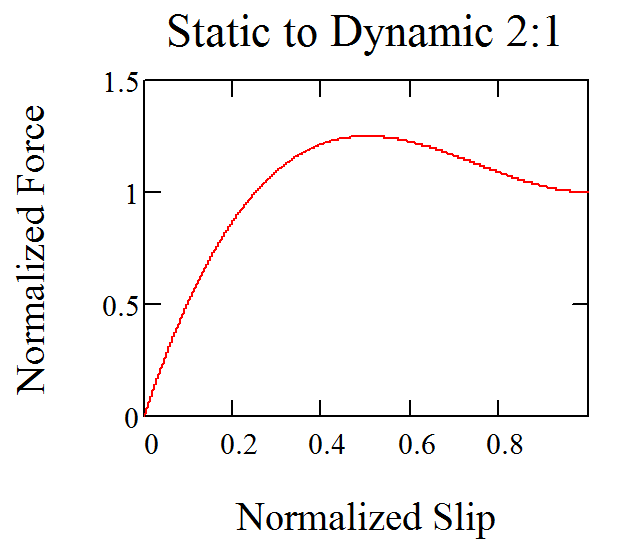
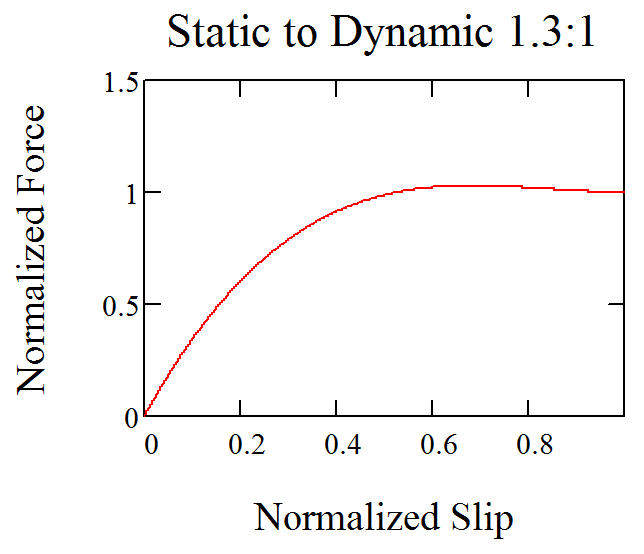
It is well known in higher levels of racing, that a cornering vehicle has more grip than a vehicle on a straightaway. This is due to static friction being highest just before the tire slips. See (https://physics.stackexchange.com/q...hat before the,maximal use of static friction.) (Rough explanation in the answers section)


Rivian R1T R1S Hell's Gate in my R1T o0kIQ


or a more reasonable

Rivian R1T R1S Hell's Gate in my R1T 8I7bQ


Note that as the slip goes towards full slip the plot levels off at one to indicate that the force levels off at full slipping force once the tire starts fully slipping. Also note that before the tire is fully slipping part of the tire is not slipping and thus providing the higher coefficient of static friction. Thus, the real reason that tires provide more cornering power while partially slipping. This allows a maximal use of static friction. Thus, while a tire has contact with the ground, you want traction control to target the very edge before a tire slips.

Rivian targets this optimal friction point with its software. This is why we hear short-duration tire chirps when the wheel is still in contact with the ground. The computers are trying to maintain the highest friction level just before slipping and dial it back after the wheel speed sensors detect an increase in speed above a certain threshold. You can see in the original video, that when the wheel is in contact with the gound, we hear the short-duration chirps, followed by the motor control dialing back the power once the wheel slips.

The main issue with a system like this is the input. using wheel speed data alone is imperfect. We all have experience with traction control systems that utilize wheel speed sensors as the primary input. Even the best, Land Rover's terrain response, suffers compared to a mechanical locker because traditionally the electronics lag behind as you have mentioned and has been mentioned throughout this thread.

What is different with Rivian's hardware is the ability to have finer motor control and more inputs into the equations. We see a software version of an electronic locker on the Hummer EV that targets tight wheel speed thresholds between opposite-side tires. This creates an additional issue. One tire might be on a lower mu surface (gravel), the other tire may be bumped up against a bolder. This creates an issue where the computer does not know which wheel speed to set as the reference point. Do you use a wheel that spins faster than is slipping on gravel? or the wheel not spinning at all and resting up against a bolder? Because of this, this additional calculation would also add time to the electronics because the vehicle has to measure the current demand differences being supplied to the motors to determine which wheel is LIKLEY to have traction. It is still a guess at the end of the day. albeit a very good mathematical guess, but a guess nonetheless.

This lag can be overcome by quickly ramping the current supplied to the motor with the lower wheel speed and controlling the wheel with lower mu based on current and wheel speed. This leads to two issues. Higher current requires more cooling. And, the force required to pull the vehicle over the obstacle may still exceed the motor's capability.

As stated in this thread, It may truly be a hardware limitation. It is no secret that the cooling system for the inverters on the Quad motors is undersized for high-performance applications. Also, it appears that sometimes a single motor just does not appear to be up to the task of pulling the entire vehicle over a larger bolder. (this is likely a combination of motor capability and tire grip) We will get a better idea of these two issues once the new update is released. It is supposed to list motor temp. Then all we need to read is the current demand of each motor and repeat Hell's Gate to see if there is truly a hardware limit.


In the late 90s and early 2000s, the Army's TACOM division did research into this exact problem. They created an Oshkosh MTVR (6x6 truck) with electric drive. (technically a hybrid, but the drive motors were electric and there was one motor per wheel). They benchmarked the prototype against the current in-service version and found that in every terrain type, the hybrid-electric prototype outperformed the diesel counterpart. One of the main determinations was that the individual motor control allowed for finer control across all terrain types and allowed the vehicle to have greater mobility (traction). Their solution had extremely tight thresholds for wheel slip, wheel speed, and motor current demand. This minimized excessive wheel slip, which in turn, limited the amount of lateral travel when traversing obstacles. One important additional note, the wheels of a 6x6 with independent suspension still spend more time in contact with the ground than a 4x4.

This project gives me hope that Rivian may be able to tune the system over time. But as stated above, if it's hardware, not much can be fixed then. I bought my R1S for its capability today. I do not expect them to end up with a vehicle that is identical to a mechanical locker. If I wanted the best vehicle for offroading alone, I would have built out a jeep, bronco, or custom job. Instead, I bought the R1S because it can get me through the Rubicon trail if needed, beat almost any car off the line at a stop light, and is comfortable on road trips.
 

Sponsored

GhostAndSkater

Well-Known Member
Joined
Feb 15, 2023
Threads
0
Messages
48
Reaction score
46
Location
Earth
Vehicles
A bycicle
I don't remember where I read or watched one of the Rivian guys talking about, but it seem that the problem that you get stuck when two diagonal wheels are in the air and the two with traction does nothings is inverter heating related

I think I can shed some light on that. The motors are three phases and the inverter drive them in a sinusoidal current pattern. Now, when the motor is spinning, even quite slowly, the heating each MOSFET/IGBT experiences follows the sine pattern to the square, so it only experiences peak heating for a very short while, on average, the heating power is 1/2 of the current needed for maximum torque

Now, if you motor is stuck in a position, and you need full torque, the maximum heating power will be the full motor current, and on semiconductor terms, even for a few milliseconds, it is too much heating

So how Rivian solves that and doesn't blow inverters? It reduces the torque, if you wanted to keep the maximum heating a single MOSFET/IGBT experiences to the same as when the vehicle is moving, you would need to reduce the torque up to 75% (due to the square resistive losses)

If that is the case, a vehicle that is stuck at 0 speed and with just 2 wheels with traction, the total torque available might be as low as 12.5% of the total torque, and when people say it feels like it doesn't have enough torque, they are totally right

What makes me feel more confident that this is the case is that if you release the throttle let if cool down for a bit, and then floor it, it can have a burst of torque that get you out, since tires will slip and start to spin and will allow you to have the full torque on each wheel, and as long as you keep moving you will be fine

Unfortunately this isn't something that can't be solved by software
 

Whataboykie!

Well-Known Member
First Name
Victor
Joined
Jan 26, 2021
Threads
36
Messages
277
Reaction score
240
Location
Florida
Vehicles
2021 Tesla Model Y, 2018 Audi SQ5,
Occupation
Tired
Clubs
 
A piece of cake! Easy as pie.
 

JeremyP

Well-Known Member
Joined
Feb 27, 2021
Threads
12
Messages
382
Reaction score
701
Location
Grand Junction, CO
Vehicles
Toyota 4runner, BMW I3, preordered R1S
Occupation
Engineer
It seems that a potential solution for when one or two motors are stalled at 0 rpm while others are rotating forward with low traction would be for the software to -very- briefly reverse the motor then apply power forward again to possibly get the motor turning and prevent electronics overheating. Then people would report 'I was stuck but then my truck did a little jiggle and got free!'
 

Lrak1973

Well-Known Member
First Name
Karl
Joined
Feb 1, 2023
Threads
1
Messages
120
Reaction score
162
Location
Arvada, Colorado
Vehicles
2005/6 Toyota Highlander Hybrid; Forest Green R1S
Occupation
Attorney
I don't remember where I read or watched one of the Rivian guys talking about, but it seem that the problem that you get stuck when two diagonal wheels are in the air and the two with traction does nothings is inverter heating related

I think I can shed some light on that. The motors are three phases and the inverter drive them in a sinusoidal current pattern. Now, when the motor is spinning, even quite slowly, the heating each MOSFET/IGBT experiences follows the sine pattern to the square, so it only experiences peak heating for a very short while, on average, the heating power is 1/2 of the current needed for maximum torque

Now, if you motor is stuck in a position, and you need full torque, the maximum heating power will be the full motor current, and on semiconductor terms, even for a few milliseconds, it is too much heating

So how Rivian solves that and doesn't blow inverters? It reduces the torque, if you wanted to keep the maximum heating a single MOSFET/IGBT experiences to the same as when the vehicle is moving, you would need to reduce the torque up to 75% (due to the square resistive losses)

If that is the case, a vehicle that is stuck at 0 speed and with just 2 wheels with traction, the total torque available might be as low as 12.5% of the total torque, and when people say it feels like it doesn't have enough torque, they are totally right

What makes me feel more confident that this is the case is that if you release the throttle let if cool down for a bit, and then floor it, it can have a burst of torque that get you out, since tires will slip and start to spin and will allow you to have the full torque on each wheel, and as long as you keep moving you will be fine

Unfortunately this isn't something that can't be solved by software
I really wish I spoke whatever language you do in this post... Now my head hurts.
 

moosehead

Well-Known Member
Joined
Sep 16, 2021
Threads
64
Messages
2,092
Reaction score
4,594
Location
Denver, CO
Vehicles
‘22 Ioniq 5, ‘78 Jeep Wagoneer
@BillArnett, well done man. You are one casual badazz.
 

Sponsored

GhostAndSkater

Well-Known Member
Joined
Feb 15, 2023
Threads
0
Messages
48
Reaction score
46
Location
Earth
Vehicles
A bycicle
I really wish I spoke whatever language you do in this post... Now my head hurts.
Lol, in a simplified way, the electronics can't command full force to the wheels when they are stopped for more than a few milliseconds, so when the wheels are stopped, the force goes way down to prevent overheating/damage.

If you have two wheels in the air and are stopped, in many situations the maximum force the motors can do is less than the force that is needed to get moving, so you go nowhere even with the pedal to the floor

Assuming my previous post is correct, the maximum grade you could climb from dead stop in two wheels is just 12%, which is less than many off road situations
 
Last edited:

dleepnw

Well-Known Member
Joined
May 13, 2021
Threads
148
Messages
3,011
Reaction score
3,417
Location
WA
Vehicles
Rivian, Toyota, Lexus
Clubs
 
you got some nerves of steel brother
 
OP
OP
BillArnett

BillArnett

Well-Known Member
First Name
Bill
Joined
Nov 23, 2019
Threads
11
Messages
186
Reaction score
352
Location
Emerald Hills CA
Vehicles
Rivian R1S Quad Max, 20" AT
Occupation
Retired
...What I'd really like to see is a mode that allows all wheels to turn at a minimum speed, say 1-3 mph with whatever torque to each motor is required. Think the way Toyota implemented Crawl Control. But there's just no reason why you should be able to floor the rig and have nothing at all happen. Now, if you move the throttle pedal very quickly you will get it to do something, but in a precarious situation you're liable to flop or do damage in the process.
Yes! But I think I would put the upper limit at more like 5 or 6mph.

The trick would be to, via software, transfer the torque previously applied to a slipping wheel to the others that still have traction. That's what a mechanical locker does. What matters is to maintain a constant amount of torque summed over all the wheels.
 
OP
OP
BillArnett

BillArnett

Well-Known Member
First Name
Bill
Joined
Nov 23, 2019
Threads
11
Messages
186
Reaction score
352
Location
Emerald Hills CA
Vehicles
Rivian R1S Quad Max, 20" AT
Occupation
Retired
A software on solution would be perfect. But wouldn't that result in the overheating condition that the gear reduction is supposed to address? Or is your proposal unique in some way?

From the first paragraph:

" With a motor at every wheel and adjustable long-travel suspension, they can conquer tough terrain, tow with ease, and stay planted in extreme weather. This capability comes at a cost, though. High torque scenarios like rock crawling, heavy-duty towing, and slippery conditions can overheat the motors and limit performance. The answer? A bolt-on low-range gearbox for every corner, of course."
Wouldn't it be cheaper and easier to beef up the cooling system?
Sponsored


Top