
Sponsored

Yokohama Geolandar H/T4: the Ultimate Tire for Your Rivian

ksurfier

Well-Known Member
First Name
Ken
Joined
Aug 23, 2022
Threads
50
Messages
1,150
Reaction score
1,064
Location
CA
Vehicles
R1S, Tesla
Occupation
Fake Science Lead
Clubs
 
Listen, my friend. Step into my office — which today is a parking lot with bad coffee, fluorescent lights, and a guy named Vinny who “knows a guy” at the distributor.

You got a Rivian. Big, beautiful, expensive, overbuilt electric adventure machine. You don’t put garbage shoes on a horse like that. You don’t buy some mystery-brand meatball tire because it was $47 cheaper and had a mountain stamped on the sidewall.

No. You buy something that makes sense.

That is why the Yokohama Geolandar H/T4 deserves a serious look.

This tire is not trying to be the loud guy at the bar. It is not pretending your Rivian is going to Moab every Tuesday. It is not some blocky all-terrain that makes your $90,000 EV sound like a lifted plumbing van.

The H/T4 is the adult in the room.

It says: “You want highway comfort? I got you. You want SUV/light-truck toughness? Don’t insult me. You want all-season usefulness without murdering your range like you bolted on four cinder blocks? Sit down, sweetheart — we’re doing business.”

The H/T4 lives where most Rivian owners actually drive: highway, suburb, rainstorm, Costco run, family trip, trailhead parking, gravel lot, and maybe a fire road when you’re feeling spicy.

That is real life. Not brochure life. Not influencer life.

A Rivian does not need a tire that looks like it came off a Baja chase truck unless you are actually using it that way. Most people say they want “adventure,” but what they really want is a tire that handles 400 miles of highway, does not howl at 70 mph, does not kill efficiency, and still has enough backbone for a heavy EV.

That is where an H/T tire can be brilliant.

Compared with aggressive all-terrains, a highway-terrain tire usually has a tighter tread pattern, less open void space, and more rubber staying calmly on the road. Translation: less squirm, less noise, better manners, and typically better efficiency.

And efficiency matters more on a Rivian than on a gas truck. Every extra pound, chunky tread block, and little bit of rubber hysteresis gets paid for by the battery. On an ICE truck, you lose MPG and shrug. On an EV, you lose range, charging flexibility, route options, and time.

That is why the H/T4 is compelling. It is not chasing fake toughness. It is chasing useful toughness.

This is the tire for the Rivian owner who is honest with himself. The guy who says, “Yeah, I like the idea of all-terrains, but 92% of my driving is pavement.”

Beautiful. Finally. An adult.

The H/T4 says: optimize for the 92%, but don’t be helpless for the other 8%.

A Rivian is heavy. Heavy vehicles punish tires. EVs punish tires even more because the torque is instant. You touch the pedal and the tires don’t get a memo — they get subpoenaed.

A proper highway-terrain SUV/light-truck tire is built for stability, load, daily abuse, and road manners. That personality makes sense under a Rivian.

And this is where the salesman in me grabs you by the shoulders and says: stop buying tires based only on tread aggression. That is amateur hour.

Tire buying is not a beauty contest. It is a financial decision, a comfort decision, an efficiency decision, and frankly, a sanity decision.

You want the tire that disappears underneath the vehicle. Not the tire you hear. Not the tire you constantly defend because “yeah, it’s loud, but it looks cool.” You want the tire that just works.

That is the H/T4 argument.

It is the “smart money” tire. The “I did the math” tire. The “I don’t need to cosplay as a forest ranger to drive to Santa Cruz” tire.

Am I saying it beats every tire in every category? Of course not. Don’t be ridiculous. You want maximum rock crawling? Buy a dedicated A/T or M/T and enjoy the hum. You want absolute lowest rolling resistance? Maybe a lighter EV-specific touring tire wins. You want prestige-name comfort? Michelin probably wants a word.

But for the middle of the Venn diagram — Rivian weight, highway use, all-season practicality, reasonable toughness, comfort, and value — the Yokohama Geolandar H/T4 makes a strong case.

Put a heavy all-terrain on your Rivian and sure, you may gain some trail confidence. But you may also lose efficiency, add noise, increase unsprung mass, soften steering response, and shorten range. That is a lot to pay for a look.

The H/T4 says: “Relax. I’ll give you enough capability without turning your truck into a penalty box.”

So here’s the deal, boss: assuming it comes in the right size, load rating, speed rating, and spec for your Rivian, this is not just “a tire.”

This is the tire that walks into the room, straightens its jacket, slaps the competition on the cheek, and says:

“Cute tread blocks. Now let the grown-ups handle the driving.”

Rivian R1T R1S Yokohama Geolandar H/T4: the Ultimate Tire for Your Rivian IMG_7439


Rivian R1T R1S Yokohama Geolandar H/T4: the Ultimate Tire for Your Rivian IMG_7440
Sponsored

 
Last edited:

Bullwinkle

Well-Known Member
First Name
Jim
Joined
Aug 12, 2022
Threads
3
Messages
303
Reaction score
269
Location
Minnesota
Vehicles
2023 Rivian RS1, 2026 BMW X5 50e
Occupation
Retired
Listen, my friend. Come here. Step into my office — which, in this case, is a parking lot with bad coffee, fluorescent lights, and a guy named Vinny who “knows a guy” at the distributor. You got a Rivian. Big, beautiful, expensive, overbuilt electric adventure machine. You don’t put garbage shoes on a horse like that. You don’t buy some mystery-brand meatball tire because it was $47 cheaper and had a picture of a mountain on the sidewall. No. You get something that actually makes sense.

And that, right there, is why the Yokohama Geolandar H/T4 deserves a serious look.

This tire is not trying to be the loud guy at the bar. It’s not pretending your Rivian is going to Moab every Tuesday. It is not some blocky, over-aggressive all-terrain tire that makes your $90,000 EV sound like a lifted plumbing van. The Geolandar H/T4 is the adult in the room. It says: “You want highway comfort? I got you. You want SUV/light-truck toughness? Don’t insult me. You want decent tread life, all-season usefulness, and not to destroy your range like you mounted four cinder blocks? Sit down, sweetheart — we’re doing business.”

The beauty of the H/T4 is that it lives in the exact space where most Rivian owners actually live: highway, suburb, mountain road, gravel lot, rainstorm, Costco run, trailhead parking, family trip, maybe a fire road when you’re feeling spicy. That is real life. Not brochure life. Not influencer life. Real life.

A Rivian does not need a tire that looks like it came off a Baja chase truck unless you are actually using it that way. Most people say they want “adventure,” but what they really want is a tire that handles 400 miles of highway, doesn’t howl at 70 mph, doesn’t kill efficiency, doesn’t wear out in 18,000 miles, and still has enough backbone to deal with a heavy EV. That is where an H/T tire can be brilliant.

The Geolandar H/T4 is an all-season highway-terrain tire, which means it is fundamentally aimed at the things a Rivian does most of the time: carrying weight, rolling efficiently, staying composed, and not making your cabin sound like a cheap motel air conditioner. Compared with aggressive all-terrain tires, an H/T tire usually has a tighter tread pattern, less open void space, and more continuous rubber contacting the road. Translation? Less squirm, less noise, better road manners, and typically better efficiency.

And efficiency matters more on a Rivian than on a gas truck. Why? Because every extra pound of tire, every chunky tread block, every bit of hysteresis loss, every deformation of rubber, every little buzz through the carcass — your battery feels it. On an ICE truck, you lose some MPG and shrug. On an EV, you lose range, charging flexibility, route options, and time. A tire that is too heavy or too aggressive can turn your Rivian from a sleek electric missile into a very expensive rolling resistance experiment.

That is why the H/T4 concept is so compelling. It is not chasing fake toughness. It is chasing useful toughness.

This is the tire for the Rivian owner who is honest with himself. The guy who says, “Yeah, I like the idea of all-terrain tires, but 92% of my driving is pavement.” Beautiful. Finally. An adult. The Geolandar H/T4 says: let’s optimize for the 92%, but not be helpless for the other 8%.

Now let’s talk ride quality. A Rivian is heavy. Heavy vehicles punish tires. EVs punish tires even more because the torque is instant. You touch the pedal and the tires don’t get a memo, they get subpoenaed. They’re immediately asked to manage weight, torque, braking, regen, cornering, and comfort. A lesser tire folds under that pressure. It gets greasy, noisy, unevenly worn, or just starts feeling tired before its time.

A proper highway-terrain light-truck/SUV tire is built around stability. It is supposed to carry load. It is supposed to behave under weight. It is supposed to take the daily abuse without turning into a marshmallow. That is exactly the kind of personality that makes sense under a Rivian.

And this is where the salesman in me grabs you by the shoulders and says: stop buying tires based only on tread pattern aggression. That is amateur hour. Tire buying is not a beauty contest. It is a financial decision, a comfort decision, an efficiency decision, and frankly, a sanity decision.

You want the tire that disappears underneath the vehicle. That is the magic. Not the tire you hear. Not the tire you explain. Not the tire you constantly defend because “yeah, it’s loud, but it looks cool.” No, no, no. You want the tire that just works.

The H/T4 is persuasive because it gives you the pitch that actually matters:

It should be quieter than a more aggressive A/T.
It should be more efficient than a heavy, blocky off-road tire.
It should be more comfortable for long trips.
It should have enough SUV/light-truck character for a heavy EV.
It should be more practical for real Rivian use than the macho tire everyone pretends they need.

This is where Yokohama also helps itself. Yokohama is not some no-name discount brand from the back page of the internet. It is a real tire company with real engineering credibility. The Geolandar line has been around forever in SUV/truck circles. That matters. You are not beta-testing some novelty tire on a 7,000-pound EV with your family inside. You are buying from a company that understands trucks, crossovers, SUVs, wet roads, tread compounds, casing design, and the boring-but-critical stuff that keeps a tire from becoming an expensive regret.

And let’s be honest: with a Rivian, the “ultimate” tire is not necessarily the one with the most off-road capability. The ultimate tire is the one that best matches how the vehicle is actually used.

A Rivian is already absurdly capable. It has power. It has traction control. It has weight. It has ground clearance. It has software managing torque better than most drivers could ever dream of doing manually. You do not need to over-tire it just to prove a point. In many cases, putting a reasonable, well-designed highway-terrain tire on a Rivian is like putting a tailored suit on a linebacker. Still powerful. Still imposing. But now it knows how to behave in public.

That is the H/T4 argument.

It is the “smart money” tire. The “I did the math” tire. The “I don’t need to cosplay as a forest ranger to drive to Santa Cruz” tire. The “my range matters, my cabin noise matters, and I still want something with enough structure for a serious vehicle” tire.

Now, am I saying it beats every tire in every category? Of course not. Don’t be ridiculous. You want maximum rock crawling? Go buy a dedicated A/T or M/T and enjoy the hum. You want absolute lowest rolling resistance? Maybe a lighter EV-specific touring tire wins. You want prestige-name comfort? Maybe Michelin gets a word in. But for the middle of the Venn diagram — Rivian weight, highway use, all-season practicality, reasonable ruggedness, comfort, and value — the Yokohama Geolandar H/T4 makes a very strong case.

This is the tire you recommend to someone who has graduated from impulse buying. Someone who understands that the best tire is not the most dramatic tire. The best tire is the one that makes the whole vehicle better.

Put a heavy all-terrain on your Rivian and you may gain some trail confidence, sure. But you may also lose efficiency, add noise, increase unsprung mass, soften steering response, and shorten range. That is a lot to pay for a look. The H/T4 says: “Relax. I’ll give you enough capability without turning your truck into a penalty box.”

And that is the sales close.

You want a tire that respects the Rivian. Not fights it. Not burdens it. Not turns it into a worse version of itself.

The Yokohama Geolandar H/T4 is compelling because it fits the Rivian’s real-world mission: refined, heavy-duty, efficient-ish, comfortable, all-season, and still tough enough to not embarrass itself when the pavement ends.

So here’s the deal, boss: assuming it comes in the right size, load rating, speed rating, and spec for your Rivian, this is not just “a tire.” This is the tire that walks into the room, straightens its jacket, slaps the competition on the cheek, and says:

“Cute tread blocks. Now let the grown-ups handle the driving.”

IMG_7439.webp


IMG_7440.webp
Is it 3PSF?
 

VandalSibs

Well-Known Member
First Name
Andrew
Joined
Dec 27, 2023
Threads
16
Messages
1,500
Reaction score
2,630
Location
Eastern Washington State
Website
www.sibulskymusic.com
Vehicles
R1T Dual Motor Large Pack
Occupation
Composer, IT Service Desk Analyst
Clubs
 
What in the ChatGPT is this
I was onboard with the tone/humor, but then saw that the post was about a million words long. The charm wore off.

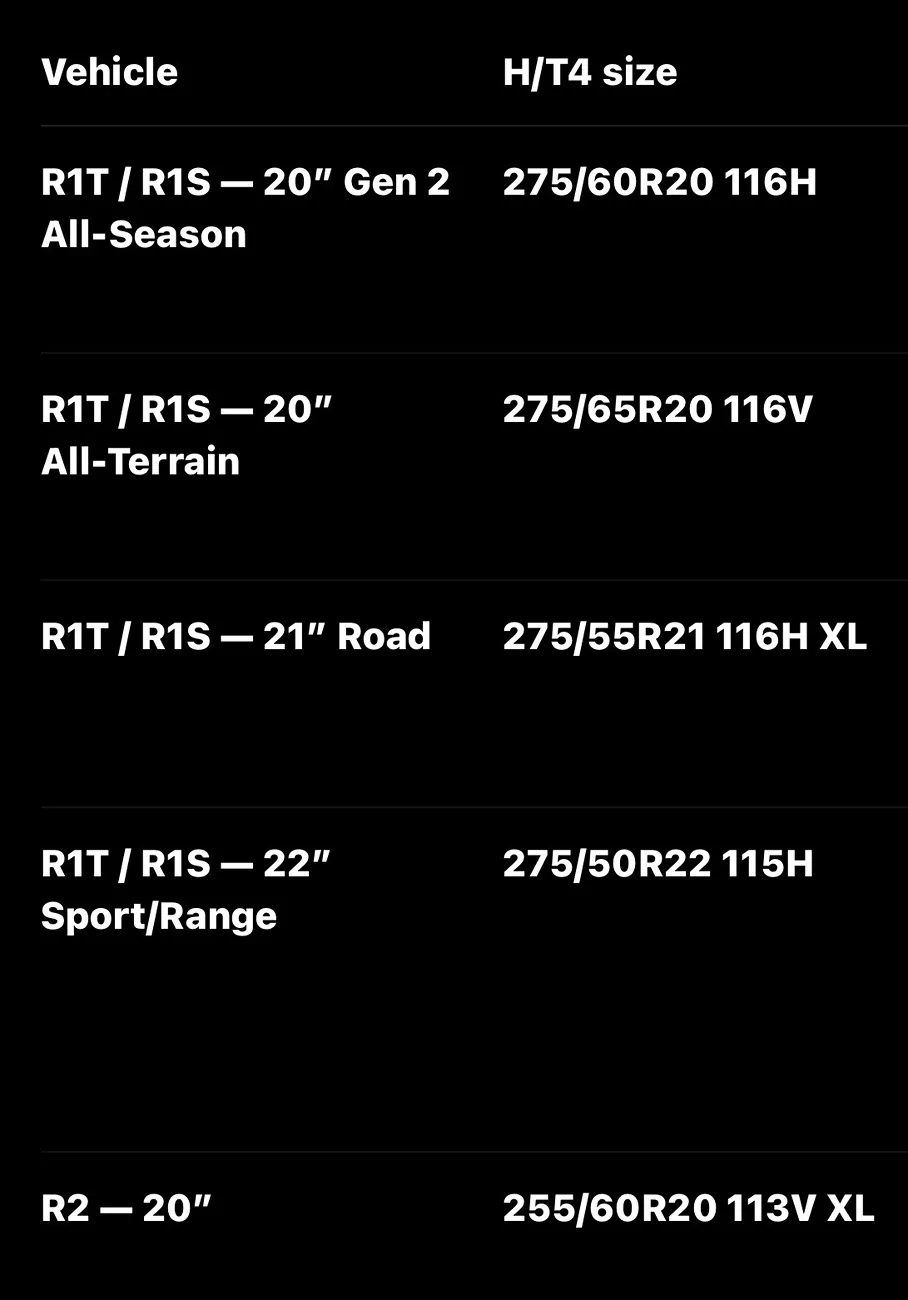
That being said, another 275/55/R21 option is never a bad thing...
 

UnsungZero_OldTimeAdMan

Well-Known Member
First Name
Barnum
Joined
Mar 20, 2023
Threads
69
Messages
8,983
Reaction score
12,382
Location
SoCal
Vehicles
'23 GW Quad-Large R1T "Ghost"
Occupation
Advertising Circus
Listen, my friend. Come here. Step into my office — which, in this case, is a parking lot with bad coffee, fluorescent lights, and a guy named Vinny who “knows a guy” at the distributor. You got a Rivian. Big, beautiful, expensive, overbuilt electric adventure machine. You don’t put garbage shoes on a horse like that. You don’t buy some mystery-brand meatball tire because it was $47 cheaper and had a picture of a mountain on the sidewall. No. You get something that actually makes sense.

And that, right there, is why the Yokohama Geolandar H/T4 deserves a serious look.

This tire is not trying to be the loud guy at the bar. It’s not pretending your Rivian is going to Moab every Tuesday. It is not some blocky, over-aggressive all-terrain tire that makes your $90,000 EV sound like a lifted plumbing van. The Geolandar H/T4 is the adult in the room. It says: “You want highway comfort? I got you. You want SUV/light-truck toughness? Don’t insult me. You want decent tread life, all-season usefulness, and not to destroy your range like you mounted four cinder blocks? Sit down, sweetheart — we’re doing business.”

The beauty of the H/T4 is that it lives in the exact space where most Rivian owners actually live: highway, suburb, mountain road, gravel lot, rainstorm, Costco run, trailhead parking, family trip, maybe a fire road when you’re feeling spicy. That is real life. Not brochure life. Not influencer life. Real life.

A Rivian does not need a tire that looks like it came off a Baja chase truck unless you are actually using it that way. Most people say they want “adventure,” but what they really want is a tire that handles 400 miles of highway, doesn’t howl at 70 mph, doesn’t kill efficiency, doesn’t wear out in 18,000 miles, and still has enough backbone to deal with a heavy EV. That is where an H/T tire can be brilliant.

The Geolandar H/T4 is an all-season highway-terrain tire, which means it is fundamentally aimed at the things a Rivian does most of the time: carrying weight, rolling efficiently, staying composed, and not making your cabin sound like a cheap motel air conditioner. Compared with aggressive all-terrain tires, an H/T tire usually has a tighter tread pattern, less open void space, and more continuous rubber contacting the road. Translation? Less squirm, less noise, better road manners, and typically better efficiency.

And efficiency matters more on a Rivian than on a gas truck. Why? Because every extra pound of tire, every chunky tread block, every bit of hysteresis loss, every deformation of rubber, every little buzz through the carcass — your battery feels it. On an ICE truck, you lose some MPG and shrug. On an EV, you lose range, charging flexibility, route options, and time. A tire that is too heavy or too aggressive can turn your Rivian from a sleek electric missile into a very expensive rolling resistance experiment.

That is why the H/T4 concept is so compelling. It is not chasing fake toughness. It is chasing useful toughness.

This is the tire for the Rivian owner who is honest with himself. The guy who says, “Yeah, I like the idea of all-terrain tires, but 92% of my driving is pavement.” Beautiful. Finally. An adult. The Geolandar H/T4 says: let’s optimize for the 92%, but not be helpless for the other 8%.

Now let’s talk ride quality. A Rivian is heavy. Heavy vehicles punish tires. EVs punish tires even more because the torque is instant. You touch the pedal and the tires don’t get a memo, they get subpoenaed. They’re immediately asked to manage weight, torque, braking, regen, cornering, and comfort. A lesser tire folds under that pressure. It gets greasy, noisy, unevenly worn, or just starts feeling tired before its time.

A proper highway-terrain light-truck/SUV tire is built around stability. It is supposed to carry load. It is supposed to behave under weight. It is supposed to take the daily abuse without turning into a marshmallow. That is exactly the kind of personality that makes sense under a Rivian.

And this is where the salesman in me grabs you by the shoulders and says: stop buying tires based only on tread pattern aggression. That is amateur hour. Tire buying is not a beauty contest. It is a financial decision, a comfort decision, an efficiency decision, and frankly, a sanity decision.

You want the tire that disappears underneath the vehicle. That is the magic. Not the tire you hear. Not the tire you explain. Not the tire you constantly defend because “yeah, it’s loud, but it looks cool.” No, no, no. You want the tire that just works.

The H/T4 is persuasive because it gives you the pitch that actually matters:

It should be quieter than a more aggressive A/T.
It should be more efficient than a heavy, blocky off-road tire.
It should be more comfortable for long trips.
It should have enough SUV/light-truck character for a heavy EV.
It should be more practical for real Rivian use than the macho tire everyone pretends they need.

This is where Yokohama also helps itself. Yokohama is not some no-name discount brand from the back page of the internet. It is a real tire company with real engineering credibility. The Geolandar line has been around forever in SUV/truck circles. That matters. You are not beta-testing some novelty tire on a 7,000-pound EV with your family inside. You are buying from a company that understands trucks, crossovers, SUVs, wet roads, tread compounds, casing design, and the boring-but-critical stuff that keeps a tire from becoming an expensive regret.

And let’s be honest: with a Rivian, the “ultimate” tire is not necessarily the one with the most off-road capability. The ultimate tire is the one that best matches how the vehicle is actually used.

A Rivian is already absurdly capable. It has power. It has traction control. It has weight. It has ground clearance. It has software managing torque better than most drivers could ever dream of doing manually. You do not need to over-tire it just to prove a point. In many cases, putting a reasonable, well-designed highway-terrain tire on a Rivian is like putting a tailored suit on a linebacker. Still powerful. Still imposing. But now it knows how to behave in public.

That is the H/T4 argument.

It is the “smart money” tire. The “I did the math” tire. The “I don’t need to cosplay as a forest ranger to drive to Santa Cruz” tire. The “my range matters, my cabin noise matters, and I still want something with enough structure for a serious vehicle” tire.

Now, am I saying it beats every tire in every category? Of course not. Don’t be ridiculous. You want maximum rock crawling? Go buy a dedicated A/T or M/T and enjoy the hum. You want absolute lowest rolling resistance? Maybe a lighter EV-specific touring tire wins. You want prestige-name comfort? Maybe Michelin gets a word in. But for the middle of the Venn diagram — Rivian weight, highway use, all-season practicality, reasonable ruggedness, comfort, and value — the Yokohama Geolandar H/T4 makes a very strong case.

This is the tire you recommend to someone who has graduated from impulse buying. Someone who understands that the best tire is not the most dramatic tire. The best tire is the one that makes the whole vehicle better.

Put a heavy all-terrain on your Rivian and you may gain some trail confidence, sure. But you may also lose efficiency, add noise, increase unsprung mass, soften steering response, and shorten range. That is a lot to pay for a look. The H/T4 says: “Relax. I’ll give you enough capability without turning your truck into a penalty box.”

And that is the sales close.

You want a tire that respects the Rivian. Not fights it. Not burdens it. Not turns it into a worse version of itself.

The Yokohama Geolandar H/T4 is compelling because it fits the Rivian’s real-world mission: refined, heavy-duty, efficient-ish, comfortable, all-season, and still tough enough to not embarrass itself when the pavement ends.

So here’s the deal, boss: assuming it comes in the right size, load rating, speed rating, and spec for your Rivian, this is not just “a tire.” This is the tire that walks into the room, straightens its jacket, slaps the competition on the cheek, and says:

“Cute tread blocks. Now let the grown-ups handle the driving.”
IMG_7439.webp


IMG_7440.webp
Do you own a tire shop?
 

Sponsored

UnsungZero_OldTimeAdMan

Well-Known Member
First Name
Barnum
Joined
Mar 20, 2023
Threads
69
Messages
8,983
Reaction score
12,382
Location
SoCal
Vehicles
'23 GW Quad-Large R1T "Ghost"
Occupation
Advertising Circus
Is it 3PSF?
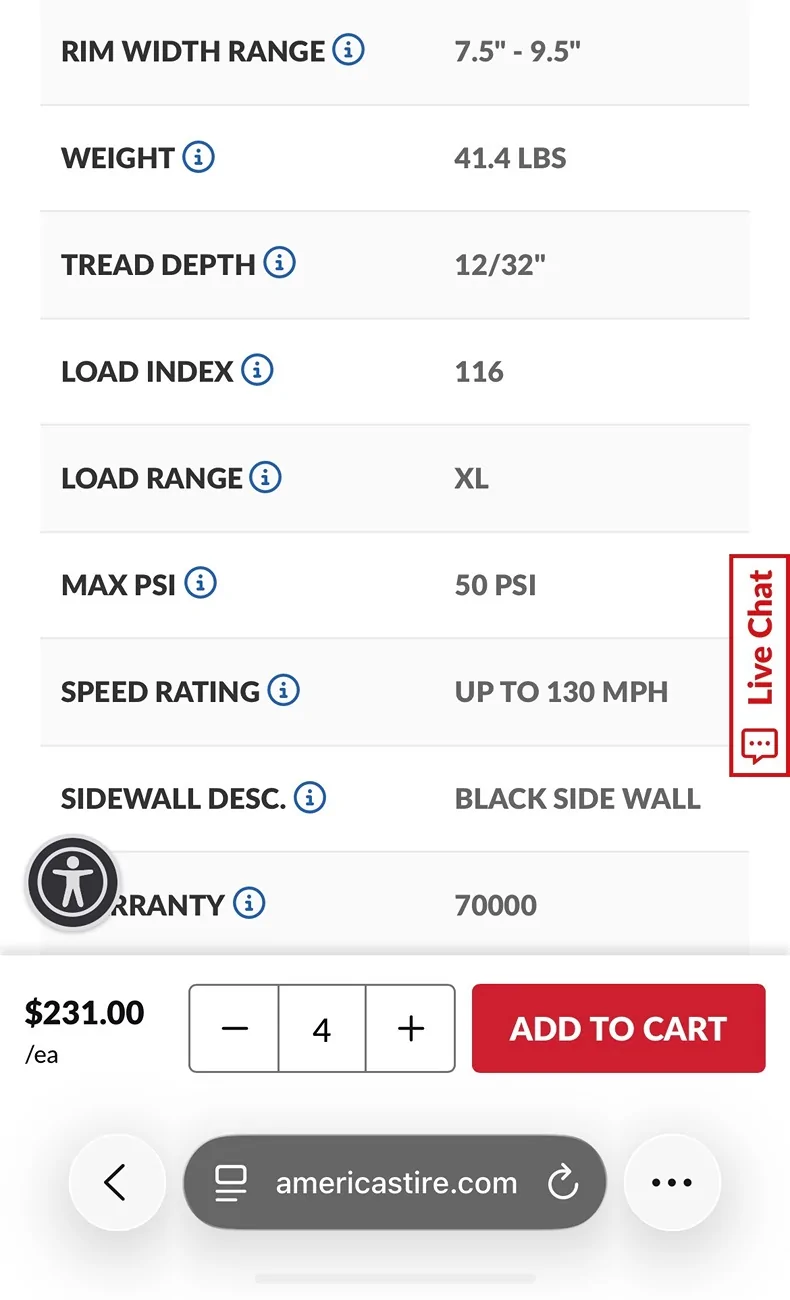
No. But 70,000 mi warranty and only $230ish a piece. Decent aesthetics too, unlike most AS/HT.

Rivian R1T R1S Yokohama Geolandar H/T4: the Ultimate Tire for Your Rivian IMG_1070


A/T4 is 3PMSF (H/T4 isn’t)
And in 275/60 it appears to be a LT with 54+ lbs of static mass. Efficiency would be sacrificed.

In 275/65 it’s a SL with 44+ lbs. Similar to factory Pirelli ATs, but so is the $400 price.
 
Last edited:

windblowlc

Well-Known Member
First Name
Loc
Joined
Jul 29, 2022
Threads
15
Messages
1,172
Reaction score
1,058
Location
WV
Vehicles
Gen 2 R1S Quad, Porsche 911 Turbo S, Porsche Cayenne Turbo Coupe
Occupation
Retired
I was onboard with the tone/humor, but then saw that the post was about a million words long. The charm wore off.

That being said, another 275/55/R21 option is never a bad thing...
Yes, the charm really wore off. I gave the post the first couple of paragraphs...
 

SwampNut

Well-Known Member
First Name
Carlos
Joined
Apr 22, 2024
Threads
53
Messages
3,703
Reaction score
3,927
Location
Peoria AZ
Vehicles
2022 R1T Launch Edition
Occupation
Geek
Clubs
 
The start of the second paragraph was pretty dumb, and at that point I was also scrolling to see that it's a wall of text. WTF!!!

I used my AI-integrated browser to fix it:

Summarize the first post here into two paragraphs at most.


Rivian R1T R1S Yokohama Geolandar H/T4: the Ultimate Tire for Your Rivian a-geolandar-h-t4-the-ultimate-tire-for-your-rivian
Yokohama Geolandar H/T4: the Ultimate Tire for Your Rivian | Rivian Forums - R1 R2 R3 R4 News, Specs, Models, RIVN Stock -- Rivianforums.com
rivianforums


The first post argues that the Yokohama Geolandar H/T4 is a better match for how most Rivian owners actually drive than aggressive all‑terrain tires,


No wait.

Still too long.


The post says most Rivian owners should choose a comfortable, efficient highway‑terrain tire like the Yokohama Geolandar H/T4 instead of aggressive off‑road tires. It argues that Rivians are driven mainly on pavement, so quieter ride, better range, and good everyday manners matter more than “rugged” looks.
 

Zathras

Well-Known Member
First Name
Eric
Joined
Apr 29, 2026
Threads
0
Messages
310
Reaction score
321
Location
Carlsbad, CA
Vehicles
Subaru Crosstrek Plug-in Hybrid
Occupation
Retired
I've heard Yokohama tires are not that highly regarded.
 

Sponsored

UnsungZero_OldTimeAdMan

Well-Known Member
First Name
Barnum
Joined
Mar 20, 2023
Threads
69
Messages
8,983
Reaction score
12,382
Location
SoCal
Vehicles
'23 GW Quad-Large R1T "Ghost"
Occupation
Advertising Circus
I've heard Yokohama tires are not that highly regarded.
Never had a single problem with them. Every brand has low to high end tires. Maybe what you heard is from someone who bought a low-end economy product. Generally, you get what you pay—unless you're talking about brands that price theirs high no matter what (*cough Pirelli).
 

Bullwinkle

Well-Known Member
First Name
Jim
Joined
Aug 12, 2022
Threads
3
Messages
303
Reaction score
269
Location
Minnesota
Vehicles
2023 Rivian RS1, 2026 BMW X5 50e
Occupation
Retired
A/T4 is 3PMSF (H/T4 isn’t)
The most interesting tire for R2 to me is VREDESTEIN PINZA AT, but it is only available in 275/55R20. The diameter is basically the same. Is it possible to space them out, or will they just not work?
Sponsored


Top