Sponsored

Battery Degradation

LL75

Well-Known Member
First Name
lance
Joined
Sep 21, 2022
Threads
44
Messages
1,756
Reaction score
1,282
Location
Dallas
Vehicles
R1S, R1T, Silverado, F150, RangeRover Evoque
I have been noticed my 2023 quad r1s total battery capacity on Electrafi went from 129 kwh earlier this year to now 126.4. ( it was at 126.7 two weeks ago). My vehicle has 41K miles. Is this something I should be concerning about? My charging is to 80% daily and rarely use L3 charging.
Sponsored
 

mudito

Well-Known Member
First Name
Aldo
Joined
Jul 30, 2024
Threads
18
Messages
1,011
Reaction score
1,414
Location
Texas
Vehicles
Rivian R1T
I have been noticed my 2023 quad r1s total battery capacity on Electrafi went from 129 kwh earlier this year to now 126.4. ( it was at 126.7 two weeks ago). My vehicle has 41K miles. Is this something I should be concerning about? My charging is to 80% daily and rarely use L3 charging.
Concerning? 100% no.

BMS might recalibrate itself upwards and downwards, but even if that's your real "degradation", should be way within the 'normal battery degradation'. Your vehicle (mine too) has NMC chemistry for the batteries and they tend to "degrade" faster during the first year of use (over simplifying here) and then they stay quite constant:


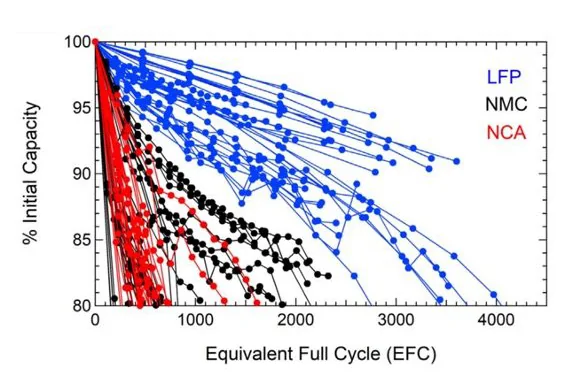
Rivian R1T R1S Battery Degradation 1754410377417-3l


The graph above (link) shows 100 to 80% degradation, the black data points are our NMC batteries and you can see that as average, after 1000-1500 cycles they tend to reach that 80% capacity.

You might charge 100 times a year (maybe? if doing 2x Week) but that's not even a full cycle because you're doing 80% charge, so I expect that your battery will out-live your ownership of the vehicle.

NOW... if you fancy to run some tests, you can do 100% charge once (and then I would drive it until it drops below 80% so you don't store it at 100%) and see if the BMS update itself. Also, if you happen to have a road trip and want to get as low as you possibly can (0%, 0mi of Range) and then charge up to 100%, that might be even better for your BMS.

While the above is not usually recommended and I do not recommend to do that (at least not as a normal practice) it might help the BMS recalibration on how much energy it's actually able to store.


Again, answer is NO, I wouldn't be concerned at all about it :)
 
OP
OP

LL75

Well-Known Member
First Name
lance
Joined
Sep 21, 2022
Threads
44
Messages
1,756
Reaction score
1,282
Location
Dallas
Vehicles
R1S, R1T, Silverado, F150, RangeRover Evoque
Concerning? 100% no.

BMS might recalibrate itself upwards and downwards, but even if that's your real "degradation", should be way within the 'normal battery degradation'. Your vehicle (mine too) has NMC chemistry for the batteries and they tend to "degrade" faster during the first year of use (over simplifying here) and then they stay quite constant:


1754410377417-3l.webp


The graph above (link) shows 100 to 80% degradation, the black data points are our NMC batteries and you can see that as average, after 1000-1500 cycles they tend to reach that 80% capacity.

You might charge 100 times a year (maybe? if doing 2x Week) but that's not even a full cycle because you're doing 80% charge, so I expect that your battery will out-live your ownership of the vehicle.

NOW... if you fancy to run some tests, you can do 100% charge once (and then I would drive it until it drops below 80% so you don't store it at 100%) and see if the BMS update itself. Also, if you happen to have a road trip and want to get as low as you possibly can (0%, 0mi of Range) and then charge up to 100%, that might be even better for your BMS.

While the above is not usually recommended and I do not recommend to do that (at least not as a normal practice) it might help the BMS recalibration on how much energy it's actually able to store.


Again, answer is NO, I wouldn't be concerned at all about it :)
Our car is always plugged in all of the time. There are days that we drive 5 miles. There are days we drive 200 miles. So it is always plugged in once it is at home. So roughly 2 and a half year of ownership we probably charge around 900x. I did the 100% test to 0% with my model 3 years ago. Doesn't seem to do anything significant
 

mudito

Well-Known Member
First Name
Aldo
Joined
Jul 30, 2024
Threads
18
Messages
1,011
Reaction score
1,414
Location
Texas
Vehicles
Rivian R1T
Our car is always plugged in all of the time. There are days that we drive 5 miles. There are days we drive 200 miles. So it is always plugged in once it is at home. So roughly 2 and a half year of ownership we probably charge around 900x. I did the 100% test to 0% with my model 3 years ago. Doesn't seem to do anything significant
What you do is totally fine. I also live in Texas and out of the blue I can drive 200+ mi in a day for no specific reason or previous planning :) Last thursday was a great example of this, I had my truck charged to 70% (I also plug every day, but with a 70% limit) and had to have a quick SuperCharge at Buc-ee's to make it back home

Rivian R1T R1S Battery Degradation 1754412645112-j7


Again, you should be fine and are within normal 'wear' limits (Assuming that the number you see is accurate).
 
OP
OP

LL75

Well-Known Member
First Name
lance
Joined
Sep 21, 2022
Threads
44
Messages
1,756
Reaction score
1,282
Location
Dallas
Vehicles
R1S, R1T, Silverado, F150, RangeRover Evoque
What you do is totally fine. I also live in Texas and out of the blue I can drive 200+ mi in a day for no specific reason or previous planning :) Last thursday was a great example of this, I had my truck charged to 70% (I also plug every day, but with a 70% limit) and had to have a quick SuperCharge at Buc-ee's to make it back home

1754412645112-j7.png


Again, you should be fine and are within normal 'wear' limits (Assuming that the number you see is accurate).

Thanks. Just a little weird to see about 3 kwh total battery dripped from jan to aug. For what it is worth, my model 3 lost about 15% degradation in 3 years. So, the rivian is minimal in comparison.
 

Sponsored

mkg3

Well-Known Member
Joined
Nov 19, 2021
Threads
91
Messages
2,790
Reaction score
3,713
Location
SoCal
Vehicles
R1S, Model 3, Outback, Artura
Clubs
 
Our car is always plugged in all of the time. There are days that we drive 5 miles. There are days we drive 200 miles. So it is always plugged in once it is at home. So roughly 2 and a half year of ownership we probably charge around 900x. I did the 100% test to 0% with my model 3 years ago. Doesn't seem to do anything significant
Two quick things.

1) Li-ion battery do not benefit from doing 100% to 0% to erase battery cell memory like the old NMH cells used in most portable devices until Li-ion became a common place. This is one of the benefits of Li-ion cells. In fact I've read in many publications on battery research that it actually can damage the cells for deeply depleting the charge. Also the first 3 years of typical use has a greater drop of % of charge capacity then it flattens out for many years.

2) More important that all the actual battery stuff, is that it's your vehicle and do as you please. It's just a car. If it loses too much range, replace, especially BEV vehicle where the technology is changing faster than DCFC.

I have accepted the fact that one day, our Rivian and Tesla both will be large paper weights, and should be replaced well befor that....
 

mudito

Well-Known Member
First Name
Aldo
Joined
Jul 30, 2024
Threads
18
Messages
1,011
Reaction score
1,414
Location
Texas
Vehicles
Rivian R1T
Two quick things.

1) Li-ion battery do not benefit from doing 100% to 0% to erase battery cell memory like the old NMH cells used in most portable devices until Li-ion became a common place. This is one of the benefits of Li-ion cells. In fact I've read in many publications on battery research that it actually can damage the cells for deeply depleting the charge. Also the first 3 years of typical use has a greater drop of % of charge capacity then it flattens out for many years.

2) More important that all the actual battery stuff, is that it's your vehicle and do as you please. It's just a car. If it loses too much range, replace, especially BEV vehicle where the technology is changing faster than DCFC.

I have accepted the fact that one day, our Rivian and Tesla both will be large paper weights, and should be replaced well befor that....
1) Hence why I stated "BMS" and not cell capacity/memory and also said that I do not recommend it. But if done once, shouldn't really harm the battery either (i.e.: Tesla Battery health test, basically does a 0% discharge and then full 100% charge).

2) YES. That. 100% :) I fully use my battery and charge when/where/how I need to.
 

mpshizzle

Well-Known Member
Joined
Jun 16, 2024
Threads
76
Messages
1,307
Reaction score
2,179
Location
Utah
Vehicles
2025 R1S Dual Max (Baymax)
Two quick things.

1) Li-ion battery do not benefit from doing 100% to 0% to erase battery cell memory like the old NMH cells used in most portable devices until Li-ion became a common place. This is one of the benefits of Li-ion cells. In fact I've read in many publications on battery research that it actually can damage the cells for deeply depleting the charge. Also the first 3 years of typical use has a greater drop of % of charge capacity then it flattens out for many years.

2) More important that all the actual battery stuff, is that it's your vehicle and do as you please. It's just a car. If it loses too much range, replace, especially BEV vehicle where the technology is changing faster than DCFC.

I have accepted the fact that one day, our Rivian and Tesla both will be large paper weights, and should be replaced well befor that....
The recommendation to drain to 0% was made because that helps the battery management system calibrate to give more accurate SOC and battery health readings. You're right that cell memory doesn't come into play here.. it's purely for BMS calibration sake.

I'd argue that you SHOULD do this once every year or two. That way you don't end up in a situation where the screen reads 10% remaining and then suddenly dead because the BMS is out of calibration.

True it is somewhat stressful to the battery cells to do this exercise, it's not meaningfully harmful so long as you do it very rarely (like once a year) and you don't let it sit below 20% or above 80% for an extended period of time
 

mudito

Well-Known Member
First Name
Aldo
Joined
Jul 30, 2024
Threads
18
Messages
1,011
Reaction score
1,414
Location
Texas
Vehicles
Rivian R1T
The recommendation to drain to 0% was made because that helps the battery management system calibrate to give more accurate SOC and battery health readings. You're right that cell memory doesn't come into play here.. it's purely for BMS calibration sake.

I'd argue that you SHOULD do this once every year or two. That way you don't end up in a situation where the screen reads 10% remaining and then suddenly dead because the BMS is out of calibration.

True it is somewhat stressful to the battery cells to do this exercise, it's not meaningfully harmful so long as you do it very rarely (like once a year) and you don't let it sit below 20% or above 80% for an extended period of time
Rivian R1T R1S Battery Degradation 1754414823507-7v


https://shop.outofspecstudios.com/en-usd/products/dont-trust-the-bms-t-shirt
:)
 

mkg3

Well-Known Member
Joined
Nov 19, 2021
Threads
91
Messages
2,790
Reaction score
3,713
Location
SoCal
Vehicles
R1S, Model 3, Outback, Artura
Clubs
 
The recommendation to drain to 0% was made because that helps the battery management system calibrate to give more accurate SOC and battery health readings. You're right that cell memory doesn't come into play here.. it's purely for BMS calibration sake.

I'd argue that you SHOULD do this once every year or two. That way you don't end up in a situation where the screen reads 10% remaining and then suddenly dead because the BMS is out of calibration.

True it is somewhat stressful to the battery cells to do this exercise, it's not meaningfully harmful so long as you do it very rarely (like once a year) and you don't let it sit below 20% or above 80% for an extended period of time
The BMS going out of calibration? its not a mechanical measurement. It's a potential energy reading. There is notation to calibrate. If the battery goest from 10% to suddenly to 0%. is either very poor BMS sw or some actual electromechanical problem (most likely the latter).

Our Tesla is 7+ years old and never have performed such a routine. it is sitting with 88% battery health (via Recurrent) and the range score of 91. So in over 7 years, we have 12% loss of range. I have about a year left on the Tesla battery warrantee so the vehicle will probably get traded for something else in 2026.

Still, if one believes it's helpful, then by all means, please do.
 

Sponsored

mpshizzle

Well-Known Member
Joined
Jun 16, 2024
Threads
76
Messages
1,307
Reaction score
2,179
Location
Utah
Vehicles
2025 R1S Dual Max (Baymax)
The BMS going out of calibration? its not a mechanical measurement. It's a potential energy reading. There is notation to calibrate. If the battery goest from 10% to suddenly to 0%. is either very poor BMS sw or some actual electromechanical problem (most likely the latter).

Our Tesla is 7+ years old and never have performed such a routine. it is sitting with 88% battery health (via Recurrent) and the range score of 91. So in over 7 years, we have 12% loss of range. I have about a year left on the Tesla battery warrantee so the vehicle will probably get traded for something else in 2026.

Still, if one believes it's helpful, then by all means, please do.
I don't think BMS reading is as much of an exact science as you think it is. It's really just an educated guess. Battery cell balance and voltages shift slightly over time and use. 0-100 gives the BMS a better idea of what the true balance of voltages are around the pack. If you don't believe me that BMS calibration is a thing, go look it up. I'm not pulling this out of my butt
 
Last edited:

portdirect

Well-Known Member
Joined
Jun 15, 2023
Threads
16
Messages
928
Reaction score
1,372
Location
Missouri
Vehicles
R1T (2023 QM - RIP, 2025 Tri Max), R1S (2024 DM Large)
Occupation
Blinkenlight Hearder
It’s also worth noting that the reported battery capacity isn’t the “true” gross capacity of the pack as calculated by the BMS, but rather the net capacity Rivian deems addressable. The gross capacity of Rivian packs is usually 6-9% higher than the maximum addressable capacity (for example, Gen1 Large packs are 141 kWh gross versus 131 kWh addressable under near-ideal conditions - I've seen ours move by ~10% based on temperature etc), which is a bigger margin than many other EV makers provide. That makes it virtually impossible to actually say how much degradation we’ve seen from the exposed data, since Rivian is almost certainly “swallowing” early degradation while keeping the addressable capacity pretty much unchanged. Honestly, it’s a great design choice that really improves the ownership experience (people are not seeing the capacity drop quickly in the 1st year or two of ownership) - at least until we want to get all nerdy about it, at which point we simply dont have the required information easily exposed via public (well semi-public) APIs - there are some that ARBP etc use that *may* have some of the required data in - but not even the 'RiDE' screen shows anything of much use anymore.
 

zefram47

Well-Known Member
First Name
Aaron
Joined
Feb 6, 2022
Threads
18
Messages
2,750
Reaction score
4,513
Location
Denver, CO
Vehicles
Rivian R1T, Alfa Romeo 4C
Occupation
Software Engineer
It’s also worth noting that the reported battery capacity isn’t the “true” gross capacity of the pack as calculated by the BMS, but rather the net capacity Rivian deems addressable. The gross capacity of Rivian packs is usually 6-9% higher than the maximum addressable capacity (for example, Gen1 Large packs are 141 kWh gross versus 131 kWh addressable under near-ideal conditions - I've seen ours move by ~10% based on temperature etc), which is a bigger margin than many other EV makers provide. That makes it virtually impossible to actually say how much degradation we’ve seen from the exposed data, since Rivian is almost certainly “swallowing” early degradation while keeping the addressable capacity pretty much unchanged. Honestly, it’s a great design choice that really improves the ownership experience (people are not seeing the capacity drop quickly in the 1st year or two of ownership) - at least until we want to get all nerdy about it, at which point we simply dont have the required information easily exposed via public (well semi-public) APIs - there are some that ARBP etc use that *may* have some of the required data in - but not even the 'RiDE' screen shows anything of much use anymore.
All of this. Plus, I assume Rivian changed how that value is calculated a bit over a year ago, IIRC. It used to be pretty consistent, but it started varying by temperature and such as you'd mentioned. I saw as low as maybe 126 kWh over the winter, but it was quite variable. Since summer really took hold it's been more consistent, but still varies maybe up to 1 kWh. After doing some towing recently with some deeper discharges and charges mine is currently showing 130.9 kWh with 36k miles and 2.5 years on the clock.
 
OP
OP

LL75

Well-Known Member
First Name
lance
Joined
Sep 21, 2022
Threads
44
Messages
1,756
Reaction score
1,282
Location
Dallas
Vehicles
R1S, R1T, Silverado, F150, RangeRover Evoque
All of this. Plus, I assume Rivian changed how that value is calculated a bit over a year ago, IIRC. It used to be pretty consistent, but it started varying by temperature and such as you'd mentioned. I saw as low as maybe 126 kWh over the winter, but it was quite variable. Since summer really took hold it's been more consistent, but still varies maybe up to 1 kWh. After doing some towing recently with some deeper discharges and charges mine is currently showing 130.9 kWh with 36k miles and 2.5 years on the clock.
What is deeper discharge value ?


Top